From the free course AP European History on Lykke
1.7 Rivals on the World Stage · 1.8 Colonial Expansion and the Columbian Exchange
Key concepts: European exploration and overseas expansion · Colonialism and the acquisition of overseas colonies · Portuguese expansion in the Indian Ocean · European colonial empires · Capitalism and commercial development · Global trade networks · The Columbian Exchange · Transatlantic exchange of plants, animals, and diseases · Social and cultural impacts of colonial expansion · The integration of Europe and the Americas into a global economy
Between approximately 1450 and 1750, European states transformed competition for wealth and power into overseas empire-building. The result was not merely more trade: Europe, Africa, Asia, and the Americas became connected through coercive colonial systems, commercial networks, and the biological exchange now…
1.7 Rivals on the World Stage · 1.8 Colonial Expansion and the Columbian Exchange
Between approximately 1450 and 1750, European states transformed competition for wealth and power into overseas empire-building. The result was not merely more trade: Europe, Africa, Asia, and the Americas became connected through coercive colonial systems, commercial networks, and the biological exchange now called the Columbian Exchange.
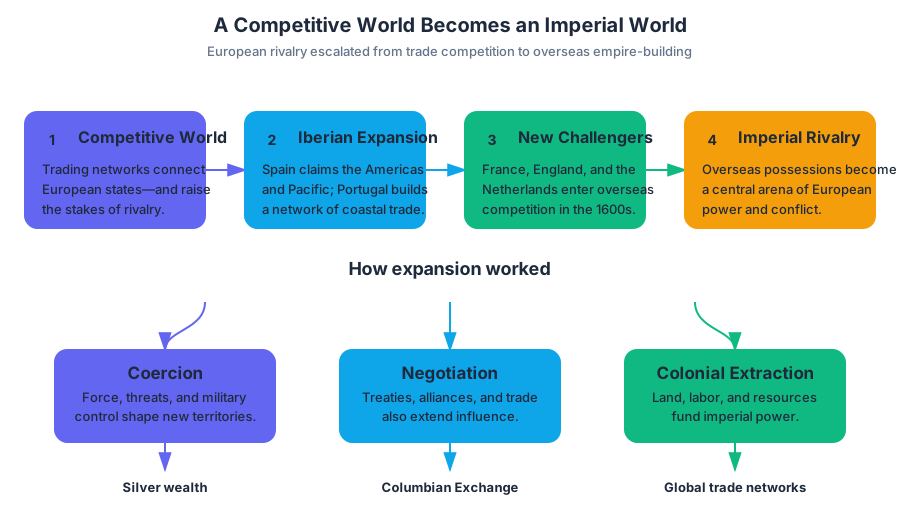
A competitive world becomes an imperial world
Colonial expansion means the establishment and control of overseas territories, usually through a mixture of military force, settlement, political negotiation, and economic extraction. Europeans established overseas empires and trade networks through both coercion—the use or threat of force—and negotiation.
Under Unit 1: Learning Objective I, students should explain how and why trading networks and colonial expansion affected relations between and among European states. The key pattern is competitive escalation:
Spain established colonies across the Americas, the Caribbean, and the Pacific. American silver and colonial possessions helped make Spain a dominant European state during the sixteenth century. Portugal, meanwhile, created a commercial network along the African coast and in South and East Asia, as well as in South America, during the late fifteenth and sixteenth centuries.
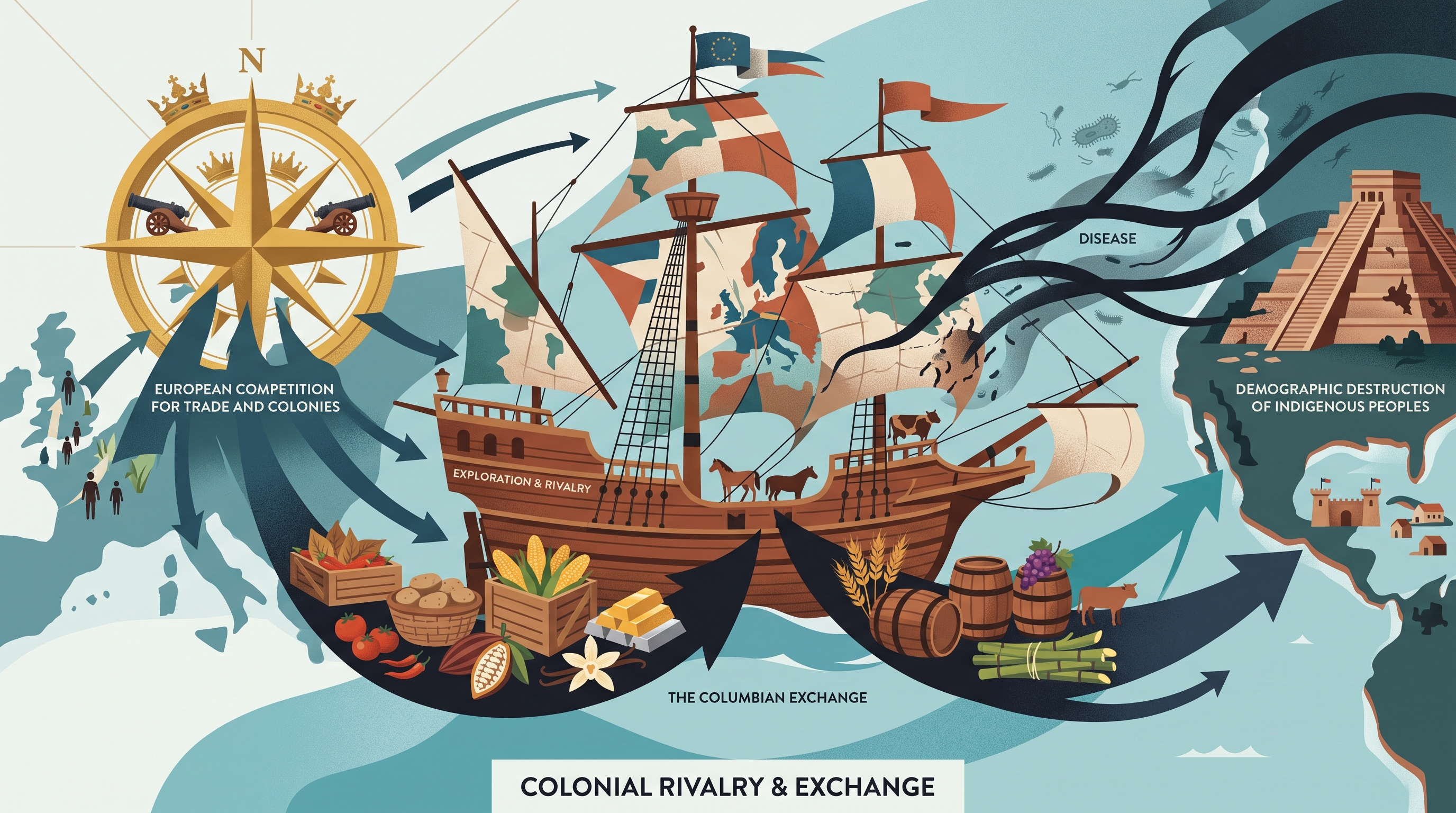
France, England, and the Netherlands later established their own colonies and trading networks in the seventeenth century. Their expansion challenged Portuguese and Spanish dominance and turned overseas empire-building into a central arena of European rivalry.
Portugal and the Indian Ocean
Portuguese expansion in the Indian Ocean often focused less on conquering huge inland territories than on controlling maritime routes, ports, and commercial chokepoints. Portuguese forces used fortified trading posts, naval power, and negotiated agreements to insert themselves into existing networks linking East Africa, India, Southeast Asia, and China.
This illustrates KC-1.3.III: Europeans established overseas empires and trade networks through coercion and negotiation. Portuguese power rested on controlling movement and exchange, while Spanish power in the Americas relied more heavily on territorial conquest and colonial settlement.
Key distinction: An overseas empire could be built through territorial colonization, maritime commercial control, or a combination of both.
From Atlantic trade to a global economy
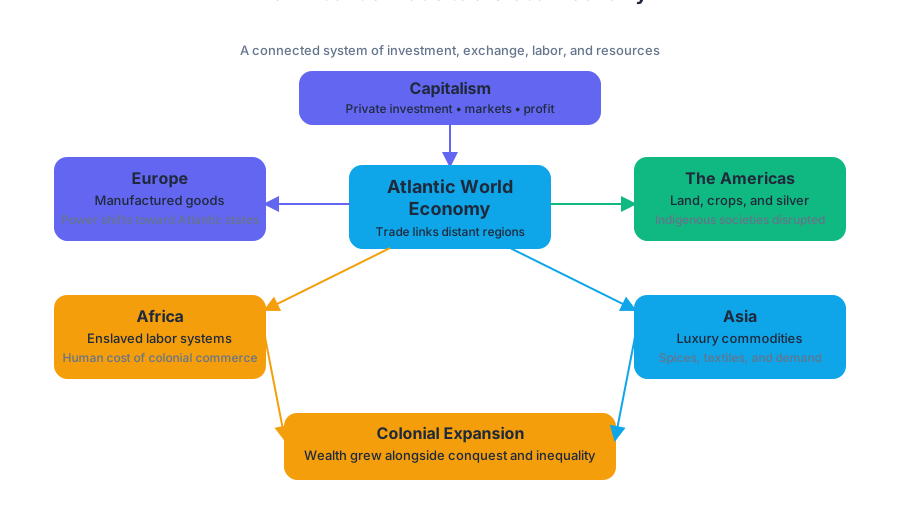
Colonial expansion shifted the center of European economic power from the Mediterranean toward the Atlantic states. KC-1.3.IV.A identifies this shift as a major consequence of exchanging goods: Atlantic states became increasingly integrated into an expanding world economy.
The development of capitalism—an economic system organized around private investment, markets, profit, and the accumulation of wealth—strengthened commercial activity. Capitalism influenced European political, social, and cultural history because merchants, investors, monarchs, and colonial companies increasingly depended on overseas commerce.
The new networks connected European manufactured goods, African labor systems, Asian commodities, and American resources. They also generated profound social and cultural changes: European dominance expanded, indigenous civilizations were destroyed or subordinated, and the trade in enslaved persons grew. The Atlantic economy therefore created wealth and power while producing extreme violence and inequality.
The Columbian Exchange
The Columbian Exchange was the transfer of plants, animals, diseases, goods, and cultural practices between Europe and the Americas after sustained contact began. Under KC-1.3.IV.B.i, the exchange of plants, animals, and diseases created economic opportunities for Europeans.
The exchange was biological as well as commercial:
| Direction | Illustrative transfers | Major consequences |
|---|---|---|
| Europe to the Americas | Wheat, cattle, horses, pigs, sheep | New food sources, livestock economies, altered land use |
| Europe to the Americas | Smallpox and measles | Severe demographic collapse among populations lacking immunity |
| Americas to Europe | Tomatoes and other new plants | New agricultural possibilities and changing European diets |
| Across regions | Goods and cultural practices | New consumer habits, labor systems, and social relationships |
Diseases transferred from Europe to the Americas had especially devastating consequences. Smallpox and measles facilitated European subjugation and contributed to the destruction of indigenous peoples, particularly in the Americas. Population loss weakened political authority, disrupted agriculture, and damaged social institutions.
Worked example: why disease mattered politically
Suppose a European expedition encounters an American society with strong cities, rulers, armies, and farming systems. If epidemic disease kills a large portion of the population, the society may lose leaders, soldiers, laborers, and caregivers at the same time. European invaders can then exploit political instability and weakened resistance. Disease did not act alone, but it helped convert contact into conquest.
Skills in action
This topic most directly develops Skill 1: Developments and Processes by tracing how exploration produced colonies, colonies expanded trade, and trade reshaped European power. It also develops Skill 5: Making Connections by linking economic development to political rivalry and social-cultural transformation.
For Unit 1: Learning Objective J, explain the economic impact of European colonial expansion and the development of trade networks. For Unit 1: Learning Objective K, explain the social and cultural impact of those same processes. In an argument, do not treat “economic” and “cultural” effects as separate boxes: Atlantic wealth financed state power, state power protected commerce, and commerce transformed societies on both sides of the ocean.
Misconception check: The Columbian Exchange was not an equal or peaceful “sharing” of cultures. It involved exchange, but also conquest, epidemic disease, forced labor, destruction of indigenous civilizations, and a shift toward European dominance.
Retrieval check
Why did colonial expansion intensify rivalry among European states, and why did the Columbian Exchange produce unequal consequences? A strong answer should connect competition for trade and colonies to Atlantic economic growth, then explain how disease, animals, plants, and cultural practices transformed European and American societies—especially through the demographic destruction of indigenous peoples.
Source Materials
- AP European History Course and Exam Description
- AP European History Course and Exam Description Clarifications and Corrections
- AP European History Course Overview
- AP European History Course at a Glance
- AP European History Course at a Glance Poster
- AP European History
- AP European History
- AP European History Sample Syllabus 1
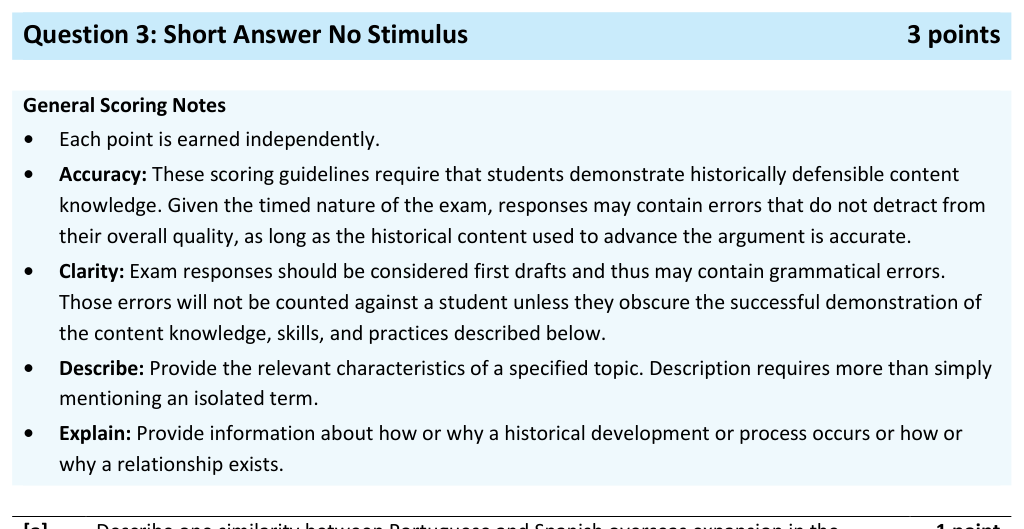
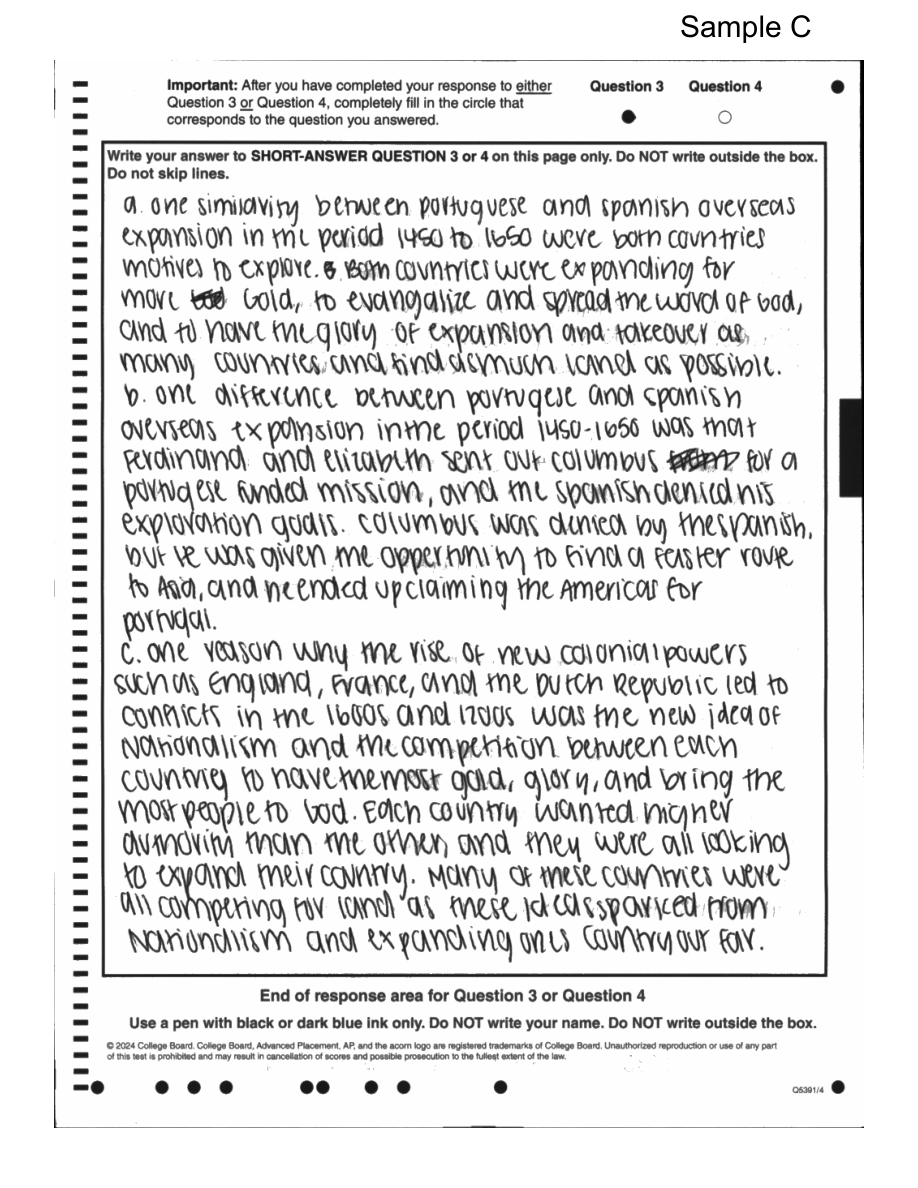
- [a] Describe one similarity between Portuguese and Spanish overseas expansion in the period 1450 to 1650.
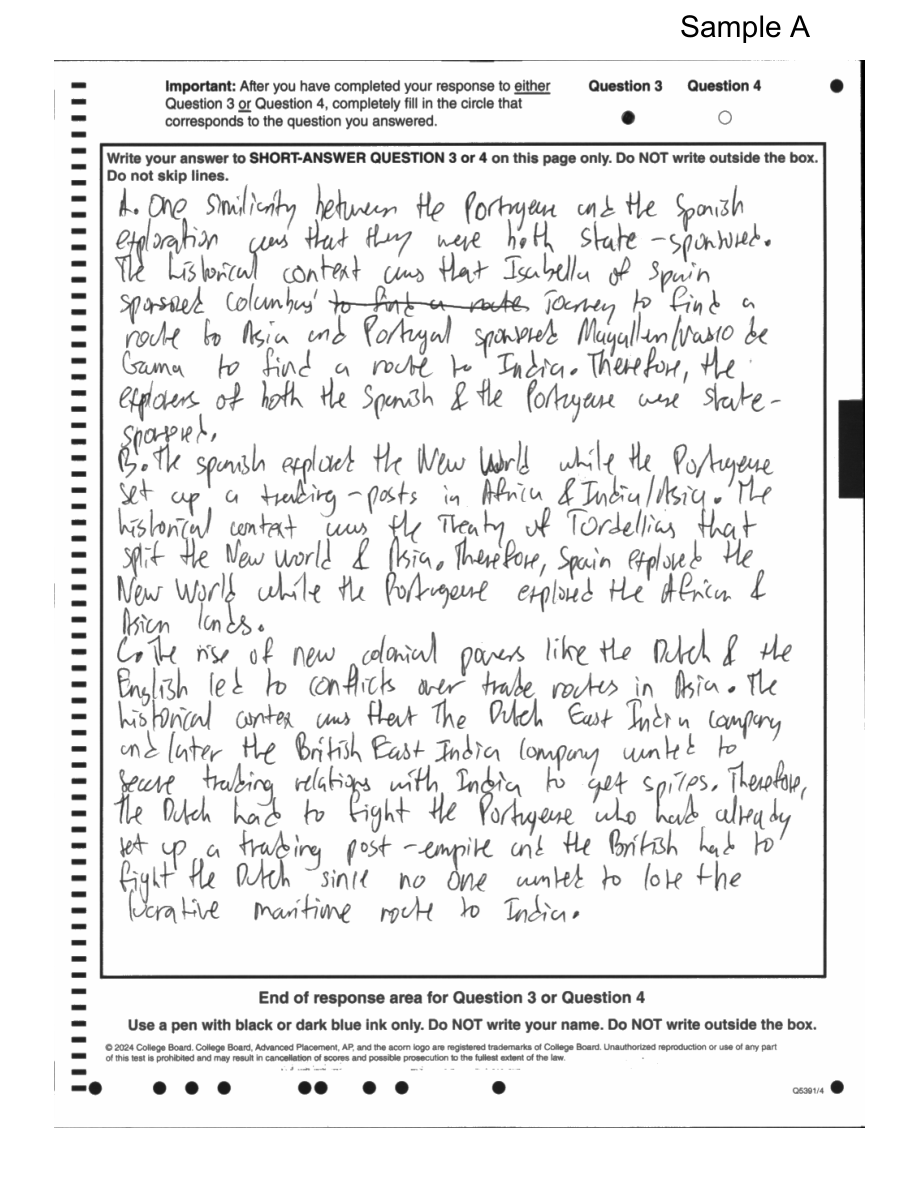
- Figure — Sample Responses - SAQ 3 - Set 1 (p. 4)
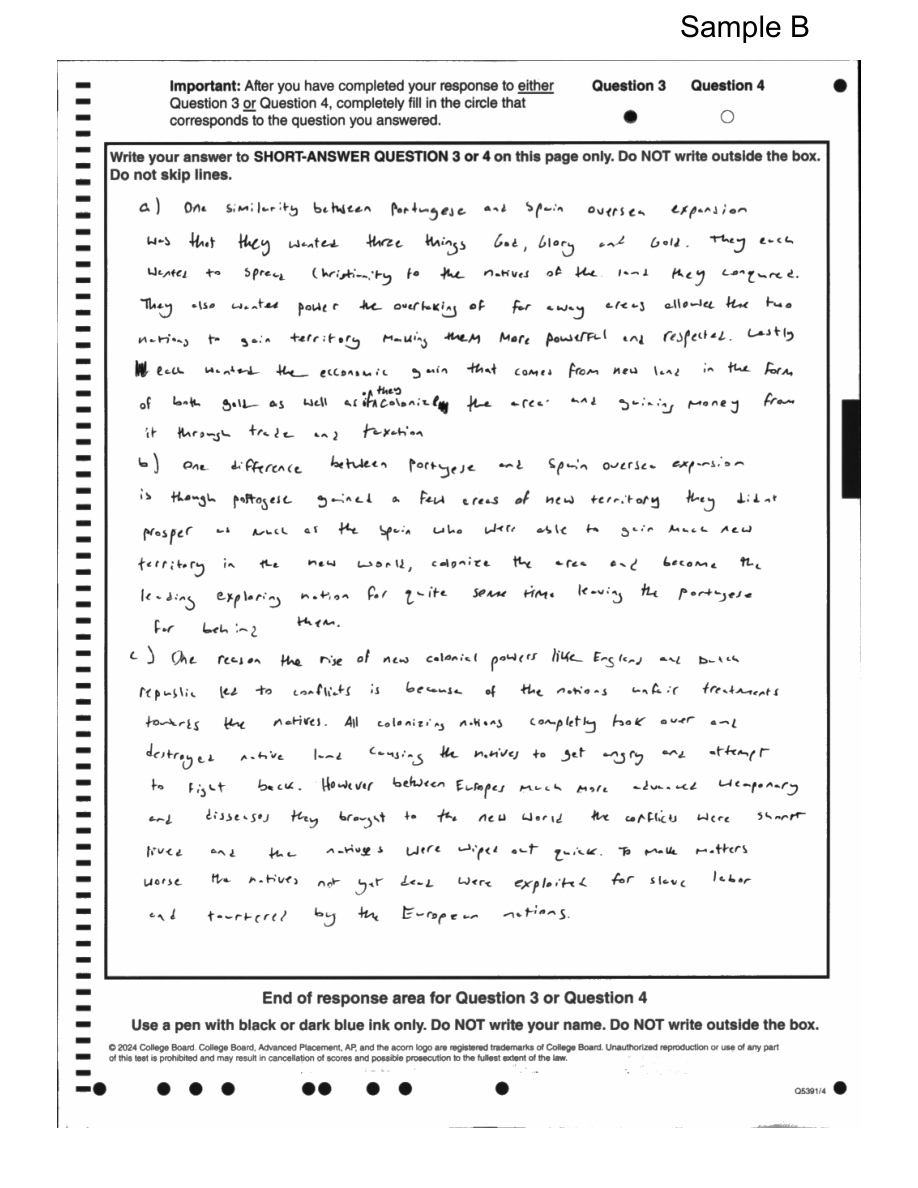
- Figure — Sample Responses - SAQ 3 - Set 1 (p. 5)
- Figure — Sample Responses - SAQ 3 - Set 1 (p. 6)