AP Macroeconomics
111 study materials · 49 sections
AP Macroeconomics students working the current College Board Course and Exam Description, including first-time students with no prior background, plus teachers reviewing the page for CED alignment.; Teach every official CED unit and every numbered topic at topic granularity.; Develop every AP skill / science-practice code explicitly and by name.; Replace description with teaching: worked contextual examples, named misconceptions, and in-flow retrieval checks.; Build an exam-practice unit covering every task type on the current exam.
Course Sections
Course Framework, Skills and Reasoning Processes
Key concepts: AP course framework · Economics skills · Principles and models · Quantitative analysis · Graphing and visual interpretation · Markets and equilibrium · Macroeconomic measurements and changes · Economic policy · College-level course expectations · Curriculum and instructional resources
Macroeconomics becomes powerful when a student can move through four steps: define the model, explain what it predicts, determine how a change alters the outcome, and represent that change accurately.
1.1 Scarcity
Every economy faces scarcity because the resources used to produce goods and services are limited, while human wants are effectively unlimited. Scarcity is not the same as poverty: even a wealthy household, successful business, or prosperous government must decide how to use limited time, money, workers, land, and…
1.2 Opportunity Cost and the Production Possibilities Curve (PPC)
Key concepts: Scarcity and choice · Opportunity cost · Production possibilities curve (PPC) · Efficiency and underutilized resources · Economic growth and contraction · PPC shifts · Opportunity-cost patterns and PPC shape · Full and efficient use of resources
A production possibilities curve (PPC) shows the maximum combinations of two goods or activities that an economy can produce with its available resources and technology.
1.3 Comparative Advantage and Gains from Trade
Key concepts: Absolute advantage · Comparative advantage · Opportunity cost · Production possibility curves (PPCs) · Specialization according to comparative advantage · Gains from trade · Exchange opportunities · Mutually beneficial terms of trade · Consumption opportunities beyond specialization · Tradeoffs and full employment
A producer can benefit from trade even when another producer is better at making everything. The key question is not “Who produces more?” but “Who gives up less to produce this good?”
1.4 Demand
When the price of a product changes, buyers usually change how much they want to purchase—even if nothing else about the market changes. Demand is the relationship between the price of a good or service and the quantity consumers are willing and able to buy at each possible price.
1.5 Supply
A bakery supplies more loaves when the selling price rises because each additional loaf becomes more rewarding to produce. Supply is the relationship between the price of a good or service and the quantity producers are willing and able to sell during a specific period, holding other relevant factors constant.
1.6 Market Equilibrium, Disequilibrium, and Changes in Equilibrium
Key concepts: Market equilibrium · Disequilibrium · Surpluses and shortages · Changes in equilibrium · Shifts in supply and demand · Equilibrium price and quantity · Money market equilibrium · Demand for money · Nominal interest rate · Loanable funds market
A market is in equilibrium when the price makes the quantity buyers want equal to the quantity sellers offer. At that point, neither side has a reason created by the market itself to change its behavior: the market “clears.”
2.1 The Circular Flow and GDP
Key concepts: Circular flow model · Households and businesses · Flow of inputs and outputs · Flow of money · GDP as total income and expenditure · GDP as final output · Expenditure approach to measuring GDP · Income approach to measuring GDP · Value-added approach to measuring GDP · GDP components
Every purchase is simultaneously someone else’s income: when a household buys a $5 sandwich, the household records consumption spending, while the bakery records $5 of revenue.
2.2 Limitations of GDP
Key concepts: quantitative analysis in economics · interpretation and application of quantitative analysis · economic indicators · explaining indicators
GDP can rise while many people’s lives fail to improve, because production is not the same thing as well-being. Using the GDP measure of market production established in 2.1, the key question is: What does this indicator measure accurately, and what does it leave out?
2.3 Unemployment
A person is unemployed only when they do not have a job, are available to work, and are actively looking for work. That final condition is crucial: unemployment statistics measure participation in the labor market, not simply whether someone currently receives a paycheck.
2.4 Price Indices and Inflation
Key concepts: Price indices · Consumer Price Index (CPI) · GDP deflator · Inflation, deflation, and disinflation · Inflation rate · Nominal and real variables · Shortcomings of the CPI · Costs of unexpected inflation · Real wages · Comparing nominal variables over time
A price index turns a changing collection of prices into one number: it measures the general price level in a given period relative to the prices in a chosen base year.
2.5 Costs of Inflation
Inflation creates costs because a rising price level makes economic decisions harder, changes the value of contracts, and can redistribute purchasing power between people. The damage is greatest when inflation is unexpected rather than merely positive.
2.6 Real versus Nominal GDP
Key concepts: Nominal GDP · Real GDP · Base-year pricing · Calculating real GDP · Calculating nominal GDP · Price-level changes · Real versus nominal values · GDP price weighting · Fixed quantities · Effects of inflation on GDP comparisons
A country can produce more goods while its GDP rises—or report higher GDP simply because prices increased. Nominal GDP and real GDP separate these two forces by asking two different questions: How much was current production worth at current prices?
2.7 Business Cycles
An economy can grow while performing below its long-run potential, and it can shrink while still producing above trend. Business cycles describe the repeated fluctuations in economic activity over time—not simply whether actual output lies above or below a trend line.
3.1 Aggregate Demand (AD)
Key concepts: Aggregate demand · Unemployment rate · Natural rate of unemployment · Recession · Expected inflation rate · Actual inflation rate · Maximum change in aggregate demand
Aggregate demand (AD) is the total quantity of final goods and services demanded in an economy at different overall price levels during a given period.
3.2 Multipliers
A $1 increase in spending can raise total real GDP by more than $1 because one person’s spending becomes another person’s income, which creates further rounds of spending.
3.3 Short-Run Aggregate Supply (SRAS)
Key concepts: Short-run aggregate supply (SRAS) curve · Relationship between the price level and aggregate output · Sticky wages and fixed input prices · Movement along the SRAS curve · Shifts in the SRAS curve · Positive and negative supply shocks · Aggregate-demand shocks · Short-run equilibrium and full-employment output · Inflationary and recessionary gaps · Effects on output, employment, and the price level
Why can firms produce more when the economy-wide price level rises, even though the economy’s technology and resources have not changed? In the short run, many production costs—especially wages and some input prices—do not adjust immediately.
3.4 Long-Run Aggregate Supply (LRAS)
Key concepts: Long-run aggregate supply (LRAS) · Maximum sustainable capacity · Full-employment level of output · Production possibilities curve (PPC) · Flexible wages and prices in the long run · Fixed input prices in the short run · Long-run equilibrium price level and output level · Economic growth · Infrastructure and technology investment · Natural rate of unemployment
Why can an economy temporarily produce above or below its sustainable capacity, yet eventually return to a particular level of output? The answer is the long-run aggregate supply (LRAS) curve: it identifies the economy’s full-employment level of real output after wages and prices have had time to adjust completely.
3.5 Equilibrium in the Aggregate Demand–Aggregate Supply (AD–AS) Model
Key concepts: Aggregate Demand–Aggregate Supply (AD–AS) model · Equilibrium in the AD–AS model · Aggregate demand · Aggregate supply · Macroeconomic indicators · Gross domestic product (GDP) · Real GDP · GDP deflator · Movement along a curve versus shifts of a curve · Accurately labeled economic graphs
The AD–AS model shows how an economy’s overall price level and real output are determined together. Its central question is simple: Where do the economy’s desired purchases meet the economy’s willingness to produce?
3.6 Changes in the AD–AS Model in the Short Run
Key concepts: Short-run changes in the AD–AS model · Effects of macroeconomic changes on output, price level, and employment · Business-cycle turning points: peaks and troughs · Actual output, potential output, and recessionary gaps · Short-run and long-run equilibrium · The short-run aggregate supply (SRAS) curve · Sticky wages and prices · Production costs and inflationary expectations as determinants of SRAS · The long-run aggregate supply (LRAS) curve · The Phillips curve and macroeconomic shocks
A recessionary gap exists when an economy’s actual output is below its potential output, so firms produce less and employ fewer workers than they would at full employment.
3.7 Long-Run Self-Adjustment
Key concepts: Long-run self-adjustment in the AD-AS model · Recessionary gaps and below-full-employment output · Downward pressure on nominal wages and input prices · Inflationary expectations and their effect on SRAS · Rightward shifts of the short-run aggregate supply (SRAS) curve · Restoration of full employment and potential output · Effects of shifts in aggregate demand on output and the price level · Using economic concepts and models to determine outcomes
A recessionary gap does not necessarily last forever: when real output falls below the economy’s full-employment level, persistent unemployment can gradually lower firms’ input costs and shift short-run aggregate supply rightward until potential output is restored.
3.8 Fiscal Policy
Key concepts: Fiscal policy · Physical capital accumulation · Graphical analysis of policy changes
Fiscal policy is the government’s use of spending, taxation, and transfer payments to influence aggregate economic activity. The central policy question is not merely whether government action changes output, but whether its short-run benefit creates a long-run cost through higher interest rates, reduced…
3.9 Automatic Stabilizers
Key concepts: Automatic stabilizers
When the economy slows, government transfer payments tend to rise while tax collections tend to fall—even if lawmakers pass no new policy. These built-in responses are automatic stabilizers: fiscal mechanisms that automatically soften expansions and contractions in the business cycle.
4.1 Financial Assets
Key concepts: Financial assets · Liquidity · Money · Cash · Demand deposits
A financial asset is valuable partly because of how quickly it can be used, sold, or exchanged without losing much value. That property is liquidity—and among the financial assets people hold, cash and demand deposits are the most liquid forms of money.
4.2 Nominal versus Real Interest Rates
Key concepts: Nominal interest rate · Real interest rate · Expected inflation · Actual inflation · Relationship between nominal and real interest rates · Lenders and borrowers · Inflation adjustment · Central bank influence on nominal interest rates · Interest rates as the price of money
An interest rate is the price of money: it tells a borrower what must be paid to use someone else’s money and tells a lender what return is earned for postponing consumption.
4.3 Definition, Measurement, and Functions of Money
Key concepts: Money as an asset generally accepted as payment · The three functions of money: medium of exchange, unit of account, and store of value · Liquidity and its relationship to money · Commodity money · Fiat money · The money supply · M1 · M2
Money is an asset that people generally accept as payment, allowing an economy to trade without requiring each buyer and seller to want exactly what the other offers.
4.4 Banking and the Expansion of the Money Supply
Key concepts: Functions of money · Monetary base (M0 or MB) · Fractional-reserve banking · Money multiplier · Banking system and money-supply expansion · Bank reserves and currency holdings · Central-bank policy rate · Federal funds rate · Ample-reserves banking systems · Quantity theory of money
A bank can transform one deposit into a much larger volume of spendable deposits—not by printing currency, but by lending part of the reserves it holds.
4.5 The Money Market
Key concepts: The money market · Money creation process · Money market versus reserve market · Interest rates and investment spending · Surpluses and shortages in a market · Transmission mechanisms linking policy actions to macroeconomic outcomes · Graphical analysis of markets · Fixed-interest-rate borrowers and inflation
The money market determines the economy’s nominal interest rate—the stated price paid to borrow money—through the interaction of the quantity of money people want to hold and the quantity available.
4.6 Monetary Policy
Key concepts: Monetary policy · Economic growth
When inflation rises too quickly or a recession leaves factories, workers, and machines idle, the central bank can influence spending by changing financial conditions. Monetary policy is the deliberate use of central-bank actions to affect the money supply, interest rates, aggregate demand, output, employment, and…
4.7 The Loanable Funds Market
Key concepts: Loanable funds market · Demand for loanable funds · Supply of loanable funds · Quantity of loanable funds demanded and supplied · National savings · Real interest rate · Market equilibrium · Surpluses and shortages in the loanable funds market · Government borrowing · Crowding out of private investment
The loanable funds market determines the equilibrium real interest rate—the interest rate adjusted for inflation—through the interaction of borrowers and savers. Borrowers demand funds to finance investment and government borrowing; savers supply funds by postponing current consumption.
5.1 Fiscal and Monetary Policy Actions in the Short Run
Key concepts: Fiscal policy · Monetary policy · Aggregate demand · Short-run macroeconomic outcomes · Recessionary output gap · Inflationary output gap · Automatic stabilizers · Government deficits · Central banks · Interest on reserves
A recessionary gap means that an economy is producing below its full-employment level, while an inflationary gap means that it is producing above that level.
5.2 The Phillips Curve
Key concepts: Short-run Phillips curve (SRPC) · Long-run Phillips curve (LRPC) · Natural rate of unemployment · Actual unemployment rate · Cyclical unemployment · Structural unemployment · Natural unemployment · Graphing Phillips curve relationships · Distinguishing short-run and long-run outcomes · Common errors in calculating unemployment rates
The Phillips curve models the relationship between inflation and unemployment: in the short run, higher inflation is associated with lower unemployment, but in the long run unemployment returns to a rate determined by the economy’s labor-market structure.
5.3 Money Growth and Inflation
When the quantity of money grows faster than the economy’s production of goods and services, the average price level tends to rise. The central question is therefore: How can more money chasing roughly the same output reduce the purchasing power of each monetary unit?
5.4 Government Deficits and the National Debt
Key concepts: Government budget surplus or deficit · Budget deficit and national debt · Government interest payments on accumulated debt · Opportunity cost of debt interest payments · Crowding out · Long-run implications of fiscal policy
A government runs a budget deficit when, during a given year, its purchases and transfer payments exceed the tax revenue it collects. The deficit is a one-year flow; the national debt is the accumulated total of past borrowing, a stock that persists over time.
5.5 Crowding Out
When the government finances a budget deficit by selling bonds, its additional borrowing increases demand for loanable funds. If the supply of saving does not increase enough to match that demand, the real interest rate rises and some private investment is displaced—a process called crowding out.
5.6 Economic Growth
Economic growth is an increase in an economy’s ability to produce goods and services over time. The key question is not merely whether a country produces more dollars of output, but whether it can produce more real output per person without mistaking higher prices for greater production.
5.7 Public Policy and Economic Growth
Key concepts: Public policy · Productivity · Labor force · Economic incentives · Household economic behavior · Business economic behavior · Long-run economic growth · Government spending · Interest rates · Previously issued bond prices
Public policy can raise long-run economic growth when it changes the incentives that guide household and business decisions, increasing productivity or labor force participation. The central question is not merely “How much does the government spend?” but “How does the policy change the economy’s ability and…
6.1 Balance of Payments Accounts
Key concepts: Capital and financial account (CFA) · Financial capital transfers between countries · International purchases and sales of assets · Balance of payments identity · Current account (CA) deficit · CFA surplus · Currency depreciation · Changes in the value of a currency · Exchange-rate effects on imports
A country can buy more from the world than it sells and still “pay” for the difference—because foreign investors may purchase its assets. The balance of payments (BOP) records these international transactions and explains why a trade imbalance is matched by a financial flow.
6.2 Exchange Rates
An exchange rate is the price of one currency measured in units of another currency. If $1$ U.S. dollar exchanges for €$0.92$, then the exchange rate is $0.92$ euros per dollar: $1\ \text{USD} = €0.92$.
6.3 The Foreign Exchange Market
Key concepts: Foreign exchange market · Exchange rate · Currency appreciation · Currency depreciation · Equilibrium exchange rate · Supply and demand for currency · Flexible exchange market · International trade and financial capital flows · Balance of payments (BOP) · Currency valuation
The foreign exchange market is where buyers and sellers trade one country’s currency for another. Its central question is simple: when millions of international payments and investments occur, what determines the price of a currency?
6.4 Effects of Changes in Policies and Economic Conditions on the Foreign Exchange Market
Key concepts: Supply-and-demand models in different market contexts · Macroeconomic graphs as tools for analyzing economic situations · Production possibilities curve (PPC) · Economic growth and full-employment output · Labor force participation rate · Unemployment rate · Full employment · Frictional and structural unemployment · Natural rate of unemployment · Business cycle phases and turning points
A policy change can move a currency even when the foreign-exchange market itself has not changed its basic structure: investors simply alter which assets they want to hold, and buyers or sellers of the currency respond.
6.5 Changes in the Foreign Exchange Market and Net Exports
Key concepts: Foreign exchange market · Exchange rate · Demand for currency · Supply of currency · Equilibrium exchange rate · Currency appreciation · Currency depreciation · Exports and net exports · Aggregate demand · Foreign trade and current account
An exchange rate is the price of one currency stated in terms of another currency: for example, $0.20 per rand means that one South African rand exchanges for $0.20.
6.6 Real Interest Rates and International Capital Flows
Key concepts: Real interest rates · International capital flows · Exchange rates · Currency appreciation and depreciation · Net exports · Current account · Capital/financial account · Balance of payments · Financial capital inflows and outflows · Interest rates and foreign investment
A saver comparing two countries does not care only about the advertised interest rate; the crucial comparison is the real interest rate, the return after accounting for the purchasing power lost to inflation:
AP Practice 1
Key concepts: AP Macroeconomics course framework · Economic indicators · Business cycle · Economic models · Evidence-based economic analysis · Independent thinking and drawing conclusions · Assessing source credibility · Respectful debate of ideas · College-level coursework readiness · Basic mathematics and graphing skills
AP Macroeconomics asks a deceptively simple question: how can one person’s spending become another person’s income? The answer begins with an economy-wide model. When a household buys a meal, the restaurant receives revenue; the restaurant then pays workers, suppliers, and owners; those recipients spend part of…
AP Practice 2
Key concepts: International trade and balance of payments · Exports, imports, and net exports · Domestic currency and exchange-rate effects on trade · Unemployment rate · Labor force participation rate · Economic performance indicators, including gross domestic product · Economic growth and contraction · Reserve banking and central-bank policies · Demand and supply graphs, including movements along curves versus shifts · Quantitative analysis and economic calculations
A country can look healthier on one economic indicator while appearing weaker on another: real GDP may grow even as unemployment remains high, and a stronger domestic currency may make imports cheaper while reducing net exports.
AP Practice 3
A short free-response question can test several economic skills at once: a student may need to make an assertion, explain a causal chain, calculate a value, and draw a correctly labeled graph—all in a tightly limited response.
AP Practice 4
A strong short free-response answer does more than name a policy: it connects an economic model to a predicted outcome, supports the prediction with a graph or calculation, and explains the causal chain in precise language.
AP Practice 5
A short free-response question can test several macroeconomic skills at once: identifying a model, explaining a causal chain, calculating a numerical outcome, and interpreting the result in context.
AP Practice 6
A rise in a country’s real interest rate can attract foreign investment, increase demand for its currency, and change its net exports. That chain links international capital flows, the foreign exchange market, and the balance of payments—exactly the kind of connected reasoning tested by a short free-response question.
Source Materials
- AP Macroeconomics Course and Exam Description
- AP Macroeconomics Course and Exam Description Clarifications and Corrections
- AP Macroeconomics Course Overview
- AP Macroeconomics Course at a Glance
- AP Macroeconomics Course at a Glance Poster
- AP Macroeconomics
- AP Macroeconomics
- AP Macroeconomics Sample Syllabus 1
- Figure — AP Macroeconomics Course and Exam Description (p. 1)
- Figure — AP Macroeconomics Course and Exam Description (p. 17)
- Figure — AP Macroeconomics Course and Exam Description (p. 25)
- Figure — AP Macroeconomics Course and Exam Description (p. 26)


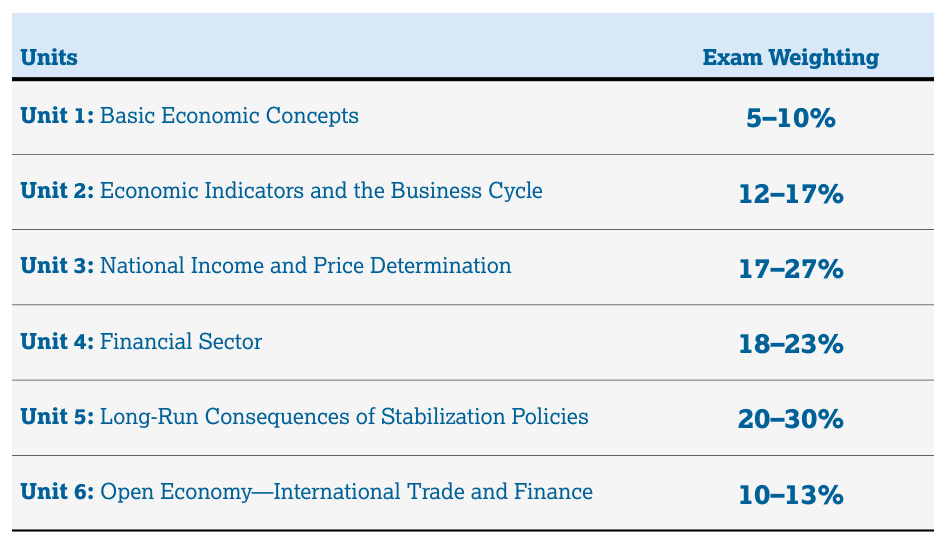
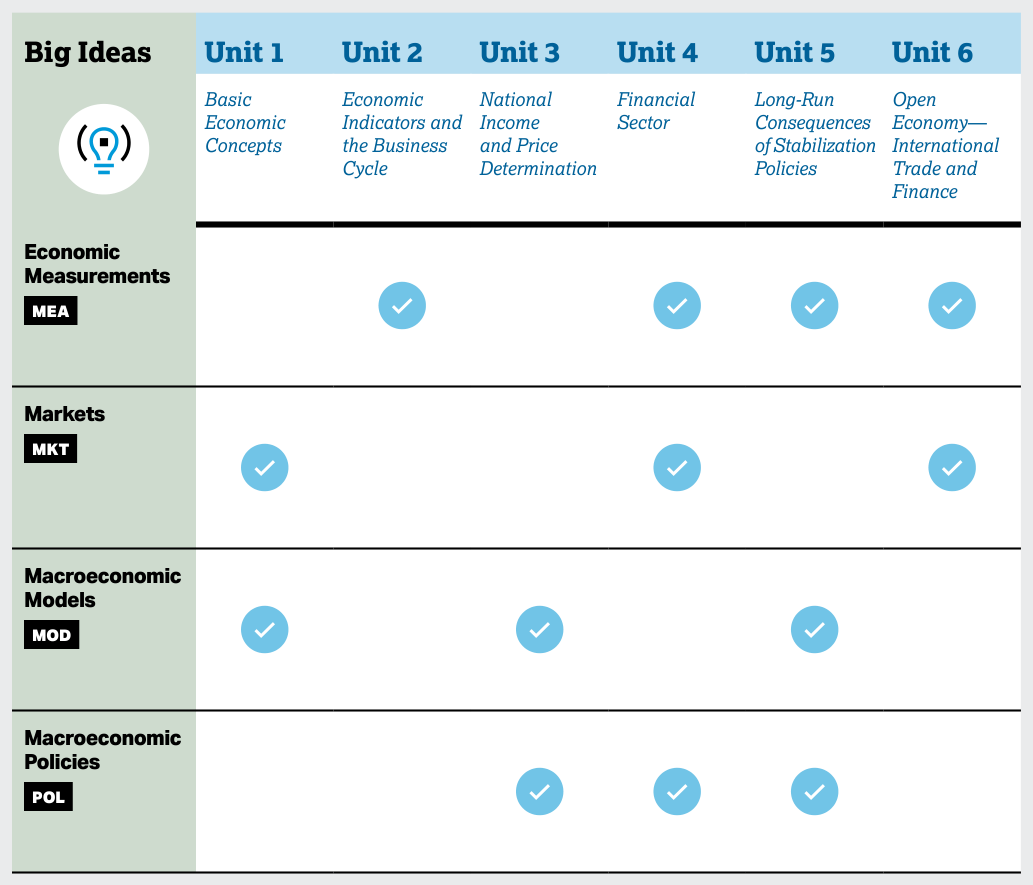
Study AP Macroeconomics on Lykke
This course page is free to open: signed out, you can read its first two sections, and signing in, on any plan, opens the rest. The free Lykke Chrome extension syncs your own Canvas courses, so ChatGPT, Claude and Muse can answer from your classes and deadlines. It only reads Canvas.
Add the free extensionSign in to open every section