From the free course AP Macroeconomics on Lykke
4.2 Nominal versus Real Interest Rates
Key concepts: Nominal interest rate · Real interest rate · Expected inflation · Actual inflation · Relationship between nominal and real interest rates · Lenders and borrowers · Inflation adjustment · Central bank influence on nominal interest rates · Interest rates as the price of money
An interest rate is the price of money: it tells a borrower what must be paid to use someone else’s money and tells a lender what return is earned for postponing consumption.
4.2 Nominal versus Real Interest Rates
An interest rate is the price of money: it tells a borrower what must be paid to use someone else’s money and tells a lender what return is earned for postponing consumption. The crucial question is whether that price is measured in ordinary dollars or adjusted for the changing purchasing power of those dollars.
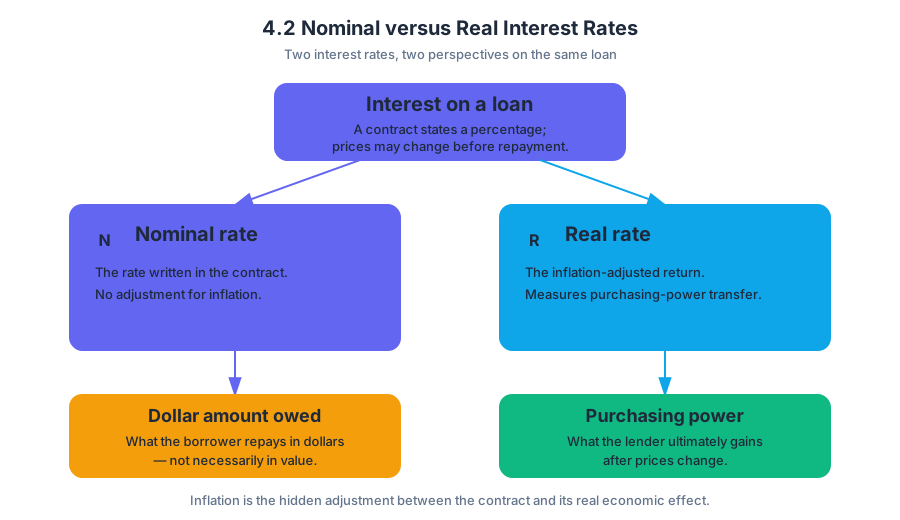
Two interest rates, two perspectives
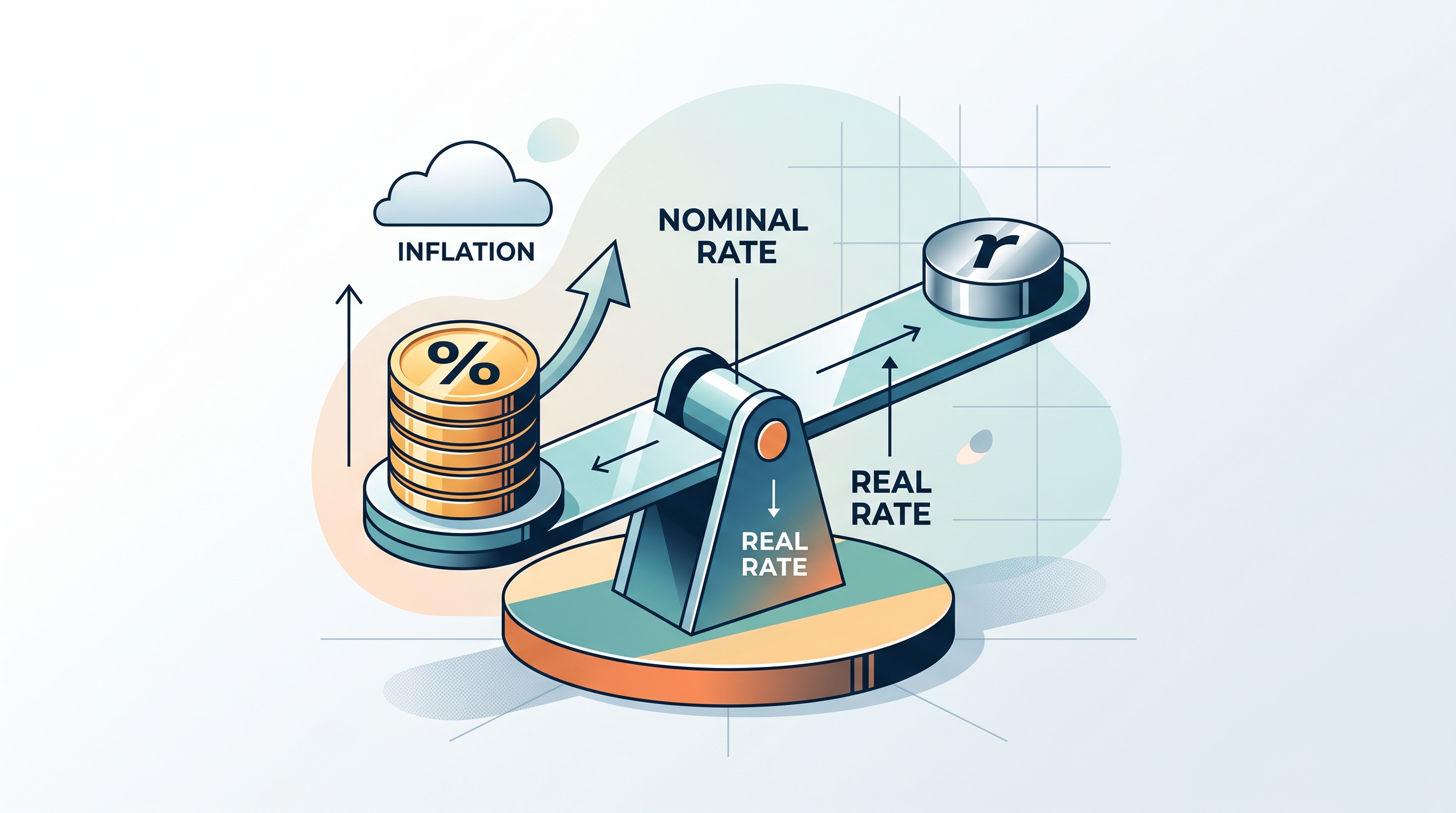
A nominal interest rate is the interest rate paid on a loan without adjustment for inflation. If a bank advertises a mortgage at $7%$, that $7%$ is nominal: it describes the dollar amount owed, not how much purchasing power the lender ultimately gains or the borrower ultimately sacrifices.
A real interest rate is the inflation-adjusted cost of borrowing or return to lending. It answers the economically meaningful question: After prices change, how much purchasing power has transferred from the borrower to the lender?
The distinction matters because a dollar received in the future may buy less than a dollar today. Inflation acts like a hidden adjustment to the loan: the nominal rate is written into the contract, while the real rate reveals the loan’s purchasing-power effect.
The expected-rate relationship
Before a loan is made, lenders and borrowers cannot know the exact future inflation rate. They therefore use expected inflation, the inflation rate they anticipate over the life of the loan, when negotiating the nominal interest rate.
MEA-3.B.2: Lenders and borrowers establish nominal interest rates as the sum of their expected real interest rate and expected inflation.
The relationship is:
$$ \text{Nominal interest rate}=\text{Expected real interest rate}+\text{Expected inflation} $$
Using standard notation, where $i$ is the nominal interest rate, $r^e$ is the expected real interest rate, and $\pi^e$ is expected inflation:
$$ i=r^e+\pi^e $$
Rearranging gives the expected real interest rate:
$$ r^e=i-\pi^e $$
For example, suppose a lender wants an expected purchasing-power return of $3%$ and expects inflation of $4%$. The nominal interest rate will be set at:
$$ i=3%+4%=7% $$
If expected inflation rises to $6%$ while the lender still requires an expected real return of $3%$, the nominal rate rises to:
$$ i=3%+6%=9% $$
The higher nominal rate does not necessarily mean the lender expects a higher real return. It may simply compensate for the expected loss in purchasing power.
Realized real interest: the hindsight calculation
After the loan period ends, economists can calculate the real interest rate in hindsight using actual inflation, the inflation rate that actually occurred rather than the rate people predicted.
MEA-3.B.3: A real interest rate can be calculated in hindsight by subtracting the actual inflation rate from the nominal interest rate.
The realized real interest rate is:
$$ r=i-\pi $$
Suppose a borrower signs a loan at a nominal rate of $7%$. If actual inflation turns out to be $5%$, the realized real interest rate is:
$$ r=7%-5%=2% $$
If actual inflation instead reaches $9%$, then:
$$ r=7%-9%=-2% $$
A negative real interest rate means the lender receives more dollars but loses purchasing power overall. The borrower repays the loan with dollars that are worth less than expected, making the borrowing cost negative in real terms.
Expected versus actual inflation
Keep the timing straight:
| When the calculation is made | Inflation measure | Formula |
|---|---|---|
| Before inflation occurs | Expected inflation, $\pi^e$ | $r^e=i-\pi^e$ |
| After inflation occurs | Actual inflation, $\pi$ | $r=i-\pi$ |
Named misconception — using actual inflation when setting the loan rate: A nominal interest rate is established using expected inflation, not inflation that has not yet occurred. Actual inflation is used later to calculate the realized real rate.
Named misconception — “nominal” means unimportant: Nominal rates determine the actual number of dollars paid or received. They are not economically sufficient by themselves because inflation determines what those dollars can purchase.
Lenders, borrowers, and central-bank influence
Lenders prefer a higher real return; borrowers prefer a lower real cost. Their agreement over the expected real return and expected inflation produces the nominal rate. If either expectation changes, the nominal rate can change even before any loan is signed.
The central bank does not directly set the economy-wide nominal interest rate. Instead, it influences nominal rates by changing its administered interest rates, such as the rates governing balances held by commercial banks. Those policy changes affect market interest rates, borrowing, lending, and interest-sensitive spending.
This distinction is especially important when analyzing monetary policy: a central bank’s higher administered rate can raise nominal market rates, while the effect on real rates depends partly on what happens to expected inflation.
AP skill connection: Principles and Models [1.A]
The suggested AP skill is Principles and Models [1.A]: Describe economic concepts, principles, or models. A strong response defines both rates precisely, identifies whether inflation is expected or actual, and uses the correct causal relationship rather than merely stating a number.
MEA-3.B: Define the nominal and real interest rate; explain the relationship between changes in nominal interest rates, expected inflation, and real interest rates; and calculate the nominal and real interest rate.
Retrieval check: A loan carries a nominal interest rate of $8%$. Expected inflation is $3%$, but actual inflation is $6%$. What are the expected real interest rate and the realized real interest rate?
Answer: Before the loan period, the expected real rate is $8%-3%=5%$. In hindsight, the realized real rate is $8%-6%=2%$. The two answers differ because they use different inflation measures.
Source Materials
- AP Macroeconomics Course and Exam Description
- AP Macroeconomics Course and Exam Description Clarifications and Corrections
- AP Macroeconomics Course Overview
- AP Macroeconomics Course at a Glance
- AP Macroeconomics Course at a Glance Poster
- AP Macroeconomics
- AP Macroeconomics
- AP Macroeconomics Sample Syllabus 1
- (b) State that the central bank would increase its administered interest rates or increase interest on reserves.
- (c) State that the central bank would increase its administered interest rates or increase interest on reserves.
- (c) State that the central bank would increase its administered interest rates or increase interest on reserves.