From the free course AP Macroeconomics on Lykke
AP Practice 2
Key concepts: International trade and balance of payments · Exports, imports, and net exports · Domestic currency and exchange-rate effects on trade · Unemployment rate · Labor force participation rate · Economic performance indicators, including gross domestic product · Economic growth and contraction · Reserve banking and central-bank policies · Demand and supply graphs, including movements along curves versus shifts · Quantitative analysis and economic calculations
A country can look healthier on one economic indicator while appearing weaker on another: real GDP may grow even as unemployment remains high, and a stronger domestic currency may make imports cheaper while reducing net exports.
AP Practice 2
A country can look healthier on one economic indicator while appearing weaker on another: real GDP may grow even as unemployment remains high, and a stronger domestic currency may make imports cheaper while reducing net exports. The central skill is connecting each measurement to the mechanism behind it rather than treating any single number as a complete diagnosis.
Task type: Original, unofficial short free-response practice. Suggested timing is approximately $12$ minutes. This task emphasizes MEA-1: Principles and Models, MEA-2: Interpretation, MEA-3: Manipulation, and MEA-4: Graphing and Visuals, especially quantitative measurement, causal explanation, and correctly labeled economic models.
Practice scenario: Lydora
Lydora’s domestic currency appreciates after foreign investors purchase more Lydoran financial assets. Before the appreciation, Lydora records exports of $$240$ billion and imports of $$275$ billion. Its adult population is $50$ million: $32$ million people are employed, $3$ million are unemployed and actively seeking work, and $15$ million are not in the labor force.
Part A: Net exports
Define net exports and calculate Lydora’s initial net exports.
Scoring target: Define net exports as exports minus imports.
$$NX = X - M$$
$$NX = $240\text{ billion} - $275\text{ billion} = -$35\text{ billion}$$
Lydora has a trade deficit of $$35$ billion because imports exceed exports. A negative value is not “negative trade”; it means the country purchases more goods and services from abroad than it sells abroad.
Part B: Currency appreciation and trade
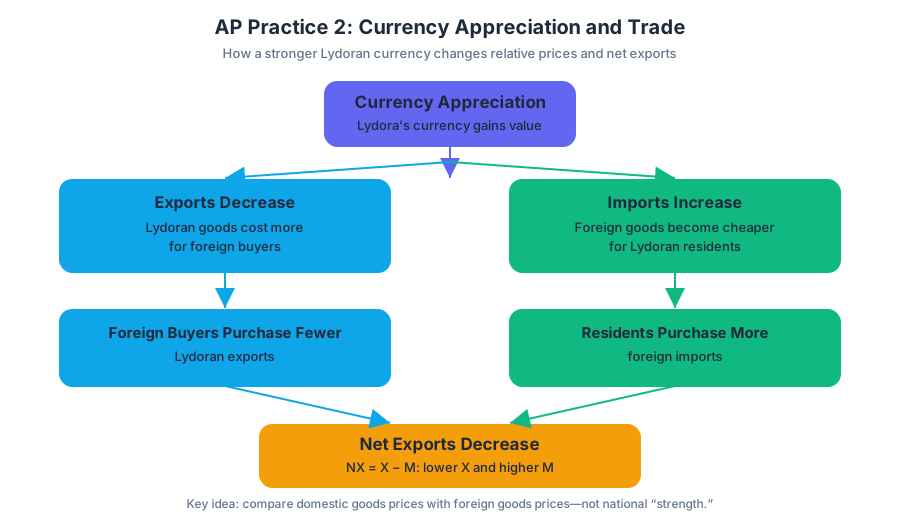
Explain why Lydora’s currency appreciation is expected to decrease exports, increase imports, and reduce net exports.
Scoring target: A complete causal chain earns the explanation point:
- Appreciation makes Lydoran goods more expensive to foreign buyers.
- Foreign buyers purchase fewer Lydoran exports.
- Appreciation makes foreign goods cheaper for Lydoran residents.
- Lydoran residents purchase more imports.
- Because $NX = X - M$, lower exports and higher imports reduce net exports.
A common misconception is that an appreciating currency automatically improves the trade balance because the currency is “stronger.” The relevant comparison is not national strength; it is the price of domestic goods relative to foreign goods.
Part C: Labor-market measurements
Calculate Lydora’s labor force, unemployment rate, and labor force participation rate. Show work.
The labor force includes people who are employed plus people who are unemployed and actively seeking work:
$$\text{Labor force} = \text{employed} + \text{unemployed}$$
$$\text{Labor force} = 32 + 3 = 35\text{ million}$$
The unemployment rate is the percentage of the labor force that is unemployed:
$$\text{Unemployment rate} = \frac{\text{unemployed}}{\text{labor force}}\times 100$$
$$\text{Unemployment rate} = \frac{3}{35}\times 100 \approx 8.6%$$
The labor force participation rate is the percentage of the adult population in the labor force:
$$\text{LFPR} = \frac{\text{labor force}}{\text{adult population}}\times 100$$
$$\text{LFPR} = \frac{35}{50}\times 100 = 70%$$
The adult population is broader than the labor force. It includes the $15$ million people outside the labor force, such as retirees, full-time students, and discouraged workers. Because discouraged workers are not actively seeking work, they are excluded from both the labor force and the measured unemployment rate.
Part D: Economic performance
Lydora’s real GDP rises from $$800$ billion to $$824$ billion. Calculate the real GDP growth rate and identify whether the economy experiences growth or contraction.
$$\text{Growth rate} = \frac{\text{new real GDP} - \text{old real GDP}} {\text{old real GDP}}\times 100$$
$$\text{Growth rate} = \frac{824-800}{800}\times 100 = 3%$$
Real GDP rises by $3%$, so Lydora experiences economic growth. A decrease in real GDP would indicate an economic contraction. GDP measures the market value of final goods and services produced within a country, but GDP alone does not measure income distribution, unpaid household production, environmental quality, or every aspect of economic well-being. Inflation and unemployment provide additional evidence about economic performance.
Part E: Reserve banking and policy
Lydora’s central bank purchases government securities from commercial banks. State the immediate effect on bank reserves and identify the likely short-run effect on aggregate demand.
A government-securities purchase increases commercial-bank reserves. In a reserve-banking system, banks can use additional reserves to support more lending, which tends to increase the money supply and lower interest rates. Lower interest rates encourage interest-sensitive consumption and investment, shifting aggregate demand rightward in the short run.
Part F: Curve reasoning and graphing
On a correctly labeled foreign-exchange-market graph for Lydora’s currency, show the effect of increased foreign demand for Lydoran financial assets. Label the vertical axis, horizontal axis, currency-demand curve, currency-supply curve, initial equilibrium, and the new equilibrium.
Scoring target: Put the exchange rate, measured as the price of Lydora’s currency in another currency, on the vertical axis. Put the quantity of Lydora’s currency on the horizontal axis. Increased foreign demand shifts the demand curve right, raising the equilibrium exchange rate and causing appreciation.
This is a shift of the demand curve, not a movement along the original demand curve: the cause is a change in foreign demand for the currency. By contrast, a change in the currency’s own exchange rate would produce a movement along a fixed demand curve.
Error-review routine
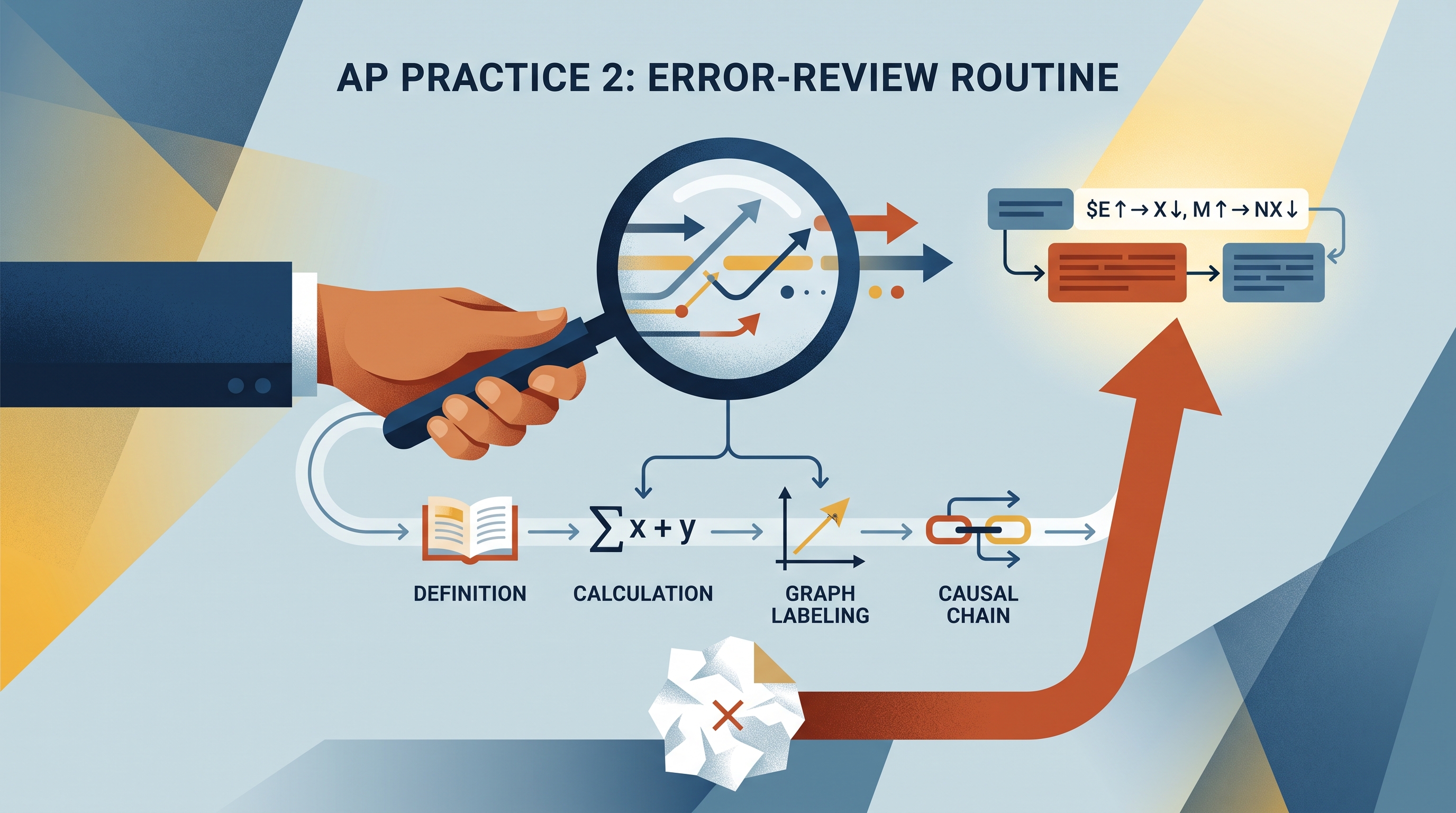
After completing the task, mark each missed point as one of four errors: definition, calculation, graph labeling, or causal chain. Rewrite only the missing link. For example, replace “appreciation lowers net exports” with “appreciation makes exports more expensive and imports cheaper, so exports fall, imports rise, and $NX$ falls.”
Source Materials
- AP Macroeconomics Course and Exam Description
- AP Macroeconomics Course and Exam Description Clarifications and Corrections
- AP Macroeconomics Course Overview
- AP Macroeconomics Course at a Glance
- AP Macroeconomics Course at a Glance Poster
- AP Macroeconomics
- AP Macroeconomics
- AP Macroeconomics Sample Syllabus 1
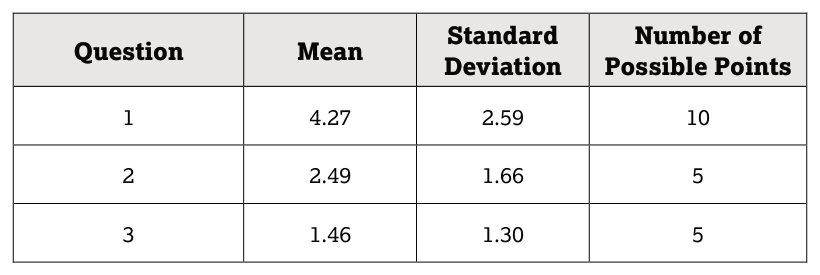
- Figure — Scoring Statistics – Set 2 (p. 1)
- AP Macroeconomics-AP Students-College Board
- AP Macroeconomics FRQ Practice
- AP/College Macroeconomics-Khan Academy