From the free course AP Macroeconomics on Lykke
1.4 Demand
When the price of a product changes, buyers usually change how much they want to purchase—even if nothing else about the market changes. Demand is the relationship between the price of a good or service and the quantity consumers are willing and able to buy at each possible price.
1.4 Demand
When the price of a product changes, buyers usually change how much they want to purchase—even if nothing else about the market changes. Demand is the relationship between the price of a good or service and the quantity consumers are willing and able to buy at each possible price.
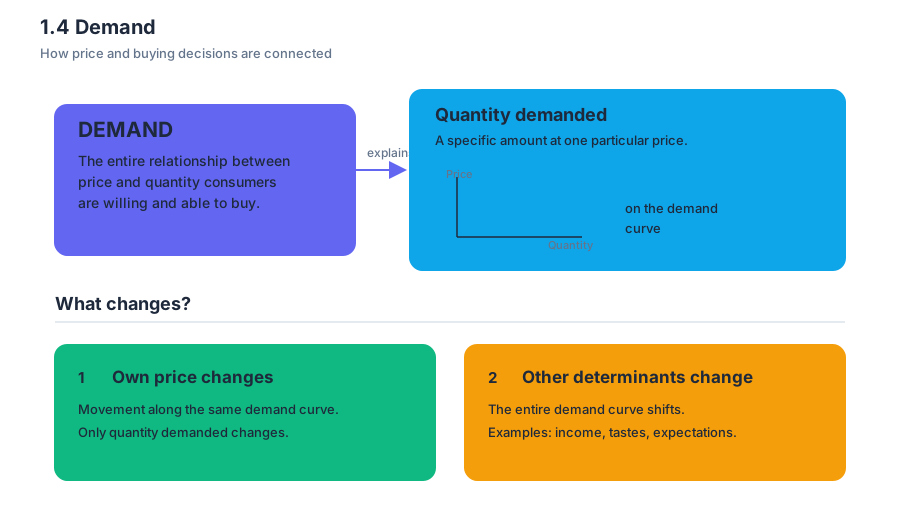
Demand is the entire relationship between price and quantity demanded. Quantity demanded is the specific amount consumers want to buy at one particular price.
The distinction matters because economists describe two different events: a change in the product’s own price causes a movement along the demand curve, while a change in any other demand determinant shifts the entire curve.
The law of demand
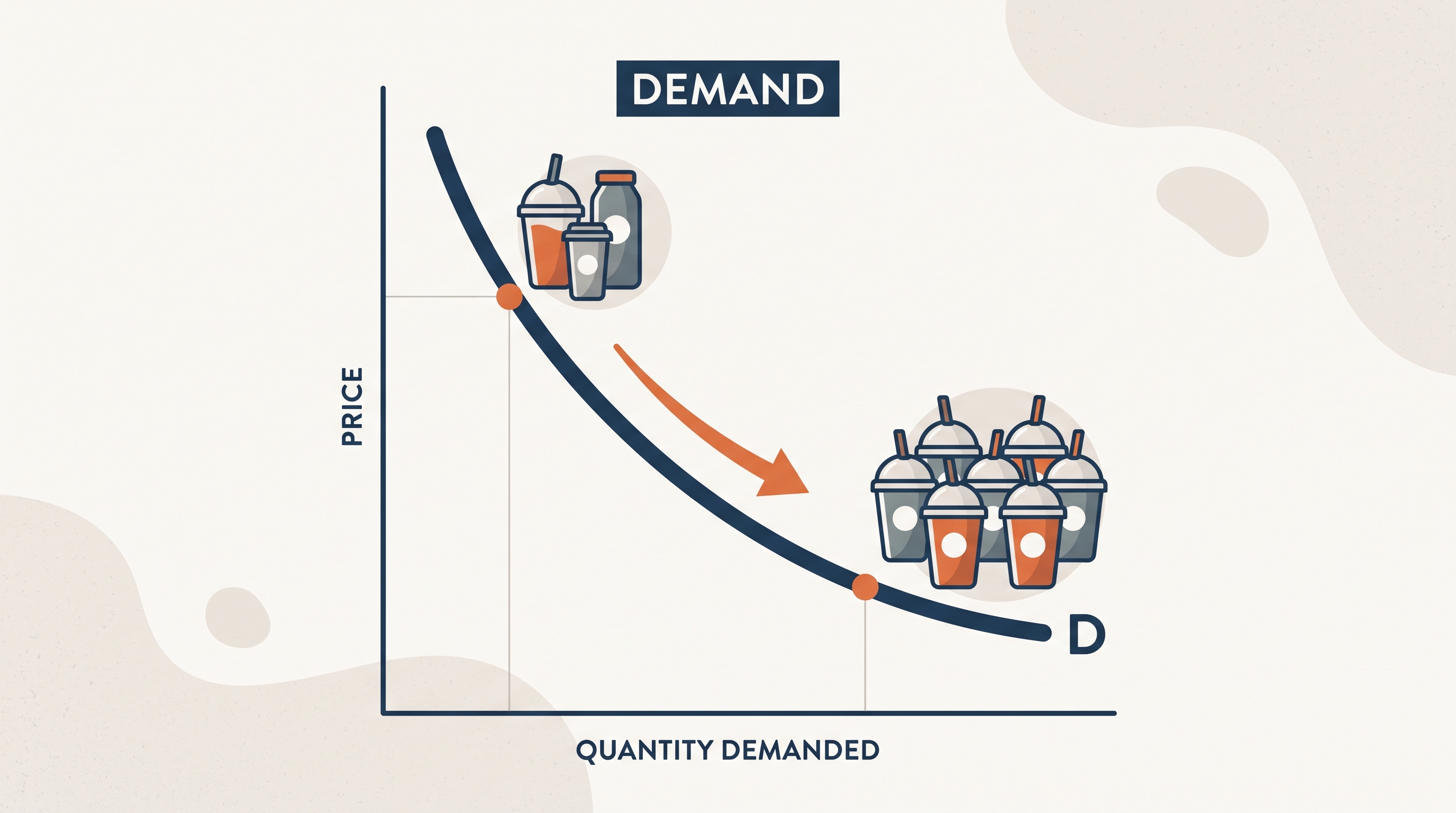
The law of demand states that, holding all other factors constant, price and quantity demanded move in opposite directions. When price rises, quantity demanded falls; when price falls, quantity demanded rises.
$$P \uparrow \Rightarrow Q_d \downarrow$$
$$P \downarrow \Rightarrow Q_d \uparrow$$
A downward-sloping demand curve represents this inverse relationship. The vertical axis measures price, $P$, and the horizontal axis measures quantity, $Q$. Each point on the curve gives the quantity demanded at one price.
Worked example — concert tickets: Suppose the number of tickets demanded is represented by
$$Q_d = 1{,}200 - 40P$$
where $P$ is the ticket price in dollars. At $P=$10$,
$$Q_d = 1{,}200 - 40(10)=800$$
At $P=$15$,
$$Q_d = 1{,}200 - 40(15)=600$$
The price rises by $$5$, and quantity demanded falls by $200$ tickets. This is a movement upward and to the left along the same demand curve.
The law of demand is connected to the idea of opportunity cost: a higher price makes the purchase more costly relative to other uses of a buyer’s limited income. Buyers may switch toward alternatives, and the higher price may also reduce the amount they can afford.
Changes in demand versus changes in quantity demanded
A change in quantity demanded occurs only when the good’s own price changes. The demand curve does not move.
A change in demand occurs when a nonprice determinant changes. The entire demand curve shifts.
| Event | Graphical result | Typical example |
|---|---|---|
| Price of the good changes | Movement along demand curve | The price of coffee falls |
| Income changes | Demand curve shifts | Household incomes rise |
| Price of a related good changes | Demand curve shifts | Tea becomes more expensive |
| Preferences change | Demand curve shifts | A health trend increases interest in fruit |
| Number of buyers changes | Demand curve shifts | More consumers enter the market |
| Expected future price changes | Demand curve shifts | Buyers expect prices to rise next month |
A shift right means an increase in demand: consumers want more at every possible price. A shift left means a decrease in demand: consumers want less at every possible price.
The determinants of demand
The principal determinants of demand are tastes and preferences, the number of buyers, consumer income, the prices of related goods, and expectations about the future.
For normal goods, an increase in income increases demand. For example, if incomes rise, consumers may purchase more restaurant meals at every restaurant price. For an inferior good, an increase in income decreases demand because consumers move toward preferred alternatives; bus rides can serve as a possible example if consumers switch to cars or ride-sharing as their incomes increase.
Substitutes are goods that can be used in place of one another. If the price of tea rises, demand for coffee may increase because coffee becomes relatively more attractive. Complements are goods used together. If the price of printers falls, demand for printer ink may increase because consumers are more likely to purchase and use printers.
Expectations can change current demand. If buyers expect a product’s price to rise soon, they may purchase more today, shifting current demand right. If they expect a price decrease, they may postpone purchases, shifting current demand left.
Named misconception check
Misconception: “If demand increases, the price must have increased.” Correction: an increase in demand is a rightward shift caused by a nonprice determinant. A price increase causes a decrease in quantity demanded—a movement along the existing curve—not an increase in demand.
Misconception: “Demand is the same as desire.” Correction: demand requires both willingness and ability to buy. Someone may want a luxury home but lack the income to participate in that market at the listed price.
AP traceability and retrieval check
Topic 1.4 Demand develops Big Idea MKT (Markets). Its core identifiers are LO MKT-1.A and EK MKT-1.A.1–MKT-1.A.2 for the law of demand, LO MKT-1.B and EK MKT-1.B.1 for determinants of demand, and LO MKT-1.C and EK MKT-1.C.1 for distinguishing movements along a demand curve from shifts of the curve. The principal assessed processes are Skill 1.A: Define economic principles and models, Skill 1.B: Explain economic outcomes, Skill 2.C: Interpret visual representations, and Skill 4.A: Draw correctly labeled graphs.
Retrieval check: The price of smoothies falls, while consumer incomes and preferences remain unchanged. Is this a movement along the demand curve or a shift? What happens to quantity demanded?
Answer: It is a movement downward along the existing demand curve, and quantity demanded increases. A shift would require a change in a nonprice determinant such as income, preferences, the number of buyers, the price of a related good, or expectations.
Source Materials
- AP Macroeconomics Course and Exam Description
- AP Macroeconomics Course and Exam Description Clarifications and Corrections
- AP Macroeconomics Course Overview
- AP Macroeconomics Course at a Glance
- AP Macroeconomics Course at a Glance Poster
- AP Macroeconomics
- AP Macroeconomics
- AP Macroeconomics Sample Syllabus 1