From the free course AP Macroeconomics on Lykke
3.8 Fiscal Policy
Key concepts: Fiscal policy · Physical capital accumulation · Graphical analysis of policy changes
Fiscal policy is the government’s use of spending, taxation, and transfer payments to influence aggregate economic activity. The central policy question is not merely whether government action changes output, but whether its short-run benefit creates a long-run cost through higher interest rates, reduced…
3.8 Fiscal Policy
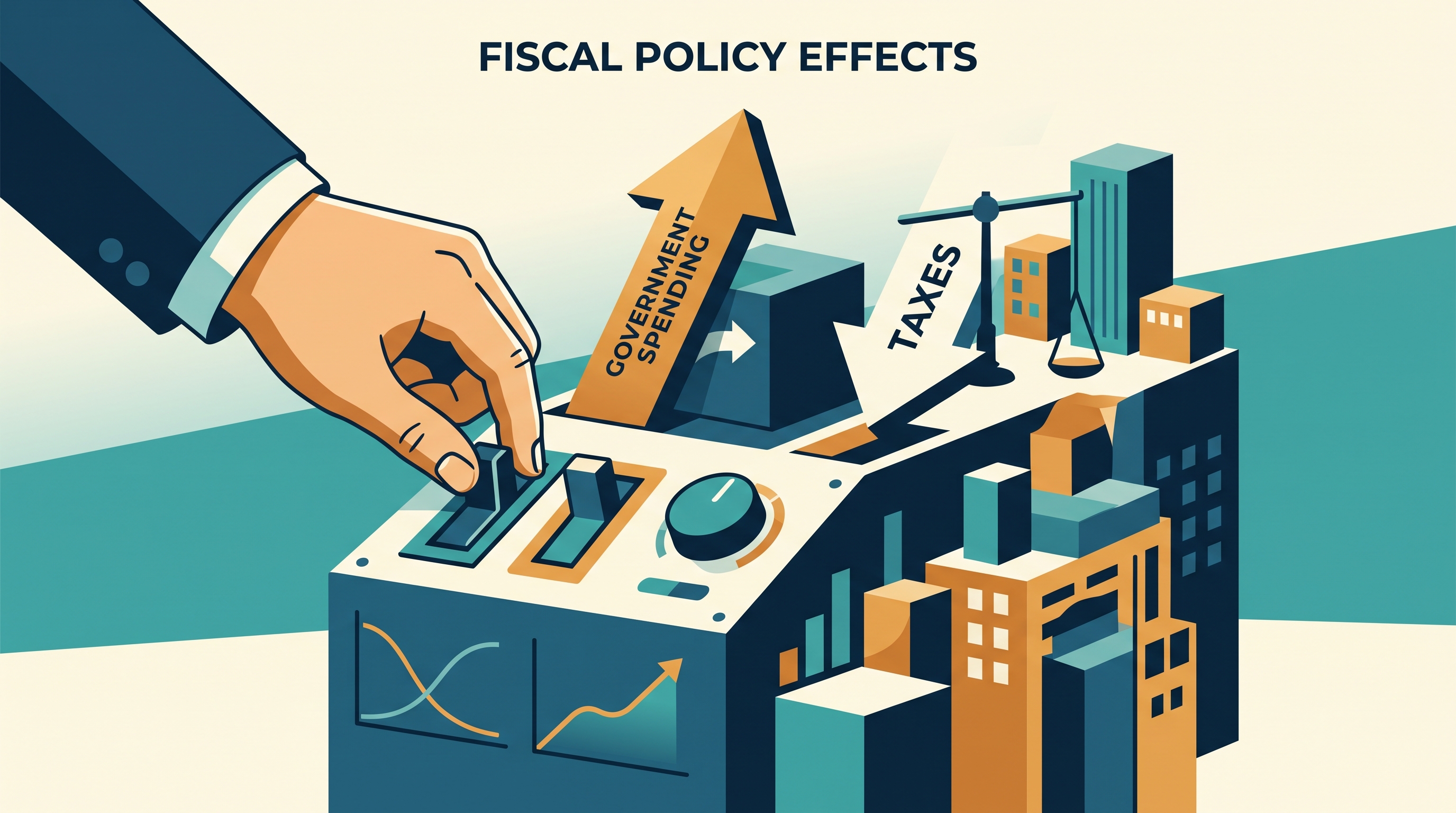
Fiscal policy is the government’s use of spending, taxation, and transfer payments to influence aggregate economic activity. The central policy question is not merely whether government action changes output, but whether its short-run benefit creates a long-run cost through higher interest rates, reduced investment, and slower growth.
Expansionary fiscal policy increases aggregate demand in the short run, but financing the policy can raise real interest rates and cause crowding out—a reduction in private investment caused by government borrowing.
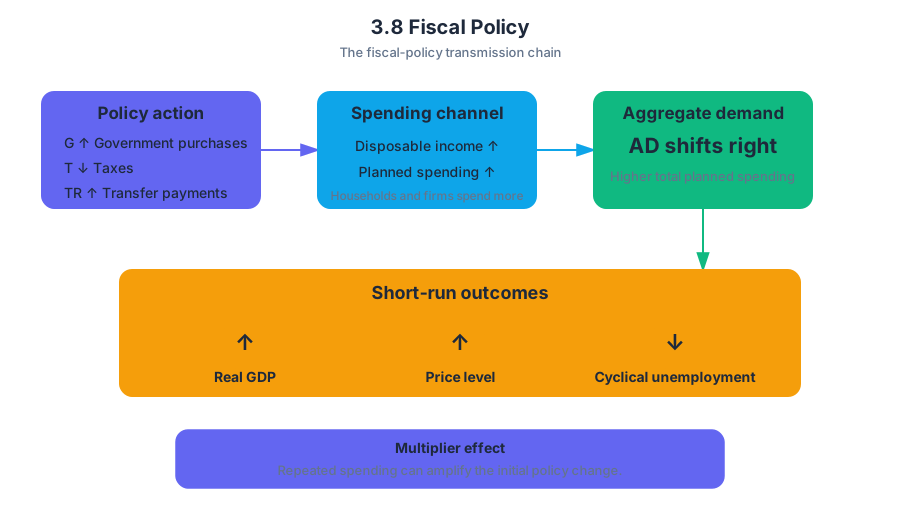
The fiscal-policy transmission chain
The most common expansionary fiscal policies are:
- an increase in government purchases,
- a decrease in taxes, or
- an increase in transfer payments.
Each can increase household or business spending and shift aggregate demand, or AD, to the right. In the short run, real output rises, unemployment falls, and the price level increases.
The full causal chain is:
$$ G \uparrow \quad \text{or} \quad T \downarrow \quad \text{or} \quad TR \uparrow $$
$$ \Rightarrow \text{disposable income or planned spending} \uparrow $$
$$ \Rightarrow AD \text{ shifts right} $$
$$ \Rightarrow \text{real GDP} \uparrow,\ \text{price level} \uparrow,\ \text{cyclical unemployment} \downarrow $$
The effect is not necessarily equal to the initial policy change. For example, an increase in government purchases can generate additional rounds of consumption as recipients spend part of their new income. The final change in real GDP depends on the spending multiplier and on factors such as the marginal propensity to consume, taxes, imports, and crowding out.
Graphical analysis of a policy change
To explain a fiscal-policy change graphically, draw an accurately labeled AD–AS model:
- vertical axis: price level;
- horizontal axis: real GDP;
- downward-sloping $AD_1$;
- upward-sloping short-run aggregate supply, $SRAS$;
- initial equilibrium at $E_1$;
- rightward shift from $AD_1$ to $AD_2$;
- new equilibrium at $E_2$.
At $E_2$, the economy has a higher price level and greater real GDP than at $E_1$. A complete explanation must connect the graph to the policy: increased government purchases shift aggregate demand right; the new equilibrium raises real GDP and the price level in the short run.
A graph earns explanatory power only when every essential label is present. A curve’s direction alone is not enough: identify both axes, label the curves, mark the initial and final equilibria, and show the direction of the shift.
Why deficits can crowd out private investment
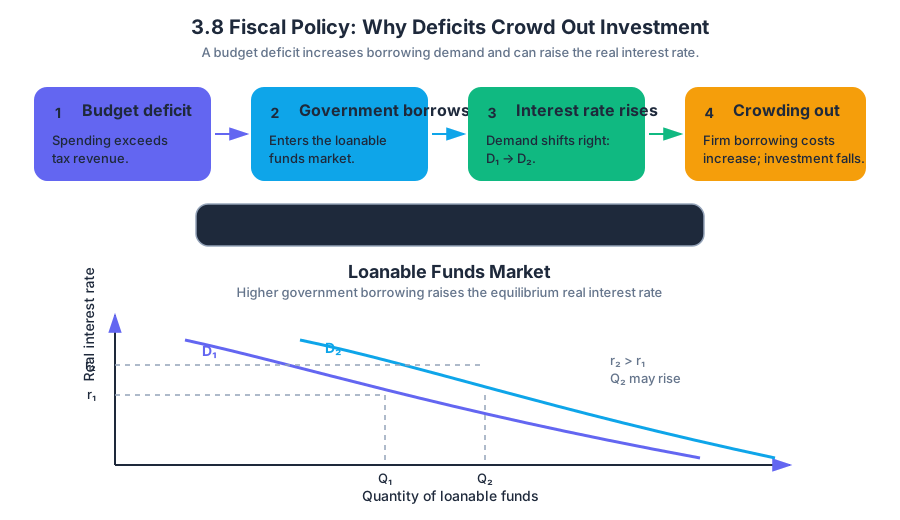
When government spending exceeds tax revenue, the government runs a budget deficit. To finance the deficit, it borrows in the loanable funds market. This increases the demand for loanable funds.
In the loanable funds model:
- vertical axis: real interest rate;
- horizontal axis: quantity of loanable funds;
- demand for loanable funds shifts right from $D_1$ to $D_2$;
- equilibrium real interest rate rises from $r_1$ to $r_2$;
- equilibrium quantity of loanable funds may rise.
The higher real interest rate makes borrowing more expensive for firms. Some firms cancel or delay purchases of factories, machinery, equipment, and technology. This decline in private investment is crowding out.
$$ \text{budget deficit} \uparrow \Rightarrow D_{\text{loanable funds}} \text{ shifts right} \Rightarrow r \uparrow \Rightarrow I \downarrow $$
The long-run cost: physical capital accumulation
Physical capital consists of productive assets such as machines, buildings, tools, and infrastructure. Physical capital accumulation occurs when an economy adds to its stock of these assets, allowing workers to produce more output per hour.
If crowding out reduces private investment, the economy accumulates physical capital at a lower rate. Over time, slower capital accumulation can reduce productivity growth and produce less economic growth than would otherwise occur.
$$ I \downarrow \Rightarrow \text{physical capital accumulation} \downarrow \Rightarrow \text{future productive capacity} \downarrow \Rightarrow \text{long-run economic growth} \downarrow $$
This creates an important distinction: expansionary fiscal policy may raise real GDP in the short run while reducing the growth of potential output in the long run if crowding out is substantial. The short-run demand gain and the long-run supply consequence must be analyzed separately.
Worked example: from stimulus to slower growth
Suppose an economy is below full employment. The government increases infrastructure spending, shifting $AD$ right. In the short run, real GDP increases from $Y_1$ to $Y_2$, the price level rises from $P_1$ to $P_2$, and cyclical unemployment falls.
The government finances the spending by issuing bonds. The resulting deficit shifts loanable-funds demand right, raising the real interest rate from $r_1$ to $r_2$. A firm that intended to borrow for new equipment now faces a higher financing cost and reduces its investment.
Therefore, the immediate policy effect is expansionary, but the later effect is a lower rate of physical capital accumulation. The economy may still grow, yet its future production possibilities expand more slowly.
Misconception check: “A deficit always reduces investment”
Misconception: Every government deficit causes complete crowding out. Correction: A deficit creates pressure for crowding out through higher demand for loanable funds, but the magnitude depends on the market. If substantial saving or capital inflows are available, the real interest rate may rise only slightly. If the economy has unused resources, the short-run increase in output may also offset some reduction in private investment.
Skill focus and retrieval check
This topic develops POL-3.C.3, explaining how fiscal policy affects economic outcomes; POL-3.C.4, explaining how fiscal policy may cause crowding out; and POL-3.B, analyzing policy effects through macroeconomic models. It also uses Skill Category 4: Graphing and Visuals, especially drawing correctly labeled graphs and explaining one or more changes using graphs.
Retrieval check: If expansionary fiscal policy is financed by government borrowing, what happens first in the loanable funds market, and how can that eventually produce a lower rate of physical capital accumulation?
Answer: Government borrowing shifts the demand for loanable funds right and raises the real interest rate. The higher rate reduces private investment, slowing the accumulation of physical capital and potentially reducing long-run economic growth.
Source Materials
- AP Macroeconomics Course and Exam Description
- AP Macroeconomics Course and Exam Description Clarifications and Corrections
- AP Macroeconomics Course Overview
- AP Macroeconomics Course at a Glance
- AP Macroeconomics Course at a Glance Poster
- AP Macroeconomics
- AP Macroeconomics
- AP Macroeconomics Sample Syllabus 1