From the free course AP Macroeconomics on Lykke
2.1 The Circular Flow and GDP
Key concepts: Circular flow model · Households and businesses · Flow of inputs and outputs · Flow of money · GDP as total income and expenditure · GDP as final output · Expenditure approach to measuring GDP · Income approach to measuring GDP · Value-added approach to measuring GDP · GDP components
Every purchase is simultaneously someone else’s income: when a household buys a $5 sandwich, the household records consumption spending, while the bakery records $5 of revenue.
2.1 The Circular Flow and GDP
Every purchase is simultaneously someone else’s income: when a household buys a $5 sandwich, the household records consumption spending, while the bakery records $5 of revenue. The circular flow model turns this simple exchange into a picture of how an entire economy connects.
Enduring Understanding MEA-1: An economy’s performance can be measured by different indicators, including gross domestic product ($GDP$), the inflation rate, and the unemployment rate.
Learning Objective MEA-1.A: Define, using the circular flow diagram as appropriate, how GDP is measured and its components; calculate nominal GDP.
The two main participants
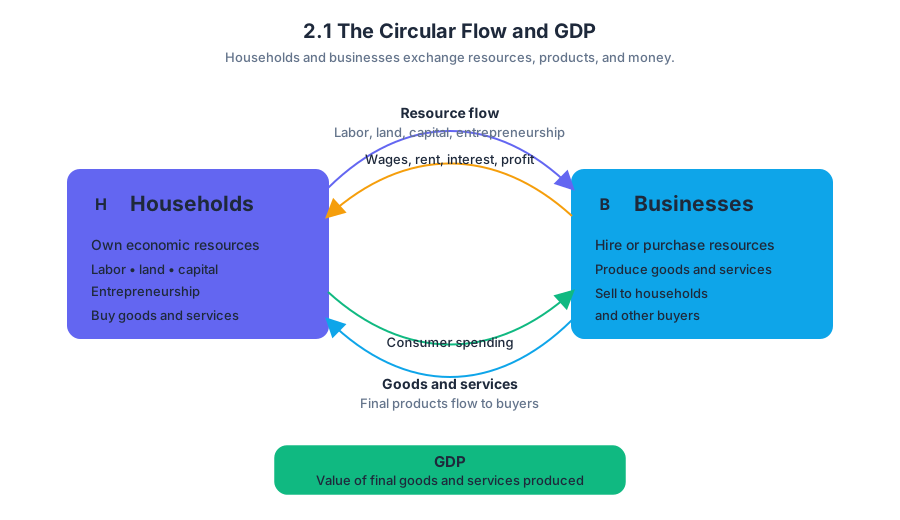
The circular flow model represents two broad groups:
- Households own the economic resources—labor, land, capital, and entrepreneurship—and sell the use of those resources to businesses.
- Businesses hire or purchase those resources to produce goods and services, which they sell to households and other buyers.
This simplified model does not mean that households and businesses are the only real participants in an economy. Rather, it isolates the basic relationship between resource owners and producers so that the movement of goods, services, resources, and money is visible.
Real flows and money flows
The model contains two connected circuits. The real flow consists of physical or productive activity: households provide inputs, businesses transform those inputs into outputs, and households receive goods and services. The money flow moves in the opposite direction: businesses pay households for inputs, and households pay businesses for final goods and services.
A useful way to read the model is to ask two questions at every arrow:
- What is moving? Resources, goods, services, or money?
- Who receives payment or income?
For example, a student works at a grocery store. The student supplies labor, an input, to the business and receives wages. The store uses labor, equipment, buildings, and inventory to produce retail services. When a household buys groceries, its spending becomes the store’s revenue, which helps pay workers, suppliers, lenders, and owners.
Key insight: One person’s expenditure is another person’s income.
GDP: final output, income, and expenditure
Gross domestic product ($GDP$) is the market value of all final goods and services produced within a country during a given period. “Final” means the product is ready for its ultimate user; intermediate goods are excluded so that the same production is not counted repeatedly.
GDP can therefore be understood in three equivalent ways:
| Approach | What it adds up | Central question |
|---|---|---|
| Expenditures approach | Spending on final goods and services | Who bought the final output? |
| Income approach | Income earned from producing output | Who received income from production? |
| Value-added approach | Value added at every production stage | How much new value did each producer create? |
The equality works because the economy’s final output generates revenue; that revenue becomes income to the people and firms involved in production. The value-added approach reaches the same total without double-counting intermediate transactions.
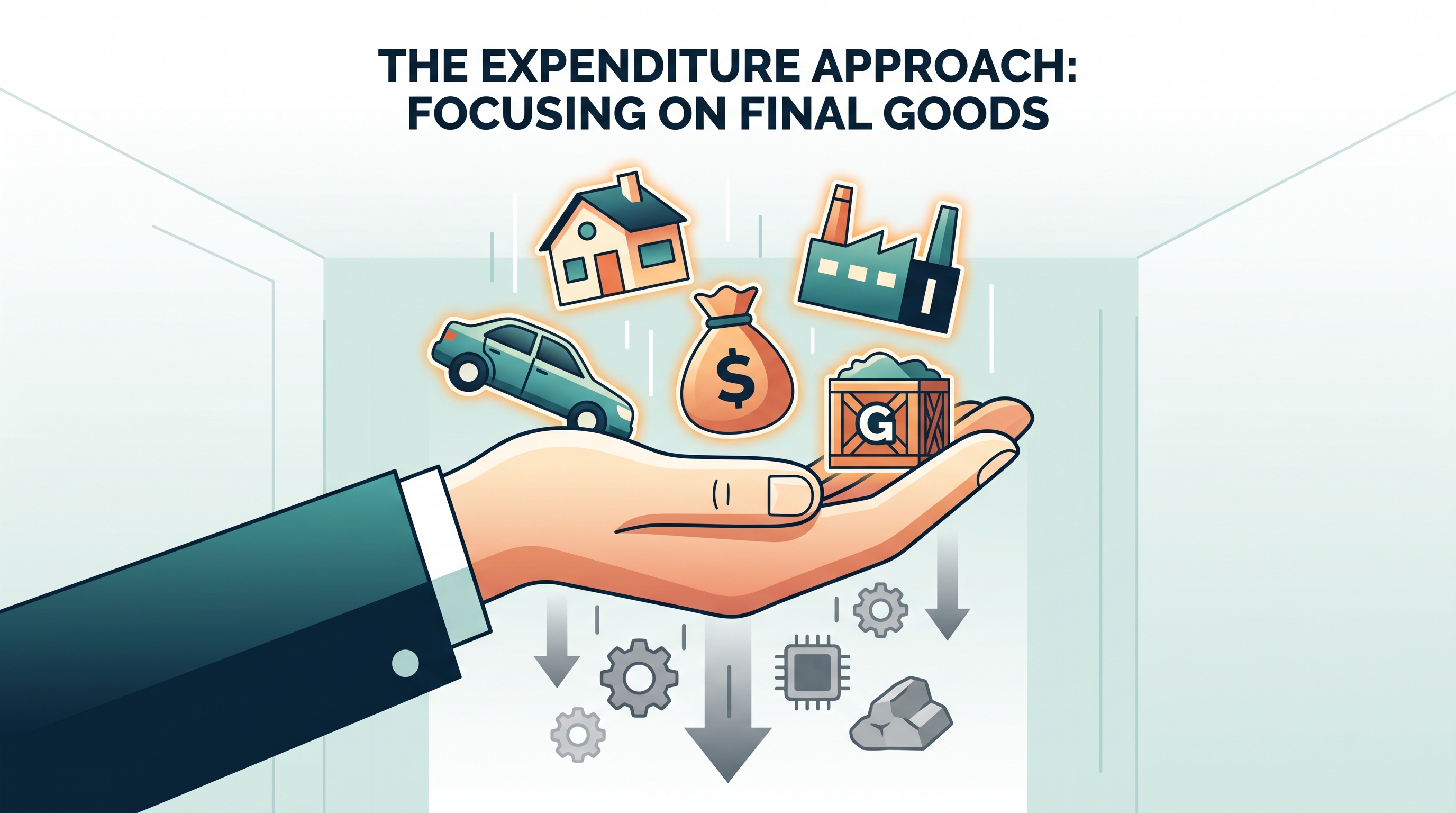
The expenditures approach
The standard expenditure identity is
$$GDP = C + I + G + NX$$
where:
- $C$ = household consumption spending;
- $I$ = business investment spending, including purchases of capital goods and construction of new structures;
- $G$ = government purchases of newly produced goods and services;
- $NX$ = net exports, calculated as exports minus imports: $NX = X - M$.
Suppose an economy records $C = $700$ billion, $I = $180$ billion, $G = $220$ billion, exports of $$90$ billion, and imports of $$120$ billion. Then
$$NX = 90 - 120 = -$30\text{ billion}$$
and
$$GDP = 700 + 180 + 220 - 30 = $1{,}070\text{ billion}.$$
Imports are subtracted because they may already be included in $C$, $I$, or $G$, but they were produced outside the country. Exports are added because they are domestic production purchased by foreigners.
Value added: avoiding double counting
Imagine that a farmer sells wheat for $$2$ to a mill, the mill sells flour for $$5$ to a baker, and the baker sells bread for $$9$ to a household. Adding every sale gives $$16$, but that exaggerates production because the wheat and flour are embedded in the final bread.
The value-added approach counts only the new value created at each stage:
$$$2 + ($5-$2) + ($9-$5) = $9.$$
The result equals the value of the final bread, which is the amount included in GDP.
Misconception check
Misconception: “GDP is every transaction in the economy.” It is not. GDP measures final domestic production during the period. A used bicycle sold this year is generally excluded because it was produced earlier, while a newly produced bicycle is included.
Skills in action
This topic primarily develops Skill 1.A: Define economic principles and models, Skill 1.B: Explain economic principles and models, Skill 2.A: Identify economic concepts, principles, and models, Skill 2.C: Explain given economic outcomes, Skill 3.B: Calculate economic outcomes, and Skill 4.A: Draw graphs and visual representations. On an exam, these skills appear when you interpret arrows in a circular-flow diagram, explain why income equals expenditure, calculate GDP, or label relationships between households and businesses.
Retrieval check
A household purchases a newly produced laptop for $$1{,}200$. The laptop contains imported components worth $$300$. The purchase is household consumption, so it initially enters $C$ at $$1{,}200$; the imported portion is removed through $M$. Why must the expenditure approach exclude intermediate goods, and which GDP approach makes that logic most explicit?
Source Materials
- AP Macroeconomics Course and Exam Description
- AP Macroeconomics Course and Exam Description Clarifications and Corrections
- AP Macroeconomics Course Overview
- AP Macroeconomics Course at a Glance
- AP Macroeconomics Course at a Glance Poster
- AP Macroeconomics
- AP Macroeconomics
- AP Macroeconomics Sample Syllabus 1
- AP Macroeconomics-AP Students-College Board
- AP Macroeconomics FRQ Practice
- AP/College Macroeconomics-Khan Academy
- AP Macroeconomics Units/Save my Exams