From the free course AP Macroeconomics on Lykke
5.3 Money Growth and Inflation
When the quantity of money grows faster than the economy’s production of goods and services, the average price level tends to rise. The central question is therefore: How can more money chasing roughly the same output reduce the purchasing power of each monetary unit?
5.3 Money Growth and Inflation
When the quantity of money grows faster than the economy’s production of goods and services, the average price level tends to rise. The central question is therefore: How can more money chasing roughly the same output reduce the purchasing power of each monetary unit?
The quantity theory of money
Imagine a small island economy producing exactly $100$ smoothies in a year. If the money used to purchase those smoothies rises from $1{,}000$ to $2{,}000$ while smoothie production stays at $100$, sellers can charge more per smoothie without producing anything additional. The economy has more spending power, but not more products.
Quantity theory of money: In the long run, a sustained increase in the money supply, with other important factors held constant, tends to produce a proportional increase in the price level.
The relationship is represented by the equation
$$MV = PY$$
where:
- $M$ is the money supply, the quantity of money available for transactions;
- $V$ is the velocity of money, the average number of times each unit of money is used to purchase final goods and services;
- $P$ is the price level;
- $Y$ is real output, or the quantity of goods and services produced.
From money growth to inflation
Because nominal GDP equals the price level multiplied by real output, $PY$ is also nominal GDP. If velocity is stable, the equation implies that money growth must be connected to nominal GDP growth:
$$\text{growth in }M+\text{growth in }V\approx\text{inflation rate}+\text{growth in }Y$$
If velocity does not change, this simplifies to
$$\text{inflation rate}\approx\text{money-supply growth rate}-\text{real-output growth rate}$$
Worked example. Suppose the money supply increases by $8%$, velocity remains unchanged, and real output increases by $3%$. The approximate inflation rate is
$$8%-3%=5%$$
The economy can absorb about $3%$ more money through increased production. The remaining $5%$ is associated with a higher price level. If real output instead grew by $8%$, the approximate inflation rate would be $0%$, assuming velocity stayed constant.
Why the result is mainly long-run
In the short run, an increase in the money supply can lower interest rates and encourage borrowing, consumption, and investment. Those changes can increase aggregate demand and raise real output as firms respond to stronger sales. This is why money growth does not instantly translate one-for-one into inflation.
Over time, however, wages and input prices adjust, productive capacity becomes the limiting factor, and real output is determined mainly by resources, technology, and institutions rather than by the number of dollars in circulation. Once the economy returns toward its long-run output level, continued money growth primarily raises the price level.
Money neutrality
Money neutrality is the long-run idea that changes in the money supply affect nominal variables—such as the price level, nominal wages, and nominal GDP—but do not permanently change real variables—such as real GDP, employment at the natural rate, or the economy’s productive capacity.
For example, if the money supply doubles while real output and velocity remain unchanged, the quantity equation requires the price level to double:
$$M_2=2M_1 \quad\Rightarrow\quad P_2=2P_1$$
The numerical prices and wages may be larger, but the economy has not automatically gained more factories, workers’ skills, land, or technology.
Misconception check: “More money always creates more real wealth”
Named misconception — money illusion: A larger dollar amount is not necessarily greater purchasing power. If a worker’s nominal wage rises by $6%$ while the price level rises by $6%$, the worker’s real wage is approximately unchanged. The worker has more dollars but can buy roughly the same quantity of goods and services.
A second misconception is that the quantity equation proves inflation must equal money-supply growth in every period. It does not. The relationship depends on velocity and real output. A change in payment habits can alter $V$, while productivity changes can alter $Y$; both affect the inflation outcome.
AP skill focus: POL (3) — Manipulation
Topic 5.3 Money Growth and Inflation is categorized as POL (3): POL identifies the big idea Macroeconomic Policies, and 3 identifies Skill Category 3, Manipulation. This skill requires using economic relationships, equations, and numerical information to determine how a change in one variable affects another.
On an exam, manipulate the quantity equation in a disciplined order:
- Identify whether the prompt gives changes in $M$, $V$, $P$, or $Y$.
- Write the growth-rate relationship.
- Hold velocity constant only when the question states or implies that assumption.
- Substitute the numbers and identify whether the result is inflation or deflation.
- Distinguish a change in nominal values from a change in real output.
Retrieval check
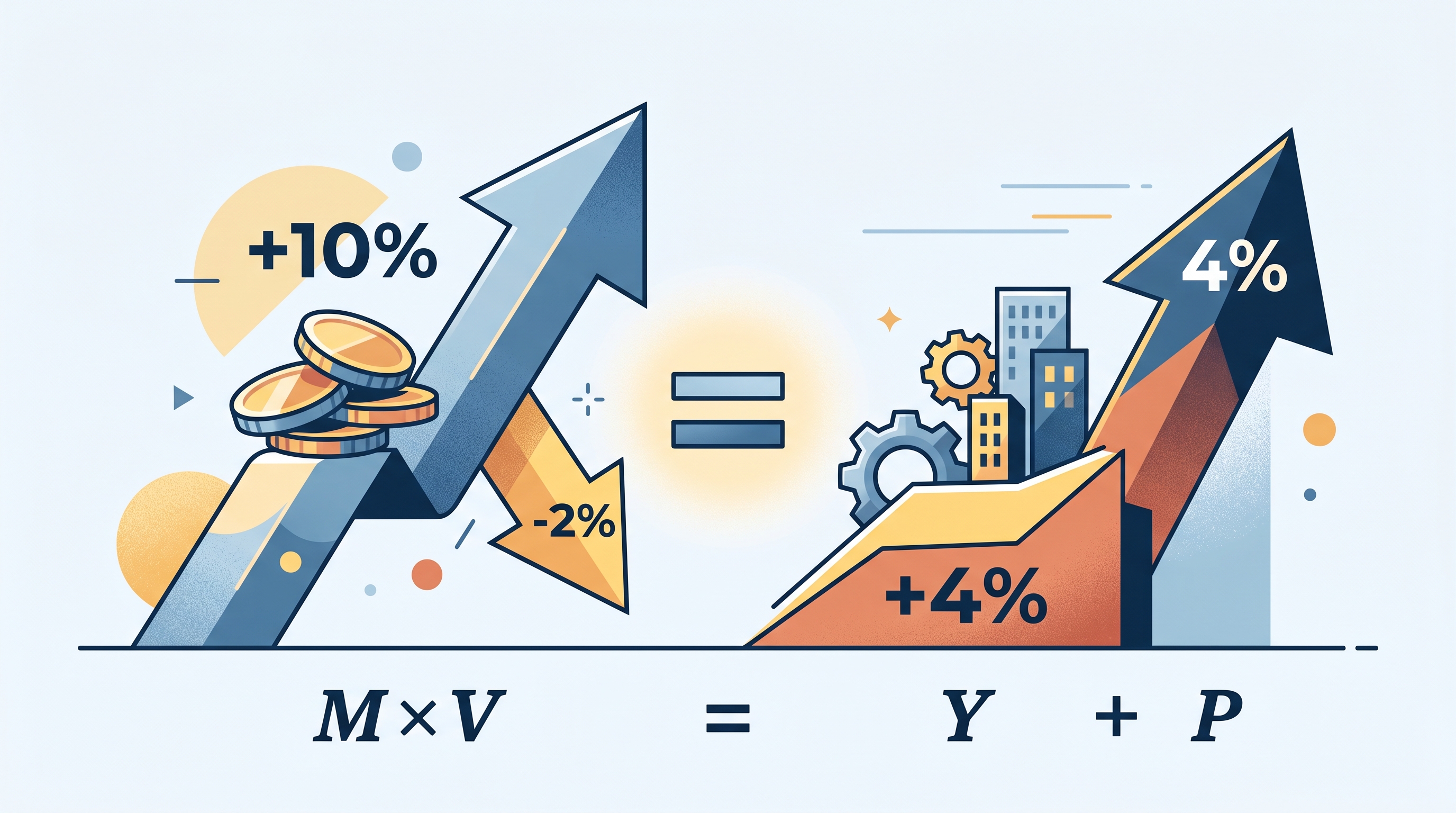
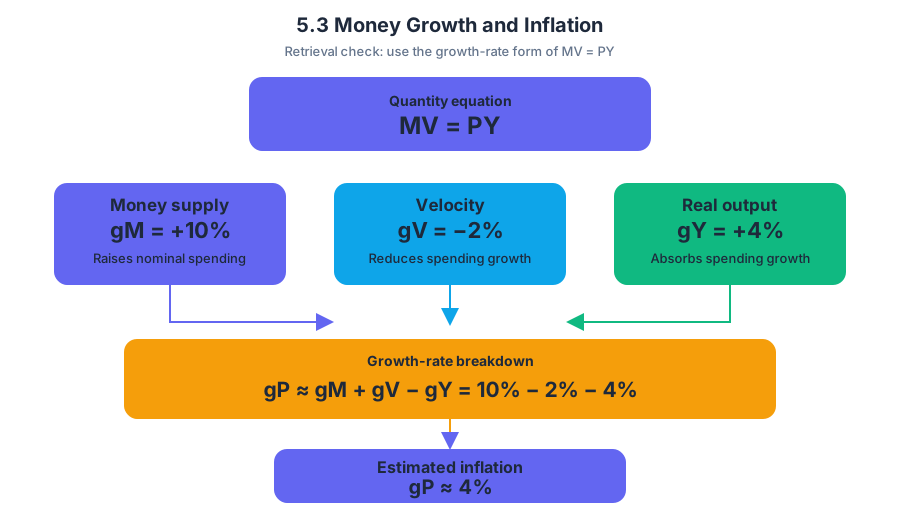
An economy’s money supply grows by $10%$, velocity falls by $2%$, and real output grows by $4%$. Using the growth-rate form of $MV=PY$, estimate the inflation rate.
The answer is
$$10%-2%-4%=4%$$
Money growth raises nominal spending, the velocity decline reduces it, and real-output growth absorbs part of the remaining spending increase. Thus the approximate price-level growth is $4%$, not $10%$.
Source Materials
- AP Macroeconomics Course and Exam Description
- AP Macroeconomics Course and Exam Description Clarifications and Corrections
- AP Macroeconomics Course Overview
- AP Macroeconomics Course at a Glance
- AP Macroeconomics Course at a Glance Poster
- AP Macroeconomics
- AP Macroeconomics
- AP Macroeconomics Sample Syllabus 1