From the free course AP Macroeconomics on Lykke
2.3 Unemployment
A person is unemployed only when they do not have a job, are available to work, and are actively looking for work. That final condition is crucial: unemployment statistics measure participation in the labor market, not simply whether someone currently receives a paycheck.
2.3 Unemployment
A person is unemployed only when they do not have a job, are available to work, and are actively looking for work. That final condition is crucial: unemployment statistics measure participation in the labor market, not simply whether someone currently receives a paycheck.
The labor-market categories
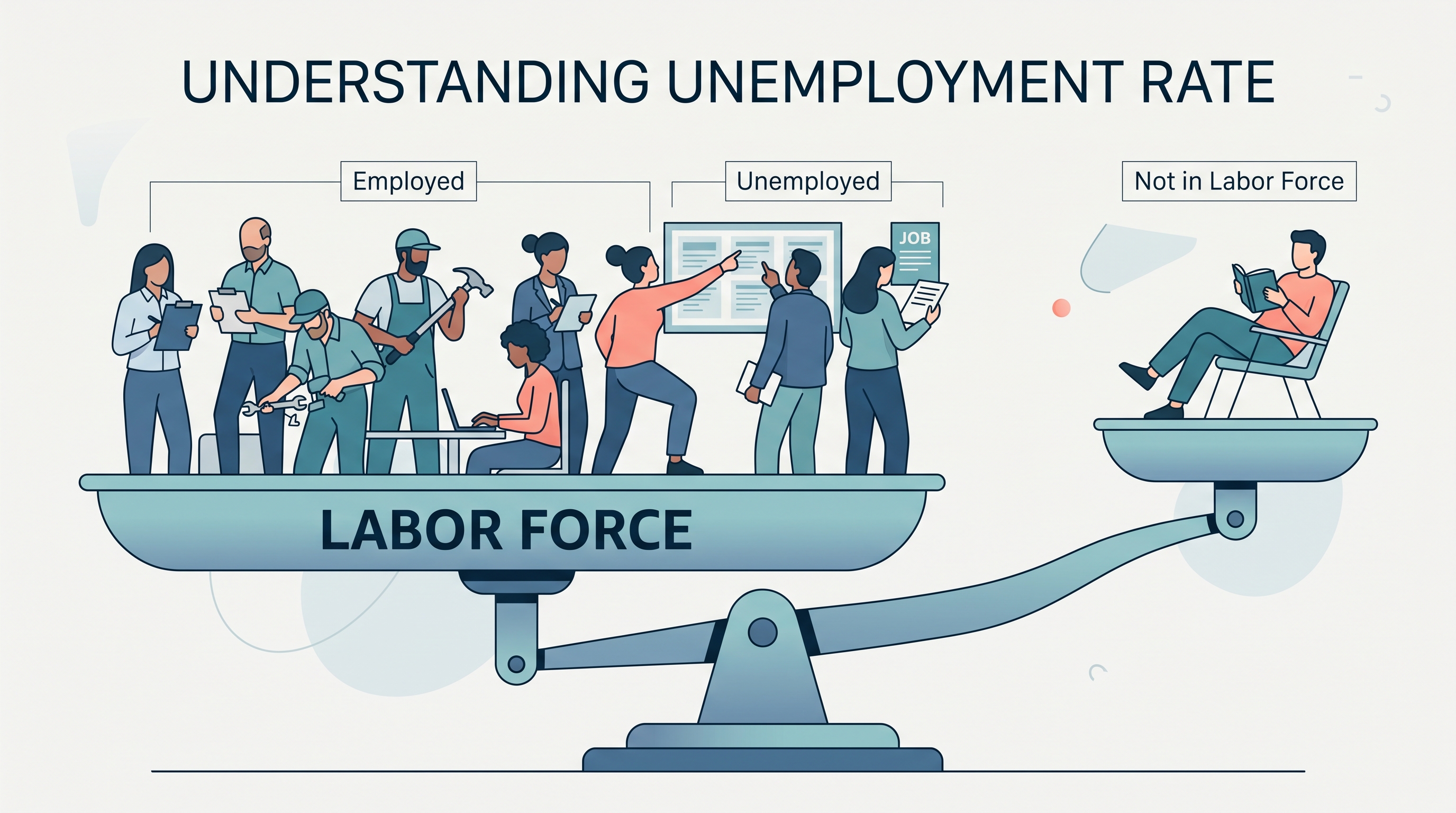
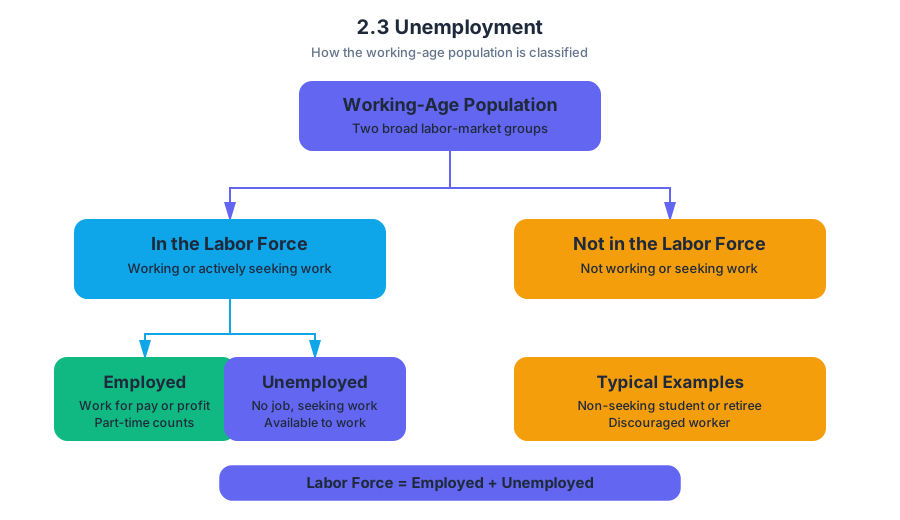
The working-age population is divided into people in the labor force and people not in the labor force. The labor force contains both employed people and unemployed people:
$$ \text{Labor Force}=\text{Employed}+\text{Unemployed} $$
A person is employed if they performed work for pay or profit during the measurement period, even if the work was part-time. A person is unemployed if they have no job but are actively seeking and available for work. A student who is not looking for a job, a retired person, and a person who has stopped searching because jobs seem unavailable are classified as not in the labor force, not unemployed.
Measuring unemployment
The unemployment rate is the percentage of the labor force that is unemployed:
$$ \text{Unemployment Rate}
\frac{\text{Number of Unemployed}}{\text{Labor Force}} \times 100 $$
The denominator is not the entire working-age population. This distinction makes the rate an indicator of conditions among people participating in the labor market.
The labor-force participation rate measures the percentage of the working-age population that is in the labor force:
$$ \text{Labor-Force Participation Rate}
\frac{\text{Labor Force}}{\text{Working-Age Population}} \times 100 $$
The two rates answer different questions: the unemployment rate asks how many labor-force participants lack jobs, while the participation rate asks how many working-age people are working or looking for work.
Worked example: calculating both rates
Suppose a town has a working-age population of $1{,}000$. Of these people, $620$ are employed, $40$ are unemployed and actively seeking work, and $340$ are not in the labor force.
First calculate the labor force:
$$ \text{Labor Force}=620+40=660 $$
Then calculate the unemployment rate:
$$ \frac{40}{660}\times 100\approx 6.1% $$
Finally calculate the labor-force participation rate:
$$ \frac{660}{1{,}000}\times 100=66% $$
Interpretation: $6.1%$ of labor-force participants are unemployed, while $66%$ of the working-age population is participating in the labor market.
Three types of unemployment
Frictional unemployment is short-term unemployment caused by workers moving between jobs or entering the labor market. A recent graduate searching for a first job is frictionally unemployed.
Structural unemployment occurs when workers’ skills, locations, or training do not match the jobs available. A factory worker whose industry adopts new technology may need retraining before finding suitable employment.
Cyclical unemployment results from downturns in the business cycle. When aggregate demand falls during a recession, firms reduce production and may lay off workers. Cyclical unemployment therefore rises during recessions and falls during expansions.
The natural rate of unemployment is the unemployment rate that exists when the economy has no cyclical unemployment. It includes frictional and structural unemployment:
$$ \text{Natural Rate}
\text{Frictional Rate} + \text{Structural Rate} $$
Actual unemployment can be expressed as:
$$ \text{Actual Unemployment}
\text{Natural Unemployment} + \text{Cyclical Unemployment} $$
Misconception check: “Everyone without a job is unemployed”
This is the most common classification error. A person who wants a job but has stopped searching is not counted as unemployed under the standard measure because they are not actively seeking work. If that person begins searching, the labor force increases and the unemployment rate may rise—even if no employed person loses a job.
Another error is assuming that a higher unemployment rate always means fewer people work. If discouraged workers begin searching, the number unemployed can increase while employment remains unchanged. Always inspect the labor force and participation rate before interpreting the percentage.
AP skills and reasoning processes
This topic is assessed through Skill Category 1: Principles and Models, especially 1.A Define economic principles and models and 1.B Explain economic outcomes using economic concepts, principles, and models; Skill Category 2: Interpretation, especially 2.A Define economic variables, 2.B Explain economic variables, and 2.C Interpret economic data; Skill Category 3: Manipulation, especially 3.B Calculate numerical outcomes; and Skill Category 4: Graphing and Visuals, especially 4.B Explain relationships within graphs and visual representations. On an exam, these skills appear as labor-force calculations, classification decisions, data interpretation, and explanations connecting cyclical unemployment to the business cycle.
Retrieval check: A population contains $800$ employed people, $100$ unemployed people actively seeking work, and $300$ people outside the labor force. What is the unemployment rate?
Answer: The labor force is $800+100=900$. Therefore,
$$ \text{Unemployment Rate}
\frac{100}{900}\times 100 \approx 11.1% $$
The $300$ people outside the labor force do not belong in the denominator.
Source Materials
- AP Macroeconomics Course and Exam Description
- AP Macroeconomics Course and Exam Description Clarifications and Corrections
- AP Macroeconomics Course Overview
- AP Macroeconomics Course at a Glance
- AP Macroeconomics Course at a Glance Poster
- AP Macroeconomics
- AP Macroeconomics
- AP Macroeconomics Sample Syllabus 1