From the free course AP Macroeconomics on Lykke
5.1 Fiscal and Monetary Policy Actions in the Short Run
Key concepts: Fiscal policy · Monetary policy · Aggregate demand · Short-run macroeconomic outcomes · Recessionary output gap · Inflationary output gap · Automatic stabilizers · Government deficits · Central banks · Interest on reserves
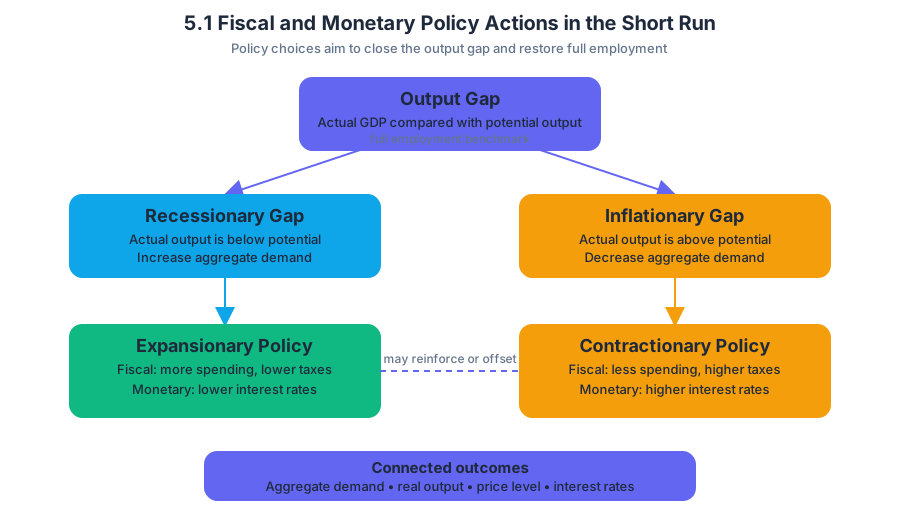
A recessionary gap means that an economy is producing below its full-employment level, while an inflationary gap means that it is producing above that level.
5.1 Fiscal and Monetary Policy Actions in the Short Run
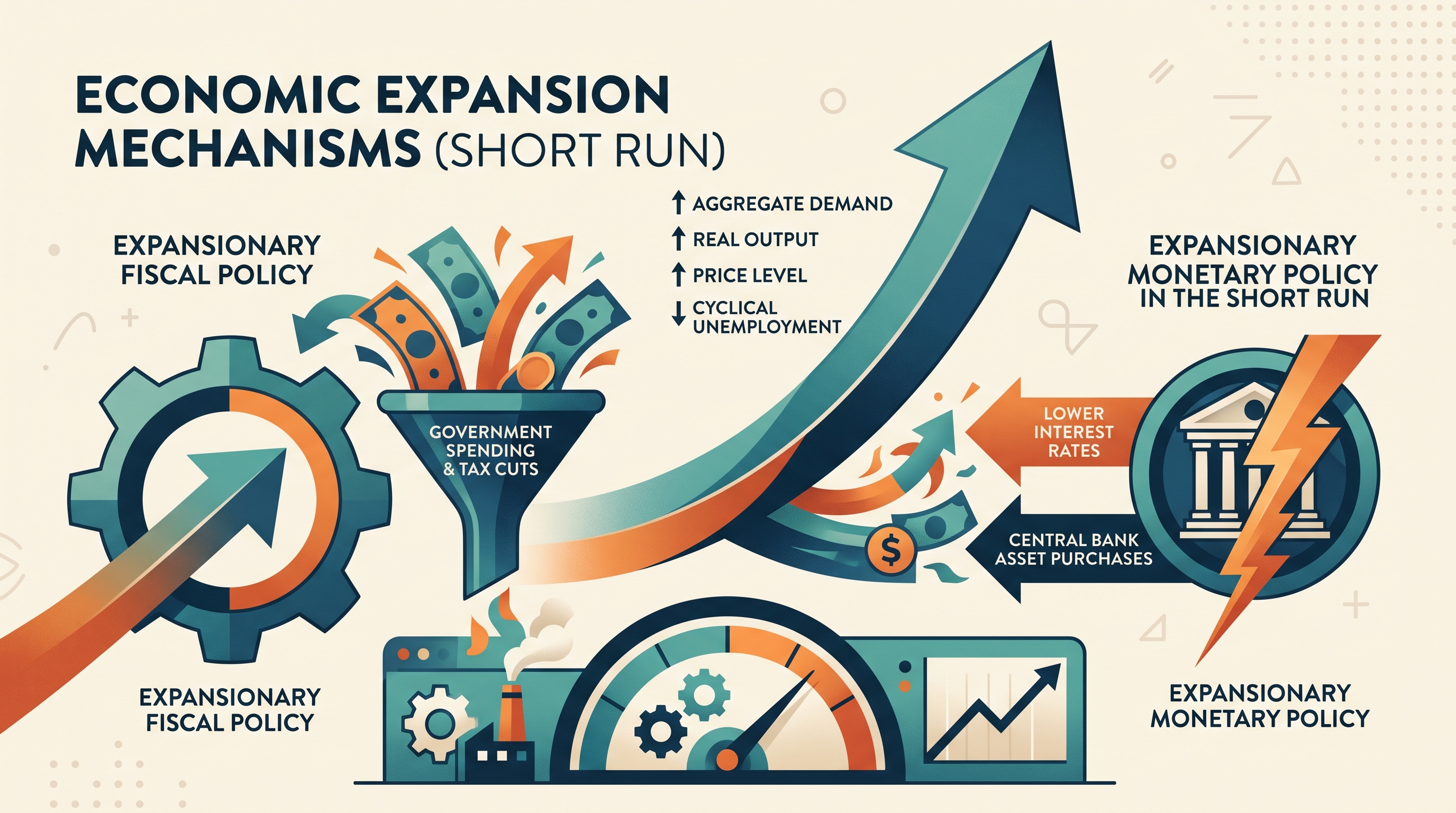
A recessionary gap means that an economy is producing below its full-employment level, while an inflationary gap means that it is producing above that level. Fiscal and monetary policy can shift aggregate demand, changing short-run real output, the price level, interest rates, and cyclical unemployment.
The policy problem: close the output gap
An output gap is the difference between actual real GDP and potential output, the level of production associated with full employment. If actual output is below potential output, the economy has a negative, or recessionary, output gap. If actual output exceeds potential output, it has a positive, or inflationary, output gap.
Under POL-1.F.1, a combination of expansionary or contractionary policies may restore full employment. Expansionary policy increases aggregate demand and is appropriate for a recessionary gap. Contractionary policy decreases aggregate demand and is appropriate for an inflationary gap.
Under POL-1.F.2, fiscal and monetary policies can influence four connected outcomes: aggregate demand, real output, the price level, and interest rates. The direction of the final result depends on the initial gap and on whether the policies reinforce or offset one another.
Fiscal policy: government spending and taxes
Fiscal policy consists of deliberate changes in government spending, taxes, and transfer payments. Increasing government purchases directly raises aggregate demand because government spending is one component of total spending:
$$Y = C + I + G + NX$$
where $Y$ is real GDP, $C$ is consumption, $I$ is investment, $G$ is government spending, and $NX$ is net exports.
For a recessionary gap, the government can use expansionary fiscal policy by increasing government spending, decreasing taxes, or increasing transfer payments. These actions raise disposable income or directly increase spending, shifting $AD$ rightward. In the short run, real GDP and the price level rise, while cyclical unemployment falls.
For an inflationary gap, the government can use contractionary fiscal policy by decreasing government spending, increasing taxes, or decreasing transfer payments. These actions reduce aggregate demand, lowering the short-run price level and real output toward their sustainable levels.
A fiscal expansion that increases spending or reduces tax revenue can create a government budget deficit. A deficit occurs when government expenditures exceed tax revenues during a period. The deficit is therefore associated with fiscal policy, but it is not itself a policy instrument that automatically determines the economy’s outcome.
Worked example: closing a recessionary gap
Suppose an economy’s potential output is $Y_F = $1{,}000$ billion, but current equilibrium output is $Y_1 = $940$ billion. The recessionary gap is:
$$\text{Output gap} = Y_F - Y_1 = $1{,}000 - $940 = $60\text{ billion}$$
The government increases infrastructure spending. That increase shifts $AD_1$ to the right. The new short-run equilibrium has higher real output and a higher price level. If the spending increase is financed by borrowing, the government budget deficit increases.
At the same time, the central bank lowers interest on reserves. Banks have less incentive to hold reserves, market interest rates tend to fall, and interest-sensitive consumption and investment increase. The resulting increase in spending shifts aggregate demand farther right, reinforcing the fiscal expansion.
Monetary policy and the ample-reserves framework
Monetary policy is the central bank’s use of its tools to pursue macroeconomic goals such as price stability and full employment. Monetary policy affects the money supply and interest rates, which influence consumption and investment and therefore aggregate demand.
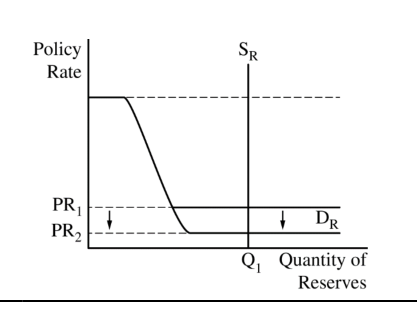
In a limited-reserves system, an expansionary open-market purchase increases bank reserves and the money supply, placing downward pressure on interest rates. In an ample-reserves framework, banks already hold substantial reserves, so changing the quantity of reserves may have little effect on the policy rate. Instead, the central bank influences interest rates through administered rates.
The Federal Reserve’s key policy tool in this framework is interest on reserves—the interest rate paid to banks on reserve balances held at the central bank. Decreasing interest on reserves is expansionary: it lowers the opportunity cost of lending, reduces interest rates, increases interest-sensitive spending, and shifts $AD$ rightward. Increasing interest on reserves is contractionary and shifts $AD$ leftward.
A complete monetary-policy explanation must show the entire transmission chain:
$$ \text{Interest on reserves}\downarrow \rightarrow \text{market interest rates}\downarrow \rightarrow I\uparrow \text{ and } C\uparrow \rightarrow AD\uparrow \rightarrow Y\uparrow,\ PL\uparrow,\ \text{cyclical unemployment}\downarrow $$
Automatic stabilizers
Automatic stabilizers are government programs that automatically reduce fluctuations in aggregate demand without requiring a new legislative decision. Progressive income taxes and unemployment benefits are standard examples: during a recession, tax payments fall and benefit payments rise, supporting household disposable income and consumption.
Automatic stabilizers tend to reduce the size of a recessionary gap and restrain an inflationary gap. They do not necessarily eliminate the gap, and they operate through changes in taxes and transfers rather than through a newly enacted discretionary policy.
Policy combinations and common errors
Fiscal and monetary policy can work together. Expansionary fiscal policy raises aggregate demand but may increase interest rates if government borrowing raises demand for loanable funds. Expansionary monetary policy can lower interest rates and partially offset that pressure, supporting investment and consumption.
Misconception check — “Any increase in government spending is always beneficial.” An increase in $G$ is expansionary, but if the economy already has an inflationary gap, it can increase the price level further. Policy must be matched to the initial economic condition.
Misconception check — “Increasing interest on reserves expands the money supply.” In an ample-reserves framework, increasing interest on reserves is contractionary: it raises the policy rate, reduces interest-sensitive spending, and shifts aggregate demand left.
Graphing rule: An AD–AS graph should include a vertical axis labeled Price Level, a horizontal axis labeled Real GDP or Real Output, correctly labeled $AD$ and $SRAS$ curves, the relevant equilibrium points, and arrows showing the direction of the policy-induced shift. A verbal claim without the causal chain or graph may not establish the economic outcome.
Retrieval check
An economy is producing below potential output. Identify one expansionary fiscal action and one expansionary monetary action, then state the short-run effects on $AD$, real output, the price level, and cyclical unemployment. A complete answer should connect each policy to spending before stating the final macroeconomic outcomes. The identifiers for this reasoning are POL-1.F.1, POL-1.F.2, and POL-12.B.
Source Materials
- AP Macroeconomics Course and Exam Description
- AP Macroeconomics Course and Exam Description Clarifications and Corrections
- AP Macroeconomics Course Overview
- AP Macroeconomics Course at a Glance
- AP Macroeconomics Course at a Glance Poster
- AP Macroeconomics
- AP Macroeconomics
- AP Macroeconomics Sample Syllabus 1
- Figure — AP Macroeconomics Course at a Glance (p. 3)
- Figure — Sample Responses Q2 - Set 1 (p. 3)
- Figure — Sample Responses Q2 - Set 1 (p. 4)
- Figure — Sample Responses Q2 - Set 1 (p. 5)