From the free course AP Macroeconomics on Lykke
6.4 Effects of Changes in Policies and Economic Conditions on the Foreign Exchange Market
Key concepts: Supply-and-demand models in different market contexts · Macroeconomic graphs as tools for analyzing economic situations · Production possibilities curve (PPC) · Economic growth and full-employment output · Labor force participation rate · Unemployment rate · Full employment · Frictional and structural unemployment · Natural rate of unemployment · Business cycle phases and turning points
A policy change can move a currency even when the foreign-exchange market itself has not changed its basic structure: investors simply alter which assets they want to hold, and buyers or sellers of the currency respond.
6.4 Effects of Changes in Policies and Economic Conditions on the Foreign Exchange Market
A policy change can move a currency even when the foreign-exchange market itself has not changed its basic structure: investors simply alter which assets they want to hold, and buyers or sellers of the currency respond. Using the market model from 6.3 as a working reference, the key task is to identify whether an event changes the demand for the currency or the supply of the currency, then trace the resulting exchange-rate movement.
Policy changes and currency demand or supply
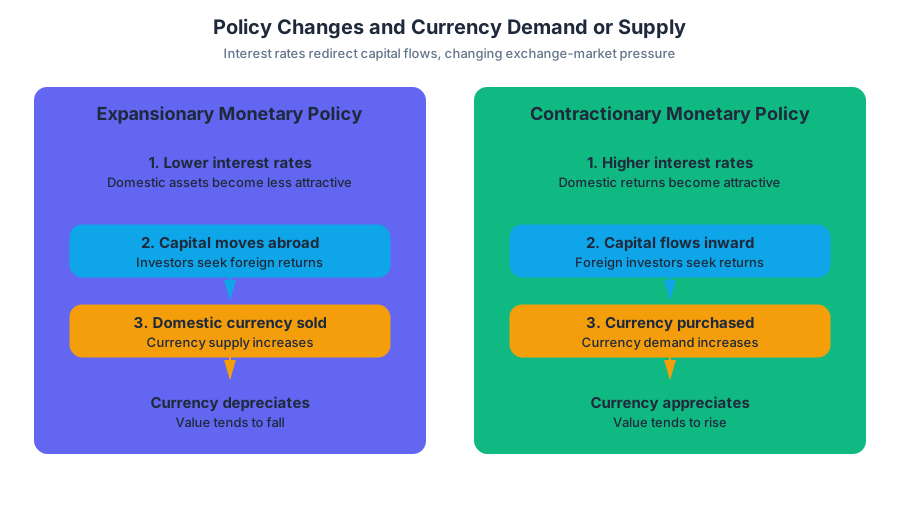
Suppose a central bank adopts expansionary monetary policy by lowering interest rates. Domestic financial assets become less attractive relative to foreign assets, so investors move funds abroad. To purchase foreign assets, they sell the domestic currency; this increases the currency’s supply in the foreign-exchange market and tends to depreciate its value.
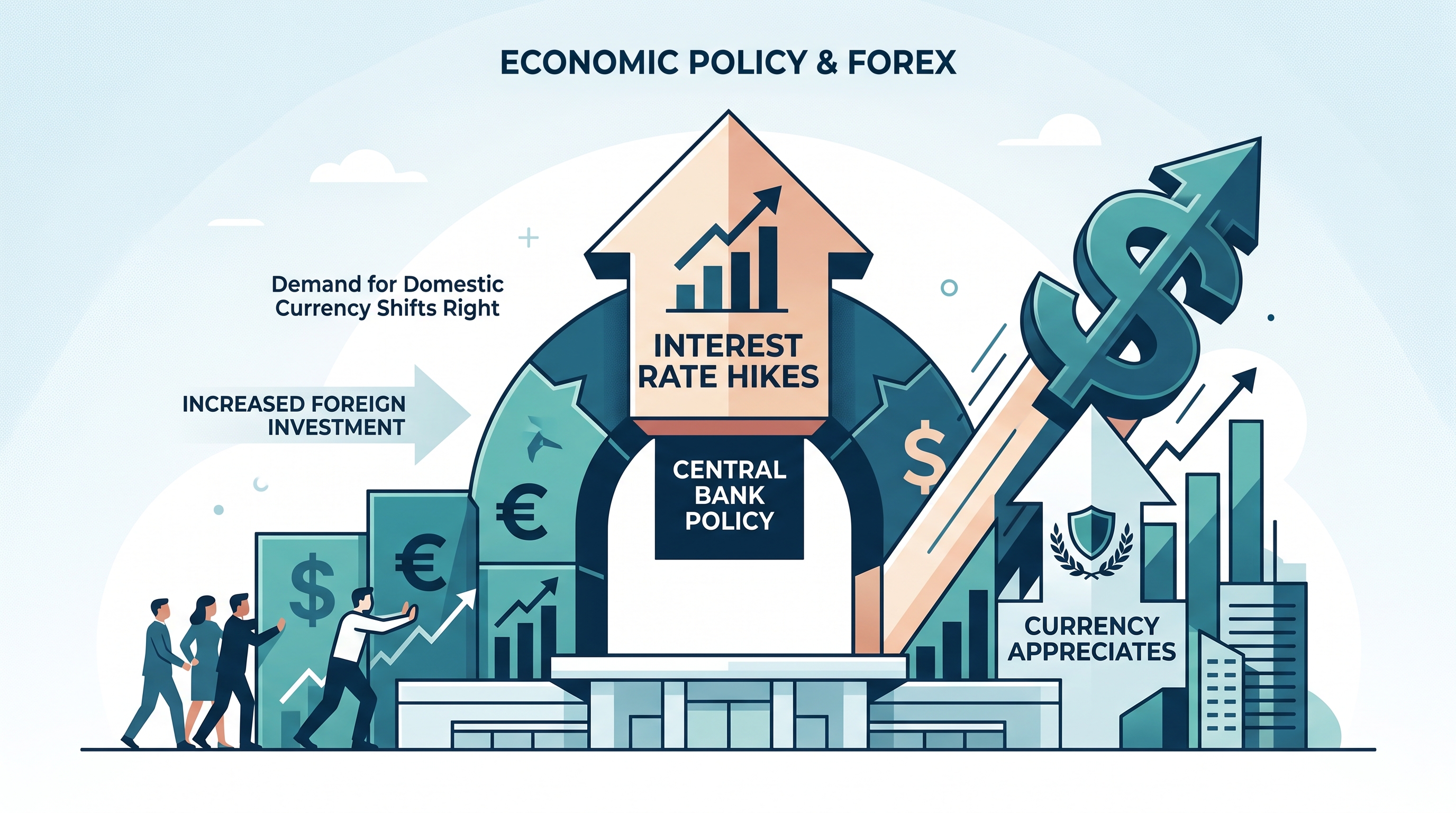
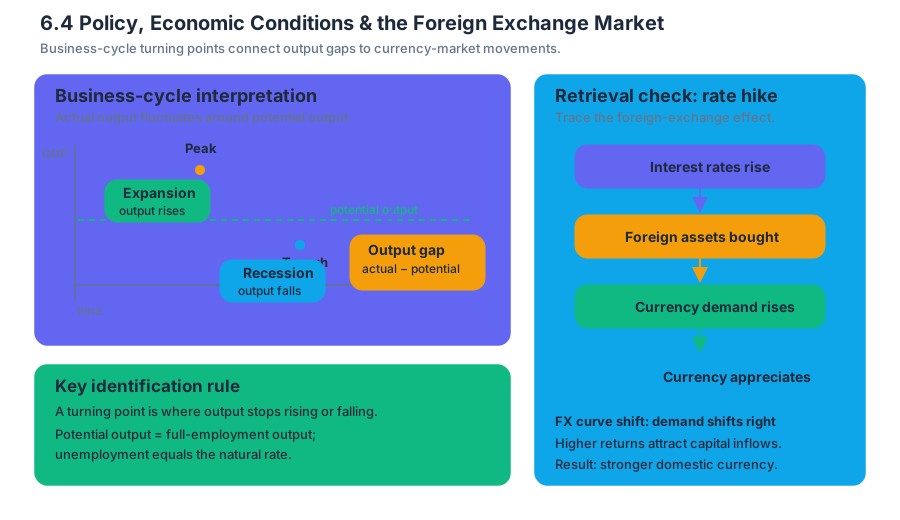
The reverse occurs with contractionary monetary policy. Higher domestic interest rates can attract foreign financial capital because investors seek the country’s now-higher returns. Foreign investors must buy the domestic currency to purchase domestic assets, increasing demand for that currency and tending to cause appreciation.
A complete causal chain is more valuable than a one-word answer:
$$ \text{contractionary monetary policy} \rightarrow \text{higher interest rates} \rightarrow \text{greater capital inflows} \rightarrow \text{higher demand for domestic currency} \rightarrow \text{currency appreciation} $$
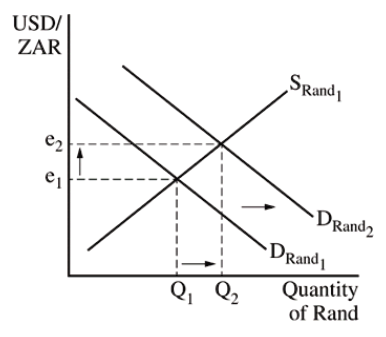
For example, if Zeetoland’s central bank raises an administered interest rate to fight inflation in an ample-reserves system, investors may purchase more Zeetoland assets. On a graph of the foreign-exchange market for the zeet, the demand curve for zeets shifts right. The equilibrium exchange rate rises, meaning the zeet appreciates.
Other economic conditions
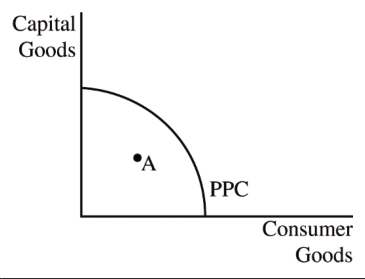
Economic growth can also affect currency markets. Growth expands productive capacity, represented by an outward shift of the production possibilities curve (PPC). If growth makes domestic firms and assets more attractive, foreign investors may demand more of the domestic currency. A stronger currency can then influence international transactions, although the exact effect on exports and imports is analyzed separately through net exports.
Macroeconomic graphs are not illustrations added after the reasoning; they are models that show the mechanism. A correctly drawn foreign-exchange graph must show the currency on the horizontal axis, the exchange rate on the vertical axis, the original and new curve when a shift occurs, and arrows indicating the direction of the shift. The written explanation must connect the shift to its cause.
Graphing rule: Do not shift a curve merely because the exchange rate changes. Shift the curve because an underlying determinant—such as interest rates, capital flows, or economic conditions—changes.
Full employment, output, and labor-market statistics
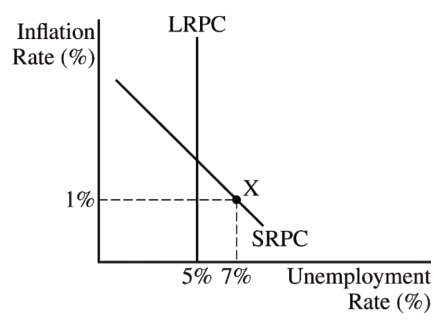
Full-employment real output is the amount of real output produced when the economy is at full employment. “Full employment” does not mean that every adult has a job; it means unemployment equals the natural rate of unemployment, which consists of frictional and structural unemployment:
$$u_N = u_F + u_S$$
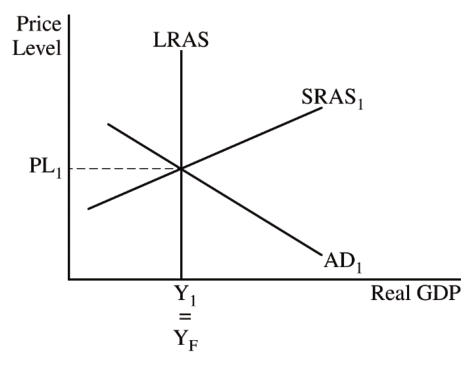
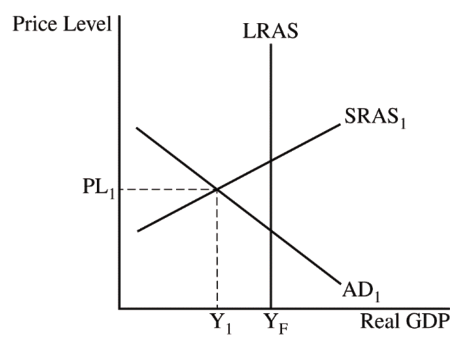
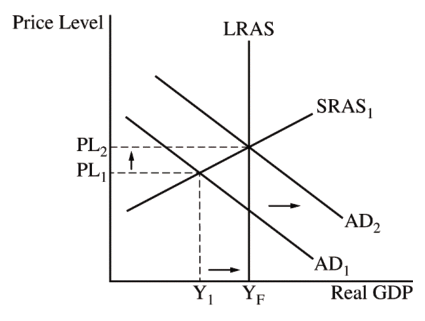
The natural rate excludes cyclical unemployment. When actual unemployment is above the natural rate, the economy generally has an employment shortfall and produces below full-employment output. When actual unemployment is below the natural rate, the economy may be producing beyond its sustainable full-employment level, creating an inflationary gap.
The labor-force statistics require careful classification. The labor force includes employed people and unemployed people who are actively seeking work. A full-time worker and a part-time worker are both employed; neither is counted as unemployed merely because the person works fewer than standard full-time hours.
$$\text{Labor force participation rate} = \frac{\text{Labor force}}{\text{Adult population}} \times 100$$
$$\text{Unemployment rate} = \frac{\text{Unemployed people}}{\text{Labor force}} \times 100$$
Worked example. An economy has an adult population of $1{,}000$, with $620$ employed full-time, $80$ employed part-time, $50$ unemployed and actively seeking work, and $250$ outside the labor force.
$$\text{Labor force}=620+80+50=750$$
$$\text{Participation rate}=\frac{750}{1{,}000}\times100=75%$$
$$\text{Unemployment rate}=\frac{50}{750}\times100\approx6.7%$$
The $250$ people outside the labor force do not enter the unemployment-rate denominator. Someone who has stopped searching for work is not classified as unemployed in the household survey, even though that person may still face economic hardship.
Misconception check: The unemployment rate is not unemployed people divided by the adult population. Its denominator is the labor force.
Business-cycle interpretation
Business cycles are fluctuations in aggregate output and employment caused by changes in aggregate demand and/or aggregate supply (MEA-2.A.1). The two phases are expansion and recession (MEA-2.A.2); the turning points are the peak and trough (MEA-2.A.3).
The difference between actual output and potential output is the output gap (MEA-2.A.4). Potential output is another name for full-employment output: the GDP level at which unemployment equals the natural rate (MEA-2.A.5). Identifying a turning point means locating where output stops rising or falling, not simply noticing that the level of output is high or low.
Retrieval check: A central bank raises interest rates, and foreign investors purchase more domestic assets. Which curve shifts in the foreign-exchange market, and what happens to the currency? Then classify a part-time worker, an active job seeker, and a discouraged nonsearcher for the labor statistics. The answer should be: demand for the domestic currency shifts right and the currency appreciates; the part-time worker is employed, the active job seeker is unemployed, and the discouraged nonsearcher is outside the labor force.
Source Materials
- AP Macroeconomics Course and Exam Description
- AP Macroeconomics Course and Exam Description Clarifications and Corrections
- AP Macroeconomics Course Overview
- AP Macroeconomics Course at a Glance
- AP Macroeconomics Course at a Glance Poster
- AP Macroeconomics
- AP Macroeconomics
- AP Macroeconomics Sample Syllabus 1
- Total for part (a) 2 points
- Total for part (c) 2 points
- (d) (i) State that the labor force participation rate will decrease and explain that the labor force
- Total for part (a) 2 points