From the free course AP Macroeconomics on Lykke
AP Practice 6
A rise in a country’s real interest rate can attract foreign investment, increase demand for its currency, and change its net exports. That chain links international capital flows, the foreign exchange market, and the balance of payments—exactly the kind of connected reasoning tested by a short free-response question.
Task type: Short Free-Response Question
This original, unofficial practice task is designed as a short free-response question. On the current hybrid AP Macroeconomics Exam, students view the question in Bluebook and handwrite the response in a paper booklet. A practical target is about $15$ minutes: roughly $2$ minutes to identify the model, $8$ minutes to write and graph, and $5$ minutes to check causal direction and labels.
Exam habit: Every explanation should have a chain: economic change $\rightarrow$ market response $\rightarrow$ macroeconomic consequence.
Original practice prompt
The economy of Norland is initially at equilibrium. The domestic real interest rate rises relative to real interest rates in other countries.
(a) Identify the effect of the higher domestic real interest rate on the demand for Norland’s currency in the foreign exchange market. Explain.
(b) On a correctly labeled graph of the foreign exchange market for Norland’s currency, show the effect of the change in part (a). Label the initial equilibrium exchange rate $E_1$ and the new equilibrium exchange rate $E_2$.
(c) Indicate whether Norland’s currency appreciates or depreciates. Explain how the change affects Norland’s exports and imports.
(d) Indicate the effect on Norland’s net exports. Explain.
(e) Suppose the exchange rate changes from $1.20$ Norlandian currency units per euro to $1.32$ Norlandian currency units per euro. Calculate the percentage change in the value of the euro measured in Norlandian currency units.
Worked reasoning
(a) Currency demand
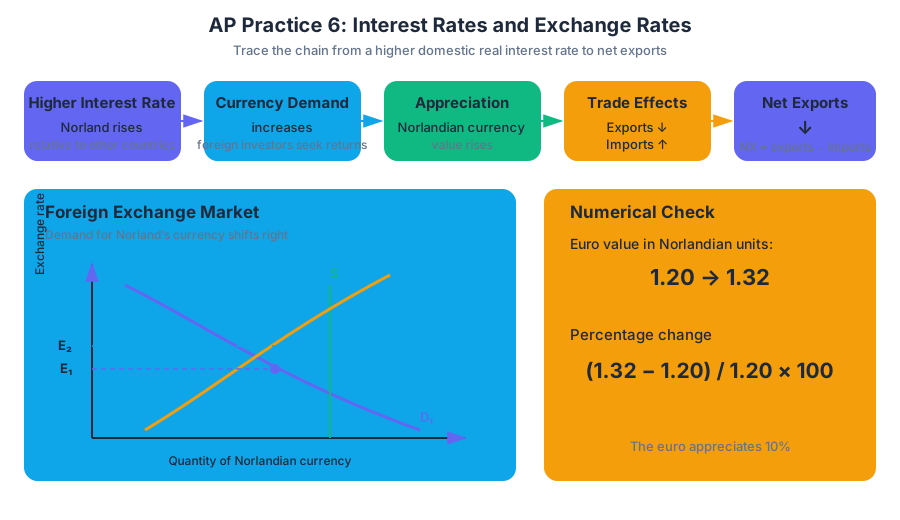
The demand for Norland’s currency increases. Foreign investors want to purchase Norlandian financial assets because those assets now offer a relatively higher real return. To buy those assets, investors must first acquire Norland’s currency.
This response earns the reasoning point because it identifies both the market change and its cause:
$$ \text{higher domestic real interest rate} \rightarrow \text{more foreign capital inflows} \rightarrow \text{greater demand for Norland’s currency} $$
(b) Foreign exchange graph
Draw the market for Norland’s currency with:
- vertical axis: exchange rate, measured as euros per Norlandian currency unit;
- horizontal axis: quantity of Norland’s currency;
- downward-sloping demand curve for Norland’s currency;
- upward-sloping supply curve for Norland’s currency;
- the demand curve shifting right from $D_1$ to $D_2$.
The equilibrium exchange rate rises from $E_1$ to $E_2$.
A graph must show the direction of the shift, not merely the final result. A rightward shift of demand creates excess demand at the original exchange rate, pushing the currency’s value upward until the new equilibrium is reached.
Graph-reading checkpoint
If the vertical axis instead measures Norlandian currency units per euro, the numerical direction of the exchange-rate movement would look different. Always read the axis before deciding whether the currency appreciates. Appreciation means the currency buys more foreign currency; it does not depend on which currency appears in the numerator of the quotation.
(c) Appreciation, exports, and imports
Norland’s currency appreciates because its value rises in the foreign exchange market. Norlandian goods become more expensive to foreign buyers, so Norland’s exports decrease. Foreign goods become less expensive to Norlandian buyers, so Norland’s imports increase.
$$ \text{currency appreciation} \rightarrow X \downarrow,\ M \uparrow $$
(d) Net exports
Norland’s net exports decrease because:
$$NX = X - M$$
Exports fall while imports rise, so:
$$NX \downarrow$$
The decrease in net exports also reduces aggregate demand because net exports are one component of planned expenditure:
$$AD = C + I + G + NX$$
(e) Percentage calculation
The value of the euro in Norlandian currency units increases from $1.20$ to $1.32$. Calculate the percentage change using:
$$\text{Percentage change}=\frac{\text{new value}-\text{old value}}{\text{old value}}\times 100$$
Substitute:
$$\frac{1.32-1.20}{1.20}\times 100 =\frac{0.12}{1.20}\times 100 =10%$$
The euro appreciates by $10%$ relative to the Norlandian currency. Equivalently, the Norlandian currency depreciates relative to the euro. The quotation is crucial: more Norlandian currency units are now needed to purchase one euro.
What the examiner rewards
| Response feature | Skill connection | What earns credit |
|---|---|---|
| Defines the capital-flow mechanism | Skill 1. Principles and Models | Uses the relationship between real interest rates and international investment |
| Explains the currency-demand shift | Skill 2. Interpretation | Connects higher returns to increased foreign demand for the currency |
| Calculates the percentage change | Skill 3. Manipulation | Shows the correct formula, substitution, and result |
| Draws and labels the graph | Skill 4. Graphing and Visuals | Labels axes, curves, shift direction, and both equilibria |
Named misconception check
Misconception: “A higher interest rate causes the currency supply to increase.” The immediate foreign-exchange effect emphasized here is an increase in demand for the domestic currency because foreigners are purchasing domestic assets. A student may discuss currency supplied by domestic investors purchasing foreign assets only if the situation specifically establishes increased purchases of foreign assets.
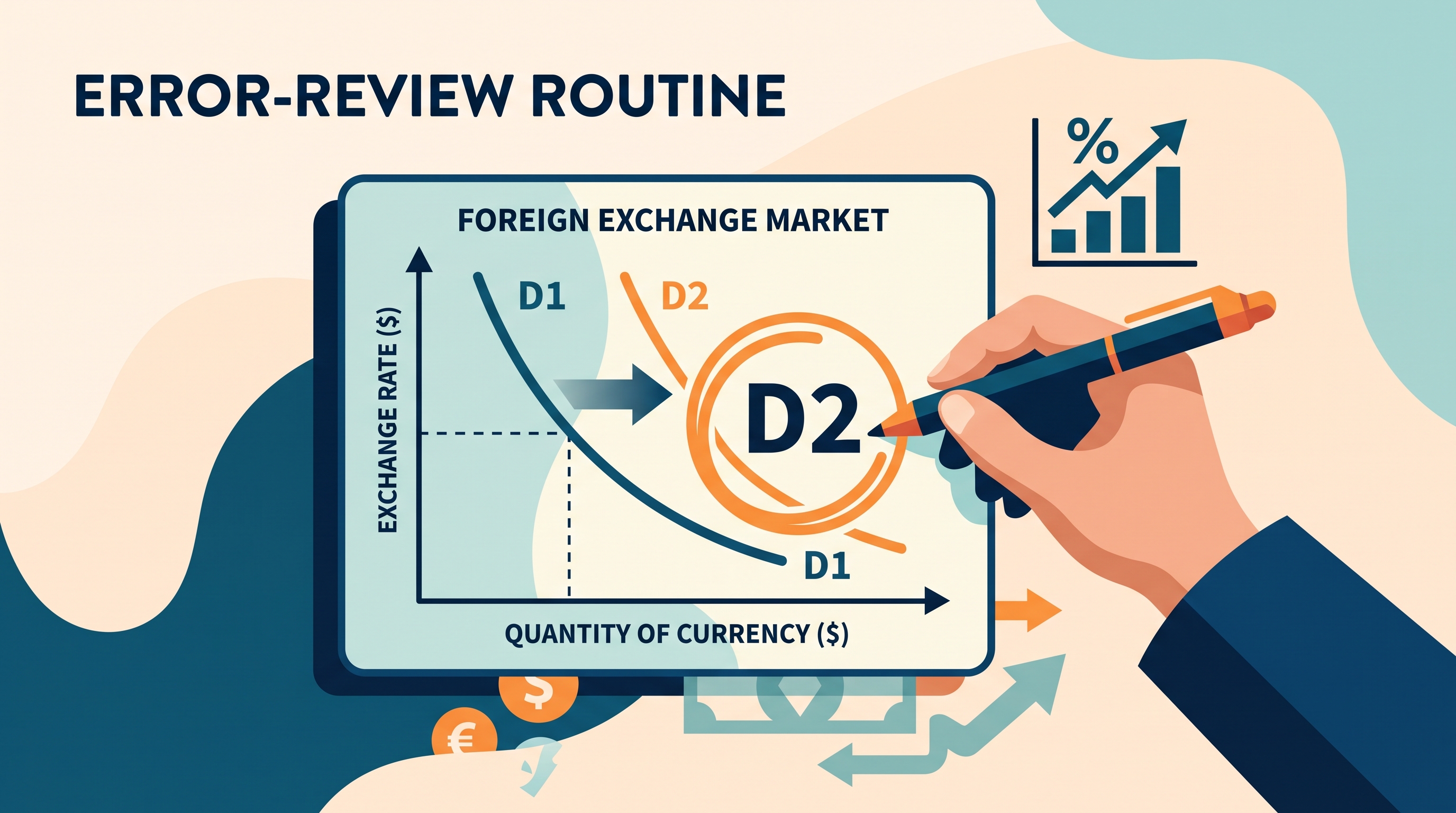
Error-review routine: After checking the answer, circle the first incorrect link in your chain. Was it the interest-rate effect, the currency-demand shift, the appreciation, the export-import relationship, or the calculation? Rewrite only that link in a complete sentence, then redraw the graph from memory.
Source Materials
- AP Macroeconomics Course and Exam Description
- AP Macroeconomics Course and Exam Description Clarifications and Corrections
- AP Macroeconomics Course Overview
- AP Macroeconomics Course at a Glance
- AP Macroeconomics Course at a Glance Poster
- AP Macroeconomics
- AP Macroeconomics
- AP Macroeconomics Sample Syllabus 1
- AP Macroeconomics-AP Students-College Board
- AP Macroeconomics FRQ Practice
- AP/College Macroeconomics-Khan Academy
- AP Macroeconomics Units/Save my Exams