From the free course AP Macroeconomics on Lykke
4.1 Financial Assets
Key concepts: Financial assets · Liquidity · Money · Cash · Demand deposits
A financial asset is valuable partly because of how quickly it can be used, sold, or exchanged without losing much value. That property is liquidity—and among the financial assets people hold, cash and demand deposits are the most liquid forms of money.
4.1 Financial Assets
A financial asset is valuable partly because of how quickly it can be used, sold, or exchanged without losing much value. That property is liquidity—and among the financial assets people hold, cash and demand deposits are the most liquid forms of money.
The three attributes of a financial asset
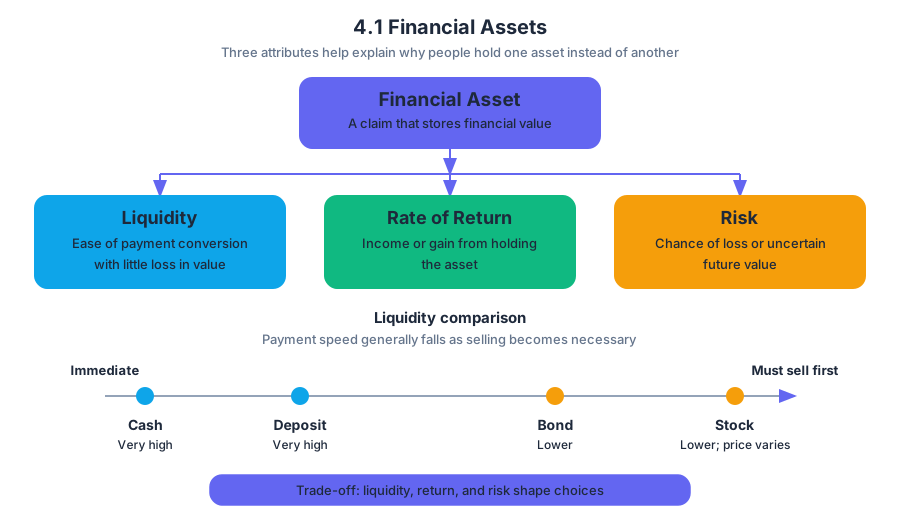
The CED identifies three principal attributes associated with financial assets, including money: liquidity, rate of return, and risk. These attributes help explain why people may choose to hold one asset instead of another.
Liquidity is the ease with which an asset can be converted into a means of payment, with little or no loss in value.
A dollar bill is immediately usable at a store. A house may be valuable, but converting it into spending power usually requires finding a buyer, negotiating a price, and completing a transaction. The house is therefore much less liquid than cash.
| Financial asset or form of money | How quickly it can be used for payment | Relative liquidity |
|---|---|---|
| Cash | Immediately | Very high |
| Demand deposit | Immediately through payment, withdrawal, or transfer | Very high |
| Bond | Usually must be sold first | Lower |
| Stock | Usually must be sold first; market price can change | Lower |
The trade-off is that highly liquid assets may not provide the same rate of return as assets designed for investment. Bonds are interest-bearing assets, while stocks are equity, meaning they represent ownership claims. People can hold bonds or stocks in place of the most liquid forms of money, but they generally must sell those assets before using the proceeds for ordinary purchases. This extra step makes them less liquid.
Money, cash, and demand deposits
Money is an asset accepted as payment for goods and services. In Topic 4.1, the important comparison is not simply whether an asset has value; it is whether the asset can function readily as a means of payment.
Cash—currency held by the public—is one of the most liquid forms of money. If a customer hands a seller a valid bill, the payment is complete immediately; no conversion, sale, or waiting period is required.
Demand deposits are funds held in checking accounts that can be accessed whenever the account holder demands them. A debit-card purchase, check, or electronic transfer allows the deposit to serve as money even though it is recorded in a bank account rather than held as physical currency.
The most liquid forms of money are cash and demand deposits (MEA-3.A.1).
A useful mental picture is a payment “ladder”:
$$ \text{Cash} ;\longleftrightarrow; \text{Demand deposits} ;\longrightarrow; \text{Immediate payment} $$
$$ \text{Bonds or stocks} ;\longrightarrow; \text{Sell the asset} ;\longrightarrow; \text{Receive funds} ;\longrightarrow; \text{Make payment} $$
The first path requires no asset sale. The second path does, so its usefulness for immediate purchases is lower.
Worked contextual example
Imagine that Maya receives $1,000 and must decide where to hold it for one month. She keeps $200 as cash, places $500 in a checking account, buys a bond with $200, and buys stock with $100.
If Maya needs to pay a $75 bill today, she can use either the cash or the demand deposit. Both are highly liquid. If she instead needs to use the bond or stock, she must sell the asset first, and the amount received may differ from the amount originally invested because market prices can change.
This example shows why liquidity is an attribute rather than a synonym for value. The stock may rise substantially in value, but that does not make it as immediately usable for payment as cash or a demand deposit.
Misconception check: “Anything valuable is money”
Misconception: A bond or stock is money because it can eventually be exchanged for money.
Correction: An asset’s ability to be sold is not the same as its ability to function directly as a means of payment. Cash and demand deposits are the most liquid forms of money; bonds and stocks are financial assets that people may hold instead (MEA-3.A.2).
AP reasoning in this topic
This topic develops MEA-3.A, especially MEA-3.A.a, which asks students to define the principal attributes—liquidity, rate of return, and risk—associated with various classes of financial assets, including money.
The relevant AP skill is Skill Category 1: Principles and Models, because students must apply the principle of liquidity to classify assets and predict which holdings are most convenient for immediate transactions. It also uses Skill Category 2: Interpretation when a prompt presents a list of assets, account types, or a financial decision and asks students to identify the most liquid option.
Retrieval check
A person owns $400 in currency, $600 in a checking account, $1,000 in a corporate bond, and $500 in stock. Which holdings are the most liquid forms of money, and why?
Answer: The $400 in currency and the $600 demand deposit are the most liquid forms of money because they can be used immediately for payment. The bond and stock must generally be sold before their value can be used for purchases.

Source Materials
- AP Macroeconomics Course and Exam Description
- AP Macroeconomics Course and Exam Description Clarifications and Corrections
- AP Macroeconomics Course Overview
- AP Macroeconomics Course at a Glance
- AP Macroeconomics Course at a Glance Poster
- AP Macroeconomics
- AP Macroeconomics
- AP Macroeconomics Sample Syllabus 1
- AP Macroeconomics-AP Students-College Board
- AP Macroeconomics FRQ Practice
- AP/College Macroeconomics-Khan Academy
- AP Macroeconomics Units/Save my Exams