From the free course AP Macroeconomics on Lykke
2.2 Limitations of GDP
Key concepts: quantitative analysis in economics · interpretation and application of quantitative analysis · economic indicators · explaining indicators
GDP can rise while many people’s lives fail to improve, because production is not the same thing as well-being. Using the GDP measure of market production established in 2.1, the key question is: What does this indicator measure accurately, and what does it leave out?
2.2 Limitations of GDP
GDP can rise while many people’s lives fail to improve, because production is not the same thing as well-being. Using the GDP measure of market production established in 2.1, the key question is: What does this indicator measure accurately, and what does it leave out?
Learning Objective MEA-1.B: Explain the limitations of using GDP as a measure of economic well-being.
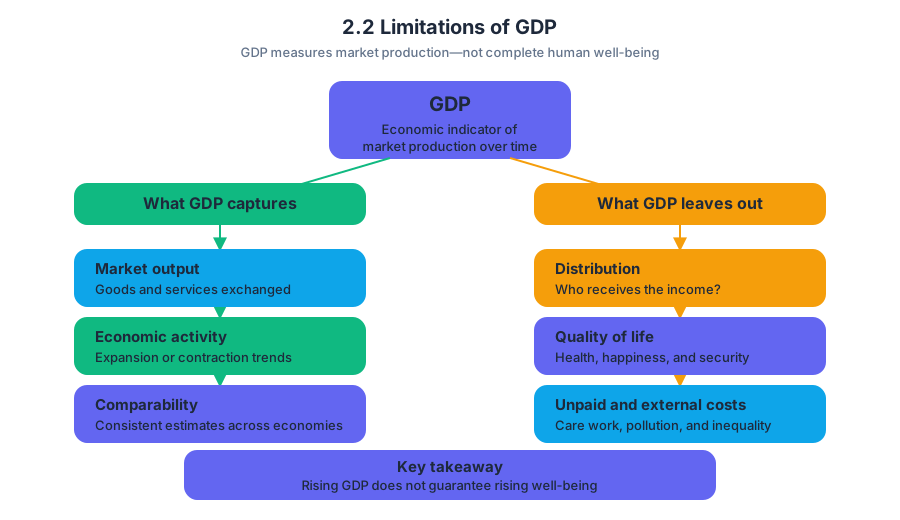
GDP is valuable because it provides a consistent estimate of market production over a period of time. It helps economists compare economies, identify changes in economic activity, and evaluate whether output is expanding or contracting. But GDP is an economic indicator, meaning a numerical measure used to describe an aspect of economic performance—not a complete scorecard for human welfare.
What GDP captures—and what it misses
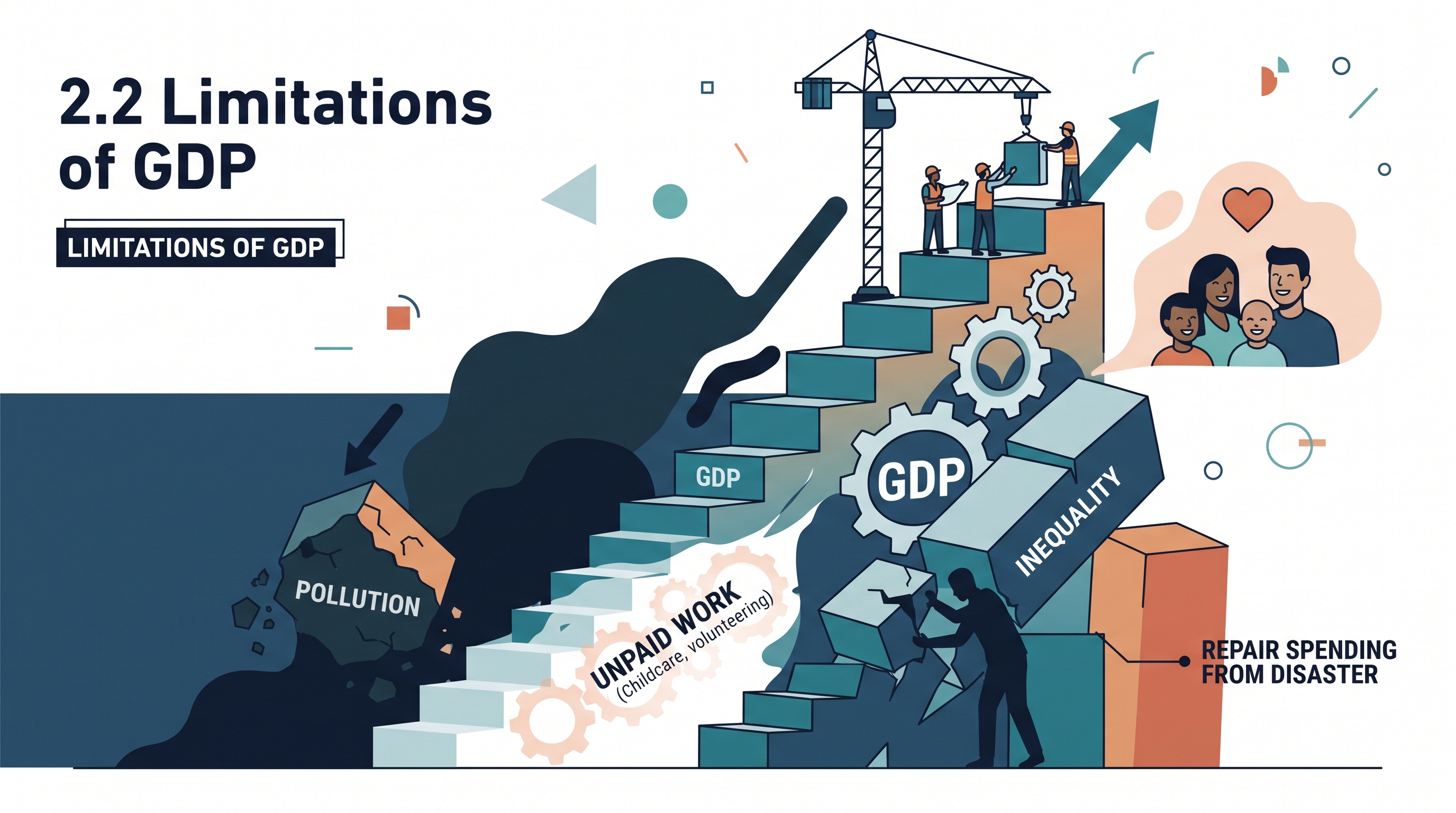
The most important distinction is between production and well-being. GDP counts the market value of final goods and services, but the same amount of production can produce very different outcomes for health, safety, equality, leisure, and environmental quality.
| GDP may record… | But GDP does not fully reveal… |
|---|---|
| More medical services purchased | Whether people are healthier |
| More spending after storm damage | The loss of homes, safety, or natural resources |
| More factory output | Pollution and damage caused by production |
| Paid childcare services | The value of unpaid care provided at home |
| Higher total output | How income and output are distributed |
| More hours worked | Whether people have less leisure or quality of life |
Several limitations follow from this distinction:
- Nonmarket activity: Unpaid household work, volunteer work, and care provided within families may create real value without involving a market transaction.
- Income distribution: GDP is a total. It does not show whether additional income is broadly shared or concentrated among a small group.
- Environmental quality: Production that creates pollution may increase GDP even when it reduces health or damages ecosystems.
- Quality of life: GDP does not directly measure leisure, personal safety, political freedom, social connection, or access to clean surroundings.
- Quality and composition of output: Two economies with equal GDP may produce different combinations of goods and services, with different consequences for residents.
- Underground or unreported activity: Economic transactions that are hidden from official measurement may not be fully included.
These limitations do not make GDP useless. They establish a boundary around the claim an economist may make. A rising GDP supports the statement that measured market production increased; it does not, by itself, prove that every household became better off.
Worked interpretation: the same GDP, different lives
Suppose Country A and Country B each report GDP of $500$ billion. Country A has clean air, widely distributed income, extensive unpaid family care, and shorter workweeks. Country B has severe pollution, unequal income, and long workweeks, while many essential household services are performed without pay. GDP alone cannot determine which country has greater economic well-being.
A careful explanation proceeds in three steps:
- Identify what the indicator measures: both countries report the same measured market production.
- State the valid comparison: their GDP totals are equal, so GDP does not distinguish their market output.
- Identify omitted dimensions: distribution, environmental quality, unpaid activity, and leisure may differ substantially.
This is quantitative analysis in economics: not merely calculating or reading a number, but interpreting what the number means and applying it to a specific context. A response that says “GDP is $500$ billion” performs measurement; a response that explains what that figure can and cannot establish performs economic reasoning.
A useful mental model
Imagine GDP as a dashboard gauge labeled market production. The gauge is useful, but it has no sensors for every variable that matters to human welfare. A responsible analyst reads the gauge precisely, then asks which important conditions remain outside its measurement.
Common misconception: “Higher GDP always means higher well-being”
Correction: Higher GDP can indicate greater capacity to purchase goods and services, but it is not conclusive evidence of higher overall well-being. The direction of GDP and the direction of welfare may differ when pollution increases, income becomes more unequal, unpaid work replaces paid work, or destructive events generate repair spending.
Skill connections: Topic 2.2 most directly develops Skill Category 2: Interpretation, especially 2.A: Define economic indicators, 2.B: Explain economic indicators, and 2.C: Interpret quantitative data. It also uses Skill Category 1: Principles and Models—1.A: Define economic principles and models and 1.B: Explain economic principles and models—when distinguishing an indicator’s measured variable from the broader concept of well-being. In an exam response, the strongest reasoning identifies the indicator, states its measurable meaning, applies the limitation to the context, and avoids claiming more than the data support.
Retrieval check: If GDP increases after a major hurricane because construction and repair spending rise, can an economist conclude that residents’ well-being increased? Answer: No. Measured production may have increased, but GDP does not subtract the destruction, lost safety, disrupted lives, or environmental damage caused by the hurricane.
Source Materials
- AP Macroeconomics Course and Exam Description
- AP Macroeconomics Course and Exam Description Clarifications and Corrections
- AP Macroeconomics Course Overview
- AP Macroeconomics Course at a Glance
- AP Macroeconomics Course at a Glance Poster
- AP Macroeconomics
- AP Macroeconomics
- AP Macroeconomics Sample Syllabus 1