From the free course AP Macroeconomics on Lykke
AP Practice 1
Key concepts: AP Macroeconomics course framework · Economic indicators · Business cycle · Economic models · Evidence-based economic analysis · Independent thinking and drawing conclusions · Assessing source credibility · Respectful debate of ideas · College-level coursework readiness · Basic mathematics and graphing skills
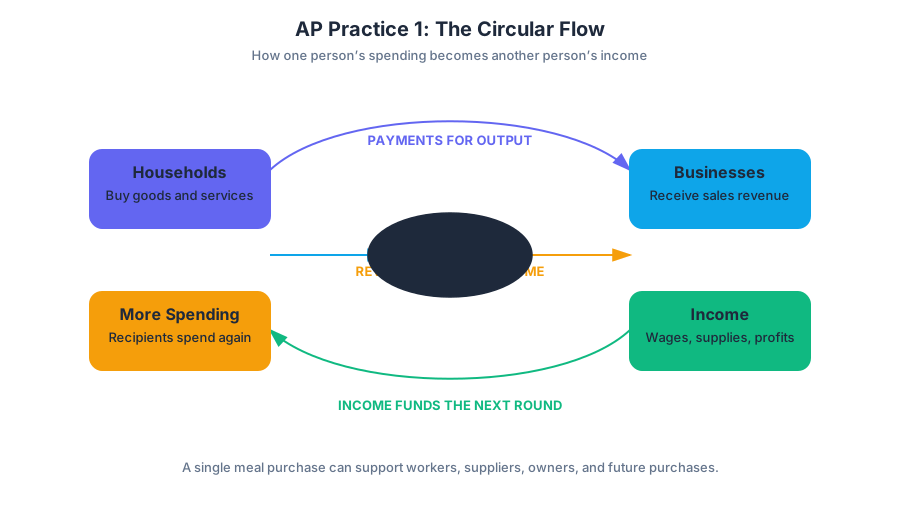
AP Macroeconomics asks a deceptively simple question: how can one person’s spending become another person’s income? The answer begins with an economy-wide model. When a household buys a meal, the restaurant receives revenue; the restaurant then pays workers, suppliers, and owners; those recipients spend part of…
AP Practice 1
AP Macroeconomics asks a deceptively simple question: how can one person’s spending become another person’s income? The answer begins with an economy-wide model. When a household buys a meal, the restaurant receives revenue; the restaurant then pays workers, suppliers, and owners; those recipients spend part of that income elsewhere. A single transaction therefore becomes part of a larger circular flow of income and production.
The course’s analytical map
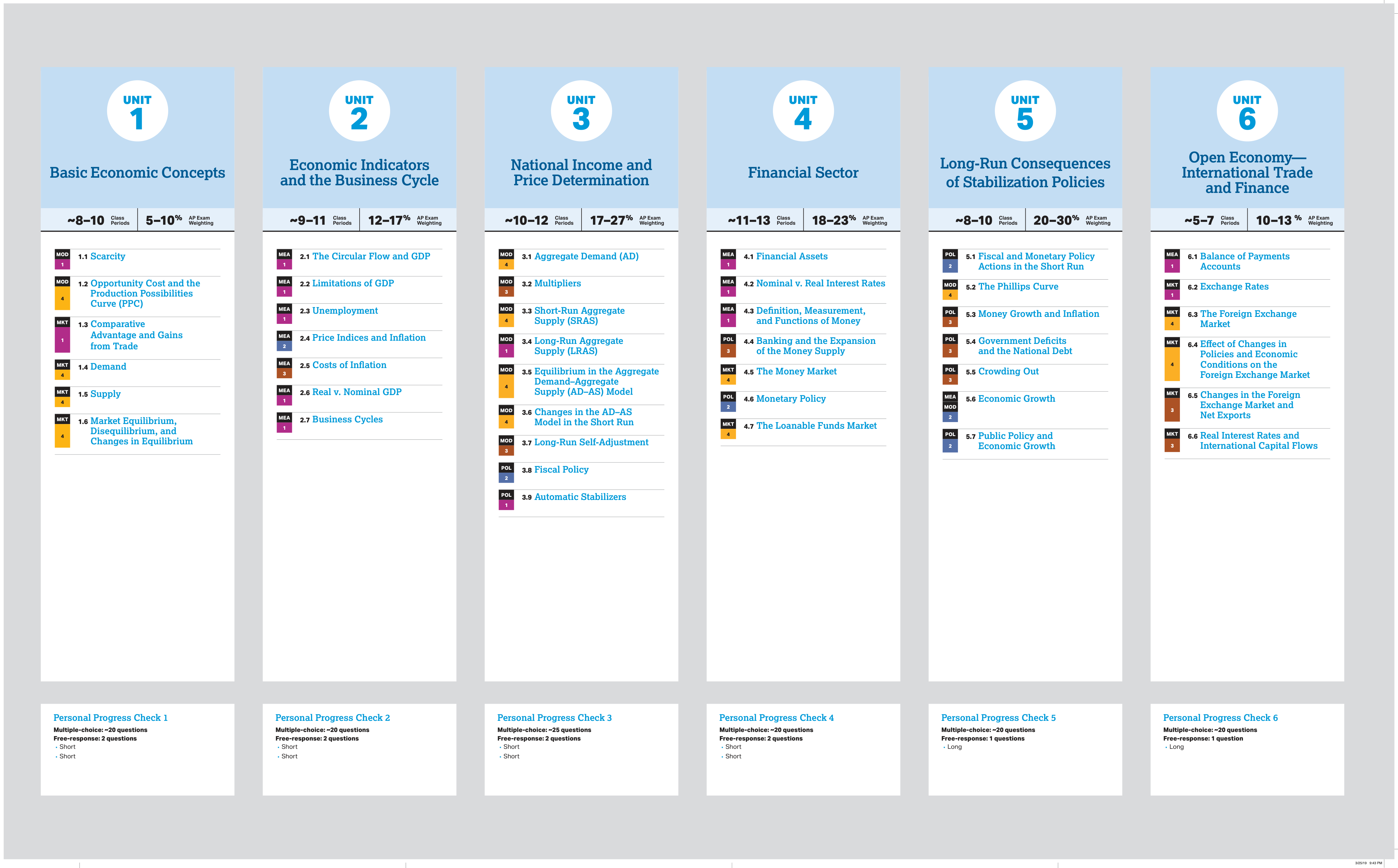
AP Macroeconomics is a college-level, one-semester introduction to the principles governing an economic system as a whole. Its central subjects include economic indicators, such as national income, unemployment, and price levels; the business cycle, which describes fluctuations in economic activity; financial markets; stabilization policies; economic growth; and international economics.
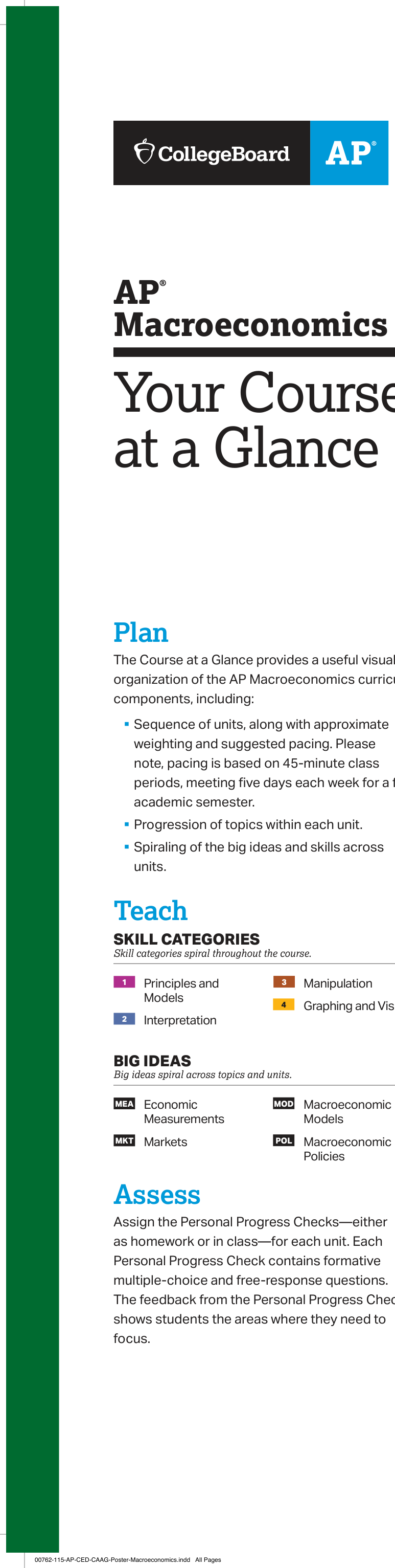
The course is organized around four cross-cutting big ideas:
- MEA: Economic Measurements — using measures such as GDP, unemployment, and inflation to describe economic performance.
- MKT: Markets — explaining how buyers and sellers interact through incentives, prices, and exchange.
- MOD: Macroeconomic Models — using simplified representations, such as the circular-flow model or AD–AS model, to predict and explain outcomes.
- POL: Macroeconomic Policies — analyzing how fiscal and monetary decisions affect the economy.
Economic models are not miniature copies of reality. They deliberately simplify reality so that a particular relationship becomes visible. The circular-flow model emphasizes connections among households, firms, product markets, and factor markets; later models use graphs, equations, charts, and data to isolate different mechanisms. A strong conclusion must therefore identify what the model explains and what it leaves out.
Evidence-based economic analysis
AP students are expected to interpret evidence rather than accept every economic claim at face value. A concise source-evaluation procedure is:
- Author expertise: Does the author or institution have relevant economic or statistical expertise?
- Data provenance: Where did the numbers originate, and can the original dataset or government release be located?
- Methodology: How were variables defined, sampled, measured, or calculated?
- Publication date: Is the evidence current for the question being asked?
- Incentives and conflicts: Could the author, sponsor, firm, or political organization benefit from a particular interpretation?
- Reporting versus opinion: Which statements report measured facts, and which statements are predictions, judgments, or advocacy?
- Corroboration: Do independent, methodologically credible sources support the same conclusion?
Worked source check. Imagine a news article titled “Households Rescue the Economy with a Spending Surge.” The article attributes a reported increase in consumer spending to a national statistical agency. That attribution improves its credibility, but the headline is still interpretation. A careful reader checks the agency’s release, confirms the publication date, determines whether spending is measured in nominal or real terms, examines how the statistic was calculated, and compares the claim with an independent economic analysis. The final conclusion might be narrower than the headline: real consumer spending increased during the measured period and contributed to aggregate demand, but the evidence alone does not prove that households permanently strengthened economic growth.
Key insight: Reliable data do not automatically produce a reliable conclusion; measurement, method, incentives, and interpretation all matter.
Independent thinking does not mean treating every opinion as equally well supported. It means drawing a conclusion that follows from the evidence, stating uncertainty when appropriate, and revising the conclusion when stronger evidence appears. Students are not expected to adopt one cultural or political value system; respectful disagreement is compatible with rigorous economic reasoning, while personal attacks are not.
Original multiple-choice practice
Question — approximately 2 minutes. A researcher observes that nominal household spending rose during a year in which the price level also increased. Which conclusion is most defensible?
A. Households definitely purchased more goods and services in real terms.
B. The economy definitely entered an expansion.
C. Nominal spending increased, but additional evidence is needed to determine whether real consumption increased.
D. The increase in spending proves that inflation was caused by higher household income.
Answer: C. Nominal spending records current-dollar expenditure. Because prices increased, the observed rise may reflect more expensive goods rather than a larger quantity of goods and services purchased. Real spending would require adjusting for the price change. Choices A and B overstate what the evidence establishes; choice D confuses a possible relationship with proof of causation.
For a multiple-choice task, the rewarded reasoning is precise identification of the measured variable, recognition of the model’s limitation, and rejection of conclusions that exceed the evidence. There is no partial credit for an unsupported explanation, so eliminate answers containing words such as definitely when the data do not justify certainty.
Preparation and error review
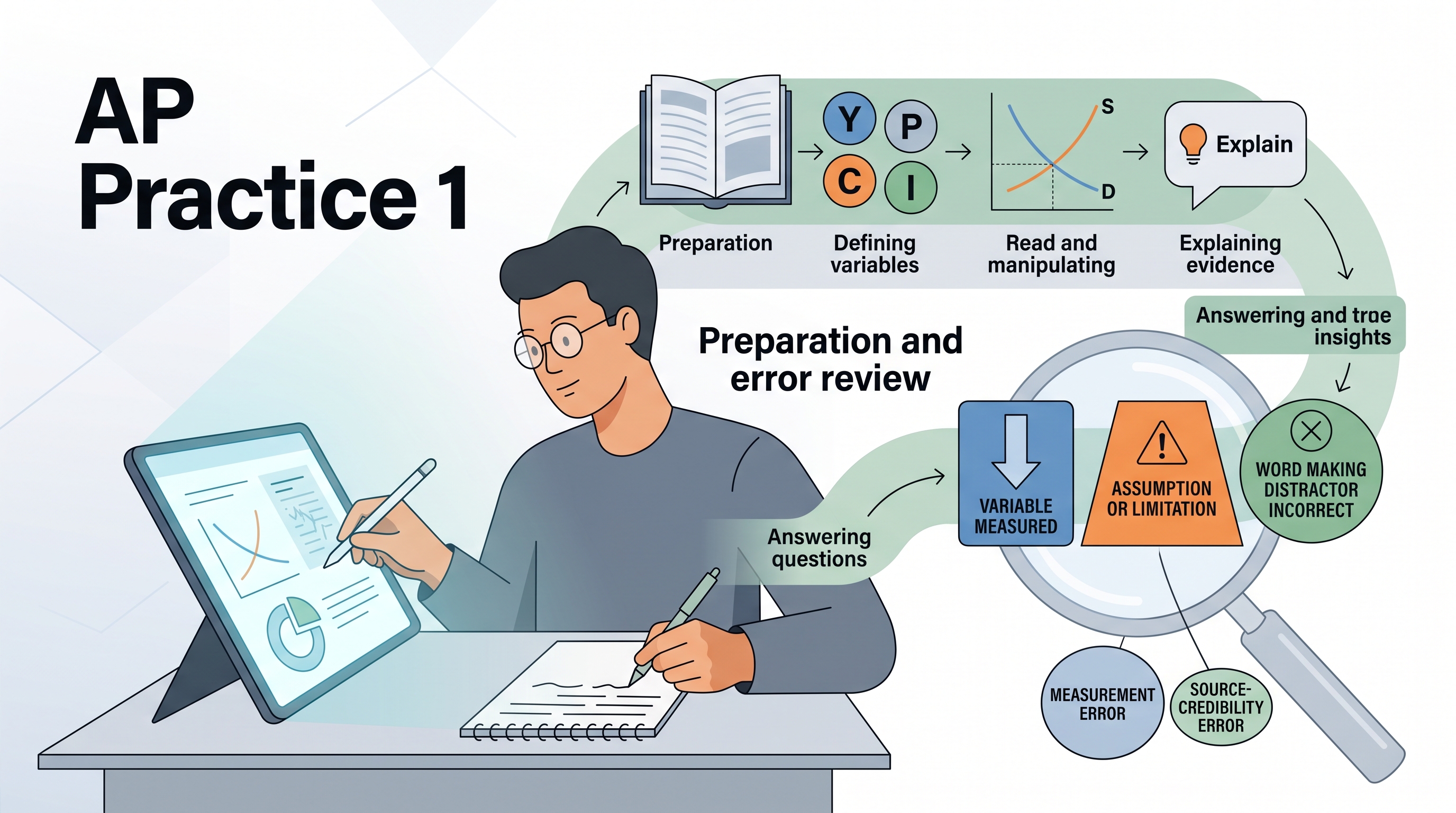
AP Macroeconomics has no prerequisites. Students should nevertheless be prepared to read a college-level textbook and use basic mathematics and graphing skills. The current exam includes a multiple-choice section and free-response questions; the same habits—defining variables, reading graphs, manipulating relationships, and explaining evidence—support both formats.
After answering, record three things: the variable the question measured, the assumption or limitation you noticed, and the exact word that made each distractor incorrect. If your error was confusing nominal with real values, label it a measurement error; if you accepted the headline without checking its evidence, label it a source-credibility error. That diagnosis is more useful than simply marking the answer wrong.

Source Materials
- AP Macroeconomics Course and Exam Description
- AP Macroeconomics Course and Exam Description Clarifications and Corrections
- AP Macroeconomics Course Overview
- AP Macroeconomics Course at a Glance
- AP Macroeconomics Course at a Glance Poster
- AP Macroeconomics
- AP Macroeconomics
- AP Macroeconomics Sample Syllabus 1
- Course Framework V.1 | 26 AP Macroeconomics Course and Exam Description
- Course Framework V.1 | 33 AP Macroeconomics Course and Exam Description
- Course Framework V.1 | 36 AP Macroeconomics Course and Exam Description
- Course Framework V.1 | 45 AP Macroeconomics Course and Exam Description