From the free course AP Macroeconomics on Lykke
Course Framework, Skills and Reasoning Processes
Key concepts: AP course framework · Economics skills · Principles and models · Quantitative analysis · Graphing and visual interpretation · Markets and equilibrium · Macroeconomic measurements and changes · Economic policy · College-level course expectations · Curriculum and instructional resources
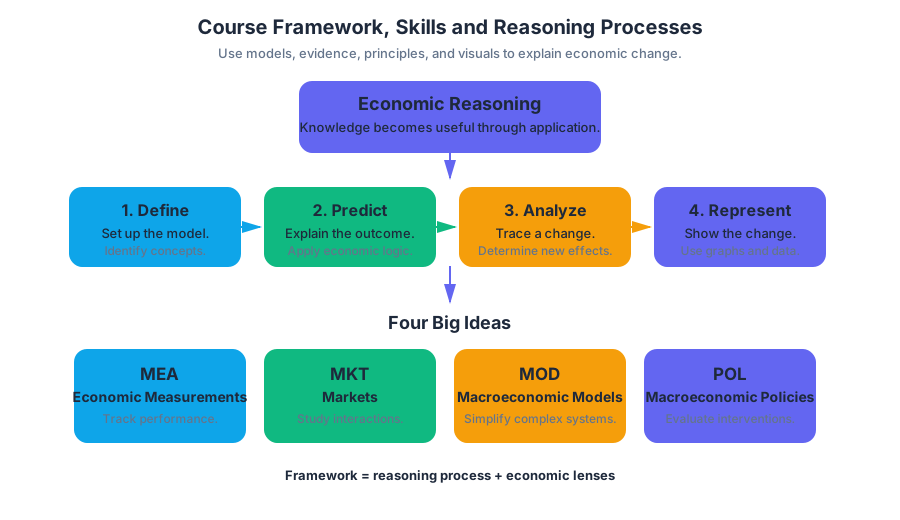
Macroeconomics becomes powerful when a student can move through four steps: define the model, explain what it predicts, determine how a change alters the outcome, and represent that change accurately.
Course Framework, Skills and Reasoning Processes
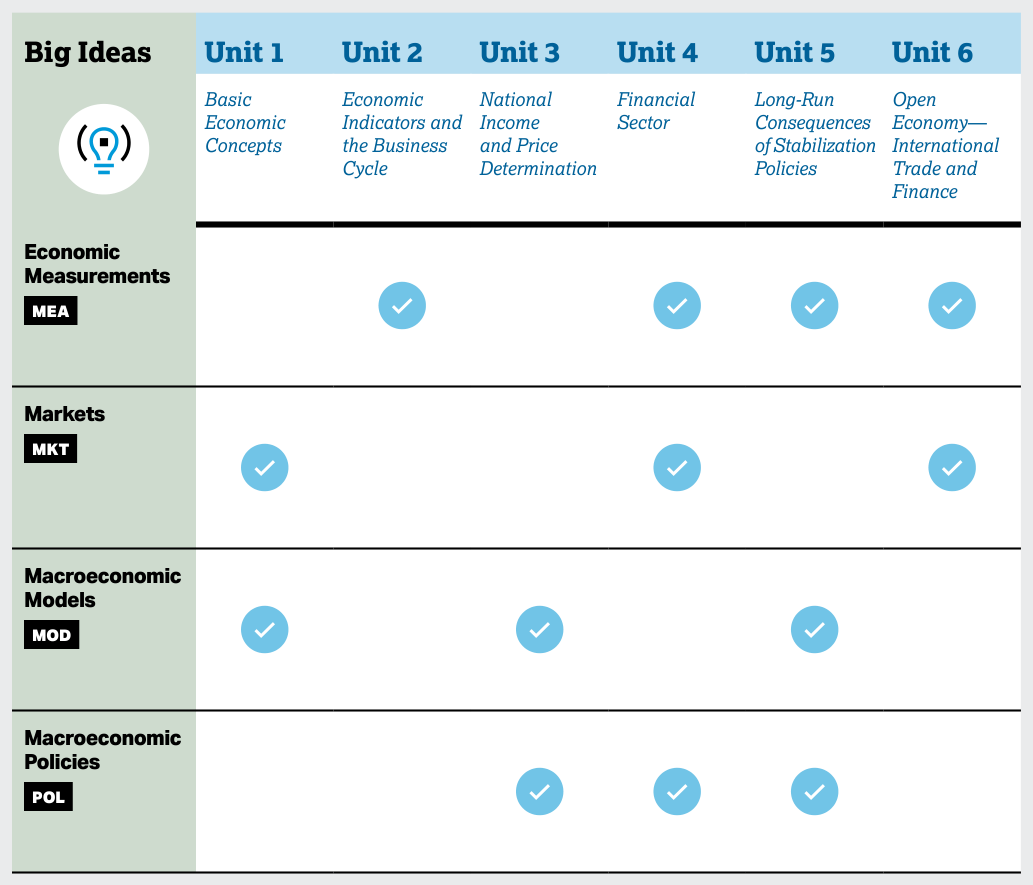
Macroeconomics becomes powerful when a student can move through four steps: define the model, explain what it predicts, determine how a change alters the outcome, and represent that change accurately. The AP Macroeconomics framework organizes this reasoning around four skill categories and four recurring Big Ideas: MEA: Economic Measurements, MKT: Markets, MOD: Macroeconomic Models, and POL: Macroeconomic Policies.
Core principle: Economic knowledge is not only knowing that a concept exists; it is using principles, models, quantitative evidence, and visual representations to explain what happens in an economy.
The framework is a guide, not a curriculum
The Course and Exam Description provides a clear, detailed description of required course content and skills, but it is not a curriculum. A college-level macroeconomics textbook should supply the substantive explanations and examples, while teachers create the instructional sequence, activities, and learning experiences.
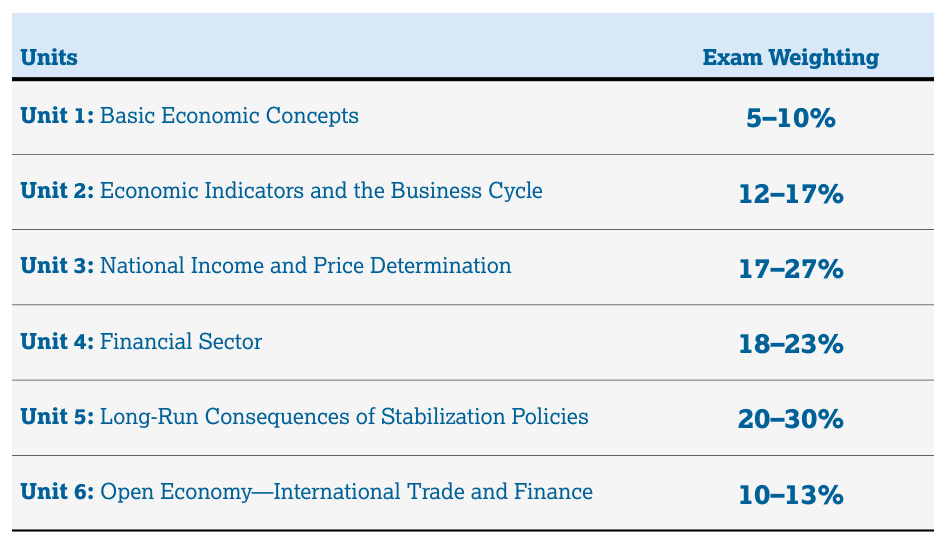
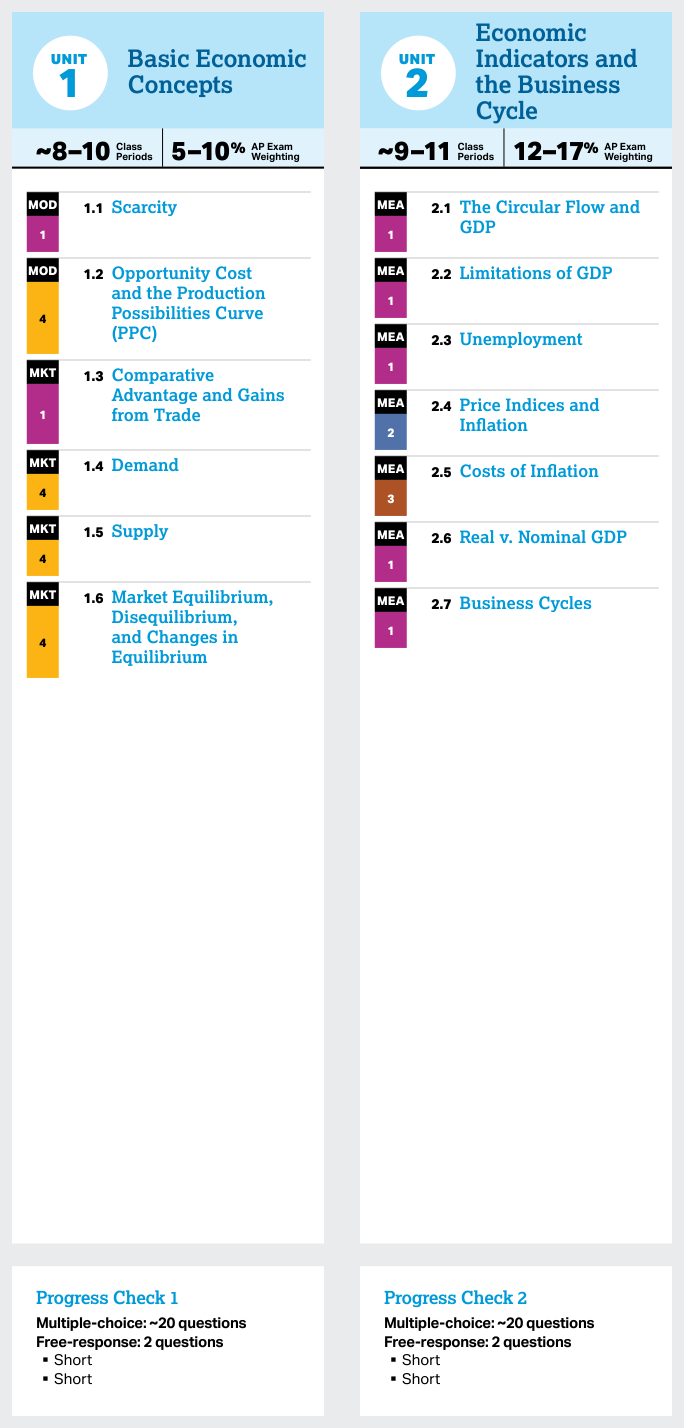
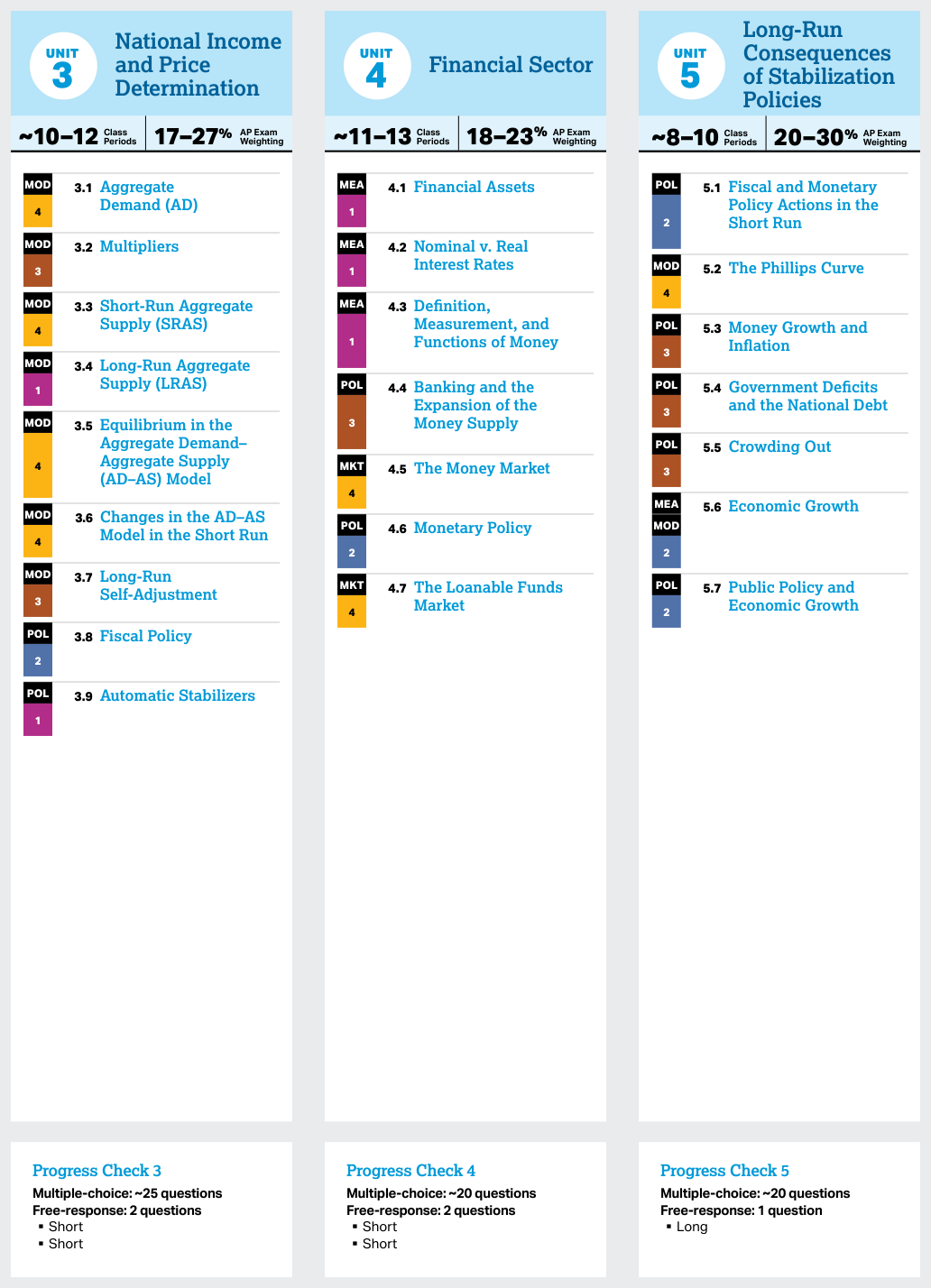
The six-unit sequence shown in the publication is therefore optional rather than mandatory. Its value is organizational: it shows how topics, Big Ideas, skills, suggested pacing, and AP Exam weighting fit together. The framework also emphasizes spiraling: students repeatedly use the same skills in increasingly complex settings, from scarcity and markets to monetary policy, economic growth, and international finance.
| Big Idea | Central concern | Typical application |
|---|---|---|
| MEA: Economic Measurements | How economic activity is measured | GDP, unemployment, inflation, real versus nominal values |
| MKT: Markets | How buyers, sellers, and financial participants interact | Equilibrium, disequilibrium, exchange rates, loanable funds |
| MOD: Macroeconomic Models | How simplified models explain economy-wide relationships | PPC, AD–AS, money market, Phillips curve |
| POL: Macroeconomic Policies | How government and central-bank actions affect outcomes | Fiscal policy, monetary policy, automatic stabilizers |
The four AP Economics Skills
The AP Economics skills describe what students should be able to do while exploring course concepts. The categories are progressive, but they are not a rigid ladder: a single response may require definition, causal explanation, calculation, and graphing together.
Skill Category 1: Principles and Models
1.A: Define economic principles and models. A response might define scarcity, aggregate demand, or the natural rate of unemployment precisely enough to distinguish it from a related idea.
1.B: Identify economic principles, models, and outcomes. Identification means recognizing which model or principle applies. For example, a question involving planned investment and interest rates points toward the loanable funds market, not the market for goods and services.
Skill Category 2: Interpretation
2.A: Explain economic outcomes. Explanation requires a causal chain, not a restatement. If consumer confidence falls, a strong explanation is: consumption decreases, aggregate demand shifts left, real output falls in the short run, and the price level decreases, assuming other factors remain constant.
2.B: Explain the effect of a change in an economic situation. This skill asks students to connect a changed condition to its consequences across a model or market. A higher reserve requirement, for instance, can reduce banks’ ability to create deposits and decrease the money supply.
2.C: Interpret a specific economic outcome using quantitative data or calculations. Students must explain what a number means economically. If nominal GDP rises from $500 billion to $525 billion, the increase is $25 billion, or $25 billion divided by $500 billion, which equals $5%$; that does not prove real production increased because prices may also have risen.
Skill Category 3: Manipulation
3.A: Determine the outcome of an economic situation using economic concepts, principles, or models. This is prediction through a model: identify the shock, select the correct curve or relationship, and state the resulting change in an economic variable.
3.B: Determine the effect(s) of one or more changes on other economic markets. Macroeconomic events often cross markets. Expansionary fiscal policy can raise aggregate demand, increase the budget deficit, increase demand for loanable funds, raise the real interest rate, and reduce private investment through crowding out.
3.C: Determine the effect of a change in an economic situation using quantitative data or calculations. For a government-spending multiplier, students may use $1/(1-\text{MPC})$. With an MPC of $0.75$, the multiplier is $1/0.25=4$; an increase in government spending of $10$ produces a maximum change in real GDP of $4 \times $10=$40$.
Skill Category 4: Graphing and Visuals
4.A: Draw an accurately labeled graph or visual to represent an economic model or market. Axes, curve names, equilibrium points, and relevant variables are not decoration: they establish whether the model is being used correctly.
4.B: Demonstrate your understanding of a specific economic situation on an accurately labeled graph or visual. The graph must show the initial condition and locate the outcome, such as equilibrium output and the price level in an AD–AS model.
4.C: Demonstrate the effect of a change in an economic situation on an accurately labeled graph or visual. A complete response shows the directional movement—such as $AD_1$ shifting to $AD_2$—and identifies the resulting changes in output, unemployment, or the price level.
How the skills appear on the exam
The multiple-choice section—$60$ questions in $70$ minutes—can test any combination of the four categories through definitions, calculations, data interpretation, model-based predictions, and graphs. The free-response section contains one long question and two short questions in $60$ minutes; it particularly rewards clear assertions, causal explanations, numerical analysis, and accurately labeled graphs.
A reliable response pattern is:
- Name the relevant principle or model.
- State the direction of the change.
- Explain the causal mechanism.
- Calculate when numerical evidence is provided.
- Graph the initial and changed equilibrium when requested.
- Connect the graph or calculation back to the specific economic outcome.
Misconception check: A graph alone is not an explanation. Saying “$AD$ shifts left” earns less reasoning value than identifying the cause—such as lower consumer spending—and linking it to lower real output and a lower price level in the short run.
Retrieval check
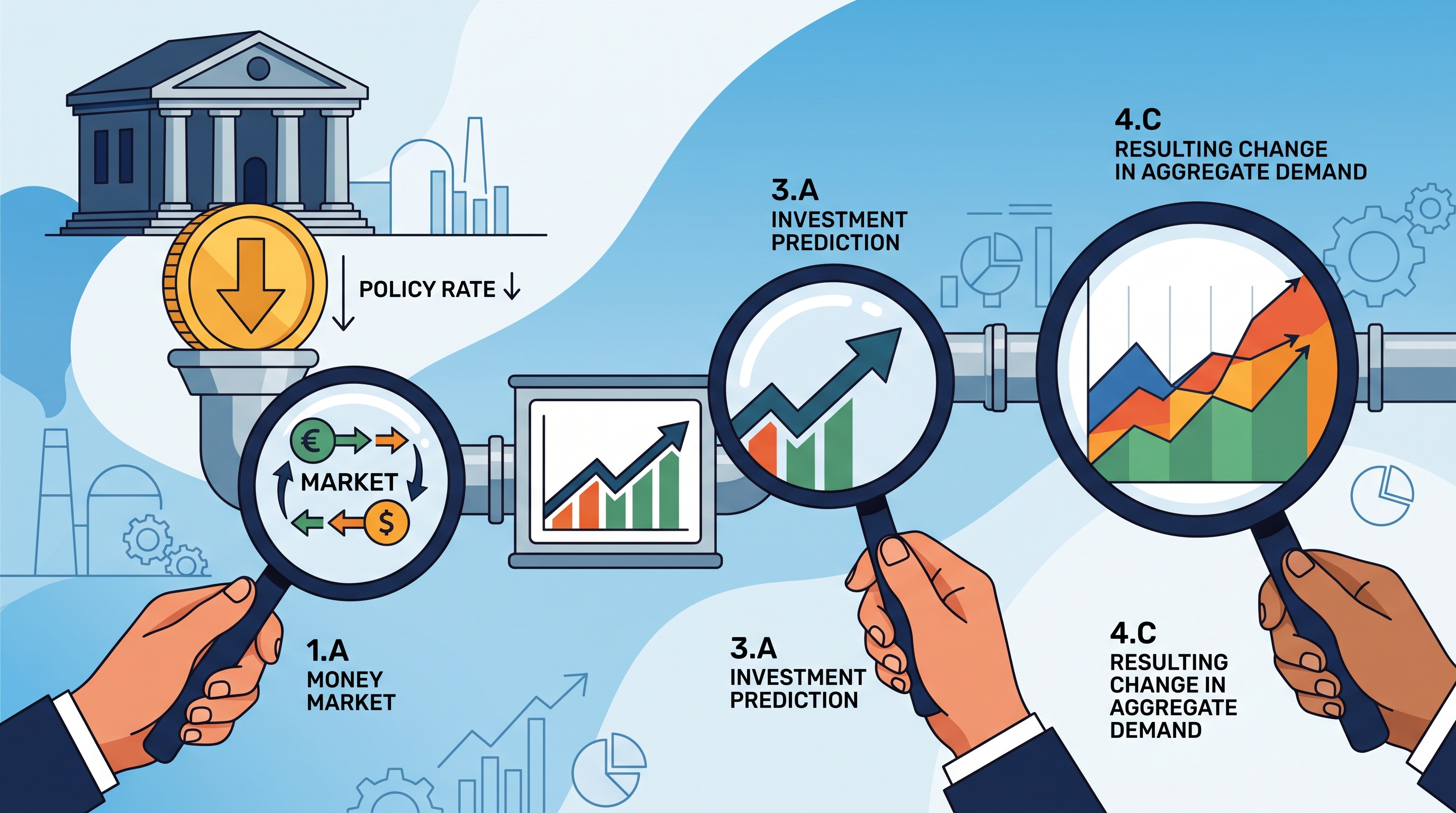
A central bank lowers its policy interest rate. Which skill is used when you define the money market, which is used when you predict the effect on investment, and which is used when you draw the resulting change? The strongest answer uses 1.A, 3.A, and 4.C, then explains the transmission from the interest rate to investment and aggregate demand.


Source Materials
- AP Macroeconomics Course and Exam Description
- AP Macroeconomics Course and Exam Description Clarifications and Corrections
- AP Macroeconomics Course Overview
- AP Macroeconomics Course at a Glance
- AP Macroeconomics Course at a Glance Poster
- AP Macroeconomics
- AP Macroeconomics
- AP Macroeconomics Sample Syllabus 1
- Figure — AP Macroeconomics Course and Exam Description (p. 1)
- Figure — AP Macroeconomics Course and Exam Description (p. 17)
- Figure — AP Macroeconomics Course and Exam Description (p. 25)
- Figure — AP Macroeconomics Course and Exam Description (p. 26)