From the free course AP Macroeconomics on Lykke
2.7 Business Cycles
An economy can grow while performing below its long-run potential, and it can shrink while still producing above trend. Business cycles describe the repeated fluctuations in economic activity over time—not simply whether actual output lies above or below a trend line.
2.7 Business Cycles
An economy can grow while performing below its long-run potential, and it can shrink while still producing above trend. Business cycles describe the repeated fluctuations in economic activity over time—not simply whether actual output lies above or below a trend line.
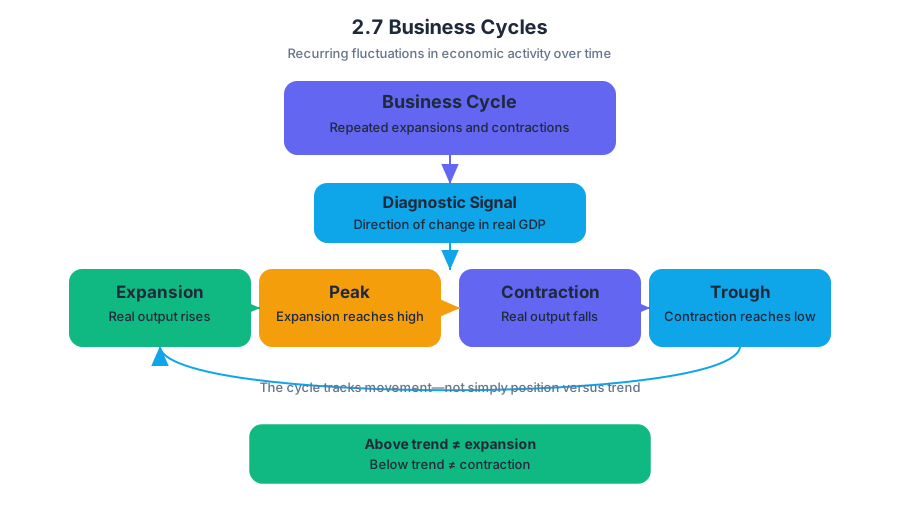
Business cycle: The recurring pattern of expansions and contractions in an economy’s level of economic activity.
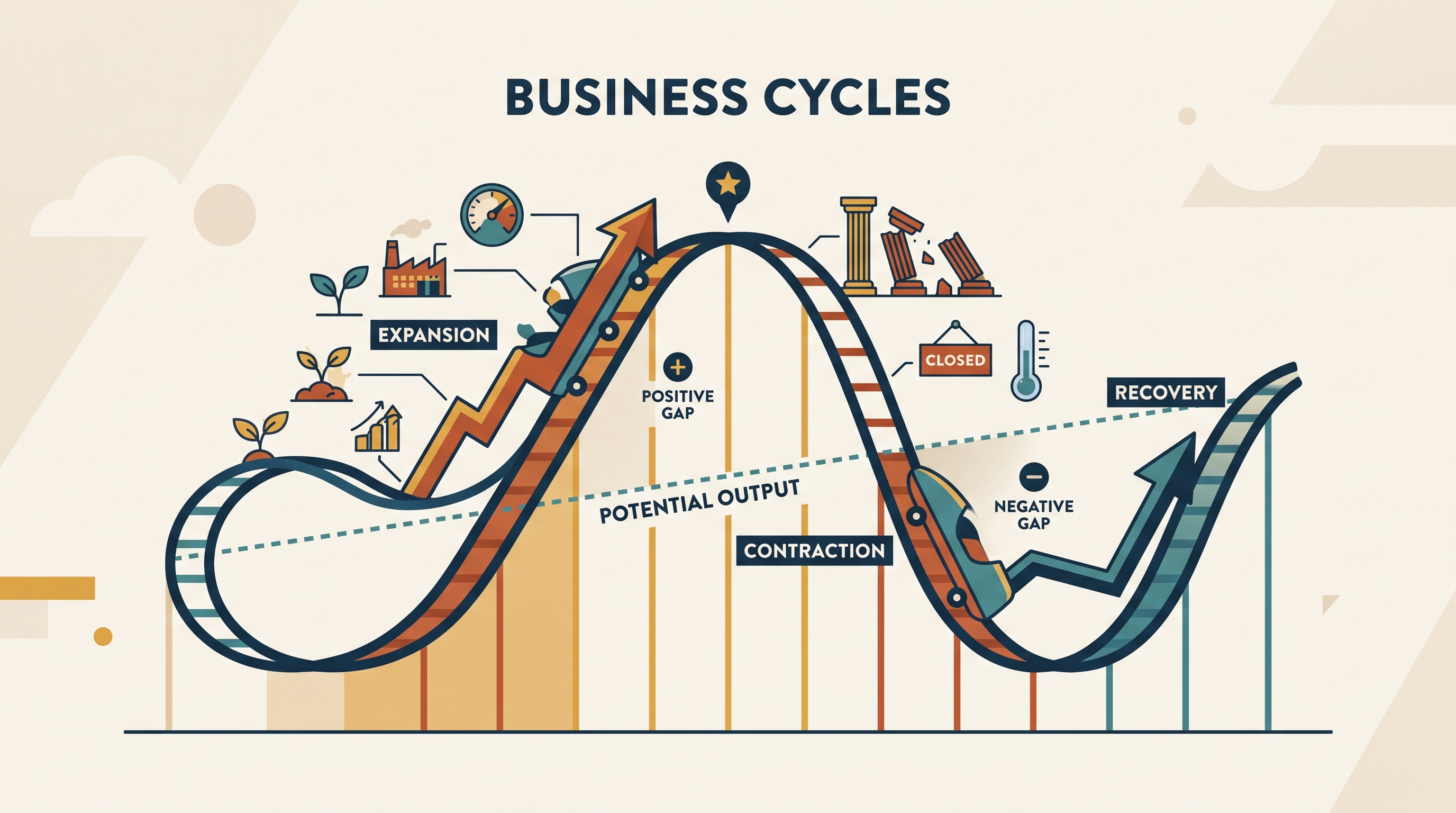
The central diagnostic is therefore the direction of change in real output. When real GDP rises, the economy is generally in an expansion; when real GDP falls or weakens substantially, it is in a contraction. The economy moves through four commonly labeled points or phases: expansion, peak, contraction, and trough.
Reading the cycle: direction first, position second
A typical business-cycle diagram plots real GDP vertically and time horizontally. The long-run trend represents the economy’s rising productive capacity, while the actual-output line moves above and below that trend.
The actual-output line’s slope identifies the phase:
- Expansion: Actual real GDP is increasing.
- Peak: Economic activity reaches a temporary high point before turning downward.
- Contraction: Actual real GDP is decreasing or economic activity is weakening.
- Trough: Economic activity reaches a temporary low point before turning upward.
The distance between actual output and the long-run trend is a different idea. It describes the economy’s relative performance and is often connected to the output gap, the difference between actual output and potential or trend output. A negative output gap means actual output is below the relevant benchmark; a positive output gap means it is above it. Neither gap, by itself, determines whether the economy is expanding or contracting.
A four-point interpretation
Suppose an economy’s long-run trend rises steadily from $100$ to $120$ billion, while actual real GDP follows this path:
| Year | Actual real GDP | Direction of change | Business-cycle interpretation |
|---|---|---|---|
| $1$ | $100$ billion | — | Starting point |
| $2$ | $104$ billion | Rising | Expansion |
| $3$ | $108$ billion | Rising | Expansion |
| $4$ | $106$ billion | Falling | Contraction |
| $5$ | $103$ billion | Falling | Contraction |
| $6$ | $105$ billion | Rising | Recovery or expansion |
Even if the trend value in Year $4$ is $112$ billion, the economy is still in a contraction because actual GDP fell from $108$ billion to $106$ billion. Conversely, an economy could be expanding below trend if actual GDP rose from $90$ billion to $92$ billion while potential output rose from $100$ billion to $105$ billion.
Exam rule: Use the direction of actual economic activity to identify the business-cycle phase. Use the gap from trend to describe whether performance is relatively weak or strong.
Why business cycles matter
Business-cycle fluctuations affect employment, income, consumption, investment, and government budgets. During an expansion, firms typically sell more, hire more workers, and increase production. During a contraction, falling demand can reduce production and employment, while tax collections may decline and spending on income-support programs may rise.
Business cycles are not perfectly regular. Their length and severity vary because economies experience changing consumer confidence, business investment, financial conditions, policy actions, supply disruptions, and international shocks. A contraction caused by falling household spending need not look identical to one caused by a sudden increase in production costs.
Misconception check: “Below trend means contraction”
Named misconception — the trend-position error: A student sees actual GDP below the long-run trend and labels the economy a contraction. That conclusion is incomplete. If actual GDP is below trend but rising, the economy is expanding with a negative output gap; if actual GDP is above trend but falling, the economy is contracting with a positive output gap.
CED traceability: Topic 2.7 Business Cycles; Big Idea MEA; Skill Category 1: Principles and Models. The associated reasoning process is to identify the relevant macroeconomic model or pattern, interpret its variables, and use the model to explain an economic condition or predict what follows from a change.
Retrieval check
An economy’s actual real GDP increases from $500$ billion to $505$ billion while its potential output increases from $510$ billion to $520$ billion. Is the economy expanding or contracting, and is its output gap positive or negative?
Answer: It is expanding, because actual GDP increased. Its output gap is negative, because actual GDP remains below potential output. The phase comes from the direction of change; the gap comes from the position relative to potential output.
Source Materials
- AP Macroeconomics Course and Exam Description
- AP Macroeconomics Course and Exam Description Clarifications and Corrections
- AP Macroeconomics Course Overview
- AP Macroeconomics Course at a Glance
- AP Macroeconomics Course at a Glance Poster
- AP Macroeconomics
- AP Macroeconomics
- AP Macroeconomics Sample Syllabus 1