From the free course AP Macroeconomics on Lykke
6.6 Real Interest Rates and International Capital Flows
Key concepts: Real interest rates · International capital flows · Exchange rates · Currency appreciation and depreciation · Net exports · Current account · Capital/financial account · Balance of payments · Financial capital inflows and outflows · Interest rates and foreign investment
A saver comparing two countries does not care only about the advertised interest rate; the crucial comparison is the real interest rate, the return after accounting for the purchasing power lost to inflation:
6.6 Real Interest Rates and International Capital Flows
A saver comparing two countries does not care only about the advertised interest rate; the crucial comparison is the real interest rate, the return after accounting for the purchasing power lost to inflation:
$$ \text{Real interest rate} \approx \text{Nominal interest rate} - \text{Actual inflation rate} $$
A bond yielding $7%$ in a country with $4%$ inflation offers an approximate real return of $3%$. If another country offers a nominal rate of $5%$ but has only $1%$ inflation, its real return is approximately $4%$. Financial capital is more likely to move toward the second country, even though its nominal interest rate is lower.
Key distinction: Nominal interest rates measure stated returns in money terms; real interest rates measure approximate gains in purchasing power.
Why real interest-rate differences move capital
International capital flows are movements of money across national borders for investment, trade, or business production. Investors may purchase foreign bonds, firms may build factories abroad, and households or businesses may transfer funds to finance international transactions. Under MKT-5.G.1, differences in real interest rates change the relative attractiveness of domestic and foreign assets.
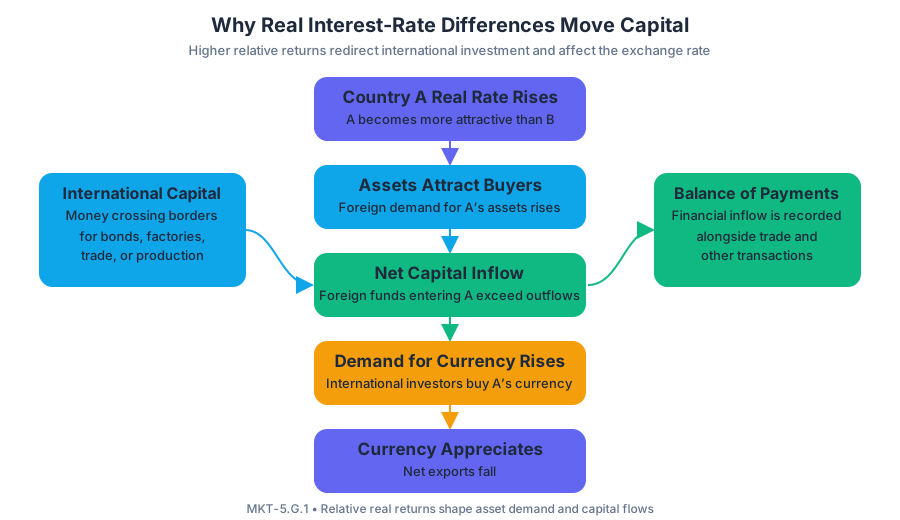
Suppose Country A’s real interest rate rises above Country B’s. Financial assets in Country A now offer a relatively higher return, so foreign investors demand more of Country A’s assets. The result is a net capital inflow: foreign financial capital entering Country A exceeds domestic financial capital leaving it.
The causal sequence is:
- Country A’s real interest rate rises relative to other countries.
- Country A’s assets become relatively more attractive.
- Foreign investors purchase more Country A assets.
- Country A experiences a net capital inflow.
- Demand for Country A’s currency increases.
- By the exchange-rate mechanism established in Topic 6.5, the currency appreciates and net exports fall.
The important new accounting insight is that the financial inflow is not an isolated event: it is recorded alongside the country’s transactions in the balance of payments.
The balance of payments: two connected accounts
The balance of payments is the accounting system that records a country’s international transactions during a particular period. It consists of the current account and the capital/financial account.
The current account records three broad categories:
- Net exports, or the balance of trade: exports minus imports.
- Income flows, such as interest, profits, and wages received from or paid to other countries.
- Net unilateral transfers, such as foreign aid or remittances that do not purchase a current good or service.
A current-account surplus means the country receives more through these current transactions than it pays out. A current-account deficit means it pays out more than it receives. These definitions correspond to MEA-4.A.1 and MEA-4.A.2.
The capital/financial account records transfers and purchases or sales of assets between countries. A capital/financial account surplus represents a financial capital inflow: foreigners are purchasing more domestic assets than domestic residents are purchasing foreign assets. A capital/financial account deficit represents a financial capital outflow.
| Account | What it records | Surplus means |
|---|---|---|
| Current account | Net exports, income flows, and net unilateral transfers | Net receipts from current international transactions |
| Capital/financial account | International purchases and sales of assets and related capital transfers | Net financial capital inflow |
Because international transactions are recorded from both sides, a country’s current-account balance and capital/financial-account balance move in opposite directions, ignoring statistical discrepancies:
$$ \text{Current account} + \text{Capital/financial account} \approx 0 $$
Thus, a current-account deficit is typically matched by a capital/financial-account surplus. The country is receiving foreign financial capital that helps finance its excess of imports and other current payments over exports and other current receipts.
Worked example: a higher real interest rate
Assume Arandia raises its nominal interest rate from $6%$ to $8%$ while actual inflation remains $2%$. Its approximate real interest rate rises from
$$ 6% - 2% = 4% $$
to
$$ 8% - 2% = 6% $$
If comparable foreign assets still yield a real return of $4%$, Arandian assets become relatively more attractive. Foreign investors purchase Arandian bonds, creating a net capital inflow and a capital/financial account surplus. The increased demand for the Arandian currency causes appreciation, so—through the previously established mechanism—Arandia’s net exports decrease.
If Arandia’s current account consequently records a deficit of $30$ billion, its capital/financial account will show an inflow of approximately $30$ billion, or a surplus of $30$ billion, under the simplified accounting identity. The financial inflow is therefore the counterpart of the current-account deficit, not an unrelated statistic.
Central banks and the international transmission channel
Under MKT-5.G.2, central banks can influence the domestic interest rate in the short run, which changes net capital inflows. A policy that raises domestic interest rates can attract foreign financial capital; a policy that lowers them can reduce that attraction or encourage capital to flow abroad. The comparison is always relative: a domestic rate matters because it is being compared with real returns available in other countries.
Misconception check: “A capital-account surplus is automatically good”
A capital/financial account surplus does not by itself mean an economy is healthier. It means the country is receiving a net inflow of financial capital. That inflow may finance productive investment, but it may also accompany a current-account deficit and greater reliance on foreign financing. Likewise, a current-account deficit is not identical to a government budget deficit; they are different accounts measuring different transactions.
Retrieval check
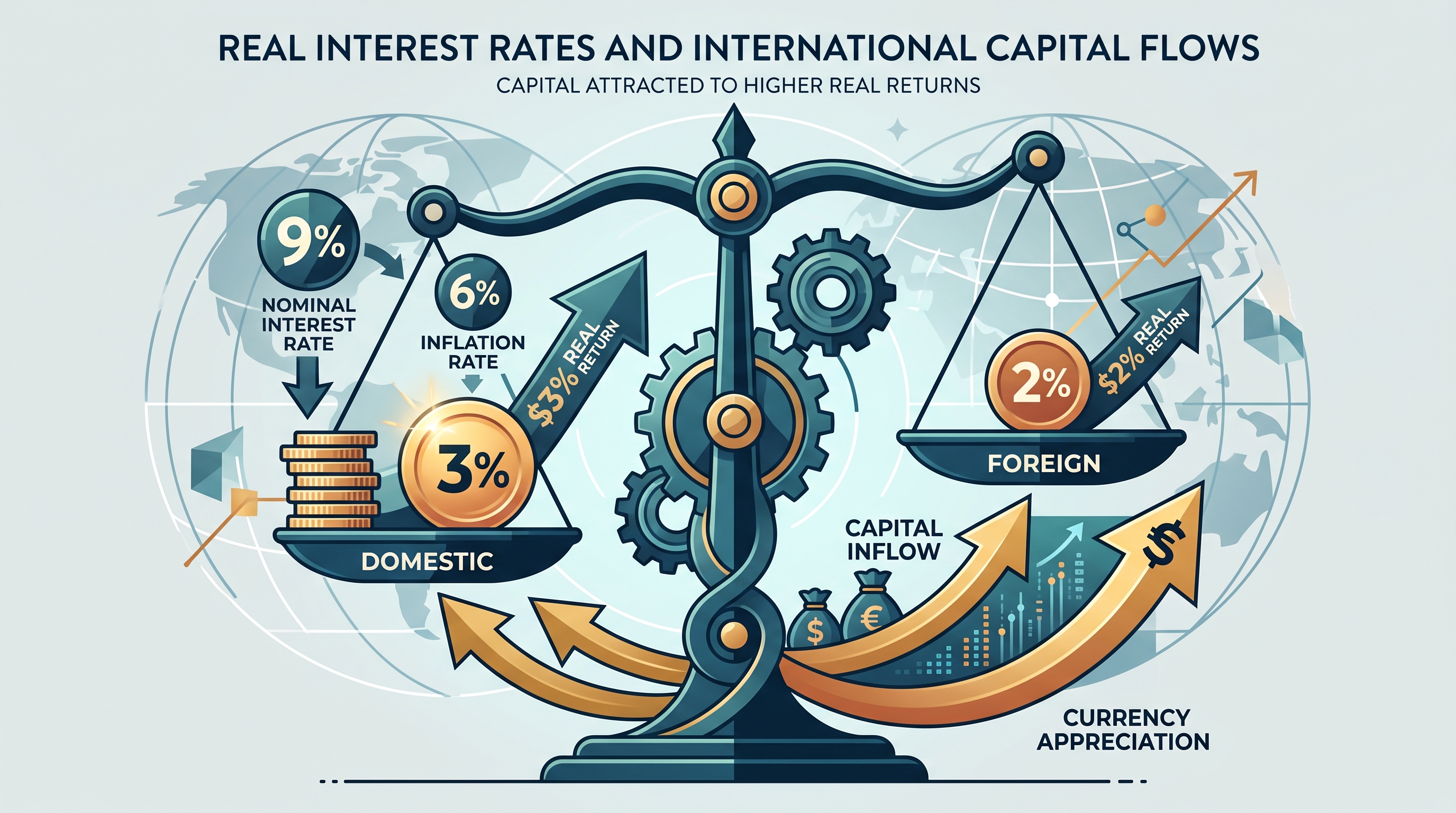
A country’s nominal interest rate is $9%$ and its actual inflation rate is $6%$, while foreign assets offer a real return of $2%$. What is the country’s approximate real interest rate, and what international financial outcome is most likely?
The real rate is $3%$, so the country’s assets offer the relatively higher return. The likely result is a net capital inflow and a capital/financial account surplus; the currency appreciates and net exports fall through the established foreign-exchange relationship.
Source Materials
- AP Macroeconomics Course and Exam Description
- AP Macroeconomics Course and Exam Description Clarifications and Corrections
- AP Macroeconomics Course Overview
- AP Macroeconomics Course at a Glance
- AP Macroeconomics Course at a Glance Poster
- AP Macroeconomics
- AP Macroeconomics
- AP Macroeconomics Sample Syllabus 1