From the free course AP Macroeconomics on Lykke
1.3 Comparative Advantage and Gains from Trade
Key concepts: Absolute advantage · Comparative advantage · Opportunity cost · Production possibility curves (PPCs) · Specialization according to comparative advantage · Gains from trade · Exchange opportunities · Mutually beneficial terms of trade · Consumption opportunities beyond specialization · Tradeoffs and full employment
A producer can benefit from trade even when another producer is better at making everything. The key question is not “Who produces more?” but “Who gives up less to produce this good?”
1.3 Comparative Advantage and Gains from Trade
A producer can benefit from trade even when another producer is better at making everything. The key question is not “Who produces more?” but “Who gives up less to produce this good?”
MKT-1: Production and consumption increase by engaging in trade.
Absolute advantage versus comparative advantage
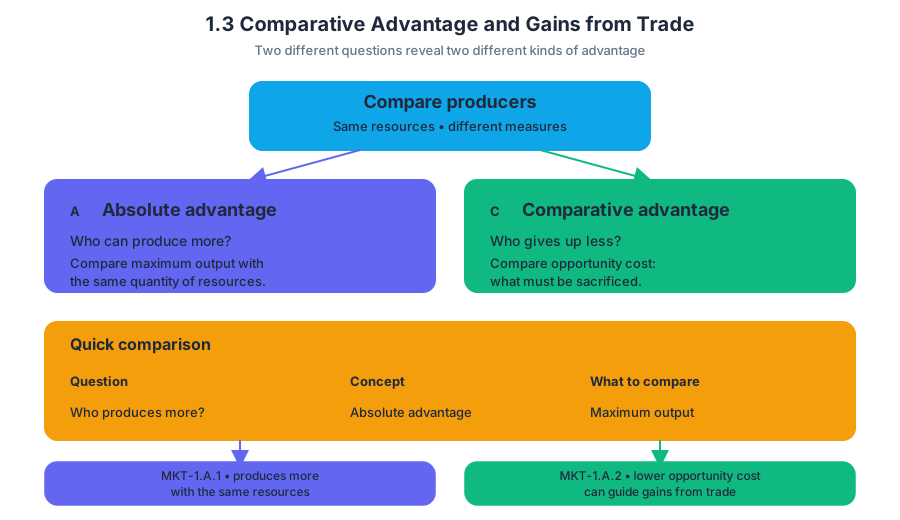
Absolute advantage means the ability of an individual, business, or country to produce more of a good or service than another producer using the same quantity of resources. It is a comparison of productivity.
Comparative advantage means the ability to produce a good or service at a lower opportunity cost than another producer. It is a comparison of what must be sacrificed.
These ideas answer different questions:
| Question | Concept | What to compare |
|---|---|---|
| Who can produce more? | Absolute advantage | Maximum output |
| Who gives up less of another good? | Comparative advantage | Opportunity cost |
The official knowledge chain is MKT-1.A.1, which defines absolute advantage as producing more with the same resources, and MKT-1.A.2, which defines comparative advantage as producing at a lower opportunity cost. A producer may have absolute advantage in both goods but comparative advantage in only one.
Finding advantage from a production table
Suppose two countries use the same resources to produce wheat and cloth:
| Country | Maximum wheat | Maximum cloth |
|---|---|---|
| Aurora | $10$ units | $5$ units |
| Borealis | $6$ units | $12$ units |
Aurora has the absolute advantage in wheat because $10>6$. Borealis has the absolute advantage in cloth because $12>5$.
To find comparative advantage, calculate opportunity costs. If each country’s production possibilities curve is linear, the opportunity cost of one unit of wheat is:
$$ \text{Opportunity cost of 1 wheat}
\frac{\text{maximum cloth}}{\text{maximum wheat}} $$
For Aurora:
$$ \text{OC}_{A}(1\text{ wheat})=\frac{5\text{ cloth}}{10\text{ wheat}}=0.5\text{ cloth} $$
For Borealis:
$$ \text{OC}_{B}(1\text{ wheat})=\frac{12\text{ cloth}}{6\text{ wheat}}=2\text{ cloth} $$
Aurora gives up less cloth when producing wheat, so Aurora has the comparative advantage in wheat. Borealis has the comparative advantage in cloth because its opportunity cost of cloth is lower:
$$ \text{OC}_{A}(1\text{ cloth})=2\text{ wheat} $$
$$ \text{OC}_{B}(1\text{ cloth})=0.5\text{ wheat} $$
Specialization and gains from trade
Specialization according to comparative advantage means each producer concentrates resources on the good it can produce at the lower opportunity cost. Aurora specializes in wheat, while Borealis specializes in cloth.
Before specialization, suppose Aurora produces $6$ wheat and $2$ cloth, while Borealis produces $3$ wheat and $6$ cloth. Total production is:
$$ 9\text{ wheat}+8\text{ cloth} $$
After specialization, Aurora produces $10$ wheat and Borealis produces $12$ cloth. Total production becomes:
$$ 10\text{ wheat}+12\text{ cloth} $$
Specialization increases total production because resources move toward their relatively most productive uses. Trade then allows the countries to share those gains.
Mutually beneficial terms of trade
Terms of trade are the rate at which one good exchanges for another. For both countries to benefit, the exchange rate must fall between their opportunity costs.
For one unit of wheat:
$$ 0.5\text{ cloth}<\text{terms of trade}<2\text{ cloth} $$
Choose the terms of trade of $1$ wheat for $1$ cloth. Aurora specializes in $10$ wheat and trades $4$ wheat for $4$ cloth. Borealis specializes in $12$ cloth and receives $4$ wheat in exchange for $4$ cloth.
Final consumption:
- Aurora: $6$ wheat and $4$ cloth
- Borealis: $4$ wheat and $8$ cloth
Both consumption bundles lie beyond what each country could produce alone on its own PPC. Aurora could not produce $6$ wheat and $4$ cloth domestically, and Borealis could not produce $4$ wheat and $8$ cloth domestically. This is MKT-1.B.1: specialization creates exchange opportunities that expand consumption beyond the PPC.
The trade rate is mutually beneficial because $1$ wheat costs Aurora more than $0.5$ cloth but less than $2$ cloth—the sacrifices faced by the two countries. This is MKT-1.B.2: comparative advantage and opportunity costs determine mutually beneficial terms of trade.
Common misconception
Misconception: Absolute advantage determines specialization.
Correction: Absolute advantage identifies who can produce more. Comparative advantage determines who should specialize. Even a country with absolute advantage in both goods should specialize in the good with the lower opportunity cost.
AP skills in action
This topic develops Skill Category 1: Principles and Models, especially 1.A Define economic principles and models and 1.B Explain economic principles and models. It also uses Skill Category 3: Manipulation, particularly calculating opportunity costs and mutually beneficial terms of trade from tables or PPC data, and Skill Category 4: Graphing and Visuals when students identify full-employment production points and consumption beyond a PPC.
MKT-1.B requires students to explain how comparative-advantage specialization and appropriate terms of trade create gains from trade, and to calculate mutually beneficial terms of trade.
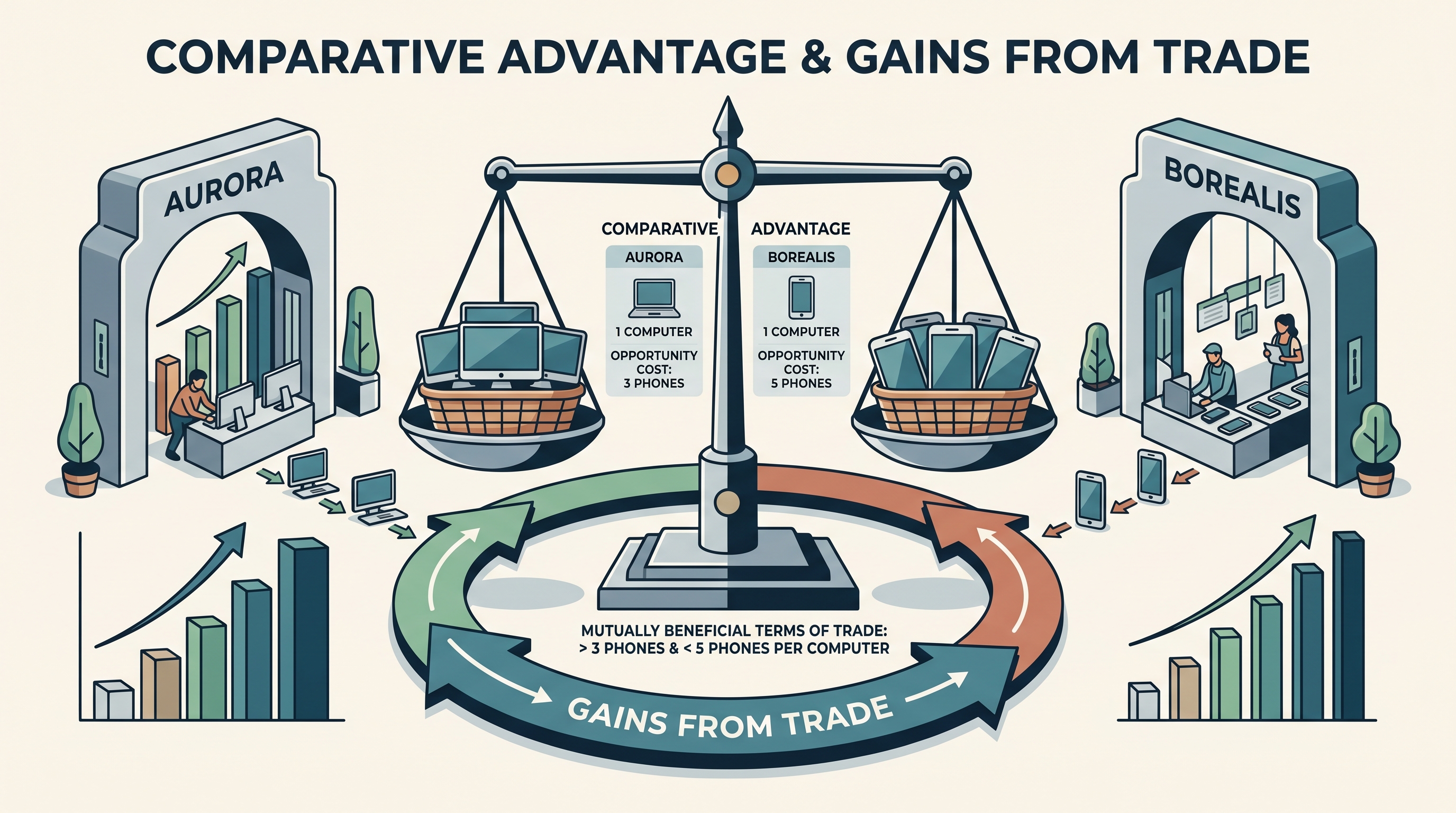
Retrieval check: Aurora’s opportunity cost of one computer is $3$ phones, while Borealis’s is $5$ phones. Who has comparative advantage in computers, and what range of terms of trade for one computer could benefit both producers?
Answer: Aurora has comparative advantage in computers. Mutually beneficial terms of trade must be greater than $3$ phones but less than $5$ phones per computer.
Source Materials
- AP Macroeconomics Course and Exam Description
- AP Macroeconomics Course and Exam Description Clarifications and Corrections
- AP Macroeconomics Course Overview
- AP Macroeconomics Course at a Glance
- AP Macroeconomics Course at a Glance Poster
- AP Macroeconomics
- AP Macroeconomics
- AP Macroeconomics Sample Syllabus 1