From the free course AP Macroeconomics on Lykke
2.4 Price Indices and Inflation
Key concepts: Price indices · Consumer Price Index (CPI) · GDP deflator · Inflation, deflation, and disinflation · Inflation rate · Nominal and real variables · Shortcomings of the CPI · Costs of unexpected inflation · Real wages · Comparing nominal variables over time
A price index turns a changing collection of prices into one number: it measures the general price level in a given period relative to the prices in a chosen base year.
2.4 Price Indices and Inflation
A price index turns a changing collection of prices into one number: it measures the general price level in a given period relative to the prices in a chosen base year. If the index rises from $100$ to $105$, the economy’s measured price level has increased by $5%$ relative to the base year—not necessarily that every individual price rose by exactly $5%$.
Essential idea — MEA-1.F.2: The CPI measures the cost of a fixed basket of goods and services in a given year relative to the cost of that basket in the base year.
The topic’s enduring understanding, MEA-1, treats the inflation rate as one indicator of an economy’s performance alongside GDP and unemployment. The required learning objective MEA-1.F asks you to define and calculate price measures, use them to compare nominal values across time, and determine changes in real variables; MEA-1.G adds the limitations of the CPI as a measure of true inflation.
The Consumer Price Index: pricing a fixed basket
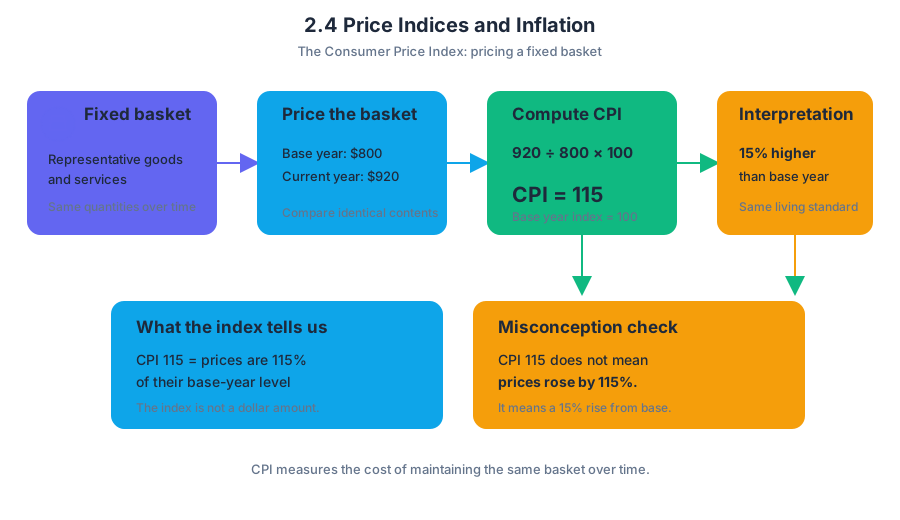
The Consumer Price Index (CPI) measures how the cost of a fixed market basket of consumer goods and services changes over time. In practical terms, it estimates how much income a household would need in a later year to maintain the same standard of living it had in the base year.
The calculation is:
$$ \text{CPI}=\frac{\text{Cost of market basket in current year}}{\text{Cost of market basket in base year}}\times 100 $$
Suppose a representative basket costs $800$ in the base year and $920$ today. Then:
$$ \text{CPI}=\frac{920}{800}\times 100=115 $$
A CPI of $115$ means the basket costs $15%$ more than it did in the base year. The number $115$ is an index value, not a dollar amount and not itself the inflation rate for the current year.
Misconception check: A CPI of $115$ does not mean that prices rose by $115%$. It means prices are $115%$ of their base-year level, or $15%$ above it.
Inflation, deflation, and disinflation
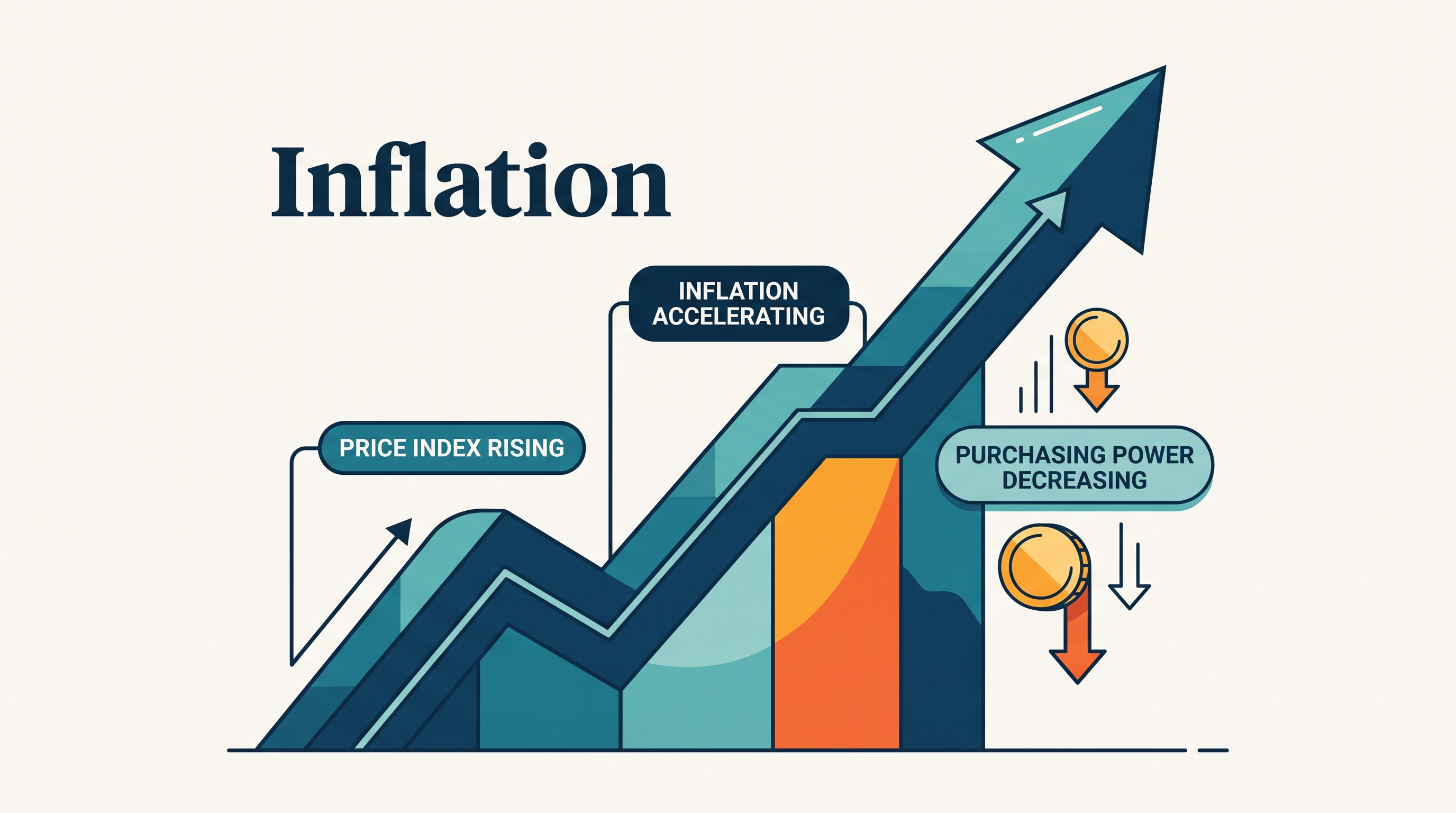
Inflation is a sustained increase in the general price level. Deflation is a decrease in the general price level, while disinflation is a decline in the inflation rate—the price level is still rising, but more slowly.
| Situation | Price-level movement | Inflation-rate movement |
|---|---|---|
| Inflation | Increases | Positive |
| Deflation | Decreases | Negative |
| Disinflation | Still increases | Positive but falling |
The inflation rate is the percentage change in a price index:
$$ \text{Inflation rate}= \frac{\text{Current price index}-\text{Previous price index}} {\text{Previous price index}}\times 100 $$
If the CPI rises from $120$ to $126$:
$$ \text{Inflation rate}=\frac{126-120}{120}\times100=5% $$
If the CPI rises from $126$ to $128$, inflation is:
$$ \frac{128-126}{126}\times100\approx1.6% $$
Prices are still increasing, so this is not deflation. Because inflation fell from $5%$ to approximately $1.6%$, it is disinflation.
CPI and the GDP deflator
The GDP deflator is another price index. It compares the value of all final goods and services produced domestically at current prices with their value at base-year prices:
$$ \text{GDP deflator}= \frac{\text{Nominal GDP}}{\text{Real GDP}}\times100 $$
For example, if nominal GDP is $525$ billion and real GDP is $500$ billion:
$$ \text{GDP deflator}=\frac{525}{500}\times100=105 $$
A GDP deflator of $105$ means that the prices of domestically produced final output are, on average, $5%$ higher than in the base year. The CPI and GDP deflator are both price indices, but the CPI uses a fixed consumer basket, whereas the GDP deflator covers domestically produced final output.
Scope note — MEA-1.F.2: Calculating the producer price index, or PPI, is beyond the scope of the AP Macroeconomics course and exam.
Nominal and real variables
A nominal variable is measured using the prices that exist at the time of measurement—for example, nominal wages or nominal GDP. A real variable has been adjusted for changes in the price level; MEA-1.F.4 defines real variables as nominal variables deflated by the price level.
Price indices allow meaningful comparisons across years. If a worker’s nominal wage rises by $10%$ while inflation is $15%$, purchasing power falls: the worker can buy less than before. Using the approximation:
$$ \text{Real wage change}\approx\text{Nominal wage change}-\text{Inflation rate} $$
Therefore:
$$ 10%-15%=-5% $$
The worker’s real wage decreases by approximately $5%$. A larger paycheck does not guarantee a higher standard of living when prices rise faster than wages.
Limits of the CPI
Under MEA-1.G, the CPI is useful but imperfect. Because it follows a fixed basket, it may overstate the true rise in the cost of maintaining a standard of living: consumers can substitute toward relatively cheaper goods, new products may improve purchasing options, and measured prices may not fully capture quality changes.
Unexpected inflation also redistributes wealth arbitrarily. For instance, a borrower who repays a fixed-rate loan with dollars that have lost purchasing power gains relative to the lender, because the lender receives less real value than expected.
Skill in action: 2.C Interpretation
AP Skill 2.C — Interpretation means interpreting a specific economic outcome using quantitative data or calculations. On an exam, do not stop after computing $105$ or $5%$: state what the number means economically—whether the price level rose or fell, whether inflation accelerated or slowed, and whether purchasing power increased or decreased.
Retrieval check: A price index falls from $110$ to $104$. Is this inflation, deflation, or disinflation? Calculate the rate:
$$ \frac{104-110}{110}\times100\approx-5.5% $$
Because the index itself fell and the inflation rate is negative, the result is deflation, not disinflation.
Source Materials
- AP Macroeconomics Course and Exam Description
- AP Macroeconomics Course and Exam Description Clarifications and Corrections
- AP Macroeconomics Course Overview
- AP Macroeconomics Course at a Glance
- AP Macroeconomics Course at a Glance Poster
- AP Macroeconomics
- AP Macroeconomics
- AP Macroeconomics Sample Syllabus 1
- (e)(i) State that the price of previously issued bonds will decrease. 1 point