From the free course AP Macroeconomics on Lykke
5.4 Government Deficits and the National Debt
Key concepts: Government budget surplus or deficit · Budget deficit and national debt · Government interest payments on accumulated debt · Opportunity cost of debt interest payments · Crowding out · Long-run implications of fiscal policy
A government runs a budget deficit when, during a given year, its purchases and transfer payments exceed the tax revenue it collects. The deficit is a one-year flow; the national debt is the accumulated total of past borrowing, a stock that persists over time.
5.4 Government Deficits and the National Debt
A government runs a budget deficit when, during a given year, its purchases and transfer payments exceed the tax revenue it collects. The deficit is a one-year flow; the national debt is the accumulated total of past borrowing, a stock that persists over time.
The annual government budget
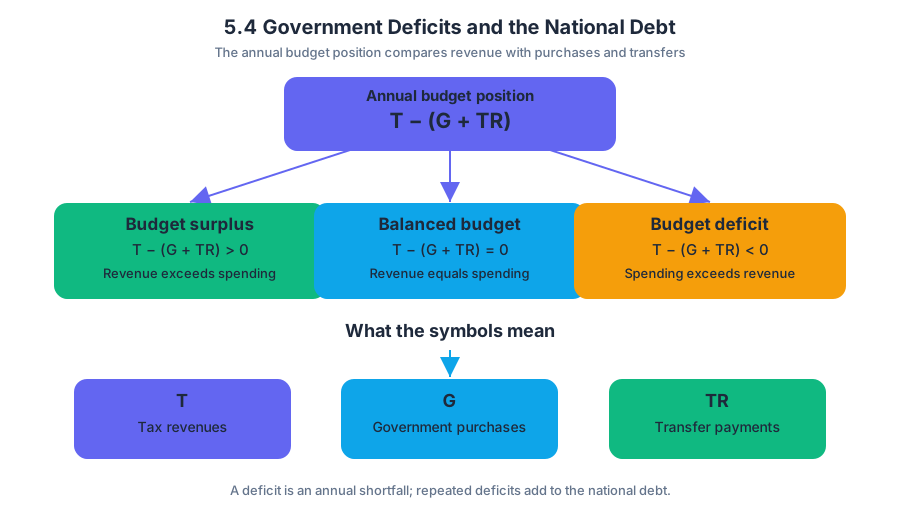
The government budget surplus or deficit is calculated as:
$$ \text{Budget surplus or deficit}=T-(G+TR) $$
where $T$ represents tax revenues, $G$ represents government purchases, and $TR$ represents transfer payments. A positive result is a surplus; a negative result is a deficit.
Learning Objective POL-3.B: Define the government budget surplus (deficit) and national debt, and explain the issues involved in the burden of the national debt.
Essential Knowledge POL-3.B.1: The government budget surplus (deficit) is the difference between tax revenues and government purchases plus transfer payments in a given year.
A useful visual distinction is:
| Annual budget position | Calculation | Immediate meaning |
|---|---|---|
| Budget surplus | $T-(G+TR)>0$ | Tax revenue exceeds purchases plus transfers |
| Balanced budget | $T-(G+TR)=0$ | Revenue equals purchases plus transfers |
| Budget deficit | $T-(G+TR)<0$ | Purchases plus transfers exceed tax revenue |
Worked example: Fehran
Suppose Fehran collects $110$ billion in taxes and makes $90$ billion in government purchases while paying $50$ billion in transfer payments. Its budget result is:
$$ T-(G+TR)=110-(90+50)=110-140=-30 $$
Fehran has a budget deficit of $30$ billion because government outlays are greater than taxes. It must finance that gap by borrowing, assuming it does not use previously accumulated financial assets.
Manipulation — Skill 3: Manipulation is central here: change one component of the expression and determine the outcome. If Fehran raises taxes by $20$ billion, the deficit falls from $30$ billion to $10$ billion. If instead it increases purchases by $20$ billion, the deficit grows to $50$ billion.
From a deficit to national debt
Essential Knowledge POL-3.B.2: A government adds to the national debt when it runs a budget deficit.
The deficit is the addition made during one year; the national debt is the total accumulated balance. All else equal, a surplus reduces the national debt, while a deficit increases it.
$$ \text{Debt}_{t}
\text{Debt}_{t-1} + \text{Current deficit}
\text{Current surplus} $$
For Fehran, if the national debt began at $800$ billion, the $30$ billion deficit raises it to $830$ billion. A later $12$ billion surplus would reduce the debt to $818$ billion, not erase the entire debt.
Misconception check — “The deficit and the debt are the same thing.”
They are not. A deficit is a yearly shortfall; the debt is the accumulated result of many shortfalls, less any surpluses.
Interest payments and opportunity cost
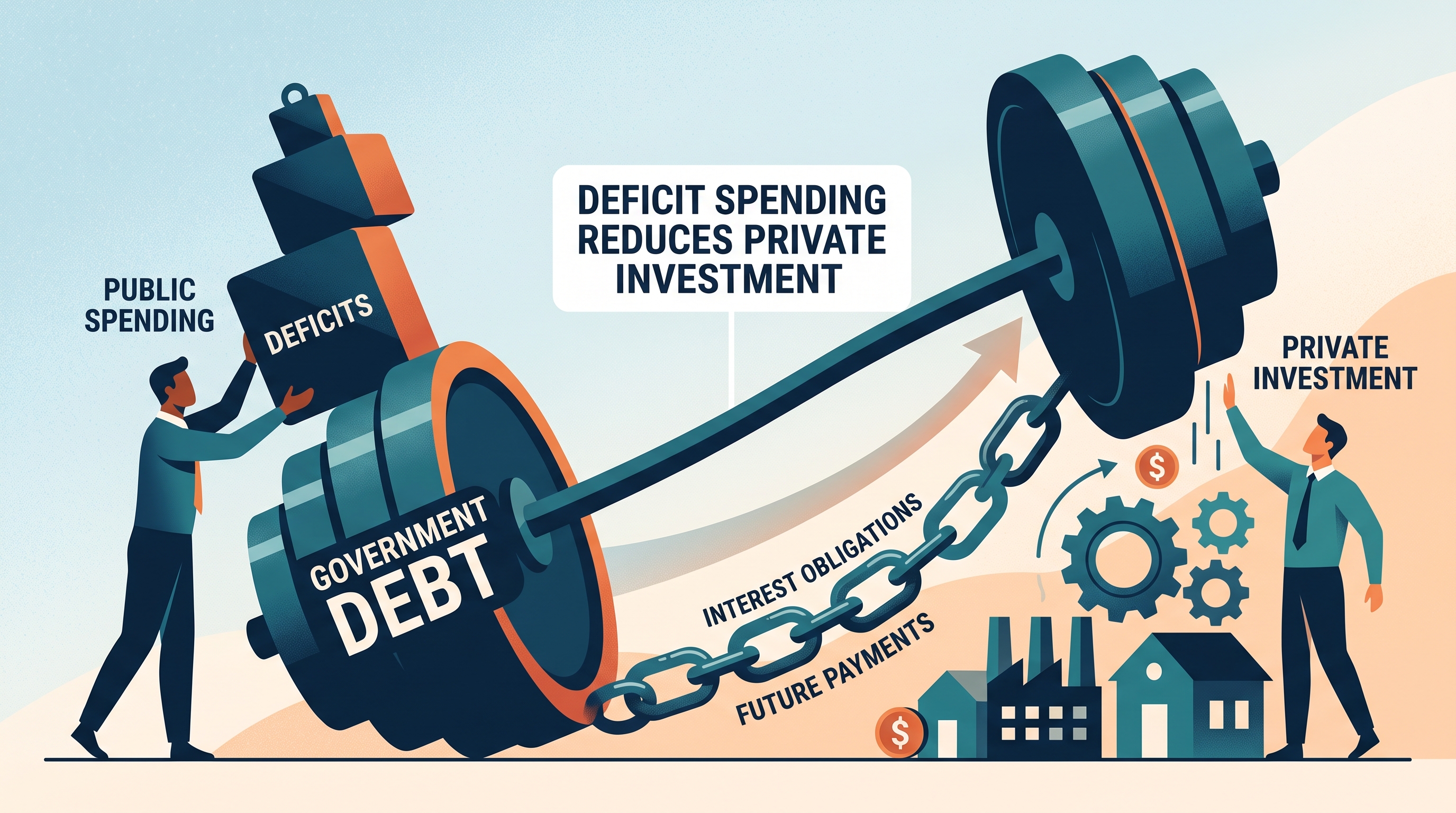
Essential Knowledge POL-3.B.3: A government must pay interest on its accumulated debt, thus increasing the national debt and increasingly forgoing those funds for alternative uses.
Borrowing creates a continuing obligation. If Fehran owes $830$ billion and must make $40$ billion in interest payments, those payments require government funds; if they are financed through additional borrowing, the debt rises further.
The economic burden is not simply the existence of a large number. Interest payments have an opportunity cost: money used to service existing debt cannot simultaneously fund infrastructure, education, emergency relief, tax reductions, or other public priorities. As debt accumulates, interest obligations can claim a larger share of the budget.
Long-run implications and the bridge to crowding out
Enduring Understanding POL-3: There are long-run implications of monetary and fiscal policy. Persistent deficits can increase borrowing, raise future interest obligations, and limit later policy choices.
When government borrowing competes with private borrowers for available loanable funds, it can reduce private investment or other interest-sensitive spending. This adverse effect is called crowding out; the detailed loanable-funds mechanism belongs to POL-3.C, but the causal starting point is established here: deficit spending usually requires borrowing.
Retrieval check: If $T=500$, $G=360$, and $TR=190$, is the government running a surplus or deficit, and by how much?
Answer: $500-(360+190)=-50$, so it is running a $50$ billion deficit. The national debt increases by $50$ billion, all else equal, before considering any further effects such as interest payments.
Source Materials
- AP Macroeconomics Course and Exam Description
- AP Macroeconomics Course and Exam Description Clarifications and Corrections
- AP Macroeconomics Course Overview
- AP Macroeconomics Course at a Glance
- AP Macroeconomics Course at a Glance Poster
- AP Macroeconomics
- AP Macroeconomics
- AP Macroeconomics Sample Syllabus 1
- State an increase in government spending, a decrease in taxes, or an increase in transfer payments.
- State an increase in government spending, a decrease in taxes, or an increase in transfer payments.
- State an increase in government spending, a decrease in taxes, or an increase in transfer payments.