From the free course AP Macroeconomics on Lykke
1.1 Scarcity
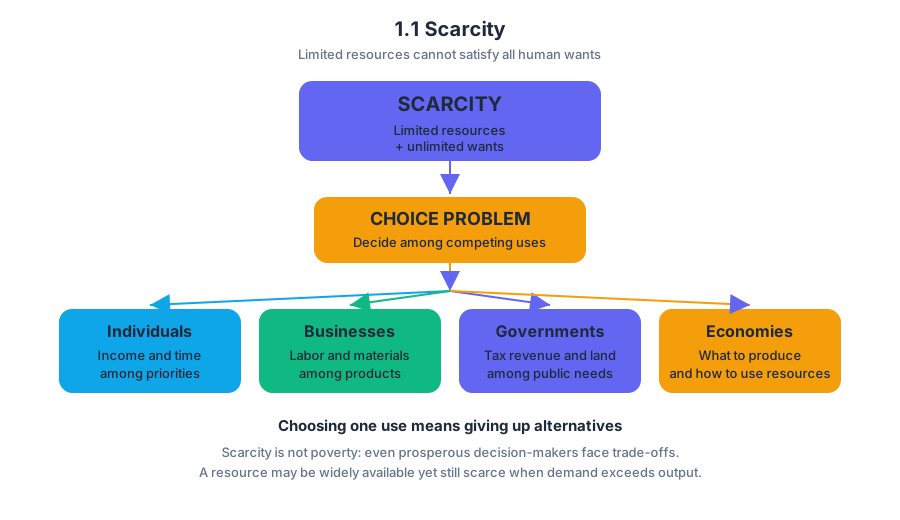
Every economy faces scarcity because the resources used to produce goods and services are limited, while human wants are effectively unlimited. Scarcity is not the same as poverty: even a wealthy household, successful business, or prosperous government must decide how to use limited time, money, workers, land, and…
1.1 Scarcity
Every economy faces scarcity because the resources used to produce goods and services are limited, while human wants are effectively unlimited. Scarcity is not the same as poverty: even a wealthy household, successful business, or prosperous government must decide how to use limited time, money, workers, land, and equipment among competing purposes.
Scarcity is the condition in which limited resources cannot satisfy all human wants.
The central economic problem is therefore a choice problem. If a city has one vacant parcel of land, it cannot simultaneously use that exact parcel for a school, a hospital, apartments, and a park. If a student has two hours before an exam, those hours cannot be fully devoted to studying, working, sleeping, and socializing at the same time. Choosing one use means giving up at least one alternative.
Scarcity operates at every level of economic decision-making:
- Individuals and households allocate limited income and time.
- Businesses allocate limited labor, raw materials, machinery, and financial resources.
- Governments allocate limited tax revenue, public workers, land, and administrative capacity.
- Entire economies must decide which goods and services to produce and how to use available resources.
The existence of scarcity does not mean that every item is rare in an absolute sense. A product can be widely available and still be scarce if people want more of it than can be produced with current resources. Scarcity is about the relationship between available resources and desired uses, not merely about whether an object exists.
Scarcity creates economic choices
Suppose a coastal town has enough construction workers and materials to complete only one major project this year. Residents want both a flood barrier and a new community health center. The resources are scarce relative to the town’s competing wants, so the town must choose. Building the flood barrier may protect homes and businesses; building the health center may improve access to medical care. The economic issue is not whether either project is desirable. Both are desirable. The issue is that the town cannot undertake both with the resources currently available.
A choice is necessary whenever resources have alternative uses. Alternative uses are the different purposes to which a resource could be devoted. A worker can produce one type of good during a particular hour; a building can house one activity at a time; a government dollar can fund one program rather than another. Scarcity makes prioritization unavoidable.
Key chain:
Limited resources $\rightarrow$ competing uses $\rightarrow$ necessary choices.
The next economic question is what is sacrificed by a choice. That sacrifice is called opportunity cost, developed formally with the Production Possibilities Curve in Topic 1.2. Scarcity is the condition that makes opportunity cost unavoidable; it does not itself identify the specific alternative sacrificed.
Scarcity versus shortage
A shortage is a situation in which quantity demanded exceeds quantity supplied at a particular price. A shortage may be temporary—for example, when a sudden storm disrupts deliveries—or persistent if the price remains below the market-clearing level or if production remains constrained.
Scarcity and shortage are related but distinct:
| Concept | Meaning | Example |
|---|---|---|
| Scarcity | Resources are insufficient to satisfy all wants. | Limited urban land must serve housing, transportation, and recreation. |
| Shortage | At a particular price, buyers want more than sellers offer. | At a legally fixed low price, more renters seek apartments than landlords provide. |
A shortage can exist for one good while scarcity exists throughout the economy. Conversely, a scarce good does not automatically produce a shortage: if its price adjusts so that quantity demanded equals quantity supplied, the market may have no shortage at that moment. Scarcity is fundamental and unavoidable; a shortage is a market condition connected to a particular price.
Worked example: choosing under scarcity
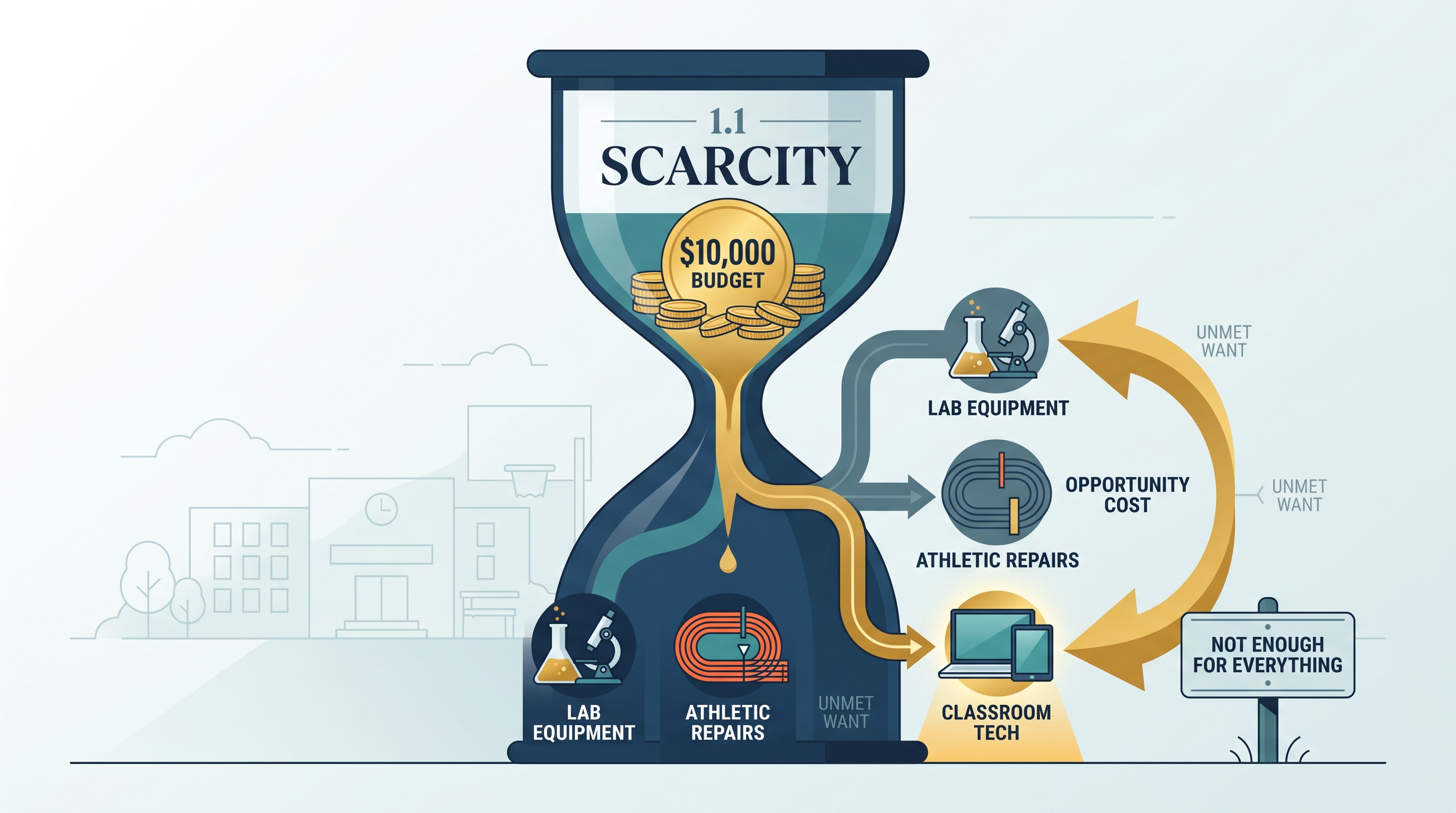
A school has $10{,}000$ available for one improvement. It can purchase laboratory equipment, repair athletic facilities, or upgrade classroom technology. Because the budget is limited and all three projects are valued, the school faces scarcity.
To reason correctly:
- The scarce resource is the school’s $10{,}000$ budget.
- The competing wants are laboratory equipment, athletic repairs, and classroom technology.
- The necessary choice is which project receives the funds.
- The chosen project uses resources that cannot simultaneously be used for the other projects.
- The best rejected alternative becomes relevant as the opportunity cost.
Named misconception — “Scarcity means nobody can obtain the good.” Incorrect. Scarcity means that available resources cannot satisfy every desired use. People may still obtain the good, but choices, trade-offs, and possibly prices determine who receives it and how much is available.
Application check: A hospital has only one intensive-care bed available, while two patients need it. Identify the scarce resource, the competing wants, and the choice that scarcity requires. Then state why the situation illustrates scarcity even if the hospital is otherwise well funded.
Retrieval check: A store has plenty of coffee in stock, but at its current low price customers want more coffee than the store offers. Is this primarily an example of scarcity, a shortage, or both? Explain the distinction in one sentence.
Source Materials
- AP Macroeconomics Course and Exam Description
- AP Macroeconomics Course and Exam Description Clarifications and Corrections
- AP Macroeconomics Course Overview
- AP Macroeconomics Course at a Glance
- AP Macroeconomics Course at a Glance Poster
- AP Macroeconomics
- AP Macroeconomics
- AP Macroeconomics Sample Syllabus 1
- AP Macroeconomics-AP Students-College Board
- AP Macroeconomics FRQ Practice
- AP/College Macroeconomics-Khan Academy
- AP Macroeconomics Units/Save my Exams