From the free course AP Macroeconomics on Lykke
4.3 Definition, Measurement, and Functions of Money
Key concepts: Money as an asset generally accepted as payment · The three functions of money: medium of exchange, unit of account, and store of value · Liquidity and its relationship to money · Commodity money · Fiat money · The money supply · M1 · M2
Money is an asset that people generally accept as payment, allowing an economy to trade without requiring each buyer and seller to want exactly what the other offers.
4.3 Definition, Measurement, and Functions of Money
Money is an asset that people generally accept as payment, allowing an economy to trade without requiring each buyer and seller to want exactly what the other offers.
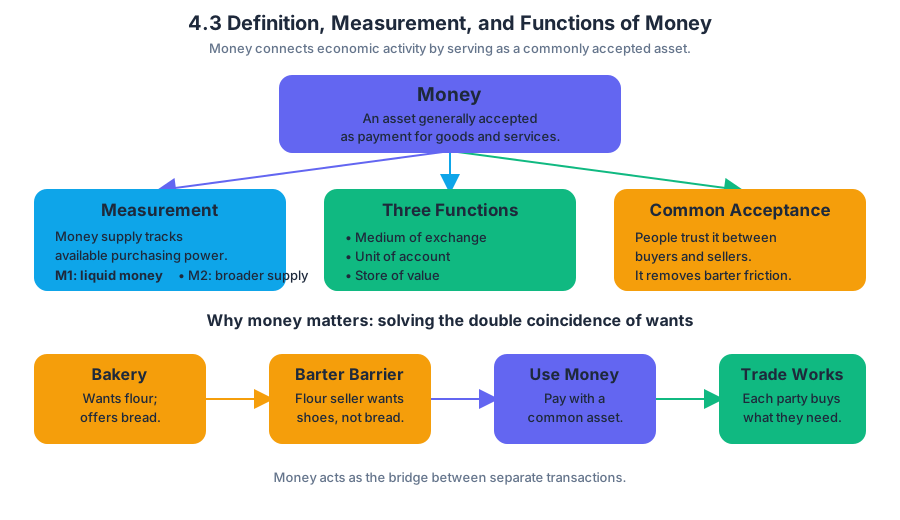
Imagine a bakery that wants flour, while the flour seller wants shoes rather than bread. Without money, the bakery must find someone who both sells flour and wants bread—a difficult double coincidence of wants. Money solves the problem by giving everyone a commonly accepted item to use between transactions.
What makes something money?
Money is an asset generally accepted as payment for goods and services and for the repayment of debts.
Money is not identical to wealth. Wealth includes houses, machinery, stocks, bonds, land, and other valuable assets. Money is one part of wealth, distinguished by its ability to function directly in transactions.
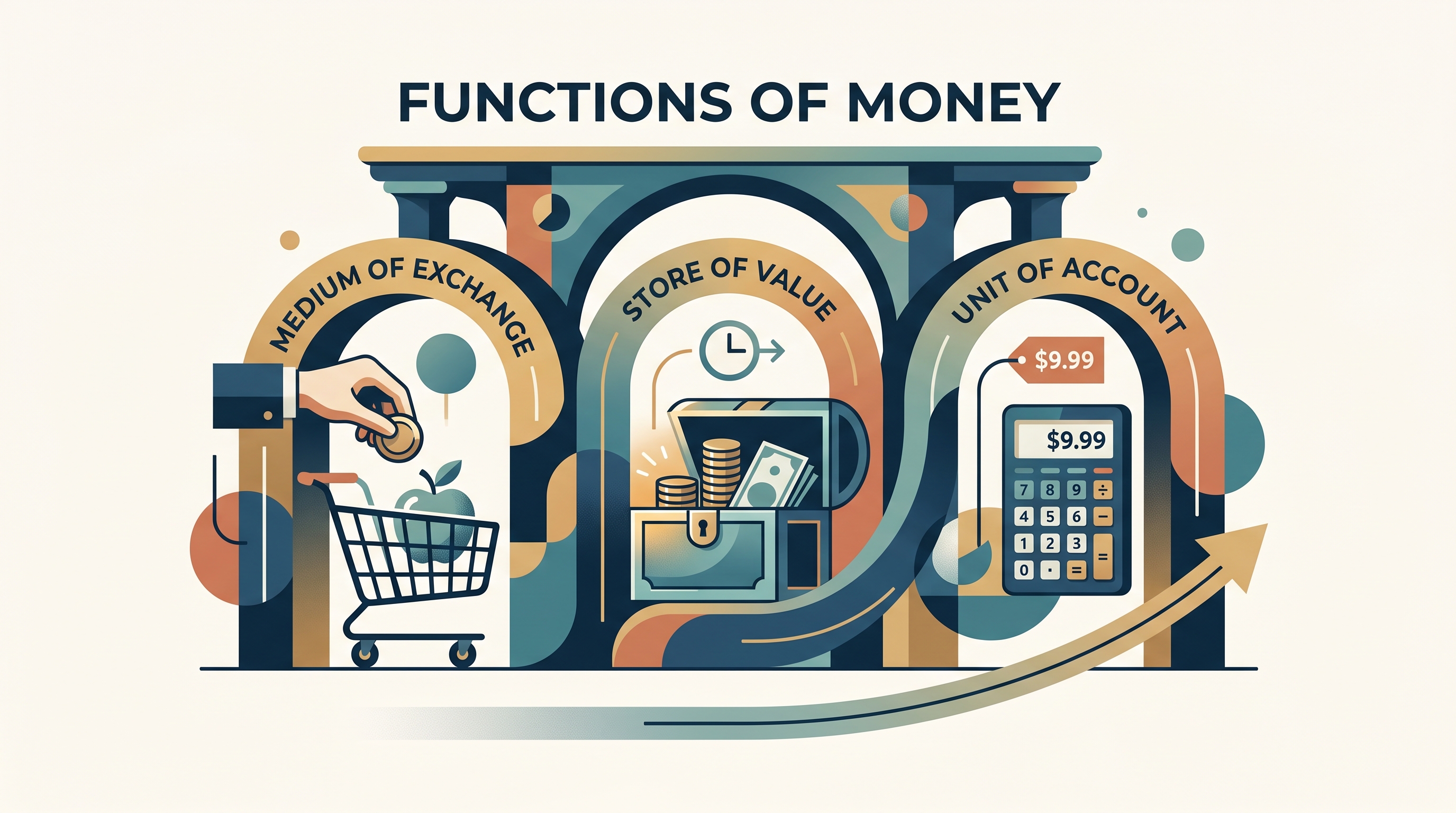
Money performs three connected functions:
- Medium of exchange: It facilitates transactions because sellers accept it in exchange for goods and services.
- Unit of account: It provides a common numerical system for measuring and comparing values.
- Store of value: It can be saved and used to purchase goods and services in the future.
A price such as $4.00 for a sandwich uses money as a unit of account: it lets consumers compare the sandwich with a $2.00 coffee or a $40.00 meal. When the customer hands over $4.00, money acts as a medium of exchange. If the customer keeps the remaining cash for next week, money acts as a store of value.
Retrieval check
A rare painting may be a valuable store of wealth, but it is usually a poor medium of exchange because most stores will not accept it at checkout. Which function of money is missing? Medium of exchange.
Liquidity: how quickly value can be spent
Liquidity is the ease with which an asset can be converted into a medium of exchange without losing value.
Currency is highly liquid: a $20 bill can be used immediately and normally retains its face value in the transaction. A house is much less liquid because selling it takes time, requires a buyer, and may involve a price reduction. A savings account is generally more liquid than a house but less immediately spendable than currency if transfers or withdrawals are restricted.
Liquidity explains why money is especially useful even when other assets may earn a higher return. Holding money makes transactions convenient, while holding less-liquid assets may require conversion before spending. The key question is not merely “Does this asset have value?” but “Can it become a means of payment quickly without losing value?”
Commodity money and fiat money
Commodity money has value partly because of the commodity itself. Gold, silver, or cigarettes used as money can have nonmonetary uses or value independent of their role in exchange.
Fiat money has value because the government declares it legal tender and because people accept it in payment. A modern dollar bill is not valuable because the paper can be used for another productive purpose; its purchasing power depends on legal recognition, public confidence, and acceptance throughout the economy.
| Type of money | Where its value comes from | Example |
|---|---|---|
| Commodity money | The underlying commodity itself, as well as its usefulness in exchange | Gold or cigarettes |
| Fiat money | Government designation as legal tender and public acceptance | Modern currency |
Misconception check — “Fiat” means worthless. Fiat money is not necessarily worthless or unstable. “Fiat” identifies the source of its value: legal status and acceptance rather than a valuable material contained in the money itself.
Measuring the money supply: M1 and M2
The money supply is the total quantity of money available in an economy, measured with monetary aggregates such as M1 and M2.
M1 focuses on assets used most directly for everyday payments. It includes:
- Currency in circulation
- Demand deposits
- Other checkable deposits
- Travelers’ checks
M2 includes everything in M1 plus assets that are slightly less liquid but can be converted into spendable funds relatively easily:
- Savings deposits
- Small time deposits
- Retail money market mutual fund shares
The relationship can be represented compactly as
$$ M2 = M1 + \text{savings deposits} + \text{small time deposits} + \text{retail money market mutual fund shares}. $$
For example, suppose an economy has $900$ billion in M1, $500$ billion in savings deposits, $100$ billion in small time deposits, and $50$ billion in retail money market mutual fund shares. Then
$$ M2 = 900 + 500 + 100 + 50 = 1{,}550\text{ billion dollars}. $$
The categories are aggregates, not separate piles of physical bills. Much of the money supply consists of account balances recorded electronically. Also, M2 is broader than M1, so an asset can be included in M2 without being as immediately spendable as currency.
AP skill connection: 1.B — Principles and Models
The suggested skill for Topic 4.3 is Skill Category 1: Principles and Models, 1.B: “Identify an economic concept, principle, or model illustrated by an example.” On an assessment, the task may present a situation rather than name the concept: a shopper pays with a debit card, a household holds savings, or a government requires a currency to be accepted for debts. The response must identify the relevant concept—medium of exchange, store of value, liquidity, fiat money, M1, or M2—and connect it to the evidence.
A reliable identification routine is:
- Ask whether the example concerns using, measuring, or saving money.
- If it concerns immediate spending, examine the asset’s liquidity.
- If it concerns the source of value, distinguish commodity money from fiat money.
- If it lists financial components, classify them under M1 or M2.
Final interpretation check: A household owns a certificate of deposit that cannot be withdrawn immediately without a penalty. Is it money in the same sense as currency? It is less liquid than currency and is included in M2 only when it meets the small-time-deposit definition; it is not part of M1.
Source Materials
- AP Macroeconomics Course and Exam Description
- AP Macroeconomics Course and Exam Description Clarifications and Corrections
- AP Macroeconomics Course Overview
- AP Macroeconomics Course at a Glance
- AP Macroeconomics Course at a Glance Poster
- AP Macroeconomics
- AP Macroeconomics
- AP Macroeconomics Sample Syllabus 1