From the free course AP Macroeconomics on Lykke
AP Practice 5
A short free-response question can test several macroeconomic skills at once: identifying a model, explaining a causal chain, calculating a numerical outcome, and interpreting the result in context.
AP Practice 5
A short free-response question can test several macroeconomic skills at once: identifying a model, explaining a causal chain, calculating a numerical outcome, and interpreting the result in context. The strongest responses do not merely state that a variable “increases” or “decreases”; they connect the change to a named economic mechanism.
Task type: Original, unofficial short free-response practice focused on assertions, explanations, numerical analysis, and graph creation.
Suggested timing: $15$ minutes, followed by $10$ minutes of error review.
Useful skill categories: 1. Principles and Models, 2. Interpretation, 3. Manipulation, and 4. Graphing and Visuals.
The scenario: a demand shock and stabilization policy
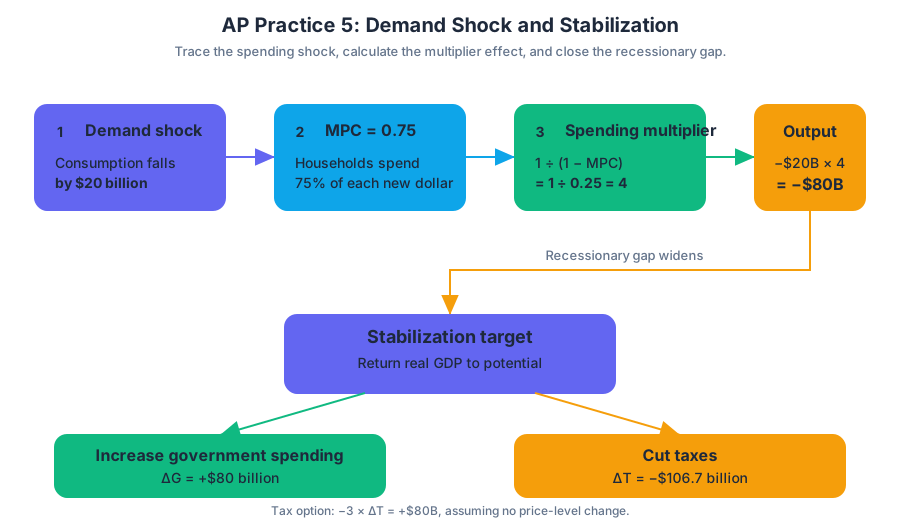
Suppose the economy of Lydora is experiencing a recessionary gap. Households become pessimistic about future income and reduce consumption spending by $20$ billion. The marginal propensity to consume is $0.75$. The price level is initially stable, and the government does not immediately change its fiscal policy.
The central question is: How large is the initial output effect, and what fiscal action could return real GDP to its potential level?
Practice prompt
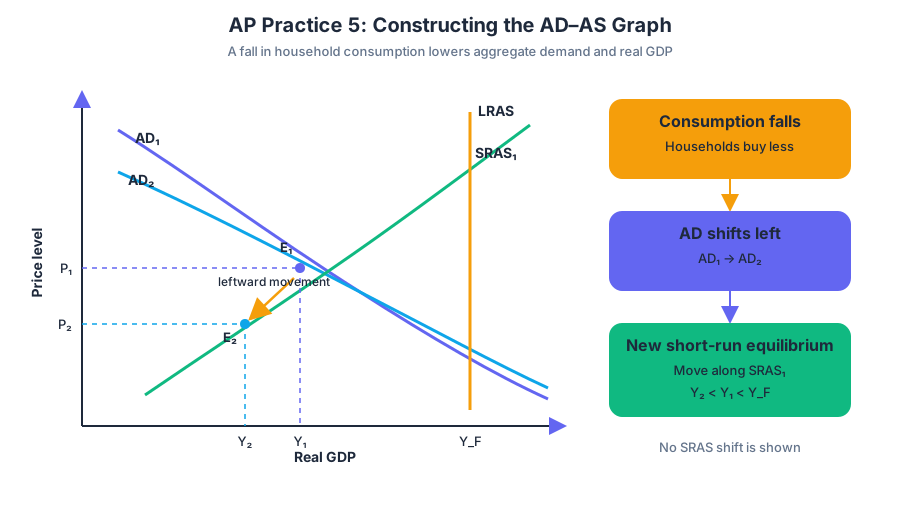
(a) Draw a correctly labeled aggregate demand–aggregate supply graph showing the economy’s initial recessionary gap. Label the initial equilibrium price level $P_1$, real GDP $Y_1$, and potential output $Y_F$.
(b) Calculate the maximum possible change in real GDP resulting from the $20$ billion decrease in consumption spending. Show your work.
(c) Assume the government wants to offset the entire decrease in real GDP using only government purchases. Calculate the required change in government purchases.
(d) Explain why the actual change in real GDP may be smaller than the maximum possible change calculated in part (b).
(e) Instead of changing government purchases, suppose the government reduces lump-sum taxes. Explain why the required tax reduction would be larger than the required increase in government purchases.
Worked reasoning
(a) Constructing the AD–AS graph
Because reduced household consumption lowers aggregate demand, the economy moves leftward along the existing short-run aggregate supply curve from potential output to a lower level of real GDP. The graph must show a downward-sloping aggregate demand curve, an upward-sloping short-run aggregate supply curve, and a vertical long-run aggregate supply curve at $Y_F$.
A complete graph labels both axes: the vertical axis is the price level, and the horizontal axis is real GDP. The initial equilibrium occurs where $AD_1$ intersects $SRAS_1$, producing $P_1$ and $Y_1$, with $Y_1 < Y_F$.
(b) Applying the spending multiplier
The expenditure multiplier measures the total change in equilibrium real GDP generated by an initial change in autonomous spending:
$$ \text{Spending multiplier}=\frac{1}{1-\text{MPC}} $$
With a marginal propensity to consume of $0.75$:
$$ \text{Spending multiplier}=\frac{1}{1-0.75}=\frac{1}{0.25}=4 $$
The initial consumption decrease is $-\$20$ billion, so:
$$ \Delta Y=(4)(-$20\text{ billion})=-$80\text{ billion} $$
Answer: The maximum possible decrease in real GDP is $80$ billion.
(c) Selecting government purchases
A change in government purchases enters aggregate demand directly, so it receives the full spending multiplier. To offset the $80$ billion decrease in real GDP:
$$ \Delta Y=(\text{spending multiplier})(\Delta G) $$
$$ $80\text{ billion}=(4)(\Delta G) $$
$$ \Delta G=$20\text{ billion} $$
Answer: Government purchases must increase by $20$ billion, assuming the economy is in the multiplier model’s maximum-impact conditions.
(d) Why the maximum effect may not occur
The calculated $80$ billion effect assumes that each round of new income generates consumption according to the stated MPC, with no leakages beyond saving. In reality, households may save more, pay taxes, or purchase imported goods. These leakages reduce later rounds of spending, so the actual multiplier and output change may be smaller.
(e) Comparing purchases and taxes
A tax cut does not increase aggregate demand dollar for dollar because households initially spend only the fraction represented by the MPC. The tax multiplier is:
$$ \text{Tax multiplier}=-\frac{\text{MPC}}{1-\text{MPC}} $$
Here:
$$ \text{Tax multiplier}=-\frac{0.75}{0.25}=-3 $$
To raise real GDP by $80$ billion:
$$ $80\text{ billion}=(-3)(\Delta T) $$
$$ \Delta T=-$26.67\text{ billion} $$
Answer: Taxes must decrease by approximately $26.67$ billion. The reduction is larger than the $20$ billion increase in government purchases because only $75$ cents of each tax-cut dollar initially becomes consumption.
What earns credit
| Part | Examiner-rewarded reasoning |
|---|---|
| (a) | Correctly labeled axes, curves, equilibrium, and recessionary gap |
| (b) | Correct multiplier formula, substitution, and negative $80$ billion result |
| (c) | Uses the spending multiplier and identifies an increase in government purchases |
| (d) | Explains leakages or why the maximum multiplier may not be realized |
| (e) | Uses the tax multiplier and explains the MPC distinction |
Misconception check
Named misconception: “A $20$ billion spending decrease causes only a $20$ billion GDP decrease.” The initial decline is $20$ billion, but one person’s reduced spending becomes another person’s reduced income. Repeated rounds of lower consumption create the larger multiplied effect.
Retrieval check: If the MPC fell from $0.75$ to $0.50$, would the spending multiplier become larger or smaller? The answer is smaller: it would fall from $4$ to $2$, because each round of income produces less additional consumption.
Error-review routine
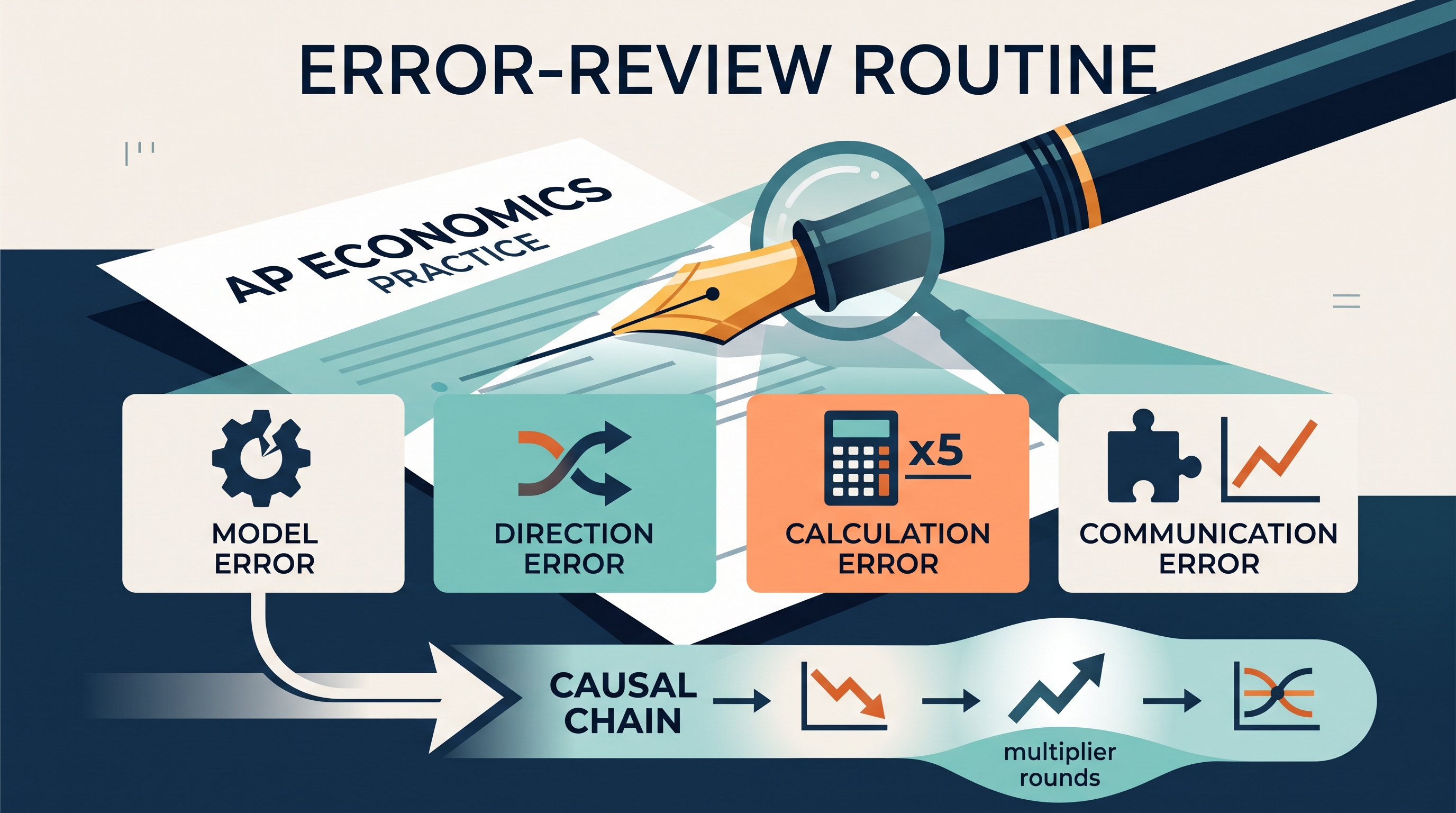
After completing the question, classify every error as one of four types: model error—the wrong graph or economic model; direction error—the correct model but the wrong increase/decrease; calculation error—incorrect formula or arithmetic; or communication error—an unsupported assertion, missing label, or absent unit. Redo only the missed part, then write one sentence explaining the causal chain: consumption falls → aggregate demand falls → equilibrium real GDP falls → multiplier rounds amplify the initial change.
Source Materials
- AP Macroeconomics Course and Exam Description
- AP Macroeconomics Course and Exam Description Clarifications and Corrections
- AP Macroeconomics Course Overview
- AP Macroeconomics Course at a Glance
- AP Macroeconomics Course at a Glance Poster
- AP Macroeconomics
- AP Macroeconomics
- AP Macroeconomics Sample Syllabus 1
- AP Macroeconomics-AP Students-College Board
- AP Macroeconomics FRQ Practice
- AP/College Macroeconomics-Khan Academy
- AP Macroeconomics Units/Save my Exams