From the free course AP Macroeconomics on Lykke
6.2 Exchange Rates
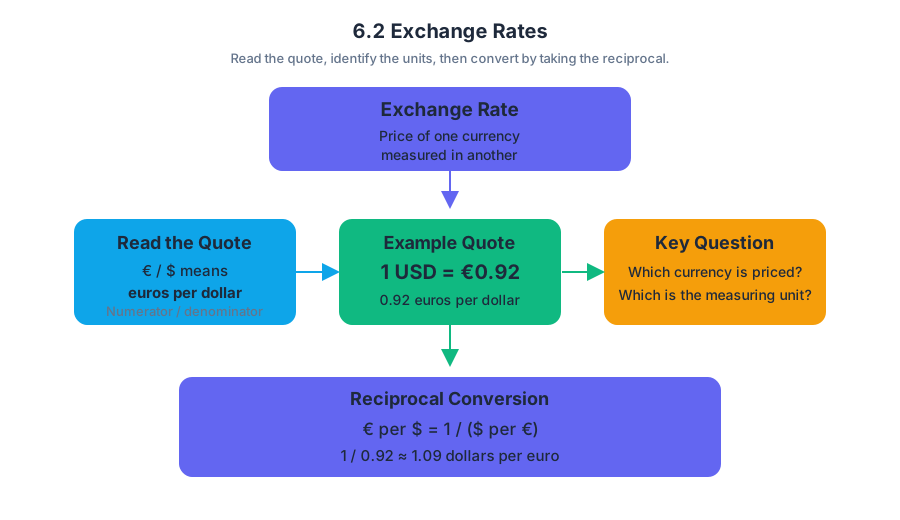
An exchange rate is the price of one currency measured in units of another currency. If $1$ U.S. dollar exchanges for €$0.92$, then the exchange rate is $0.92$ euros per dollar: $1\ \text{USD} = €0.92$.
6.2 Exchange Rates
An exchange rate is the price of one currency measured in units of another currency. If $1$ U.S. dollar exchanges for €$0.92$, then the exchange rate is $0.92$ euros per dollar: $1\ \text{USD} = €0.92$.
The key question is always: which currency is being priced, and which currency is the unit of measurement? A quotation such as €/$ means “euros per dollar,” while $/€ means “dollars per euro.” These are reciprocals:
$$ \text{€ per $}=\frac{1}{\text{$ per €}} $$
If $1$ dollar equals €$0.92$, then $1$ euro equals approximately $1.09$ dollars:
$$ \frac{1}{0.92}\approx 1.09 $$
Appreciation and depreciation
A currency appreciates when it becomes more valuable relative to another currency. It can then purchase more units of the foreign currency. A currency depreciates when it becomes less valuable and purchases fewer units of the foreign currency.
Suppose the exchange rate changes from $1\ \text{USD}=€0.92$ to $1\ \text{USD}=€0.80$. One dollar now buys fewer euros, so the dollar has depreciated relative to the euro. Equivalently, the euro has appreciated relative to the dollar.
The direction depends on the quotation. If the exchange rate is written as dollars per euro, $1\ \text{EUR}=$1.09$ becoming $1\ \text{EUR}=$1.25$ means the euro appreciates. But if it is written as euros per dollar, €/$, an increase means the dollar appreciates relative to the euro. Never label appreciation or depreciation until the numerator and denominator currencies are clear.
Exam rule: An increase in a currency’s value is an appreciation; a decrease is a depreciation. The numerical direction alone is not enough.
Worked contextual example: travel and trade
A U.S. student plans to buy a €$500$ camera. Initially, the exchange rate is $1\ \text{USD}=€0.92$. The dollar cost is:
$$ \text{Cost in dollars}=\frac{€500}{€0.92/$1}\approx $543.48 $$
Now suppose the dollar appreciates to $1\ \text{USD}=€1.00$. The same camera costs:
$$ \frac{€500}{€1.00/$1}=$500 $$
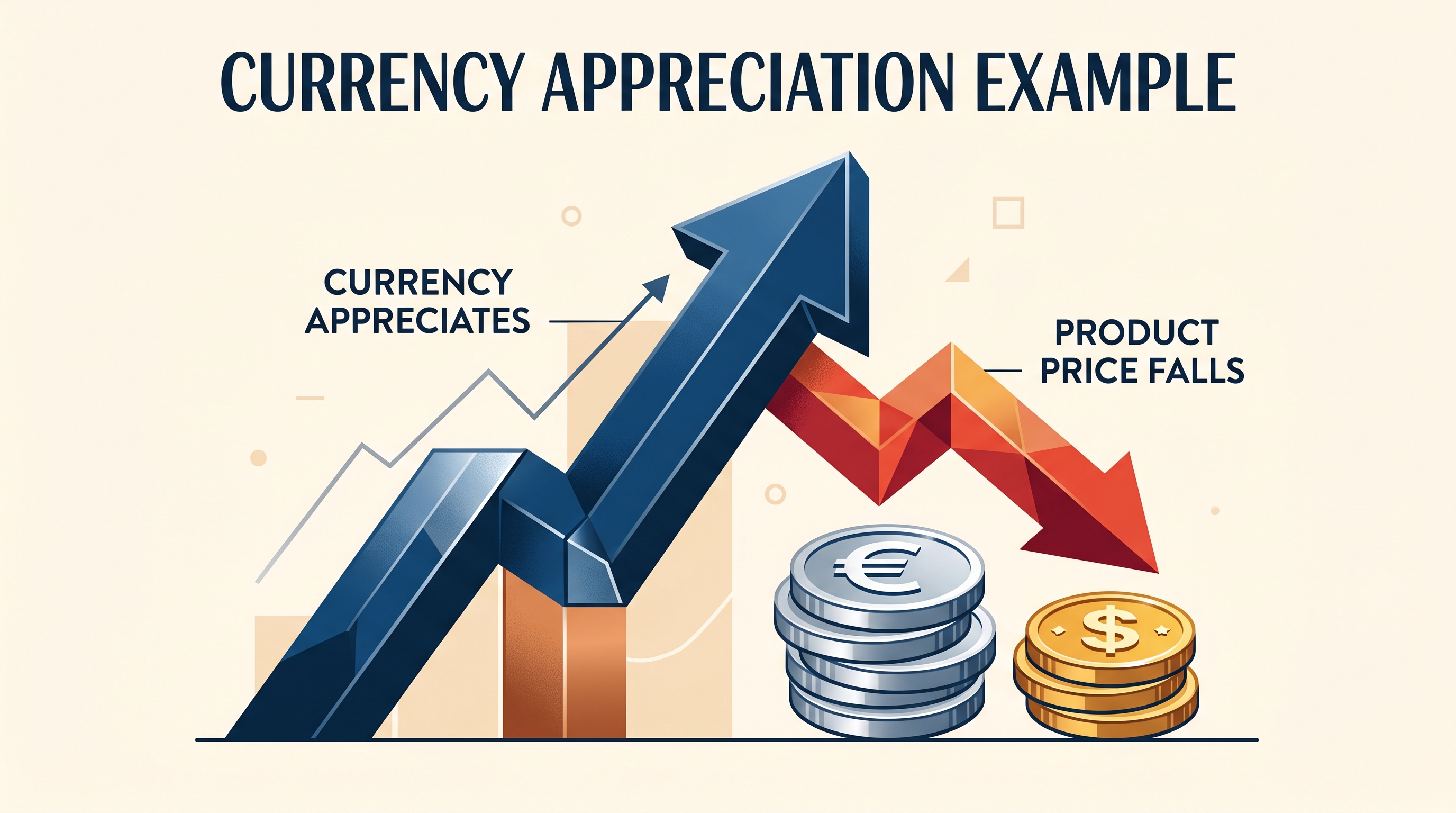
The appreciated dollar makes European goods cheaper for U.S. buyers. At the same time, U.S. goods become more expensive to European buyers because each euro purchases fewer dollars. Thus, holding other factors constant:
- U.S. imports tend to increase.
- U.S. exports tend to decrease.
- U.S. net exports, defined as $NX=X-M$, tend to decrease.
The reverse occurs after a dollar depreciation: U.S. exports become relatively cheaper to foreign buyers, imports become relatively more expensive to U.S. buyers, and U.S. net exports tend to increase. The effect on aggregate demand follows because net exports are one component of aggregate demand:
$$ AD=C+I+G+NX $$
Connection to international accounts
An exchange-rate movement also changes the value of international transactions when they are converted into a common currency. A U.S. firm earning revenue in euros receives fewer dollars when the dollar appreciates, even if the euro price of the product has not changed. This is why exchange rates matter for both trade decisions and the recording of international flows.
Common misconception: “a higher number always means appreciation”
Misconception: “If the exchange-rate number rises, the domestic currency must have appreciated.”
Correction: The quotation determines the interpretation. If the rate rises from $$1.10$ per euro to $$1.25$ per euro, the euro appreciates because it now costs more dollars. But if the rate rises from €$0.91$ per dollar to €$0.95$ per dollar, the dollar appreciates because it now buys more euros.
AP reasoning and skills
This topic is assessed through Learning Objective 6.2.A: Define exchange rates and the associated Essential Knowledge 6.2.A.1: An exchange rate is the price of one currency in terms of another currency. Apply the identifiers by naming both currencies, identifying the quotation, and then explaining the appreciation or depreciation rather than guessing from the number.
The most important connected AP skills are Skill Category 1: Principles and Models, especially 1.A: Define economic principles and models and 1.B: Explain economic principles and models; Skill Category 2: Interpretation, especially 2.A: Identify economic concepts, principles, and models and 2.B: Interpret economic data, information, and models; Skill Category 3: Manipulation, especially 3.A: Solve economic problems using mathematical procedures; and Skill Category 4: Graphing and Visuals, especially 4.A: Draw correctly labeled graphs and visual representations. In practice, these skills require students to interpret a currency quotation, calculate a reciprocal or converted price, and connect the exchange-rate change to exports, imports, and net exports.
Retrieval check: If the exchange rate changes from $$1=€0.80$ to $$1=€0.88$, which currency appreciated? What happens to the dollar price of a €$440$ product?
Answer: The dollar appreciated because it buys more euros. The product’s dollar price falls from $$550$ to $$500$:
$$ \frac{€440}{€0.80/$1}=$550, \qquad \frac{€440}{€0.88/$1}=$500 $$
Source Materials
- AP Macroeconomics Course and Exam Description
- AP Macroeconomics Course and Exam Description Clarifications and Corrections
- AP Macroeconomics Course Overview
- AP Macroeconomics Course at a Glance
- AP Macroeconomics Course at a Glance Poster
- AP Macroeconomics
- AP Macroeconomics
- AP Macroeconomics Sample Syllabus 1