From the free course AP Macroeconomics on Lykke
4.4 Banking and the Expansion of the Money Supply
Key concepts: Functions of money · Monetary base (M0 or MB) · Fractional-reserve banking · Money multiplier · Banking system and money-supply expansion · Bank reserves and currency holdings · Central-bank policy rate · Federal funds rate · Ample-reserves banking systems · Quantity theory of money
A bank can transform one deposit into a much larger volume of spendable deposits—not by printing currency, but by lending part of the reserves it holds.
4.4 Banking and the Expansion of the Money Supply
A bank can transform one deposit into a much larger volume of spendable deposits—not by printing currency, but by lending part of the reserves it holds. That process is fractional-reserve banking, and it explains how the banking system expands the money supply.
From money’s functions to bank-created deposits
A newly created bank deposit expands the money supply because the deposit can be used as a means of payment and held as a store of value. For example, when a bank credits a borrower’s checking account with a loan, the borrower can use that balance to purchase equipment even though no new physical currency has appeared.
The deposit also provides a unit of account: prices, debts, and loan balances can be recorded in the same monetary units. Thus, banking connects money’s functions to money creation: loans create deposits, and deposits make economic transactions possible.
Key idea: Banks do not create wealth simply by creating deposits. They create additional money-like purchasing power by recording deposits as liabilities while recording loans as assets.
The monetary base and bank balance sheets
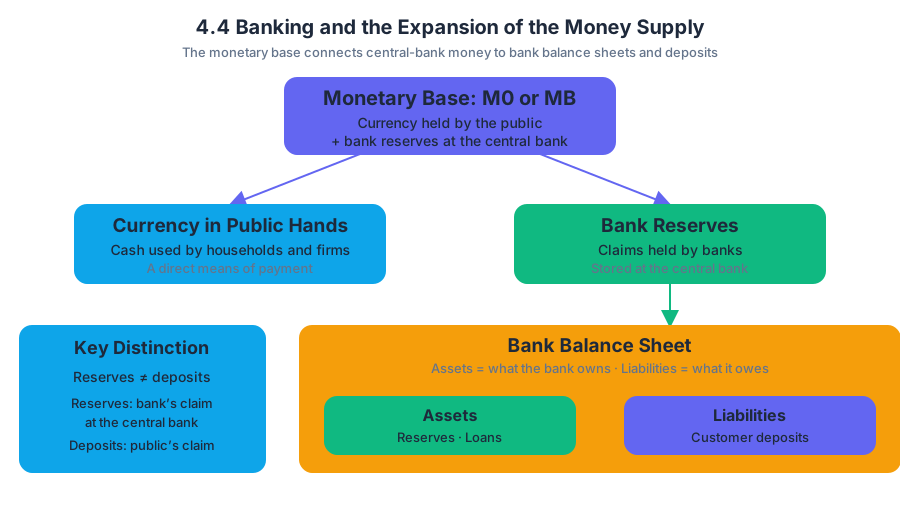
The monetary base, also called $M0$ or $MB$, consists primarily of currency held by the public plus bank reserves held at the central bank. A bank’s balance sheet records what it owns as assets and what it owes as liabilities.
Under POL-2.A.1, depository institutions use balance sheets to track assets and liabilities. A customer’s checking-account deposit is the bank’s liability because the bank owes that amount to the depositor; the bank’s reserves and loans are assets.
The central distinction is that reserves are not identical to deposits. Reserves are claims held by banks at the central bank, while deposits are claims held by the public at banks. When a bank lends, reserves may support the transaction, but the borrower receives a deposit that can circulate through the economy.
Fractional-reserve banking
Under POL-2.A.2, banks operate through fractional-reserve banking: they hold only a fraction of deposits as reserves and lend or invest the remainder. The required reserve ratio, written as $r$, is the fraction of deposits a bank must hold as required reserves.
Reserves have two categories under POL-2.A.3:
- Required reserves: the minimum reserves associated with a bank’s deposits.
- Excess reserves: reserves held above the required minimum.
Excess reserves matter because they provide the immediate basis for additional lending and deposit creation, as identified in POL-2.A.4. A bank cannot safely expand loans indefinitely: it must maintain enough reserves to meet withdrawals, payments to other banks, and applicable requirements.
Worked example: one deposit, many deposits
Suppose a banking system receives an initial deposit of $1{,}000$ and the required reserve ratio is $0.10$. The first bank keeps $100$ as required reserves and lends $900$.
If the borrower spends the $900$ and the recipient deposits the payment in another bank, that second bank keeps $90$ and lends $810$. Repeated redepositing and relending produces the following idealized sequence:
$$ 1{,}000 + 900 + 810 + 729 + \cdots $$
The simple money multiplier is the ratio of the money supply to the monetary base, as specified in POL-2.A.5. Its maximum value is determined by the reciprocal of the required reserve ratio under POL-2.A.7:
$$ \text{Money multiplier}=\frac{1}{r} $$
Here,
$$ \frac{1}{0.10}=10 $$
so the maximum total deposit expansion from $1{,}000$ of new reserves is:
$$ \Delta \text{Deposits}=\frac{1}{r}\times \Delta \text{Reserves} =10\times 1{,}000 =10{,}000 $$
This is a maximum, not a guaranteed outcome. The calculation assumes every bank lends all excess reserves and that the public redeposits every dollar rather than holding currency.
Why actual expansion is smaller
Under POL-2.A.6 and POL-2.A.8, actual money-supply expansion depends on behavior throughout the banking system. The simple multiplier overstates expansion when banks hold excess reserves or when the public keeps more currency outside banks.
Misconception check — “A bank lends out the original deposit.” A bank does not hand the same deposit to the borrower and erase the depositor’s claim. It keeps the depositor’s account as a liability and creates a loan as an asset; the loan generally generates a new deposit in the borrower’s account. The banking system’s repeated process of deposits and loans expands the measured money supply.
Policy rates in an ample-reserves system
The central bank can influence nominal interest rates and the money supply through monetary policy. An interest rate is the price paid for borrowing money and the return received from saving.
The policy rate is the central bank’s administered target or operating rate—the rate it directly sets or closely controls through its policy tools. In the United States, the federal funds rate is the interest rate banks charge one another for overnight loans of reserves. The Federal Reserve influences this market rate by changing administered rates, especially the interest rate paid on reserves, which helps guide the federal funds rate toward the central bank’s desired level.
In a traditional limited-reserves system, changing the quantity of reserves can move the federal funds rate and affect lending conditions. In an ample-reserves system, banks already hold abundant reserves, so adding or removing reserves does not effectively change the nominal interest rate. Instead, the central bank primarily changes administered rates, including interest on reserves, to guide the federal funds rate and other market rates.
Exam distinction: In an ample-reserves system, expansionary policy means lowering administered rates—not necessarily increasing the quantity of reserves. Contractionary policy means raising administered rates.
Retrieval check
A bank receives $2{,}000$ in new reserves, and the required reserve ratio is $0.20$. The simple multiplier is $\frac{1}{0.20}=5$, so the maximum deposit expansion is $10{,}000$. If banks hold excess reserves or households hold currency, is the actual expansion larger, equal to, or smaller than $10{,}000$? Answer: smaller. In an ample-reserves system, would the central bank normally rely on a large change in reserves to alter the federal funds rate? Answer: no; it would adjust administered policy rates, such as interest on reserves.

Source Materials
- AP Macroeconomics Course and Exam Description
- AP Macroeconomics Course and Exam Description Clarifications and Corrections
- AP Macroeconomics Course Overview
- AP Macroeconomics Course at a Glance
- AP Macroeconomics Course at a Glance Poster
- AP Macroeconomics
- AP Macroeconomics
- AP Macroeconomics Sample Syllabus 1