From the free course AP Macroeconomics on Lykke
4.6 Monetary Policy
Key concepts: Monetary policy · Economic growth
When inflation rises too quickly or a recession leaves factories, workers, and machines idle, the central bank can influence spending by changing financial conditions. Monetary policy is the deliberate use of central-bank actions to affect the money supply, interest rates, aggregate demand, output, employment, and…
4.6 Monetary Policy
When inflation rises too quickly or a recession leaves factories, workers, and machines idle, the central bank can influence spending by changing financial conditions. Monetary policy is the deliberate use of central-bank actions to affect the money supply, interest rates, aggregate demand, output, employment, and the price level.
Monetary policy is conducted by the central bank—in the United States, the Federal Reserve—to pursue macroeconomic stability.
The policy transmission chain
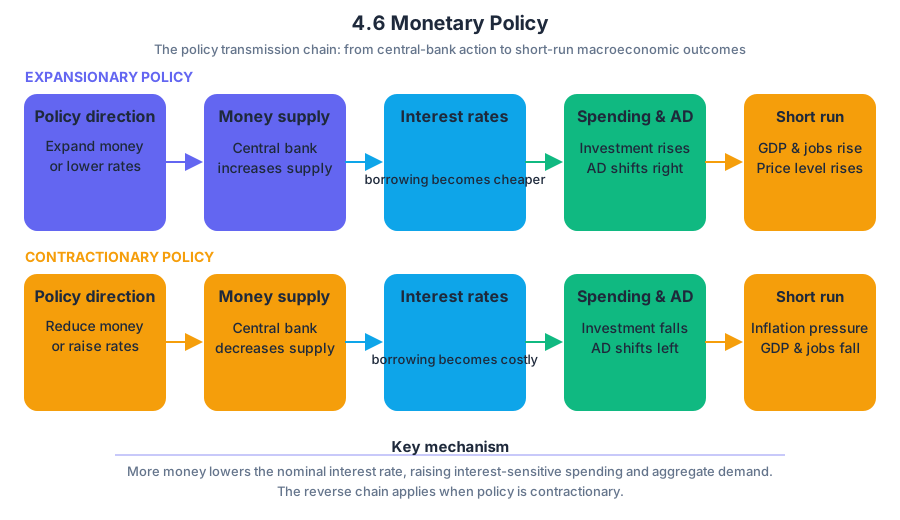
The key is not the policy instrument by itself, but the chain of effects that follows. Using the money-market result that an increase in money supply lowers the nominal interest rate, expansionary policy can raise interest-sensitive spending and aggregate demand.
| Policy direction | Central-bank action | Interest rates | Spending and aggregate demand | Short-run macroeconomic result |
|---|---|---|---|---|
| Expansionary monetary policy | Increase the money supply or lower the policy interest rate | Decrease | Investment and interest-sensitive consumption increase; $AD$ shifts right | Real GDP and employment rise; the price level tends to rise |
| Contractionary monetary policy | Decrease the money supply or raise the policy interest rate | Increase | Investment and interest-sensitive consumption decrease; $AD$ shifts left | Inflationary pressure falls; real GDP and employment tend to decline |
For example, suppose an economy is operating below full employment. The Federal Reserve adopts expansionary monetary policy, which lowers the nominal interest rate. Firms find it cheaper to finance new equipment, households face lower borrowing costs for durable goods, investment rises, and aggregate demand shifts right. In the short run, real output increases from $Y_1$ toward potential output $Y_f$, while the price level rises from $PL_1$ to $PL_2$.
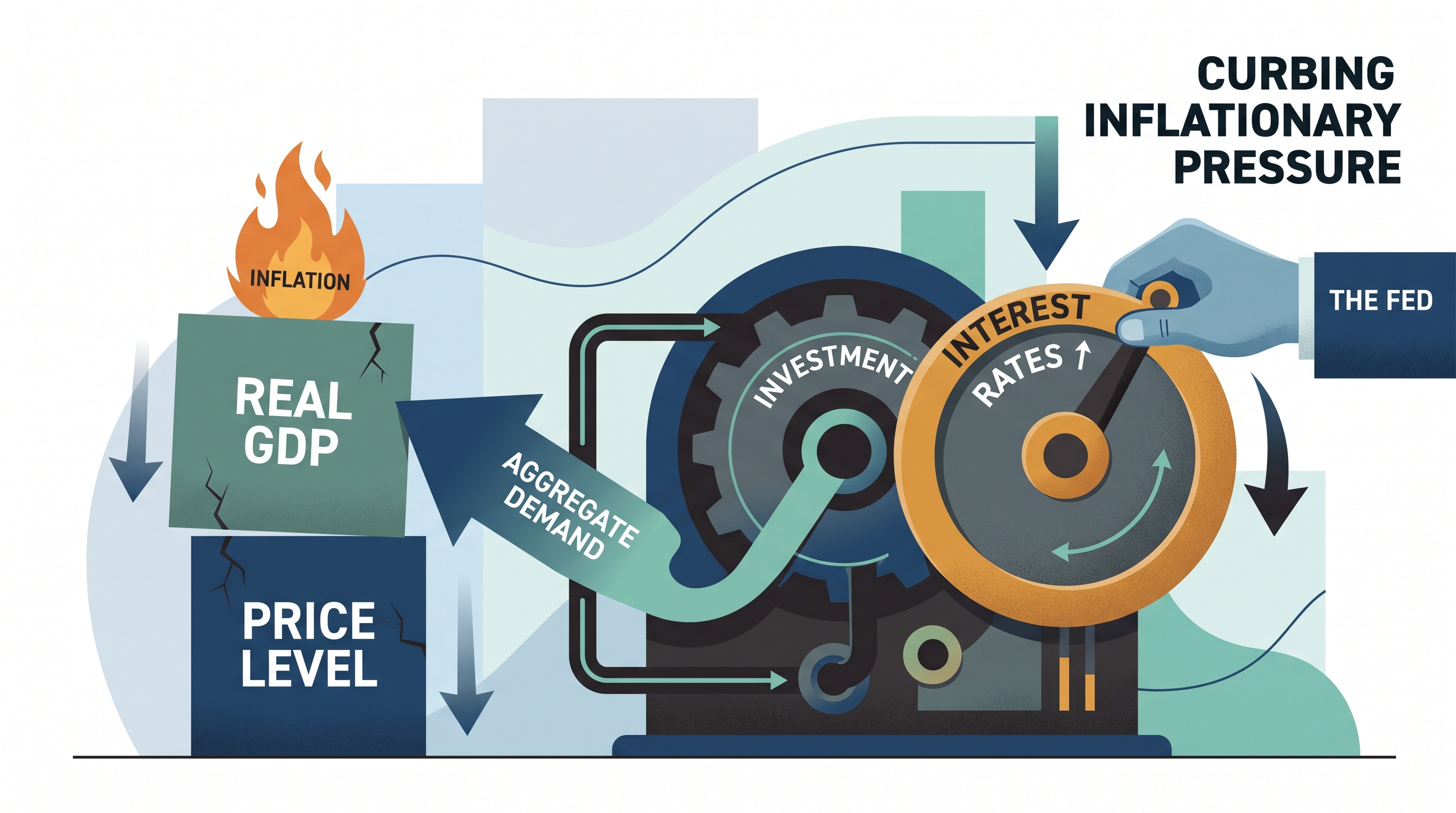
The reverse occurs when inflation is excessive. Contractionary monetary policy raises interest rates, discourages borrowing and investment, reduces aggregate demand, and slows increases in the price level. The trade-off is that weaker demand can reduce real GDP and employment in the short run.
Choosing the policy direction
A useful diagnostic is the output gap. A recessionary gap exists when equilibrium real GDP is below potential real GDP, $Y < Y_f$; expansionary monetary policy may help close it. An inflationary gap exists when equilibrium real GDP exceeds potential, $Y > Y_f$; contractionary monetary policy may reduce excess demand.
Policy effects are not instantaneous. Households and firms may take time to refinance loans, change purchases, or revise investment plans. The size of the response also depends on confidence, the sensitivity of investment to interest rates, and whether banks are willing to lend.
Monetary policy and economic growth
A short-run increase in real GDP is not automatically economic growth. Short-run recovery moves an economy closer to its existing productive capacity after a recession; long-run economic growth is a sustained increase in the economy’s productive capacity, shown by a rightward shift of the long-run aggregate supply curve, $LRAS$, or an increase in potential real GDP, $Y_f$.
Stable, appropriately managed monetary policy can support long-run growth indirectly. By reducing the severity of recessions, limiting damaging inflation, and helping maintain predictable financial conditions, it can encourage saving, investment, and productive planning. However, monetary policy alone cannot permanently increase the economy’s productive capacity: it cannot by itself create better technology, expand the labor force, improve human capital, or add physical capital.
Critical distinction: Expansionary monetary policy can raise actual output in the short run, but lasting growth requires an increase in potential output.
Misconception check
Misconception: “Lower interest rates always create economic growth.” Lower rates can increase aggregate demand and temporarily raise real GDP, but if the economy is already near capacity, the main effect may be a higher price level. Permanent growth requires productive-capacity changes, not merely stronger spending.
AP skill application
Topic 4.6 Monetary Policy develops Learning Objective 4.6.A: Explain how the Federal Reserve uses monetary policy to influence the economy and Learning Objective 4.6.B: Explain how monetary policy affects economic outcomes. Its essential knowledge includes 4.6.A.1, 4.6.A.2, 4.6.B.1, and 4.6.B.2: identify the policy direction, connect it to interest rates and financial conditions, trace the effect through spending and $AD$, and state the resulting changes in output, employment, and the price level.
The main assessed reasoning uses Skill Category 1: Principles and Models, especially 1.B Explain economic outcomes; Skill Category 2: Interpretation, especially 2.B Interpret economic models; Skill Category 3: Manipulation, especially 3.A Calculate economic quantities when numerical changes are supplied; and Skill Category 4: Graphing and Visuals, especially 4.A Draw models and graphs. On a graph, label the axes, identify $AD$, $SRAS$, and $LRAS$ when relevant, mark the initial and new equilibria, and show the direction of the shift.
Retrieval check
If the Federal Reserve raises interest rates while the economy is experiencing an inflationary gap, what happens to investment, aggregate demand, real GDP, and the price level in the short run? The expected chain is: investment decreases, $AD$ shifts left, real GDP decreases, and inflationary pressure falls.
Source Materials
- AP Macroeconomics Course and Exam Description
- AP Macroeconomics Course and Exam Description Clarifications and Corrections
- AP Macroeconomics Course Overview
- AP Macroeconomics Course at a Glance
- AP Macroeconomics Course at a Glance Poster
- AP Macroeconomics
- AP Macroeconomics
- AP Macroeconomics Sample Syllabus 1