From the free course AP Macroeconomics on Lykke
3.1 Aggregate Demand (AD)
Key concepts: Aggregate demand · Unemployment rate · Natural rate of unemployment · Recession · Expected inflation rate · Actual inflation rate · Maximum change in aggregate demand
Aggregate demand (AD) is the total quantity of final goods and services demanded in an economy at different overall price levels during a given period.
3.1 Aggregate Demand (AD)
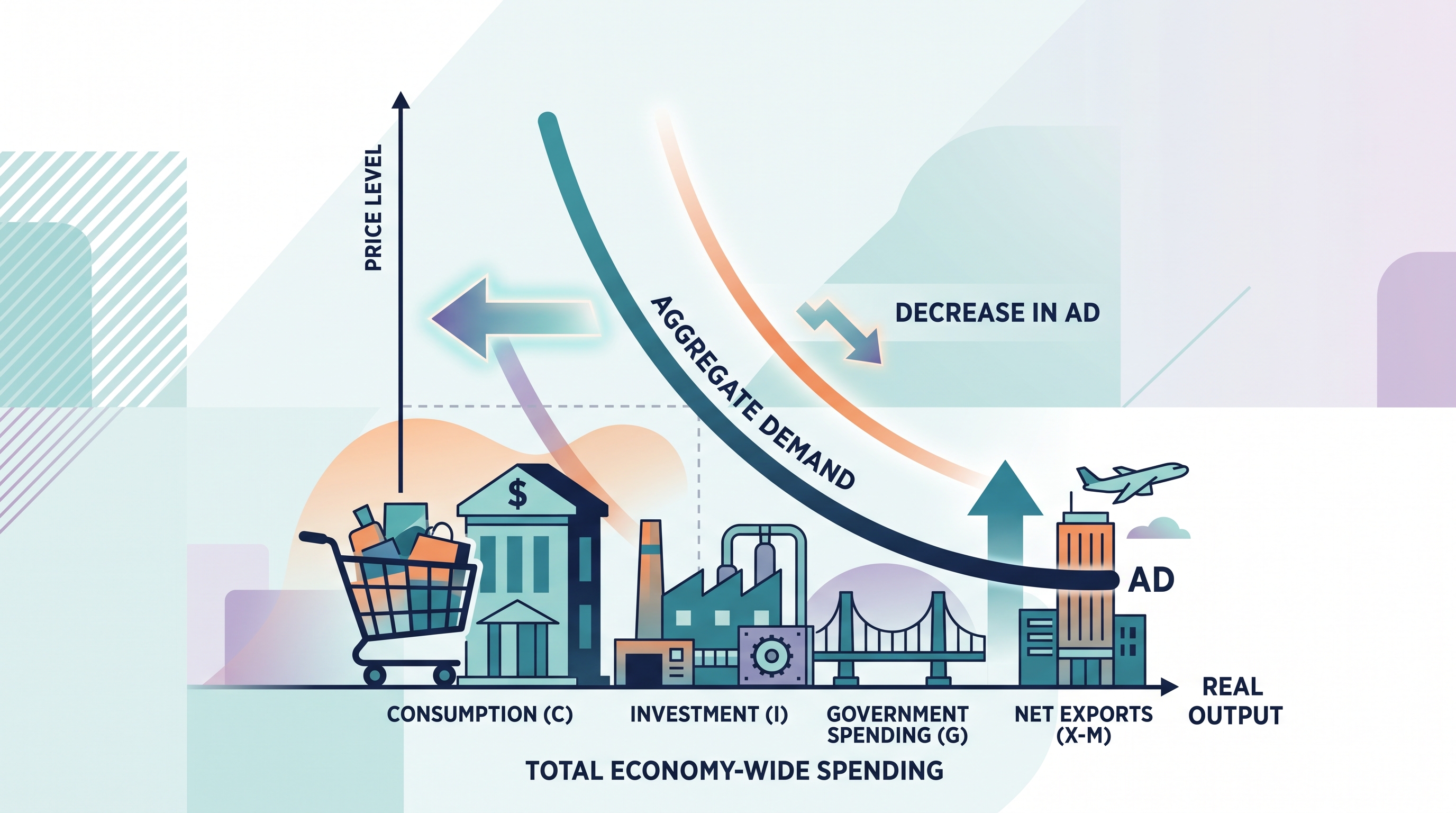
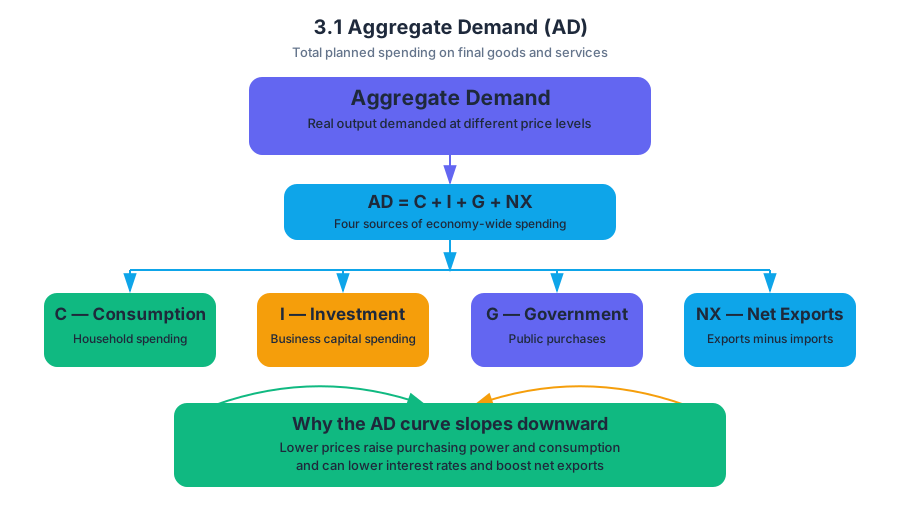
Aggregate demand (AD) is the total quantity of final goods and services demanded in an economy at different overall price levels during a given period. It answers a macroeconomic question: How much real output will households, firms, the government, and foreign buyers collectively purchase?
The four components of aggregate demand are consumption, investment, government purchases, and net exports:
$$AD = C + I + G + NX$$
where $C$ is consumption spending, $I$ is investment spending, $G$ is government purchases, and $NX$ is net exports, calculated as exports minus imports.
The AD curve slopes downward because a lower overall price level generally encourages more consumption, increases the purchasing power of money, lowers interest rates through the money market, and makes domestic goods relatively less expensive to foreign buyers. A higher price level tends to produce the opposite effects.
Aggregate demand and the state of the economy
Suppose an economy has an actual unemployment rate of $7%$ and a natural rate of unemployment of $5%$. The natural rate is the unemployment rate that remains when the economy is producing at its sustainable, long-run level; it includes frictional and structural unemployment, but not cyclical unemployment.
Because the actual unemployment rate exceeds the natural rate,
$$7% - 5% = 2%$$
the economy has positive cyclical unemployment of $2$ percentage points. This condition indicates a recession: real output is below its potential or full-employment level, so the economy is experiencing a recessionary gap.
The causal chain is:
$$ \text{AD decreases} \rightarrow \text{real output decreases} \rightarrow \text{firms need fewer workers} \rightarrow \text{cyclical unemployment increases} $$
A recession does not mean that every industry is shrinking or that every worker is unemployed. It means that economy-wide production and employment are below their sustainable levels. A fall in aggregate demand is one important cause, although adverse short-run aggregate supply changes can also reduce output.
Expected and actual inflation
The expected inflation rate is the rate at which people and firms anticipate the overall price level will rise. The actual inflation rate is the rate at which the price level ultimately rises. Expectations influence wage contracts, borrowing decisions, pricing, and investment before the final inflation rate is known.
In a recession, weak aggregate demand places downward pressure on actual inflation. If households and firms expected inflation to be higher than the rate that actually occurs, then:
$$\text{Actual inflation} < \text{Expected inflation}$$
For example, if firms and workers expected prices to rise by $3%$, but weak demand causes prices to rise by only $1%$, actual inflation is below the expected inflation rate. This relationship is consistent with an economy operating to the right of its natural rate of unemployment on a short-run Phillips curve.
Misconception check — “A recession always means deflation.” A recession usually reduces the inflation rate relative to what was expected, but it does not necessarily make the price level fall. Prices may still increase, only more slowly than expected. A positive inflation rate can coexist with a recession.
From spending changes to changes in AD
A change in one component of spending shifts the AD curve. For instance, a $20 billion decrease in initial spending reduces aggregate demand. The maximum total change in AD depends on repeated rounds of spending, but the detailed multiplier mechanism belongs to Topic 3.2. Here, the essential point is that an initial spending change can produce a larger total change in equilibrium output and AD.
Using a marginal propensity to consume of $0.9$, the maximum change can be calculated as:
$$\text{Spending multiplier} = \frac{1}{1 - 0.9} = 10$$
$$\text{Maximum change in AD} = -$20\text{ billion} \times 10 = -$200\text{ billion}$$
The negative sign matters: the initial reduction in spending causes aggregate demand to decrease by a maximum of $$200$ billion. If the question instead supplies a different multiplier or a different marginal propensity to consume, use the values provided and show each substitution clearly.
AP skill connections
Topic 3.1 commonly assesses the following official skill categories:
- Skill 1: Principles and Models — identify aggregate demand and use the AD model to represent economy-wide spending.
- Skill 2: Interpretation — infer recessionary conditions by comparing actual unemployment with the natural rate and by comparing actual inflation with expected inflation.
- Skill 3: Manipulation — calculate a change in aggregate demand from an initial spending change and a supplied multiplier relationship.
- Skill 4: Graphing and Visuals — draw a correctly labeled AD curve with the price level on the vertical axis and real output on the horizontal axis; show a decrease in AD as a leftward shift.
Retrieval check: An economy has an actual unemployment rate of $7%$ and a natural rate of $5%$. Is it in a recession, and how should actual inflation compare with expected inflation if aggregate demand is weak?
Answer: Yes. Since actual unemployment exceeds the natural rate, the economy has cyclical unemployment and is in a recession. With weak aggregate demand, actual inflation is below the expected inflation rate.
Source Materials
- AP Macroeconomics Course and Exam Description
- AP Macroeconomics Course and Exam Description Clarifications and Corrections
- AP Macroeconomics Course Overview
- AP Macroeconomics Course at a Glance
- AP Macroeconomics Course at a Glance Poster
- AP Macroeconomics
- AP Macroeconomics
- AP Macroeconomics Sample Syllabus 1
- AP Macroeconomics-AP Students-College Board
- AP Macroeconomics FRQ Practice
- AP/College Macroeconomics-Khan Academy
- AP Macroeconomics Units/Save my Exams