From the free course AP Macroeconomics on Lykke
3.3 Short-Run Aggregate Supply (SRAS)
Key concepts: Short-run aggregate supply (SRAS) curve · Relationship between the price level and aggregate output · Sticky wages and fixed input prices · Movement along the SRAS curve · Shifts in the SRAS curve · Positive and negative supply shocks · Aggregate-demand shocks · Short-run equilibrium and full-employment output · Inflationary and recessionary gaps · Effects on output, employment, and the price level
Why can firms produce more when the economy-wide price level rises, even though the economy’s technology and resources have not changed? In the short run, many production costs—especially wages and some input prices—do not adjust immediately.
3.3 Short-Run Aggregate Supply (SRAS)
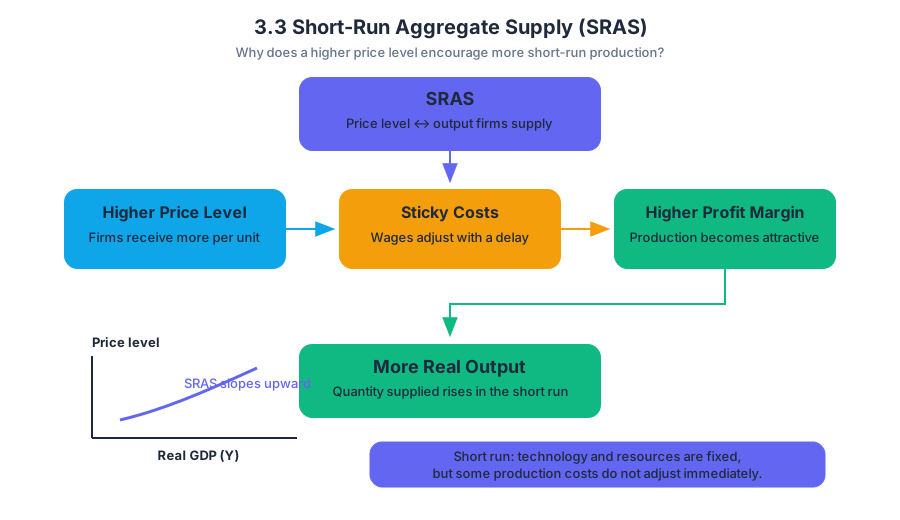
Why can firms produce more when the economy-wide price level rises, even though the economy’s technology and resources have not changed? In the short run, many production costs—especially wages and some input prices—do not adjust immediately. That temporary mismatch makes the short-run aggregate supply (SRAS) curve upward-sloping.
Short-run aggregate supply (SRAS) describes the relationship between the economy-wide price level and the quantity of goods and services firms are willing and able to produce in the short run.
The vertical axis of the AD–AS graph measures the price level, and the horizontal axis measures real output, usually labeled real GDP or $Y$. SRAS slopes upward: a higher price level is associated with a greater quantity of output supplied in the short run.
Why SRAS slopes upward
Suppose a bakery agrees to pay its workers a wage of $15 per hour for the next year. If the prices of the bakery’s products rise while that wage remains fixed, each loaf becomes more profitable to produce. The bakery responds by increasing production and hiring more workers. Across the economy, this produces the upward-sloping SRAS curve.
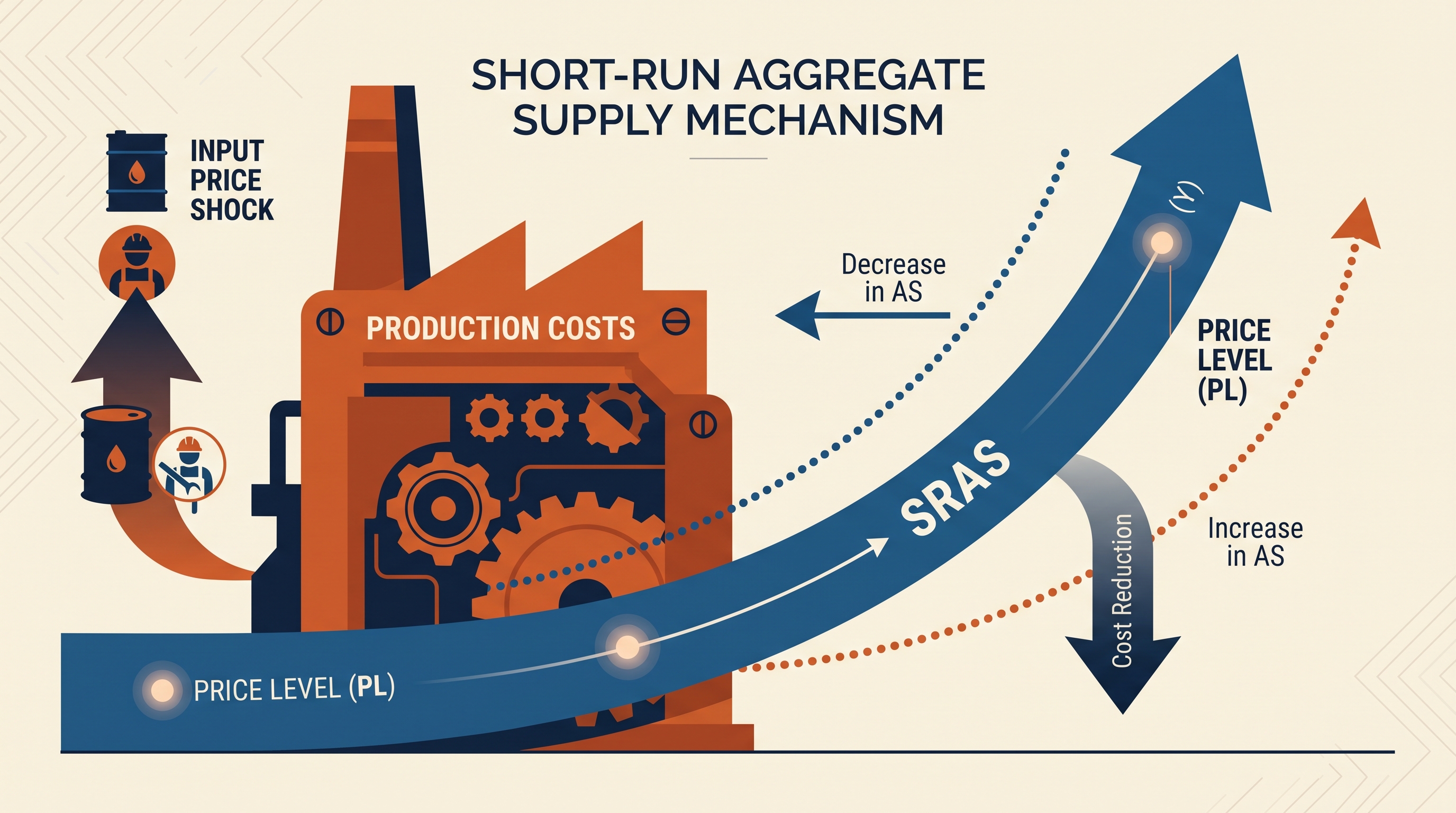
The key mechanism is sticky wages: nominal wages are slow to change. Some other input prices may also be fixed temporarily because of contracts, menus, leases, or delayed information. Therefore, when the price level rises, firms’ selling prices may increase before their production costs do, encouraging greater real output and employment.
Essential Knowledge MOD-2.C.2: The SRAS curve is upward-sloping because wages and some input prices are sticky or fixed in the short run. This is a short-run relationship—not a claim that firms can permanently increase output merely by raising prices.
Movement along SRAS versus a shift
A movement along the SRAS curve occurs when the price level changes because aggregate demand changes. The SRAS curve itself remains in place. For example, a positive aggregate-demand shock shifts AD rightward; the new equilibrium moves upward and rightward along the existing SRAS curve, raising the price level, real output, and employment in the short run.
Conversely, a negative aggregate-demand shock shifts AD leftward. The economy moves downward and leftward along SRAS, reducing the price level, real output, and employment in the short run.
| Event | Graphical change | Short-run result |
|---|---|---|
| Positive AD shock | AD shifts right | Price level rises; output and employment rise |
| Negative AD shock | AD shifts left | Price level falls; output and employment fall |
| Positive SRAS shock | SRAS shifts right | Price level falls; output and employment rise |
| Negative SRAS shock | SRAS shifts left | Price level rises; output and employment fall |
Essential Knowledge MOD-2.C.3: Any factor that changes production costs—such as input prices or inflationary expectations—shifts SRAS. A change in the price level alone does not shift SRAS; it causes movement along the curve.
Supply shocks: good news and bad news
A positive SRAS shock lowers firms’ production costs. Examples include cheaper energy, improved production technology, or lower expected inflation. SRAS shifts right, increasing short-run output and employment while lowering the price level.
A negative SRAS shock raises production costs. A sudden increase in oil prices, for instance, makes transportation and manufacturing more expensive. SRAS shifts left, decreasing output and employment while raising the price level—a difficult combination often called stagflation.
Output gaps and short-run equilibrium
Short-run equilibrium occurs where AD and SRAS intersect, consistent with Essential Knowledge MOD-2.G.1. That equilibrium output may be below, at, or above the economy’s short-run full-employment level of output.
- Below full employment: a negative, or recessionary, output gap; unemployment is elevated.
- At full employment: output equals the full-employment level.
- Above full employment: a positive, or inflationary, output gap; upward pressure on prices is present.
A positive AD shock can push output above full employment, creating an inflationary situation. A negative AD shock can push output below full employment, creating a recessionary situation. These gaps describe the economy’s position relative to full employment; they are not themselves shifts of SRAS.
Worked example
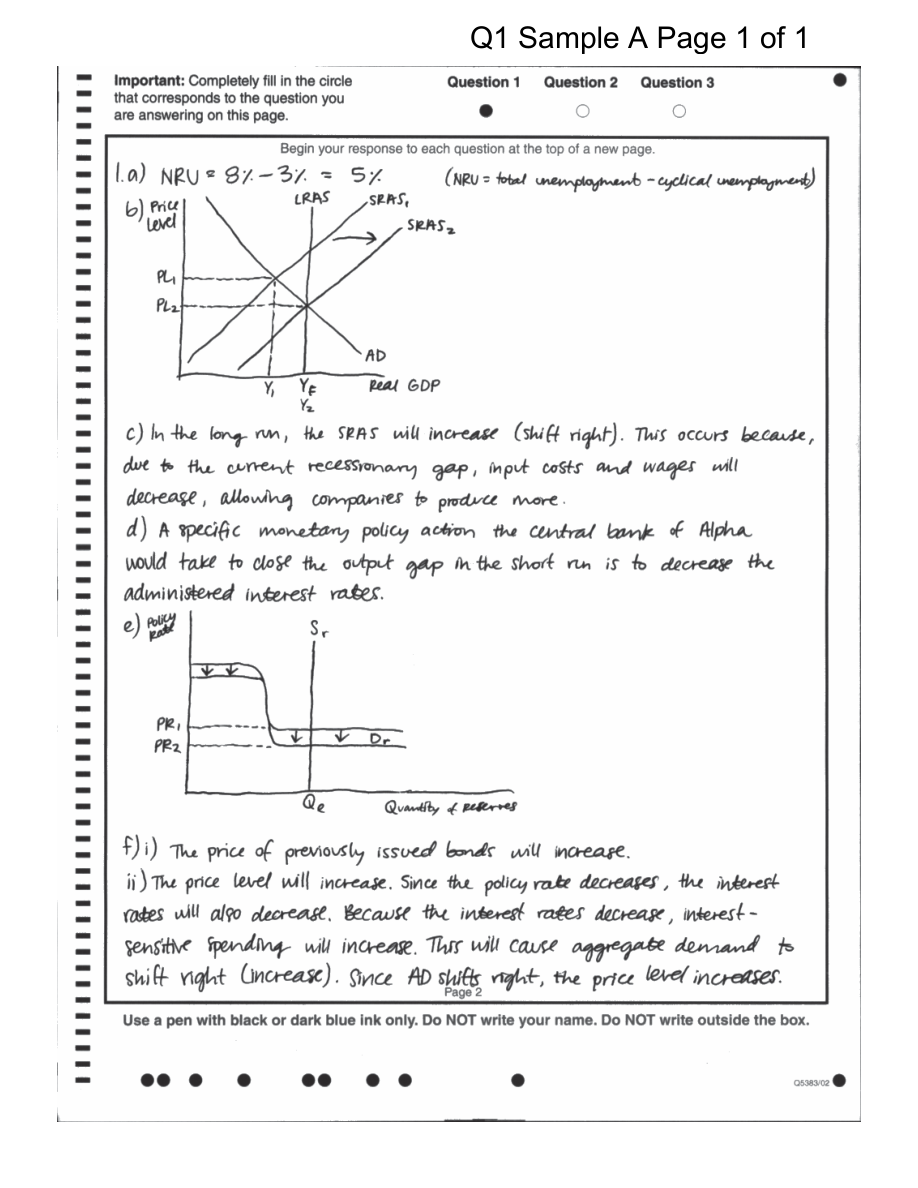
Assume the economy begins at the intersection of $AD_1$ and $SRAS_1$, with output below full employment. Consumer confidence rises, increasing consumption and shifting AD rightward from $AD_1$ to $AD_2$. The economy moves along $SRAS_1$: the price level rises from $PL_1$ to $PL_2$, output rises from $Y_1$ to $Y_2$, and employment increases.
Now instead assume a major drought raises food prices and production costs. SRAS shifts left from $SRAS_1$ to $SRAS_2$. The new equilibrium has a higher price level and lower real output. The correct explanation must include the complete chain: higher input prices $\rightarrow$ higher production costs $\rightarrow$ SRAS shifts left $\rightarrow$ output and employment fall while the price level rises.
Misconception check
Common misconception: “Any increase in the price level shifts SRAS.”
Correction: An increase in the price level caused by higher aggregate demand creates a movement along SRAS. SRAS shifts only when a determinant of production costs changes, such as wages, input prices, technology, or inflationary expectations.
AP skill in action
This topic most directly uses Skill 1—Principles and Models, to identify the SRAS mechanism; Skill 2—Interpretation, to infer changes in output, employment, and the price level; and Skill 4—Graphing and Visuals, to draw labeled AD–AS graphs, distinguish movements from shifts, and identify output gaps. The central reasoning process is always causal: identify the shock, determine which curve changes, locate the new equilibrium, and state all affected macroeconomic variables.
Retrieval check: If input prices fall while aggregate demand is unchanged, does the economy move along SRAS or does SRAS shift? What happens to the price level, output, and employment?
Source Materials
- AP Macroeconomics Course and Exam Description
- AP Macroeconomics Course and Exam Description Clarifications and Corrections
- AP Macroeconomics Course Overview
- AP Macroeconomics Course at a Glance
- AP Macroeconomics Course at a Glance Poster
- AP Macroeconomics
- AP Macroeconomics
- AP Macroeconomics Sample Syllabus 1
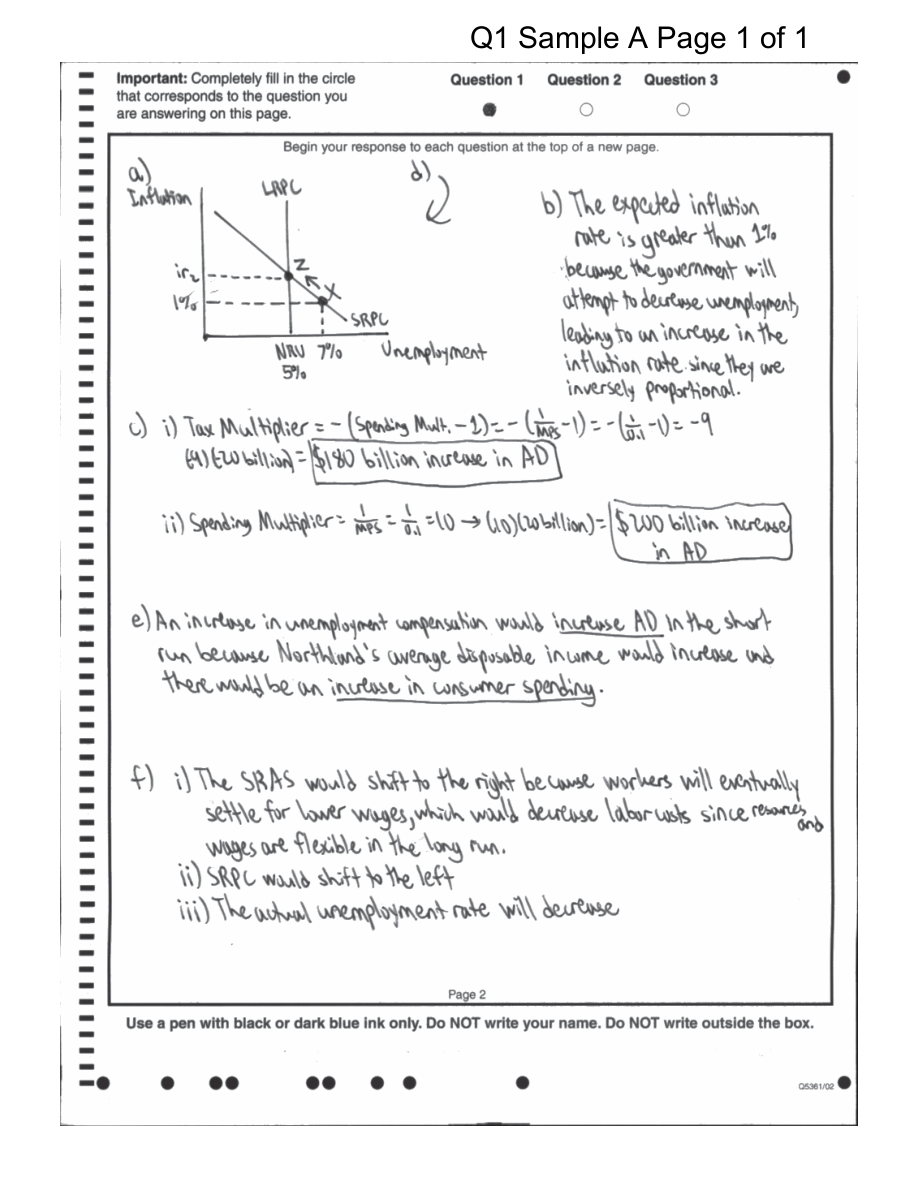
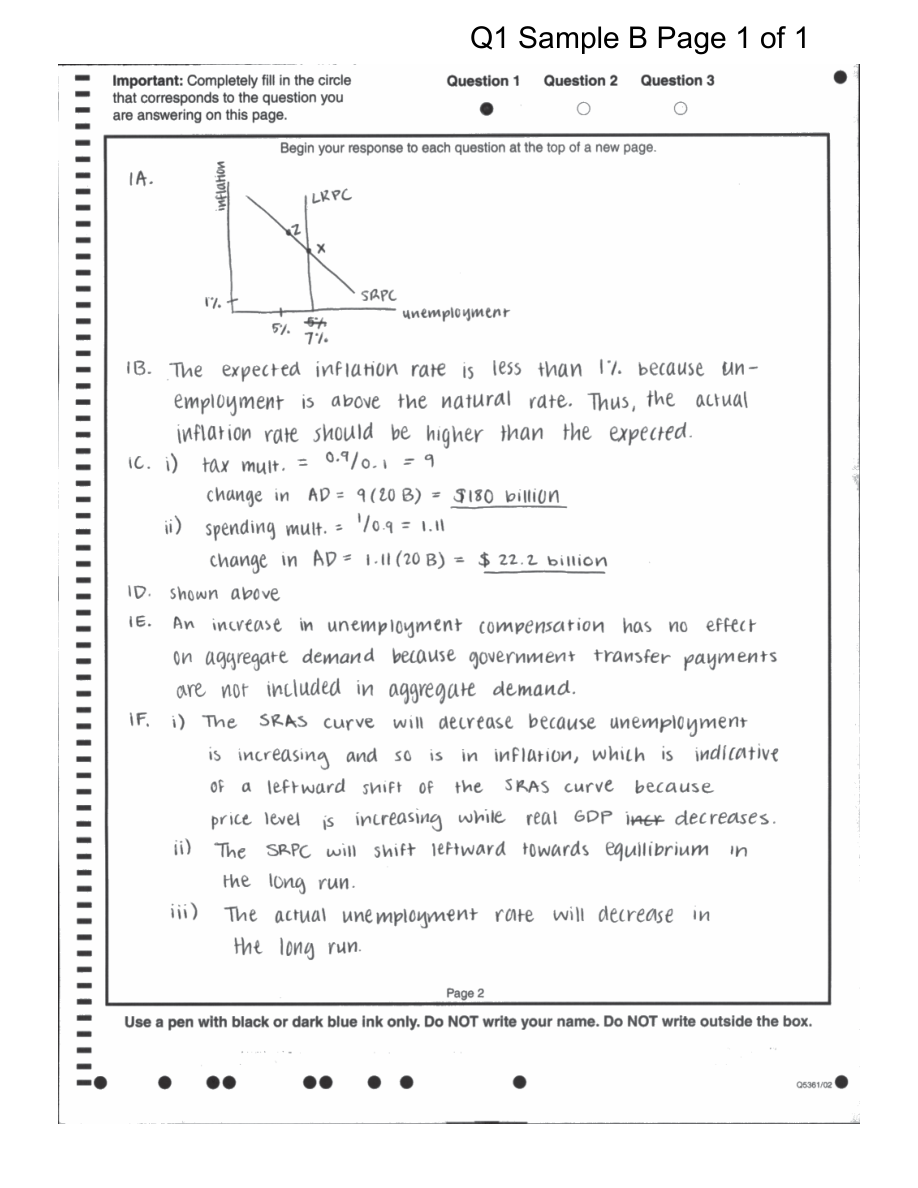
- (e) State that aggregate demand would increase and explain that the increase in disposable income would increase consumption spending.
- Figure — Sample Responses Q1 - Set 2 (p. 4)
- Figure — Sample Responses Q1 - Set 2 (p. 5)
- Figure — Sample Responses Q1 - Set 2 (p. 6)