From the free course AP Macroeconomics on Lykke
5.7 Public Policy and Economic Growth
Key concepts: Public policy · Productivity · Labor force · Economic incentives · Household economic behavior · Business economic behavior · Long-run economic growth · Government spending · Interest rates · Previously issued bond prices
Public policy can raise long-run economic growth when it changes the incentives that guide household and business decisions, increasing productivity or labor force participation. The central question is not merely “How much does the government spend?” but “How does the policy change the economy’s ability and…
5.7 Public Policy and Economic Growth
Public policy can raise long-run economic growth when it changes the incentives that guide household and business decisions, increasing productivity or labor force participation. The central question is not merely “How much does the government spend?” but “How does the policy change the economy’s ability and willingness to produce?”
POL-4.A.1: Public policies that impact productivity and labor force participation affect real GDP per capita and economic growth.
From incentives to growth
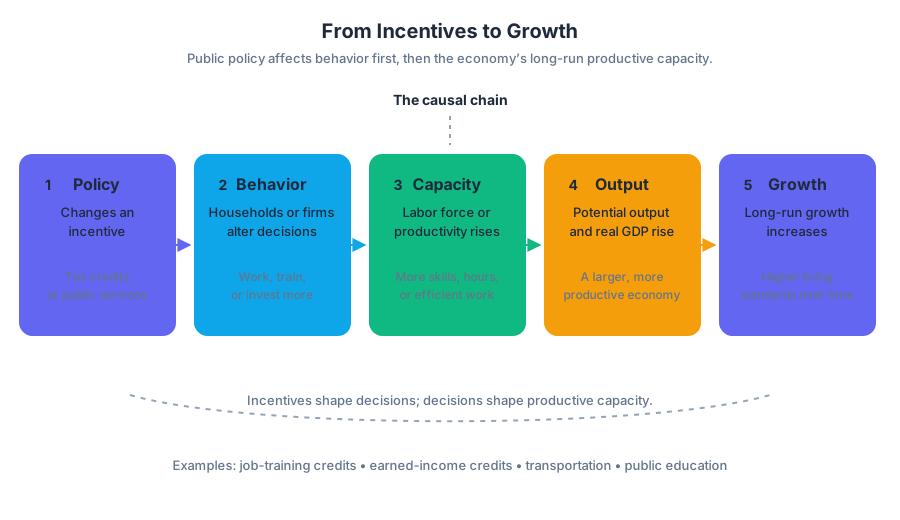
An economic incentive is a reward or cost that influences a decision. A tax credit for job training may encourage firms to invest in worker skills; an earned-income tax credit may increase the incentive for people to work; improved transportation or public education may make productive employment easier. These policies affect behavior first, then productivity or the labor force, and finally the economy’s long-run productive capacity.
The causal chain is:
- Policy changes an incentive
$\rightarrow$ households or businesses alter behavior
$\rightarrow$ labor force participation or productivity changes
$\rightarrow$ potential output and real GDP per capita change
$\rightarrow$ long-run economic growth changes.
Household and business responses
Household economic behavior includes decisions about working, acquiring education, saving, and consuming. For example, a policy that lowers the effective cost of attending technical school can increase human capital. More skilled workers can produce more output per hour, so productivity rises.
Business economic behavior includes decisions about hiring, investment, research, and production methods. A tax incentive for purchasing advanced equipment can reduce the cost of capital. Firms may then invest more, allowing each worker to produce more output. In the long run, this shifts the economy’s productive capacity outward rather than merely increasing demand temporarily.
A policy can also create a disincentive. If an additional dollar earned causes a household to lose more than a dollar in benefits and pay additional taxes, the effective reward from working may fall. Labor force participation may decrease, reducing the amount of labor available for production.
Supply-side fiscal policy
Supply-side fiscal policies are changes in government spending, taxes, or transfers intended to increase the economy’s productive capacity by affecting incentives, productivity, or labor force participation. Their long-run effect depends on how households and firms respond—not simply on the policy’s label.
For example, suppose a government offers firms a credit equal to $20%$ of eligible research spending. If firms respond by developing more efficient production technology, productivity rises. The result is greater potential real GDP and a higher level of real GDP per capita, assuming population does not increase faster than output.
Government spending: demand now, capacity later
A change in government spending can be represented in the aggregate demand–aggregate supply model. Holding other components constant, an increase in government purchases raises aggregate demand because:
$$AD = C + I + G + NX$$
In the short run, higher government spending shifts $AD$ to the right. Real output and the price level rise at the new short-run equilibrium. If the spending funds infrastructure, education, or research that improves productivity, the policy may also shift long-run aggregate supply or LRAS to the right over time.
The distinction matters:
| Policy effect | Immediate model consequence | Possible long-run consequence |
|---|---|---|
| Government purchases of ordinary goods and services | $AD$ shifts right | Mainly higher short-run output and price level |
| Investment in infrastructure, education, or technology | $AD$ shifts right | Greater productivity and an increase in potential output |
| Tax or transfer change that alters work incentives | Consumption or labor decisions change | Labor force participation and productive capacity may change |
Interest rates and investment incentives
Interest rates connect stabilization policy to long-run growth. A lower interest rate reduces the cost of borrowing, which can encourage businesses to purchase capital and households to finance durable goods or education. Greater business investment can expand the economy’s capital stock and raise future productivity.
The financial mechanism also includes asset prices: when market interest rates rise, the prices of previously issued fixed-payment bonds decrease because new bonds offer higher returns. For growth analysis, the key real-economy channel is that higher borrowing costs tend to discourage interest-sensitive investment, while lower borrowing costs can increase investment and support a higher future level of productive capacity.
Misconception check
Misconception: “Every increase in government spending causes economic growth.” Government spending can raise $AD$ and short-run real GDP without increasing productivity. Long-run growth requires a lasting increase in productive capacity—such as better technology, more human capital, a larger participating labor force, or a greater capital stock.
Retrieval check
A government increases spending on a nationwide broadband network and gives firms a tax credit for worker training. Identify one household or business incentive, state the likely effect on productivity or labor force participation, and describe the long-run consequence. Then state what happens to $AD$ immediately if government purchases increase.
Answer: The training credit lowers firms’ cost of improving worker skills, so productivity may rise. The broadband investment immediately shifts $AD$ right and may later increase productive capacity, raising potential output and long-run real GDP per capita.
Source Materials
- AP Macroeconomics Course and Exam Description
- AP Macroeconomics Course and Exam Description Clarifications and Corrections
- AP Macroeconomics Course Overview
- AP Macroeconomics Course at a Glance
- AP Macroeconomics Course at a Glance Poster
- AP Macroeconomics
- AP Macroeconomics
- AP Macroeconomics Sample Syllabus 1