From the free course AP Macroeconomics on Lykke
3.4 Long-Run Aggregate Supply (LRAS)
Key concepts: Long-run aggregate supply (LRAS) · Maximum sustainable capacity · Full-employment level of output · Production possibilities curve (PPC) · Flexible wages and prices in the long run · Fixed input prices in the short run · Long-run equilibrium price level and output level · Economic growth · Infrastructure and technology investment · Natural rate of unemployment
Why can an economy temporarily produce above or below its sustainable capacity, yet eventually return to a particular level of output? The answer is the long-run aggregate supply (LRAS) curve: it identifies the economy’s full-employment level of real output after wages and prices have had time to adjust completely.
3.4 Long-Run Aggregate Supply (LRAS)
Why can an economy temporarily produce above or below its sustainable capacity, yet eventually return to a particular level of output? The answer is the long-run aggregate supply (LRAS) curve: it identifies the economy’s full-employment level of real output after wages and prices have had time to adjust completely.
Investigative question: If the price level changes, why does the economy’s long-run productive capacity not automatically change?
The long run is defined by flexibility
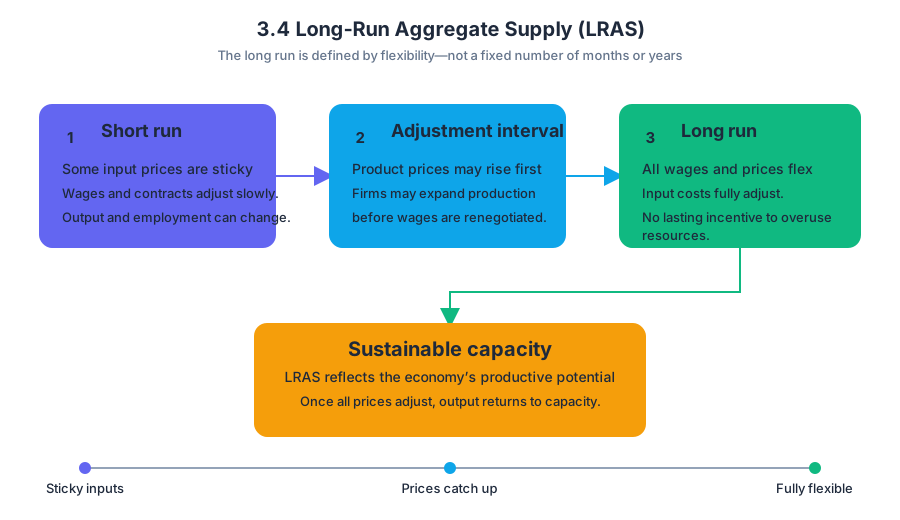
The short run and long run are distinguished by how quickly prices respond, not by a fixed number of months or years. In the short run, some input prices—especially wages and contracted costs—are fixed or “sticky.” In the long run, all wages and prices are fully flexible (MOD-2.E.1).
This distinction matters because a business may face higher product prices before it can renegotiate worker wages or supplier contracts. During that interval, production and employment can change. Once wages and other input prices fully adjust, however, firms no longer have a lasting reason to employ resources beyond the economy’s sustainable capacity.
What LRAS measures
The long-run aggregate supply curve shows the quantity of real output an economy can produce when all resources are fully employed. This quantity is called the full-employment level of output, or $Y_F$. It is also the economy’s maximum sustainable capacity: the total output an economic system can produce over a period of time when its resources are fully employed (MOD-2.F.1).
On an AD–AS graph, the LRAS curve is vertical at $Y_F$ (MOD-2.F.2). The vertical shape means that changes in the price level alone do not permanently change the economy’s full-employment output. The horizontal axis measures real output, while the vertical axis measures the price level.
$$ \text{LRAS: } Y = Y_F $$
The LRAS curve resembles the production possibilities curve (PPC) because both models represent maximum sustainable capacity. The PPC displays the maximum combinations of two goods that can be produced with fully employed resources; LRAS compresses the economy’s productive possibilities into one macroeconomic output measure.
Principles and Models (1.A): Describe economic concepts, principles, or models. A complete description must do more than state “LRAS is vertical.” It must connect verticality to flexible wages and prices, connect $Y_F$ to full employment, and explain why a change in productive resources—not merely a change in the price level—moves LRAS.
Shock and long-run adjustment
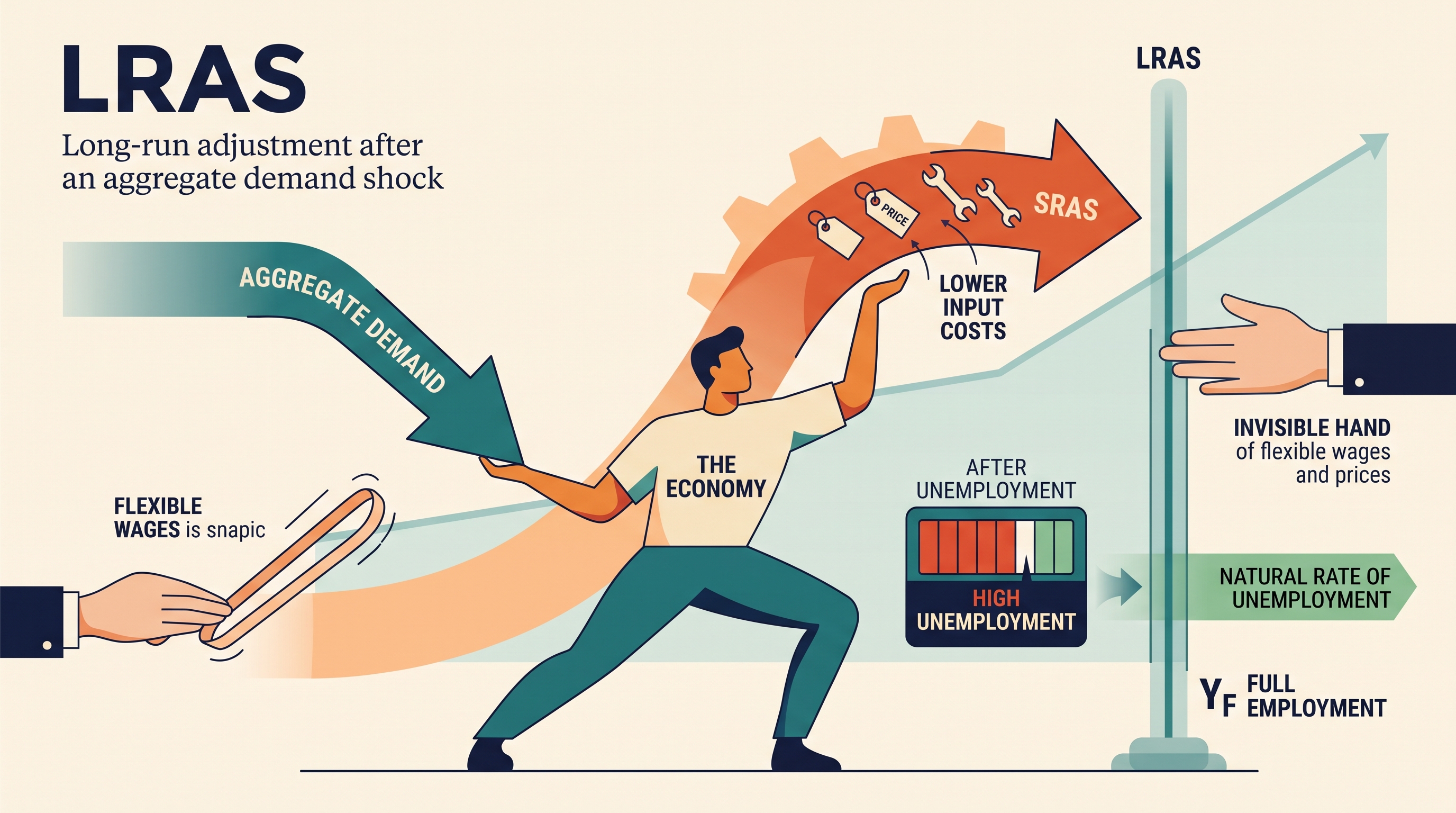
Suppose households suddenly reduce consumption. Aggregate demand falls, and in the short run real output and employment decrease while the price level falls. Because wages and other input prices do not immediately adjust, firms can temporarily produce at an output level below $Y_F$.
Over time, weaker demand reduces pressure on labor and product markets. Nominal wages and other input prices fall, lowering firms’ production costs. Short-run aggregate supply shifts rightward until output returns to $Y_F$; unemployment returns to its natural rate, the rate associated with normal frictional and structural unemployment (MOD-2.I.1).
The same logic works after an adverse short-run aggregate supply shock, such as a sudden increase in energy costs. Output initially falls and the price level rises. If no government policy intervenes, wages and other input prices eventually adjust, allowing short-run aggregate supply to move back and restoring full employment.
Because wages and prices fully adjust in the long run, there is no permanent long-run trade-off between inflation and unemployment (MOD-2.E.1). Expansionary demand can temporarily increase output and reduce unemployment, but once expectations, wages, and prices adjust, output returns to $Y_F$ rather than remaining permanently above it.
Worked example: identifying the adjustment
An economy begins in long-run equilibrium at $Y_F = 500$ billion of real output. A fall in consumer confidence shifts AD left, moving short-run output to $470$ billion. The economy now has a recessionary gap of $30$ billion:
$$ \text{Recessionary gap} = Y_F - Y_{\text{short run}} $$
$$ \text{Recessionary gap} = $500\text{ billion} - $470\text{ billion} = $30\text{ billion} $$
With no policy action, falling wages and input prices shift SRAS right. The final long-run result is real output of $500$ billion, unemployment at its natural rate, and a lower price level than before the demand shock. The shock changes the price level temporarily and output temporarily, but it does not change $Y_F$.
When LRAS shifts
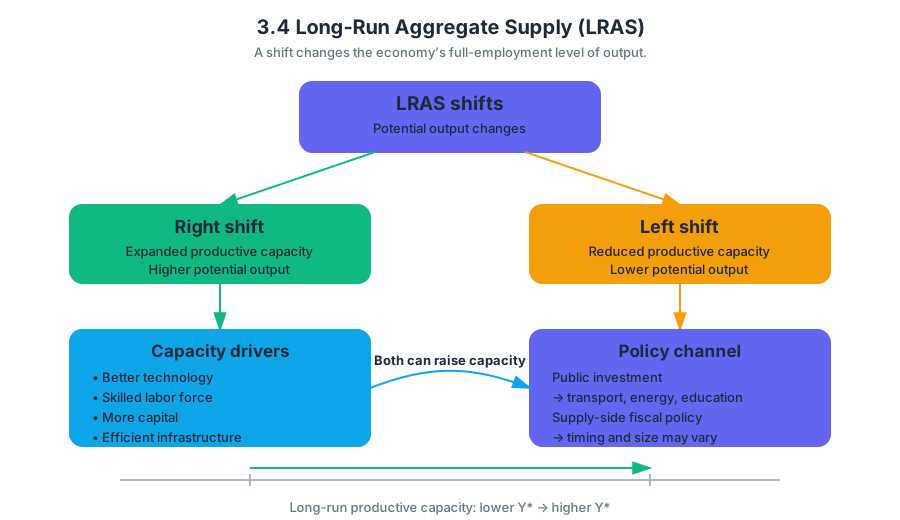
A shift in LRAS means that the economy’s full-employment level of output has changed (MOD-2.I.2). LRAS shifts right when productive capacity expands—for example, through improved technology, a larger or better-trained labor force, additional capital, or infrastructure that makes production more efficient.
Government policies can therefore affect potential output. Public investment in transportation networks, energy systems, communications, education, or technology can increase long-run productive capacity. Supply-side fiscal policies may affect aggregate supply and potential output in both the short run and the long run, although the timing and size of those effects depend on the policy.
Misconception check
Misconception: “A higher price level shifts LRAS right.” Correction: a higher price level is a movement along the vertical LRAS curve, not a change in productive capacity. LRAS shifts only when the full-employment quantity of output changes.
Misconception: “Full employment means zero unemployment.” Correction: at $Y_F$, the economy still has its natural rate of unemployment. Full employment means no cyclical unemployment, not that every person is employed at every moment.
Retrieval check
An economy’s output falls below $Y_F$ after an aggregate demand shock. What restores full employment in the absence of policy, and what happens to unemployment in the long run? The essential chain is: flexible wages and prices $\rightarrow$ lower input costs $\rightarrow$ SRAS shifts right $\rightarrow$ output returns to $Y_F$ $\rightarrow$ unemployment returns to its natural rate.
Source Materials
- AP Macroeconomics Course and Exam Description
- AP Macroeconomics Course and Exam Description Clarifications and Corrections
- AP Macroeconomics Course Overview
- AP Macroeconomics Course at a Glance
- AP Macroeconomics Course at a Glance Poster
- AP Macroeconomics
- AP Macroeconomics
- AP Macroeconomics Sample Syllabus 1
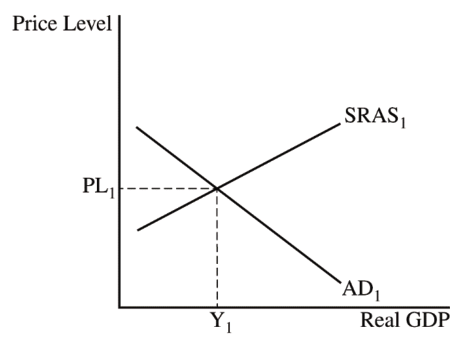
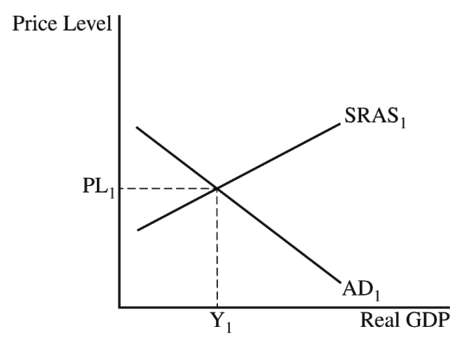
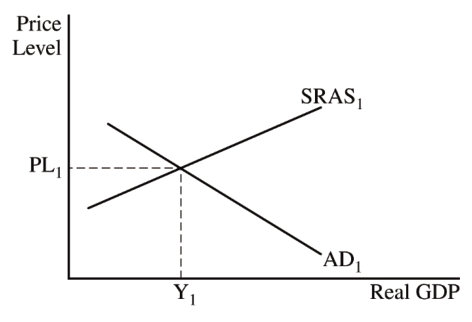
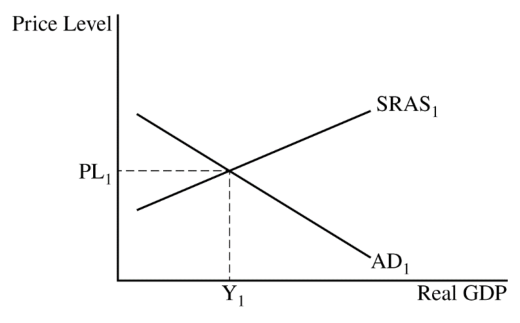
- For the second point, the graph must show a vertical long-run aggregate supply curve to the right of Y1 and label the full-employment output as YF.
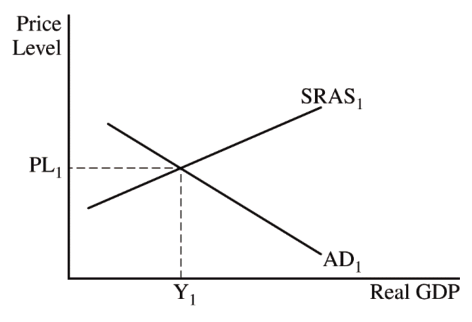
- For the second point, the graph must show a vertical long-run aggregate supply curve at equilibrium real output Y1 = YF.
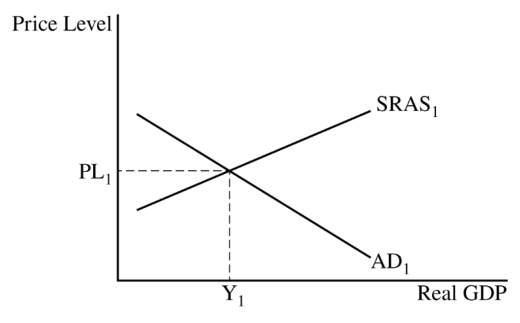
- For the second point, the graph must show a vertical long-run aggregate supply curve to the right of Y1 and label the full-employment output as YF.
- For the second point, the graph must show a vertical long-run aggregate supply curve at equilibrium real output Y1 = YF.