From the free course AP Macroeconomics on Lykke
2.5 Costs of Inflation
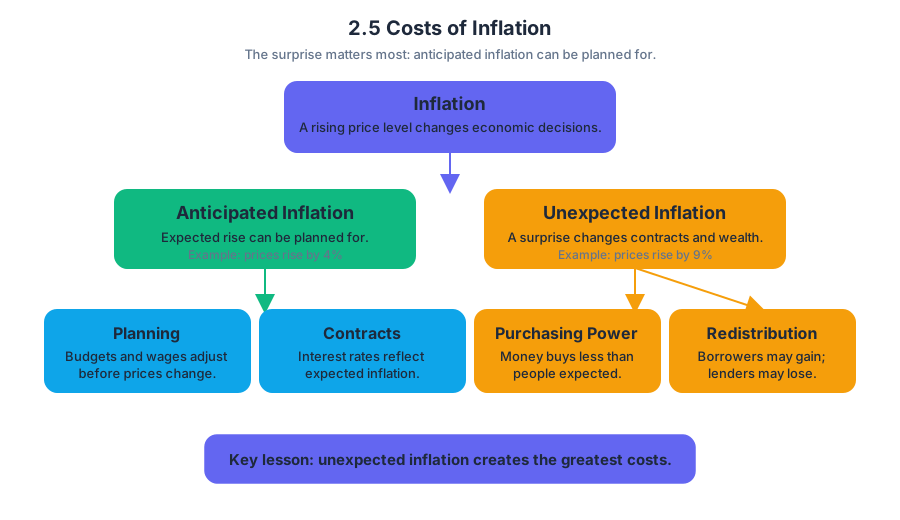
Inflation creates costs because a rising price level makes economic decisions harder, changes the value of contracts, and can redistribute purchasing power between people. The damage is greatest when inflation is unexpected rather than merely positive.
2.5 Costs of Inflation
Inflation creates costs because a rising price level makes economic decisions harder, changes the value of contracts, and can redistribute purchasing power between people. The damage is greatest when inflation is unexpected rather than merely positive.
LO 2.5.A — Explain the costs of inflation.
The central distinction is anticipated inflation versus unexpected inflation. If households and firms correctly expect prices to rise by $4%$, they can adjust wages, contracts, interest rates, and budgets. If prices instead rise by $9%$, the surprise changes who gains and who loses.
The predictable costs of a rising price level
Even anticipated inflation consumes real resources. People and firms must spend time and effort changing prices, recalculating budgets, and managing cash balances. These costs are commonly grouped into three categories.
| Cost | What changes | Concrete example |
|---|---|---|
| Menu costs | Firms must update posted prices, catalogs, labels, and software | A restaurant repeatedly reprints menus as ingredient costs rise |
| Shoe-leather costs | People make more frequent trips or transactions to avoid holding cash that loses purchasing power | A household visits the bank more often or moves money between accounts |
| Unit-of-account costs | Prices become less useful as a measuring stick for comparing values | A business has difficulty judging whether a higher price reflects improved quality or general inflation |
The phrase shoe-leather is a metaphor: frequent trips to manage money wear out shoes. The underlying idea is that inflation makes money balances more expensive to hold because each dollar buys fewer goods and services over time.
Unexpected inflation redistributes purchasing power
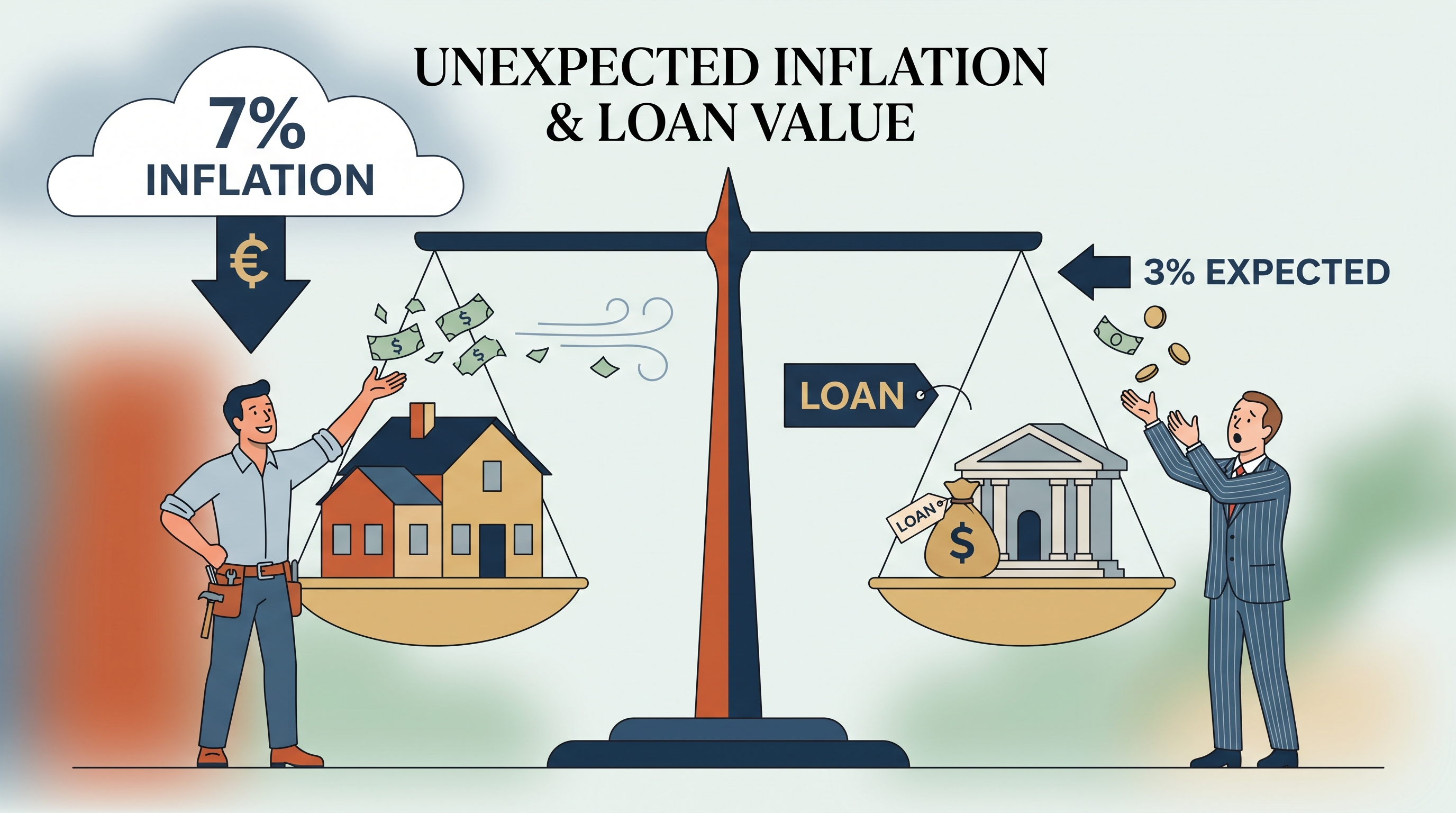
Unexpected inflation changes the real value of payments that were fixed in nominal terms. A nominal value is measured in current dollars; the real value is its purchasing power after accounting for the price level. When inflation is higher than expected, borrowers generally gain and lenders generally lose because the borrower repays with dollars that buy less.
Worked example: a fixed-rate loan
Suppose a student borrows $10{,}000$ at a fixed nominal interest rate of $5%$. The repayment due after one year is:
$$ $10{,}000(1.05)=$10{,}500 $$
If the expected inflation rate was $2%$, the approximate expected real interest rate would be:
$$ 5%-2%=3% $$
But if actual inflation unexpectedly reaches $8%$, the approximate actual real interest rate becomes:
$$ 5%-8%=-3% $$
The lender receives $10{,}500$ nominal dollars, but those dollars have less purchasing power than expected. The borrower benefits from repaying a debt whose real burden has fallen. The reverse occurs when inflation is lower than expected: lenders gain and borrowers lose relative to their expectations.
Other distributional and decision-making costs
Unexpected inflation can also redistribute income between workers and employers. If wages are fixed by a contract and prices rise faster than expected, workers’ real wages fall temporarily, while the firm’s labor costs are lower in real terms. If wages adjust immediately but product prices are fixed, the distribution can move in the opposite direction.
Inflation can distort tax outcomes when tax brackets or deductions do not adjust perfectly with prices. A worker whose nominal income rises only because of inflation may move into a higher tax bracket even though the worker’s real purchasing power has barely increased. Inflation can therefore reduce the incentive to save, invest, or work when tax rules and contracts fail to adjust.
Uncertainty is an additional cost. When firms cannot predict future input prices, wages, or borrowing costs, they may postpone investment or make less efficient production decisions. Households also find long-term planning—such as saving for education or retirement—more difficult when the future purchasing power of money is unclear.
Misconception check
Misconception: “Inflation makes everyone poorer by exactly the same amount.”
Inflation does not affect everyone identically. The outcome depends on whether a person’s income, assets, debts, and contracts adjust with the price level. A borrower with a fixed-rate loan may gain from unexpected inflation, while the lender loses; a worker with a cost-of-living adjustment may be protected, while a worker with a fixed nominal wage may lose purchasing power.
Retrieval check
A bank makes a fixed-rate loan expecting inflation of $3%$, but actual inflation is $7%$. Who benefits, and why? Answer: the borrower benefits because the fixed repayment is made with dollars whose purchasing power has fallen more than expected; the lender receives a lower-than-expected real return.
Source Materials
- AP Macroeconomics Course and Exam Description
- AP Macroeconomics Course and Exam Description Clarifications and Corrections
- AP Macroeconomics Course Overview
- AP Macroeconomics Course at a Glance
- AP Macroeconomics Course at a Glance Poster
- AP Macroeconomics
- AP Macroeconomics
- AP Macroeconomics Sample Syllabus 1