From the free course AP Macroeconomics on Lykke
2.6 Real versus Nominal GDP
Key concepts: Nominal GDP · Real GDP · Base-year pricing · Calculating real GDP · Calculating nominal GDP · Price-level changes · Real versus nominal values · GDP price weighting · Fixed quantities · Effects of inflation on GDP comparisons
A country can produce more goods while its GDP rises—or report higher GDP simply because prices increased. Nominal GDP and real GDP separate these two forces by asking two different questions: How much was current production worth at current prices?
2.6 Real versus Nominal GDP
A country can produce more goods while its GDP rises—or report higher GDP simply because prices increased. Nominal GDP and real GDP separate these two forces by asking two different questions: How much was current production worth at current prices? and How much would that production be worth if prices were held constant?
Two ways to value the same output
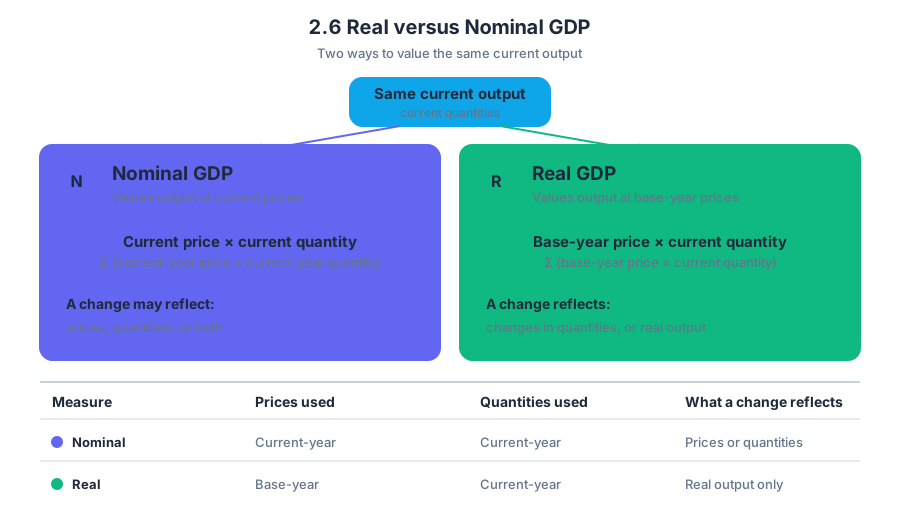
Nominal GDP is the value of current output using current-year prices. It changes when either production quantities or prices change:
$$\text{Nominal GDP}=\sum(\text{current-year price}\times\text{current-year quantity})$$
Real GDP is the value of current output using prices from a designated base year, the reference year whose prices are held constant:
$$\text{Real GDP}=\sum(\text{base-year price}\times\text{current quantity})$$
The quantities can change from year to year, but the prices used in real GDP remain fixed. That makes real GDP a measure of changes in actual output, rather than a mixture of output changes and price-level changes.
| Measure | Prices used | Quantities used | What a change can reflect |
|---|---|---|---|
| Nominal GDP | Current-year prices | Current-year quantities | Changes in prices, quantities, or both |
| Real GDP | Base-year prices | Current-year quantities | Changes in quantities, or real output |
Middleland: holding prices constant
Suppose Middleland produces food, clothing, and machinery. In the base year, 2021, the table gives these prices and quantities:
| Good | 2021 price | 2021 quantity | 2022 quantity |
|---|---|---|---|
| Food | $50 | $11$ units | $10$ units |
| Clothing | $70 | $4$ units | $5$ units |
| Machinery | $30 | $12$ units | $15$ units |
In the base year, 2021, real GDP equals nominal GDP because both calculations use the same prices:
$$\text{GDP}_{2021}=(11\times 50)+(4\times 70)+(12\times 30)$$
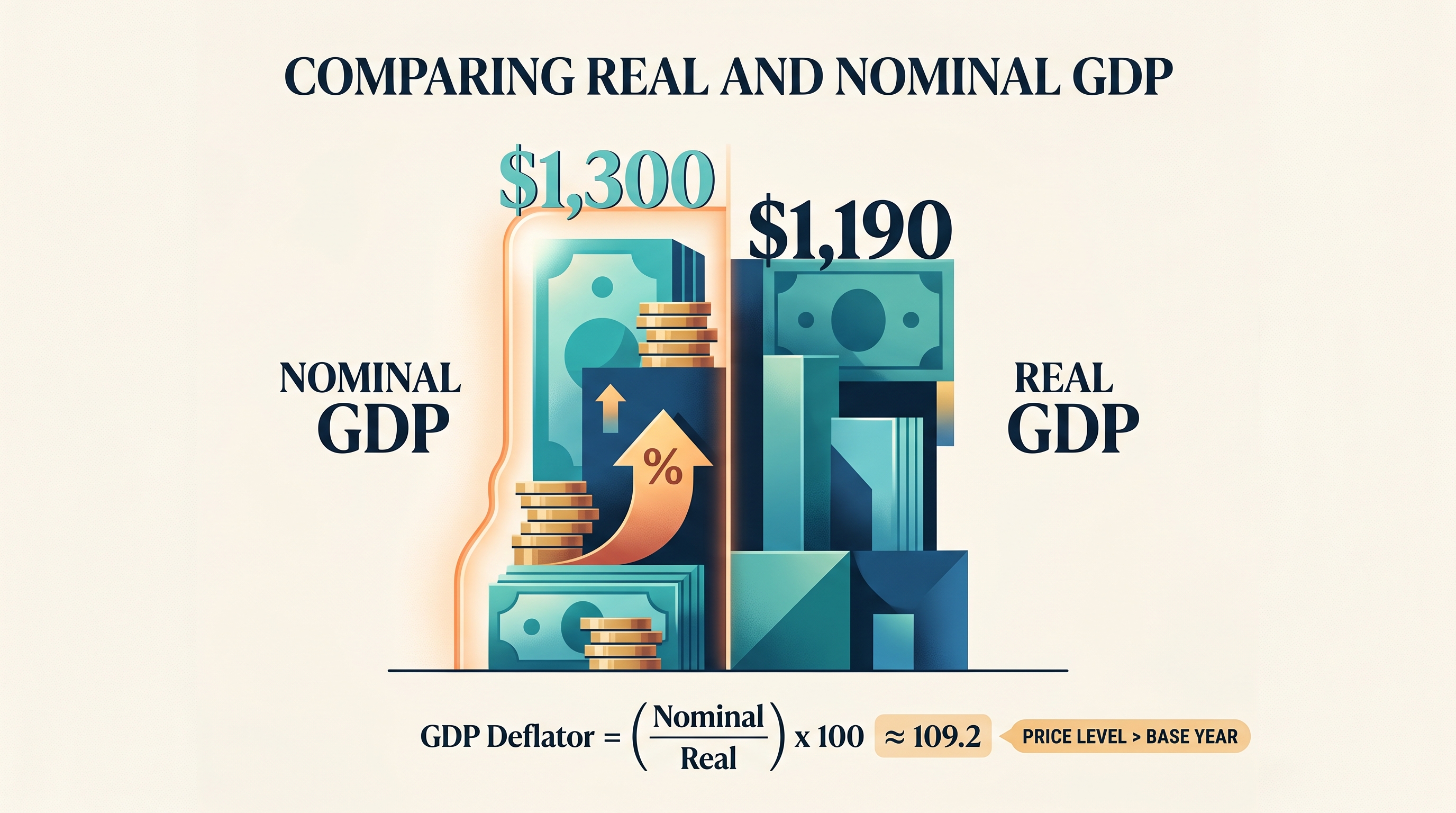
$$\text{GDP}_{2021}=550+280+360=$1{,}190$$
Thus, in 2021:
$$\text{Real GDP}{2021}=\text{Nominal GDP}{2021}=$1{,}190$$
Using the stated Middleland comparison, 2022 real GDP is calculated with 2021 prices:
$$\text{Real GDP}_{2022}=(11\times 50)+(4\times 70)+(12\times 30)=$1{,}190$$
The central operation is the price substitution: use base-year prices while evaluating the relevant output at constant prices. By contrast, 2022 nominal GDP uses 2022 prices and quantities:
$$\text{Nominal GDP}_{2022}=(10\times 50)+(5\times 70)+(15\times 30)$$
$$\text{Nominal GDP}_{2022}=500+350+450=$1{,}300$$
The GDP deflator and price weighting
The GDP deflator is a broad price index for domestically produced final goods and services. It compares nominal GDP with real GDP:
$$\text{GDP deflator}=\left(\frac{\text{Nominal GDP}}{\text{Real GDP}}\right)\times 100$$
For Middleland in 2022:
$$\text{GDP deflator}_{2022}=\left(\frac{1{,}300}{1{,}190}\right)\times 100\approx 109.2$$
A deflator of approximately $109.2$ means the measured price level is about $9.2%$ above the base-year level of $100$. Unlike a simple average of price changes, the GDP deflator is quantity-weighted: goods produced in larger quantities, or goods with greater production value, exert more influence on the overall price measure than goods with smaller weights. A large change in the price of a rarely produced good may matter less than a modest change in the price of a major component of national output.
What changes in GDP actually mean
If nominal GDP rises from $$1{,}190$ to $$1{,}300$ while real GDP is held at $$1{,}190$, the increase in nominal GDP reflects the pricing method rather than an increase in measured real output. Real GDP is designed to prevent price-level fluctuations from masquerading as production growth.
Key distinction: Nominal GDP answers “What was current production worth at today’s prices?” Real GDP answers “What would current production be worth at constant base-year prices?”
Misconception check: “Higher nominal GDP means the economy produced more.”
Not necessarily. A bakery could sell the same number of loaves at higher prices, causing nominal GDP to rise even though output is unchanged. To identify a change in production, economists use real GDP, which removes the price-change component by fixing prices at the base-year level.
Retrieval check
If nominal GDP is $$1{,}300$ and real GDP is $$1{,}190$, calculate the GDP deflator. What does a result above $100$ indicate?
The answer is:
$$\left(\frac{1{,}300}{1{,}190}\right)\times 100\approx 109.2$$
A value above $100$ indicates that the current measured price level is above the base-year price level.
Source Materials
- AP Macroeconomics Course and Exam Description
- AP Macroeconomics Course and Exam Description Clarifications and Corrections
- AP Macroeconomics Course Overview
- AP Macroeconomics Course at a Glance
- AP Macroeconomics Course at a Glance Poster
- AP Macroeconomics
- AP Macroeconomics
- AP Macroeconomics Sample Syllabus 1
- Figure — Sample Responses Q2 - Set 1 (p. 3)
- Figure — Sample Responses Q2 - Set 1 (p. 4)
- Figure — Sample Responses Q2 - Set 1 (p. 5)
- Figure — Sample Responses Q2 - Set 2 (p. 3)