From the free course AP Macroeconomics on Lykke
6.1 Balance of Payments Accounts
Key concepts: Capital and financial account (CFA) · Financial capital transfers between countries · International purchases and sales of assets · Balance of payments identity · Current account (CA) deficit · CFA surplus · Currency depreciation · Changes in the value of a currency · Exchange-rate effects on imports
A country can buy more from the world than it sells and still “pay” for the difference—because foreign investors may purchase its assets. The balance of payments (BOP) records these international transactions and explains why a trade imbalance is matched by a financial flow.
6.1 Balance of Payments Accounts
A country can buy more from the world than it sells and still “pay” for the difference—because foreign investors may purchase its assets. The balance of payments (BOP) records these international transactions and explains why a trade imbalance is matched by a financial flow.
Balance of payments: an accounting system that records a country’s international transactions during a particular time period. It consists of the current account (CA) and the capital and financial account (CFA). (MEA-4.A.5)
The two accounts that must fit together
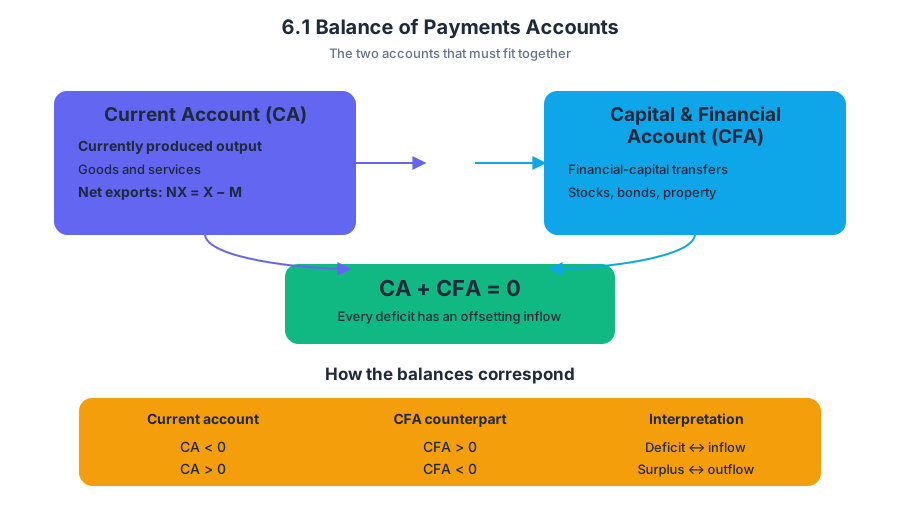
The current account (CA) records transactions involving currently produced goods and services, including net exports, where $NX = X - M$. The capital and financial account (CFA) records financial capital transfers between countries and international purchases and sales of assets such as stocks, bonds, factories, and real estate. (MEA-4.A.2, MEA-4.A.3)
The CFA may show either a surplus, meaning a net financial-capital inflow, or a deficit, meaning a net financial-capital outflow. The capital account and financial account should not be treated as two entirely separate balances when applying the AP relationship: the relevant combined measure is the capital and financial account (CFA). (MEA-4.A.4)
For accounting purposes, the two accounts offset one another:
$$CA + CFA = 0$$
This identity means that a current-account deficit corresponds to an offsetting CFA surplus. If a country imports more goods and services than it exports, the money flowing out through the CA is matched by financial capital flowing into the country through foreign purchases of domestic assets.
| Account movement | Meaning | Required counterpart |
|---|---|---|
| $CA < 0$ | Current-account deficit | $CFA > 0$, a CFA surplus |
| $CA > 0$ | Current-account surplus | $CFA < 0$, a CFA deficit |
| $CA = 0$ | Current account balances | $CFA = 0$ |
Worked example: a current-account deficit
Suppose Country A imports $120$ billion of goods and services but exports only $90$ billion. Its net exports are:
$$NX = X - M = 90 - 120 = -30$$
Assume this makes the current account equal to $-30$ billion. To keep the BOP in balance:
$$CA + CFA = 0$$
$$-30 + CFA = 0$$
$$CFA = 30$$
Country A therefore has a CFA surplus of $30$ billion. Foreign investors must be purchasing $30$ billion more of Country A’s assets than Country A’s residents are purchasing of foreign assets. The deficit does not mean the country’s accounts are “broken”; it identifies the financial inflow financing the current-account deficit.
Why direction matters: Jamaica
A depreciation means that the Jamaican dollar falls in value relative to another currency. The direction must be stated explicitly: writing only “the Jamaican dollar changes” is incomplete, and saying it appreciates when it actually depreciates reverses the economic result.
Exchange-rate changes can also affect the value of imports. For example, if the Jamaican dollar depreciates against the U.S. dollar, U.S. goods become more expensive when priced in Jamaican dollars. Even if the physical quantity of U.S. imports does not immediately change, their measured value in Jamaican currency can increase.
Common misconception: “a deficit means no investment”
Misconception check — “A current-account deficit means financial capital leaves the country.” The opposite is true under the BOP identity. A CA deficit is paired with a CFA surplus: money spent on net imports flows outward, while foreign financial capital flows inward to purchase domestic assets.
AP reasoning process — Principles and Models: Use the accounting model rather than an isolated verbal rule. Identify the sign of the CA, substitute it into $CA + CFA = 0$, and infer the opposite sign for the CFA. This is the complete causal-and-accounting chain exam scoring rewards.
Retrieval check
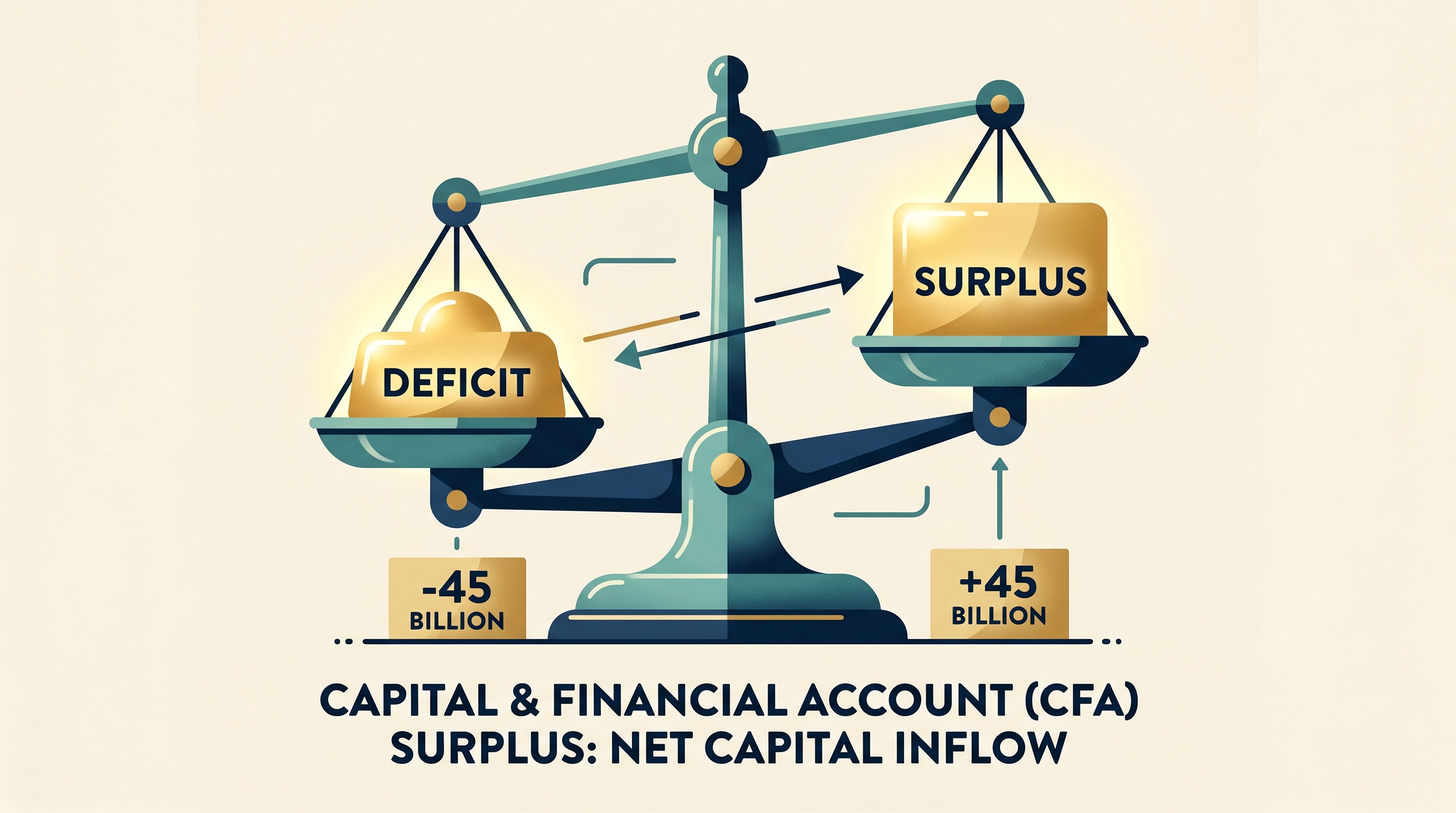
A country records a current-account deficit of $-45$ billion. What must its CFA equal, assuming the accounts balance? State the result in words as well as symbols.
Answer: $CFA = +45$ billion, so the country has a CFA surplus, representing a net financial-capital inflow.
Source Materials
- AP Macroeconomics Course and Exam Description
- AP Macroeconomics Course and Exam Description Clarifications and Corrections
- AP Macroeconomics Course Overview
- AP Macroeconomics Course at a Glance
- AP Macroeconomics Course at a Glance Poster
- AP Macroeconomics
- AP Macroeconomics
- AP Macroeconomics Sample Syllabus 1
- State that Barrikos’ capital and financial account (CFA) will move into surplus and explain that international investors will seek higher returns on financial capital in Barrikos, which will increase
- State that Barrikos’ capital and financial account (CFA) will move into surplus and explain that international investors will seek higher returns on financial capital in Barrikos, which will increase
- AP Macroeconomics-AP Students-College Board
- AP Macroeconomics FRQ Practice