From the free course AP Macroeconomics on Lykke
3.9 Automatic Stabilizers
Key concepts: Automatic stabilizers
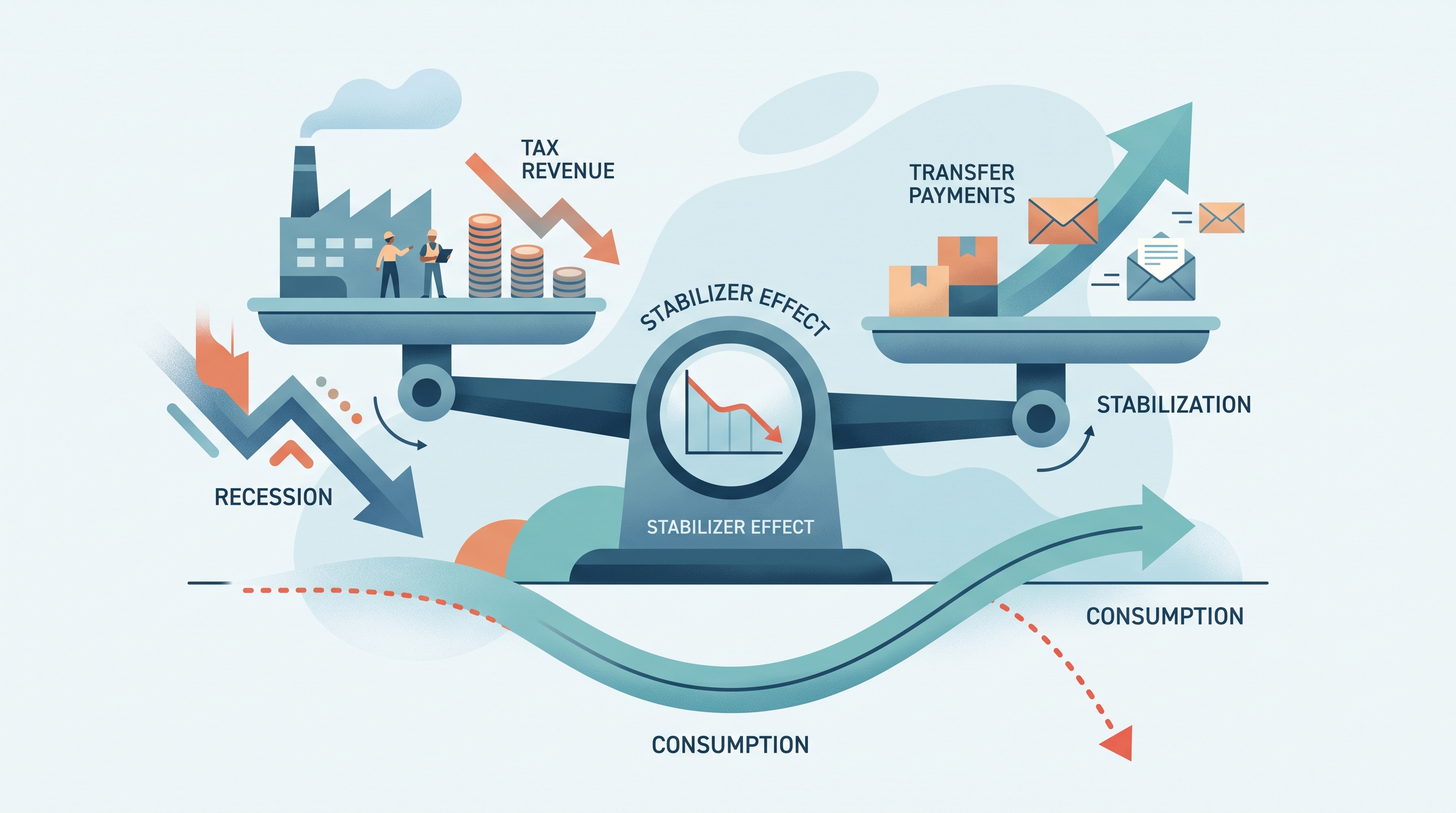
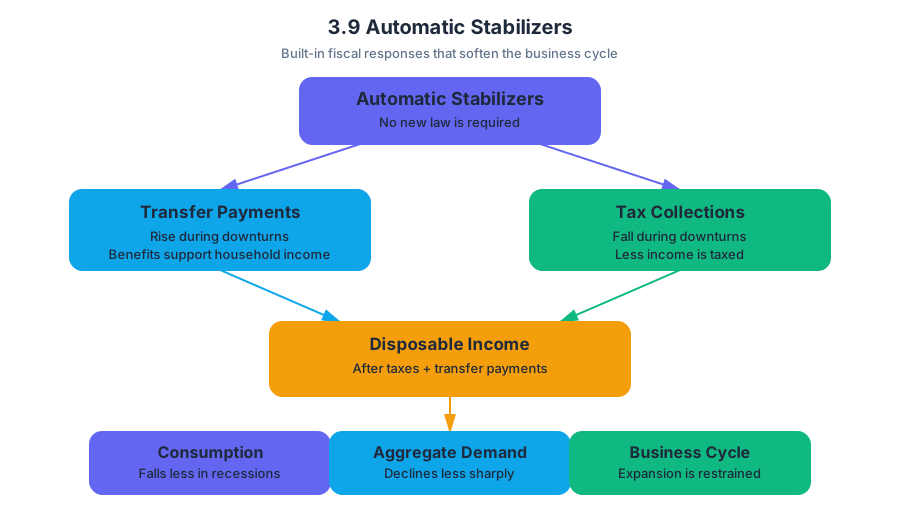
When the economy slows, government transfer payments tend to rise while tax collections tend to fall—even if lawmakers pass no new policy. These built-in responses are automatic stabilizers: fiscal mechanisms that automatically soften expansions and contractions in the business cycle.
3.9 Automatic Stabilizers
When the economy slows, government transfer payments tend to rise while tax collections tend to fall—even if lawmakers pass no new policy. These built-in responses are automatic stabilizers: fiscal mechanisms that automatically soften expansions and contractions in the business cycle.
Learning Objective 3.9.A: Explain how automatic stabilizers affect the business cycle.
Automatic stabilizers work through the government’s effects on disposable income, the income households have available after taxes and including transfer payments. During a recession, disposable income falls less than it otherwise would, so consumption and aggregate demand decline by a smaller amount. During an expansion, the same mechanisms restrain excessive growth in disposable income and aggregate demand.
The automatic response
The key mechanism can be visualized as a two-sided shock absorber:
- Recession: Real GDP and employment fall $\rightarrow$ tax revenue falls and transfer payments rise $\rightarrow$ disposable income falls less $\rightarrow$ consumption falls less $\rightarrow$ aggregate demand is supported.
- Expansion: Real GDP and employment rise $\rightarrow$ tax revenue rises and transfer payments fall $\rightarrow$ disposable income rises less $\rightarrow$ consumption grows less rapidly $\rightarrow$ aggregate demand is restrained.
Common automatic stabilizers include a progressive income tax system, in which the tax rate rises as income rises, and transfer payment programs, such as unemployment benefits. These mechanisms do not eliminate the business cycle; they reduce the size of fluctuations in output, employment, and consumption.
Essential Knowledge 3.9.A.1: Automatic stabilizers are fiscal policy mechanisms that work automatically to reduce fluctuations in the business cycle.
Essential Knowledge 3.9.A.2: Automatic stabilizers include progressive income tax systems and transfer payments.
Worked example: cushioning a recession
Suppose a negative spending shock initially reduces aggregate demand by $$100$ billion. Assume the marginal propensity to consume is $0.80$, so the simple spending multiplier is
$$ \frac{1}{1-\text{MPC}}
\frac{1}{1-0.80}
$$
Without any stabilizing response, the eventual change in real GDP could be
$$ \Delta Y = 5(-$100\text{ billion})=-$500\text{ billion}. $$
Now suppose the recession causes tax payments to fall by $$20$ billion and transfer payments to rise by $$30$ billion. Household disposable income therefore receives a $$50$ billion cushion. If households spend $80%$ of that additional disposable income, the first-round increase in consumption is
$$ $50\text{ billion}\times 0.80=$40\text{ billion}. $$
That extra consumption creates further income for other households, which creates additional consumption. Using the simple multiplier for this illustrative support,
$$ \Delta Y_{\text{support}}
5($40\text{ billion})
$200\text{ billion}. $$
The economy still experiences a downturn, but the automatic stabilizers prevent the initial decline from passing through the entire repeated-spending process without interruption. On an aggregate demand–aggregate supply diagram, the result is a smaller leftward movement of aggregate demand than would occur without the stabilizers.
Automatic versus discretionary fiscal policy
Discretionary fiscal policy requires an intentional change in government spending, taxes, or transfer payments. Automatic stabilizers require no new legislative decision: tax collections and transfer payments change as income and employment change.
| Feature | Automatic stabilizers | Discretionary fiscal policy |
|---|---|---|
| Trigger | Changes in income or employment | Deliberate government action |
| Timing | Begins automatically | Requires policy design and implementation |
| Examples | Progressive taxes, unemployment benefits | A new infrastructure program or tax law |
| Main effect | Moderates fluctuations | Intentionally changes aggregate demand |
Automatic stabilizers are especially valuable because discretionary policy can face recognition, legislative, and implementation lags. However, they also create larger government budget deficits during recessions and larger surpluses, or smaller deficits, during expansions. The budget balance changes as part of the stabilizing process; that change is not itself evidence that policymakers have adopted a new discretionary policy.
Misconception check: “A recession automatically causes expansionary fiscal policy”
Correction: A recession automatically produces expansionary effects through the budget system, not necessarily a new expansionary law. Falling tax revenue and rising transfers support aggregate demand, but government officials may not have changed tax rates, spending laws, or eligibility rules.
A second common error is to say that automatic stabilizers increase aggregate demand during every recession. More precisely, they make aggregate demand higher than it would have been without them. Aggregate demand may still decrease overall; the decline is simply smaller.
AP skills and reasoning processes
Automatic stabilizers are commonly assessed through the official skill categories Skill Category 1: Principles and Models, Skill Category 2: Interpretation, Skill Category 3: Manipulation, and Skill Category 4: Graphing and Visuals.
- 1.B — Explain given economic outcomes: connect a recession to lower tax revenue, higher transfers, stronger disposable income, and a smaller decline in consumption.
- 2.B — Explain economic variables: distinguish changes in real GDP, disposable income, consumption, tax revenue, and transfer payments.
- 2.C — Interpret visual representations: read an AD–AS graph and identify the smaller change in equilibrium real output.
- 3.A — Calculate rate, ratio, or percentage change: calculate changes in tax revenue, transfers, or disposable income when data are provided.
- 3.C — Calculate an economic variable: apply the spending multiplier to estimate the effect of a change in consumption or government support.
- 4.A — Draw a correctly labeled graph: label the vertical axis as Price Level, the horizontal axis as Real GDP or real output, and show the appropriate AD shift and equilibrium changes.
Retrieval check
If real GDP falls and unemployment rises, what happens automatically to tax revenue and transfer payments, and why does that reduce the size of the recessionary decline in consumption? A complete answer should state: tax revenue falls, transfer payments rise, disposable income falls less, and consumption—and therefore aggregate demand—falls less than it otherwise would.
Source Materials
- AP Macroeconomics Course and Exam Description
- AP Macroeconomics Course and Exam Description Clarifications and Corrections
- AP Macroeconomics Course Overview
- AP Macroeconomics Course at a Glance
- AP Macroeconomics Course at a Glance Poster
- AP Macroeconomics
- AP Macroeconomics
- AP Macroeconomics Sample Syllabus 1