AP Comparative Government and Politics
Institution: MIT
123 study materials · 50 sections
AP Comparative Government and Politics students working the current College Board Course and Exam Description, including first-time students with no prior background, plus teachers reviewing the page for CED alignment.; Teach every official CED unit and every numbered topic at topic granularity.; Develop every AP skill / science-practice code explicitly and by name.; Replace description with teaching: worked contextual examples, named misconceptions, and in-flow retrieval checks.; Build an exam-practice unit covering every task type on the current exam.
Course Sections
Course Framework, Skills and Reasoning Processes
Key concepts: Purpose and structure of the AP Program · Course framework and alignment with higher education expectations · Disciplinary practices and related skills · Instructional model: exploring, teaching, and assessing learning · Formative assessment and actionable feedback · AP Classroom Progress Checks · AP Question Bank and its organization by topics and skills · Teacher responsibility for curriculum design and pacing · The six AP Comparative Government and Politics countries · Interdisciplinary analysis using economics, sociology, history, and geography
Political science asks more than who governs: it asks how power is organized, why institutions are obeyed, how citizens participate, and why similar political problems produce different outcomes in different countries.
Course Framework, Skills and Reasoning Processes
Political science asks more than who governs: it asks how power is organized, why institutions are obeyed, how citizens participate, and why similar political problems produce different outcomes in different countries. AP Comparative Government and Politics studies those questions comparatively across China, Iran, Mexico, Nigeria, Russia, and the United Kingdom, drawing evidence from political science as well as economics, sociology, history, and geography.
AP courses provide challenging college-level coursework. Many U.S. four-year colleges and universities grant credit, advanced placement, or both for successful AP Exam performance, although each institution sets its own policy.
What the course framework does
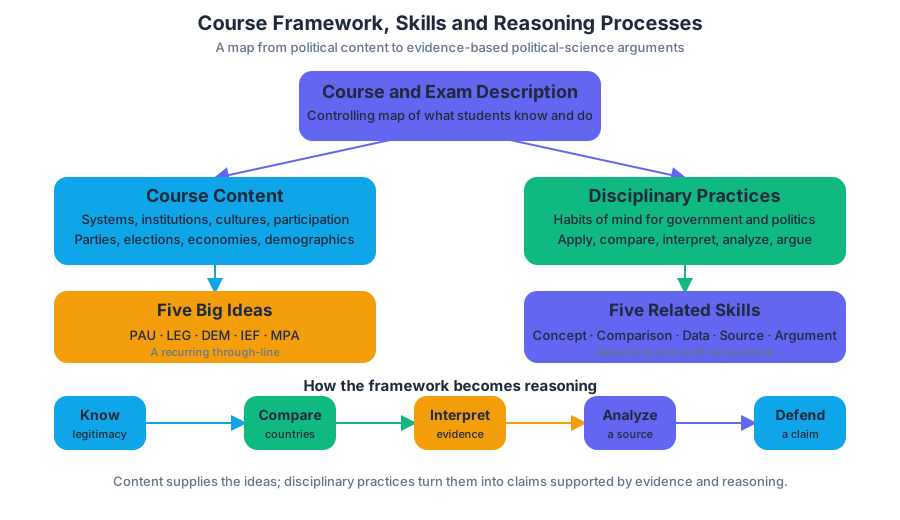
The Course and Exam Description is the controlling map of what students should know and be able to do. It connects required political content to the skills used to construct political-science arguments: applying concepts, comparing countries, analyzing data, interpreting sources, and defending claims with evidence and reasoning.
The framework has two essential components:
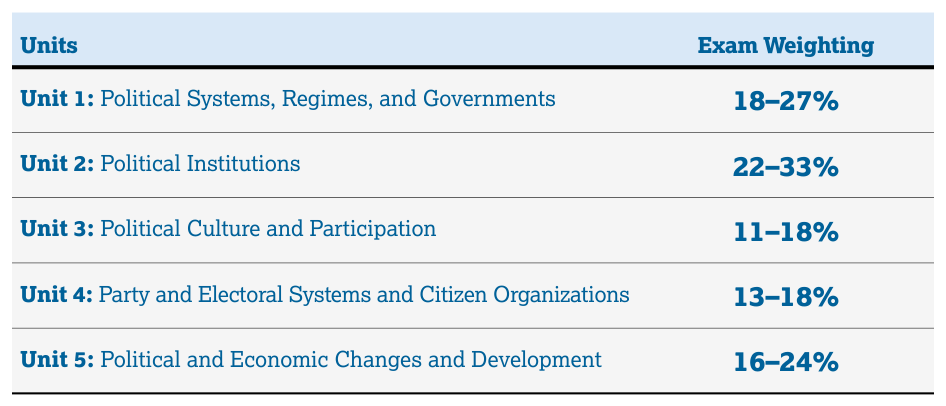
- Course content: the political systems, institutions, cultures, participation patterns, parties, elections, economic changes, demographic pressures, and resource challenges studied across the five units.
- Disciplinary practices: the habits of mind central to the study and practice of government and politics.
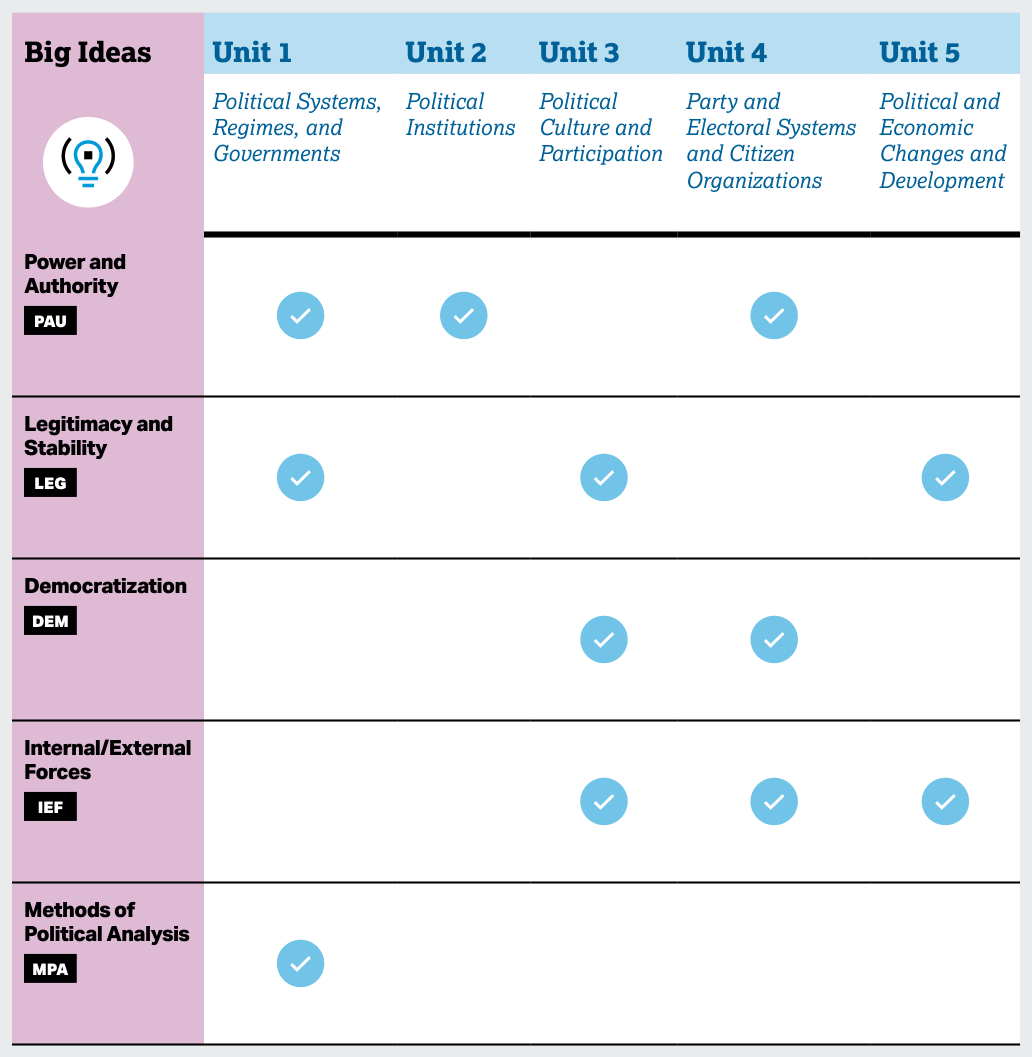
The five recurring Big Ideas give the content a through-line:
- PAU: Power and Authority
- LEG: Legitimacy and Stability
- DEM: Democratization
- IEF: Internal and External Forces
- MPA: Methods of Political Analysis
The five disciplinary practices appear together with related skills. A student may therefore need to know what legitimacy means, compare legitimacy across two countries, interpret evidence about it, analyze a source discussing it, and use the evidence in an argument.
The five disciplinary practices and official skills
| Disciplinary practice | Related skills | What strong work does |
|---|---|---|
| Practice 1: Concept Application | Skill 1.A: Define and explain concepts and theories; Skill 1.B: Describe political systems, institutions, regimes, or processes; Skill 1.C: Explain how political systems, institutions, regimes, or processes relate to one another | Uses a precise concept, not a vague synonym, and connects it to a political mechanism. |
| Practice 2: Country Comparison | Skill 2.A: Describe similarities and/or differences; Skill 2.B: Explain similarities and/or differences | Moves from “Country A has more” to why the difference exists and what it produces. |
| Practice 3: Data Analysis | Skill 3.A: Identify and describe data; Skill 3.B: Describe patterns and trends; Skill 3.C: Draw conclusions from data; Skill 3.D: Explain patterns and trends in data | Reads values accurately, identifies a pattern, draws a defensible conclusion, and explains its political meaning. |
| Practice 4: Source Analysis | Skill 4.A: Identify the claims or arguments in a source; Skill 4.B: Describe the claims or arguments in a source; Skill 4.C: Explain the perspective, purpose, or reasoning of a source | Separates what a source says from why its author says it. |
| Practice 5: Argumentation | Skill 5.A: Make a claim; Skill 5.B: Support a claim with evidence; Skill 5.C: Use reasoning to explain why the evidence supports the claim; Skill 5.D: Use refutation, concession, or rebuttal | Builds a logical chain: claim → evidence → reasoning, while addressing an alternative interpretation. |
A frequent error is confusing description with explanation. For example, “Nigeria has ethnic diversity” describes a condition; “ethnic diversity can encourage coalition-building or intensify competition for state resources, depending on institutions” explains a political relationship. The second statement uses Skill 1.C, and it becomes stronger when supported through Skills 2.B, 3.D, or 5.C.
Plan → Teach → Assess
Teachers design their own AP curriculum and select appropriate instructional resources. The framework focuses that design on assessed content and skills, but the published unit sequence is optional: pacing may be adjusted to students’ needs.
A repeatable instructional cycle connects planning, classroom learning, and feedback:
- Plan: Use unit guides, topic pages, required skills, instructional strategies, and varied resources to decide what students will investigate and what evidence of learning will count.
- Teach: Provide necessary scaffolding, then let students apply concepts, compare countries, analyze data and sources, and construct arguments.
- Assess: Measure understanding, identify the exact point of failure, and provide feedback that tells students what to change.
Formative assessment is most useful when feedback is actionable. “Review political institutions” is too broad; “You identified the trend but did not explain how executive term limits affect accountability” points to a specific conceptual and reasoning repair.
AP Classroom and Progress Checks
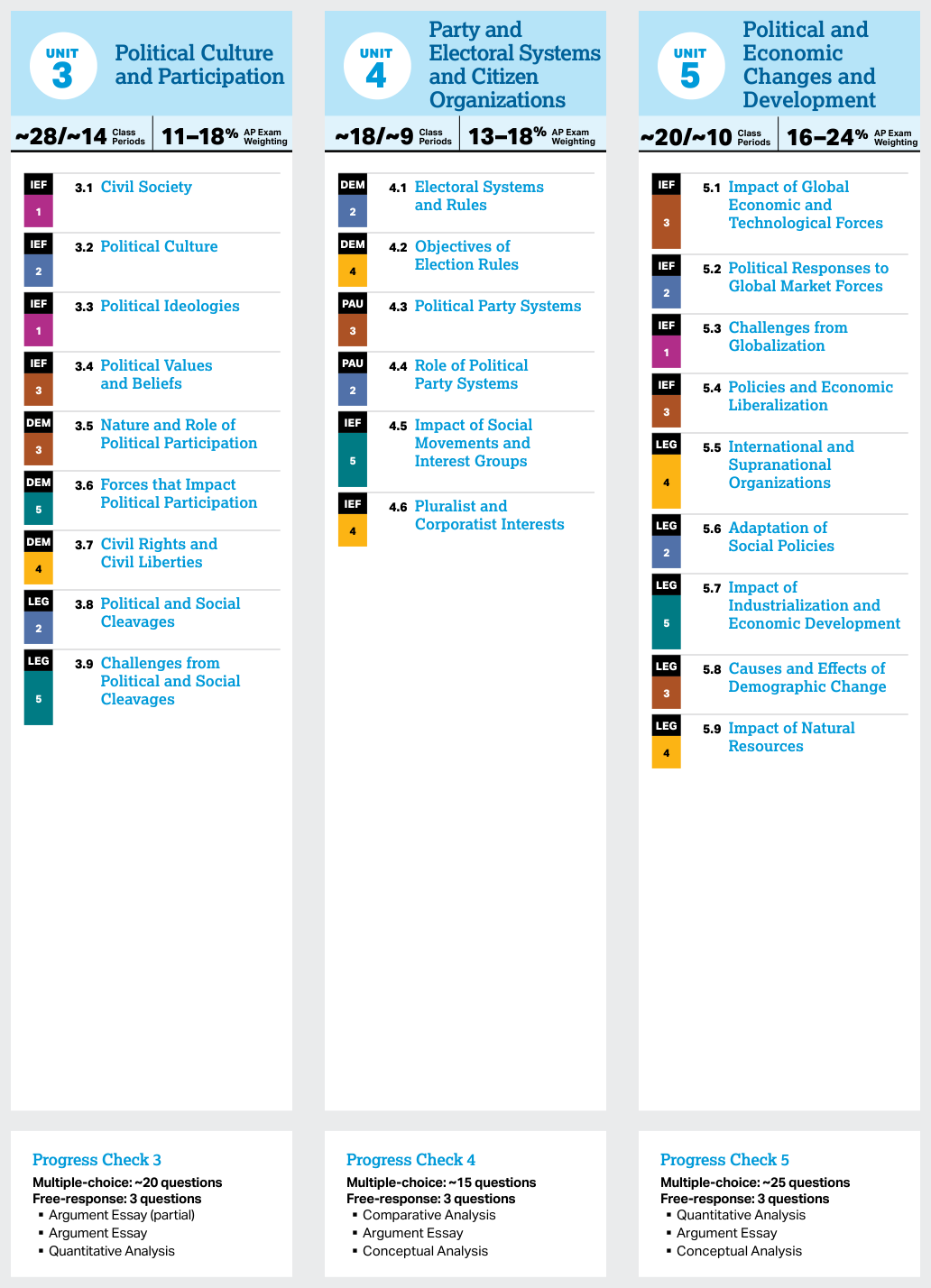
At the end of each unit, teachers can assign an online Progress Check through AP Classroom. Whether completed in class or as homework, it provides immediate feedback connected to that unit’s topics and skills.
Progress Checks combine approximately twenty to thirty multiple-choice questions with three free-response tasks. Across the units, the free-response tasks sample Conceptual Analysis, Quantitative Analysis, Comparative Analysis, and Argument Essay formats, sometimes in partial combinations. The purpose is not merely to produce a score; the dashboard and question-level feedback help locate whether the problem was content knowledge, data interpretation, comparison, source reasoning, or argument construction.
The AP Question Bank supplies secure, real AP Exam questions indexed by course topics and skills for classroom use. It can extend practice after a Progress Check while allowing teachers to target a precise weakness—for example, Skill 3.C: Draw conclusions from data rather than assigning undifferentiated review.
How the skills appear on the exam
The fully digital AP Exam uses multiple-choice and free-response sections, each contributing 50% of the score. Questions may require political concept application, quantitative analysis, qualitative or source analysis, country comparison, and argumentation across the six course countries.
The most reliable response pattern is analytical rather than encyclopedic:
- Name or identify the relevant political concept, pattern, claim, or institution.
- Describe the evidence accurately.
- Explain the relationship or mechanism.
- Compare or qualify when the prompt requires it.
- Support the argument with specific evidence and reasoning.
In-flow check: A graph shows that trust in government rises in Country A after a major expansion of social services but remains flat in Country B. Identifying the rise uses Skill 3.A; describing the trend uses Skill 3.B; concluding that the cases differ uses Skill 3.C; explaining how service delivery may strengthen legitimacy uses Skill 3.D and potentially Skill 5.C.



1.1 The Practice of Political Scientists
Key concepts: political legitimacy · political stability · authority · comparative political science · similarities and differences between political systems · quantitative sources · qualitative sources · author’s claims and perspective
A comparative political scientist asks a deceptively simple question: What is similar, what is different, and why does the difference matter? Comparing China, Iran, Mexico, Nigeria, Russia, and the United Kingdom requires more than memorizing institutions.
1.1 The Practice of Political Scientists
A comparative political scientist asks a deceptively simple question: What is similar, what is different, and why does the difference matter? Comparing China, Iran, Mexico, Nigeria, Russia, and the United Kingdom requires more than memorizing institutions. It requires disciplined methods for connecting evidence to political concepts such as authority, political legitimacy, and political stability.
Political legitimacy is the degree to which a government’s right to rule is accepted by the citizenry.
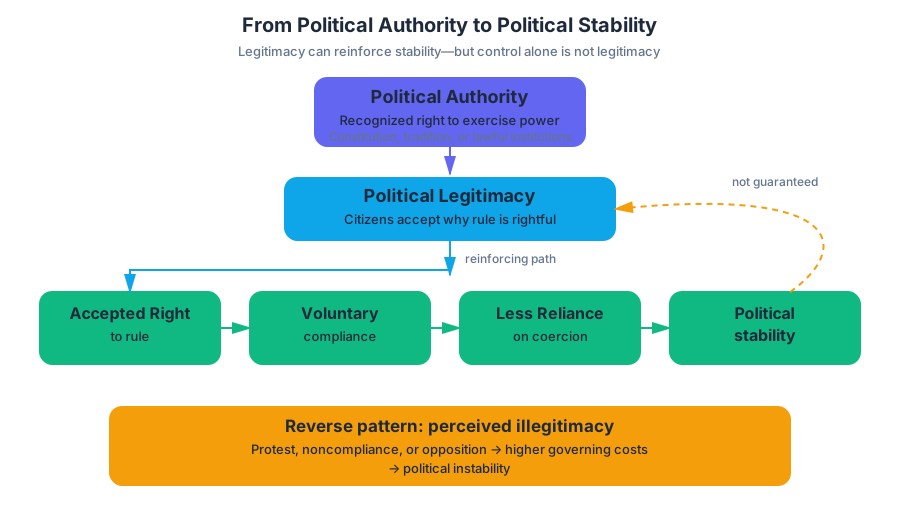
From political authority to political stability
Authority is the recognized right of a government to exercise power—to make and enforce decisions that citizens are expected to obey. A government may possess authority because its constitution grants it power, because citizens accept its traditional role, or because its institutions are viewed as lawful and appropriate.
Political legitimacy is different from mere control. A government can compel obedience through police power while still lacking broad acceptance of its right to rule. Legitimacy concerns why citizens accept rule; authority concerns the recognized right to exercise that rule.
Political stability is the persistence of a political system without frequent, disruptive challenges to the government or its basic institutions. Legitimacy often supports stability because citizens who view rule as rightful are more likely to obey laws, pay taxes, participate through established channels, and accept election outcomes. The relationship is not automatic: a government may remain stable for a time through coercion, while a legitimate government may face instability during war, economic crisis, or a contested transition.
The causal relationship can be pictured as a reinforcing—but not guaranteed—chain:
Accepted right to rule $\rightarrow$ voluntary compliance $\rightarrow$ lower reliance on coercion $\rightarrow$ greater political stability
The reverse pattern is also possible:
Perceived illegitimacy $\rightarrow$ protest, noncompliance, or opposition $\rightarrow$ greater governing costs $\rightarrow$ political instability
Comparative political science as a method
Comparative political scientists study similarities and differences between countries. They apply political concepts to different political systems rather than assuming that one country’s institutions work everywhere in the same way. A comparison might examine whether citizens in two countries view elections as legitimate, whether courts constrain executives, or whether regional governments possess meaningful authority.
A useful comparison changes one’s question from “Is this country democratic?” to a more precise question: “How do political institutions, citizen beliefs, and government performance affect acceptance of the government’s right to rule in these two countries?” This approach helps political scientists evaluate political realities and understand political change.
Worked comparison
Suppose a researcher compares two countries after disputed elections. In Country A, courts independently review complaints, opposition parties can organize, and the governing party accepts an unfavorable ruling. In Country B, courts follow executive instructions, opposition leaders are detained, and official media describe criticism as disloyal.
The researcher should not simply label Country A “good” and Country B “bad.” Instead, the evidence suggests that Country A has institutional procedures that may strengthen legitimacy by making government decisions appear lawful and contestable. Country B may preserve short-term stability through coercion, but restrictions on opposition can weaken citizens’ belief that authority is rightful, creating longer-term instability.
Reading quantitative and qualitative sources
Quantitative sources present numerical information in tables, charts, graphs, maps, or infographics. The first task is accurate description: identify the countries, categories, time period, units, and visible pattern before explaining its political meaning. A statement such as “Country A has a higher percentage than Country B” is description; claiming that the difference results from stronger legitimacy is an explanation that requires additional evidence.
Qualitative, text-based sources require a different method. Identify the author’s claim—the main assertion—and the author’s perspective, meaning the standpoint, interests, assumptions, or position shaping the text. Then evaluate whether the evidence actually supports the claim. An official government statement may claim that restrictions protect stability, but its institutional perspective may lead it to understate the costs to civil liberties or public trust.
Named misconception: stability equals legitimacy
A common mistake is treating the absence of visible protest as proof of legitimacy. Silence may reflect acceptance, but it may also reflect censorship, fear, surveillance, or limited access to political information. Strong analysis separates what the evidence shows from what the evidence may imply, and it avoids claiming causation without supporting evidence.
Skills and reasoning processes
Topic 1.1 The Practice of Political Scientists is aligned with MPA—Methods of Political Analysis—and Disciplinary Practice 3: Data Analysis. Its central learning objective is LO 1.1.A: Explain the research methods used by comparative political scientists. The essential knowledge identifiers are MPA-1.A.1, MPA-1.A.2, MPA-1.A.3, and MPA-1.A.4: comparative political scientists evaluate political realities and political change; study similarities and differences among countries; analyze quantitative sources; and analyze qualitative, text-based sources.
The key AP skills are Skill 2.A: Describe similarities and/or differences between countries, Skill 3.A: Describe data presented in a table, chart, graph, map, or infographic, Skill 3.B: Describe patterns and trends in quantitative data, Skill 4.A: Identify and describe claims and perspectives, and Skill 4.B: Explain how an author’s claim or perspective is supported by evidence. These skills work in sequence: observe accurately, compare carefully, identify claims, and judge whether evidence supports an interpretation.
Retrieval check
A graph shows that citizens in Country X report high trust in the national government, while an article from the government calls restrictions on opposition groups necessary for stability. Name one conclusion supported by the graph, one perspective present in the article, and one reason the evidence does not by itself prove that Country X is legitimate.



1.2 Defining Political Organizations
Key concepts: Political systems and regimes · Civil society organizations · Nongovernmental organizations (NGOs) · Organizations autonomous from the state · Regime type and civil society strength · Roles of civil society organizations · Electoral regulatory organizations · Multinational corporations (MNCs) and state sovereignty
A government is never the only organized force in a society. Religious associations, neighborhood groups, professional bodies, news organizations, businesses, and nongovernmental organizations can all shape what citizens demand and what governments are able—or willing—to do.
1.2 Defining Political Organizations
A government is never the only organized force in a society. Religious associations, neighborhood groups, professional bodies, news organizations, businesses, and nongovernmental organizations can all shape what citizens demand and what governments are able—or willing—to do. The central question is: who has political power, and how independently can citizens organize outside the state?
Political systems, regimes, states, and governments
A political system is the broad arrangement of laws, ideas, and procedures that determines who should rule and how much influence government should have over people and the economy. A state is a political organization with a permanent population, governing institutions, a defined territory, and international recognition.
A regime consists of the fundamental rules governing access to political power and the exercise of that power. Regimes usually last longer than individual governments: a new president or cabinet may take office while the underlying regime remains unchanged. A government is the group of officials currently directing the state, while a nation is a community connected by shared identity, history, culture, or political aspirations.
PAU-1.A.1: Political systems comprise the laws, ideas, and procedures that address who should have authority to rule and what the government’s influence on its people and economy should be.
PAU-1.A.2: States combine a permanent population with governing institutions to control a defined territory with international recognition; regimes establish the fundamental rules for access to and exercise of political power.
PAU-1.A.3: A regime can be characterized as democratic or authoritarian according to how it establishes rules and makes decisions about political power.
These concepts connect to the enduring understanding PAU-1: political systems and regimes reflect a dynamic balance of power between government and citizens. Civil society is one way to observe that balance. If citizens can organize independently, they may monitor, criticize, or pressure the government; if the government controls nearly every organization, citizens have fewer independent channels for collective action.
Civil society: organization outside the state
Civil society organizations are voluntary associations that are autonomous from the state. “Voluntary” means people join by choice rather than by legal requirement. “Autonomous” means the organization is not created, directed, or controlled by government officials.
Examples include local religious organizations, neighborhood associations, news media, business and professional associations, and NGOs. An NGO, or nongovernmental organization, is an organization that operates independently of the government, often to pursue humanitarian, environmental, educational, economic, or human-rights goals.
An organization is not automatically part of civil society merely because it is called an association or does useful work. The key test is its relationship to the state:
| Organization | Civil society? | Why |
|---|---|---|
| Independent neighborhood association | Yes | Citizens voluntarily organize outside direct state control. |
| Independent news outlet | Yes | It can provide information and scrutinize officials. |
| Government ministry | No | It is a formal state institution. |
| State-sponsored “union” required to represent workers | Not fully autonomous | Its legal existence or leadership may depend on government control. |
| Amnesty International | Yes | Its members and supporters organize voluntarily, and the organization can criticize governments rather than serve as a government agency. |
Strength, variety, and regime type
Civil society varies in strength and variety depending on the regime in which it operates. Registration requirements, surveillance, censorship, restrictions on funding, and government monitoring can limit which organizations exist and what they are allowed to do. In a more open political environment, many organizations may compete to represent different interests; in a more restrictive environment, organizations may be narrow, state-approved, or forced to avoid political criticism.
Consider the United Kingdom and China. In the United Kingdom, independent charities, professional associations, news organizations, and advocacy groups can generally organize, lobby Parliament, publish criticism, and campaign publicly. In China, organizations may provide social services or represent professional interests, but registration and monitoring policies give the state greater ability to restrict organizations that challenge the Chinese Communist Party.
Misconception check — “Civil society means civil rights.”
Civil rights are legally protected claims to equal treatment and participation. Civil society is the network of voluntary organizations operating independently from the state. Civil-rights groups may belong to civil society, but the concepts are not interchangeable.
What civil society organizations do
Civil society organizations are not necessarily political. A neighborhood association may focus on sanitation, and a professional association may set standards for its members. Nevertheless, a robust civil society can become an agent of democratization by teaching people how to organize, communicate demands, monitor officials, and participate collectively.
For example, Nigerian civil society organizations can represent community interests, expose corruption, monitor government performance, and lobby for policy changes. In Mexico, NGOs and independent civic groups can document abuses, advocate for victims, and pressure public institutions to respond. These organizations also give members practical organizational experience—holding meetings, selecting leaders, raising funds, and coordinating campaigns.
Civil society organizations may therefore perform four major roles: monitoring and lobbying government, exposing governmental malfeasance, representing members’ interests, and providing organizational experience. Their success depends partly on whether the regime permits independent activity and whether citizens can safely participate.
Electoral regulators and controlled participation
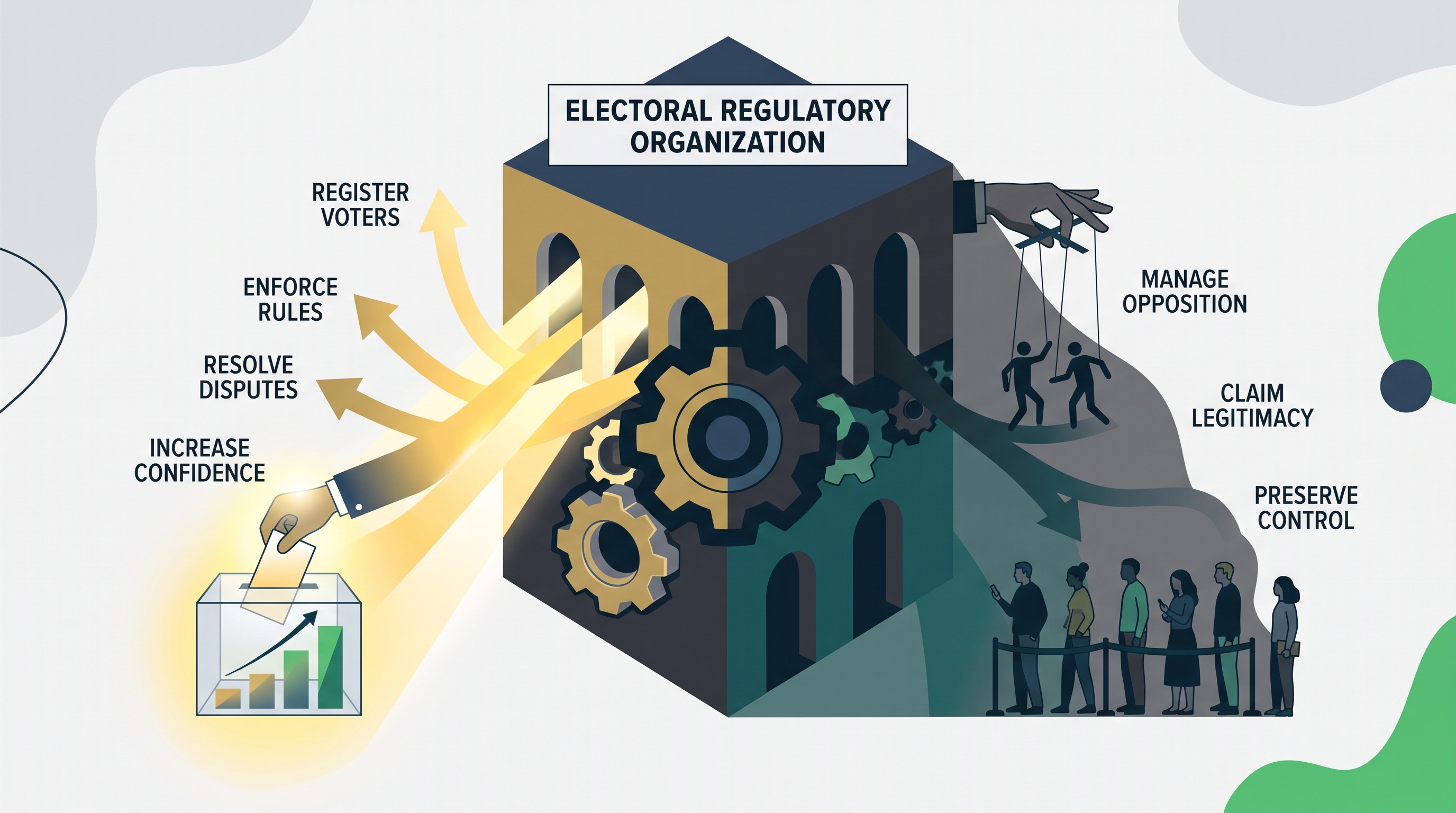
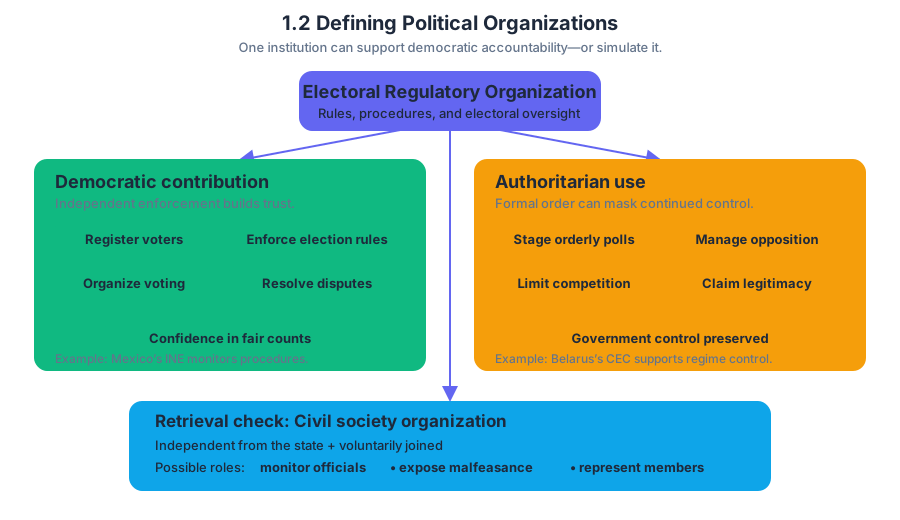
An electoral regulatory organization can contribute to democratization by registering voters, enforcing election rules, organizing voting procedures, resolving electoral disputes, and increasing confidence that votes are counted fairly. However, an authoritarian system might also create such an organization to produce the appearance of orderly elections, manage opposition participation, or claim domestic and international legitimacy while preserving government control.
Skill connection — 1.A: Concept Application — “Describe political systems, principles, institutions, processes, policies, and behaviors.” A strong application identifies the concept, gives a specific country example, and explains the mechanism. Do not merely write “an NGO helps democracy”; explain how it monitors officials, represents members, or changes political participation.
Retrieval check: An organization is independent from the state, voluntarily joined, and campaigns against corruption. What makes it a civil society organization, and which two roles could it perform? A complete answer should identify its autonomy and voluntary membership, then explain monitoring, exposing malfeasance, representation, or organizational training.
1.3 Democracy vs. Authoritarianism
Key concepts: Democracy · Claiming and maintaining power in a country · Religious influence in a democracy
A government can claim power through elections yet maintain power by restricting competition, controlling information, or weakening opponents. The central comparative question is therefore not merely Who governs?
1.3 Democracy vs. Authoritarianism
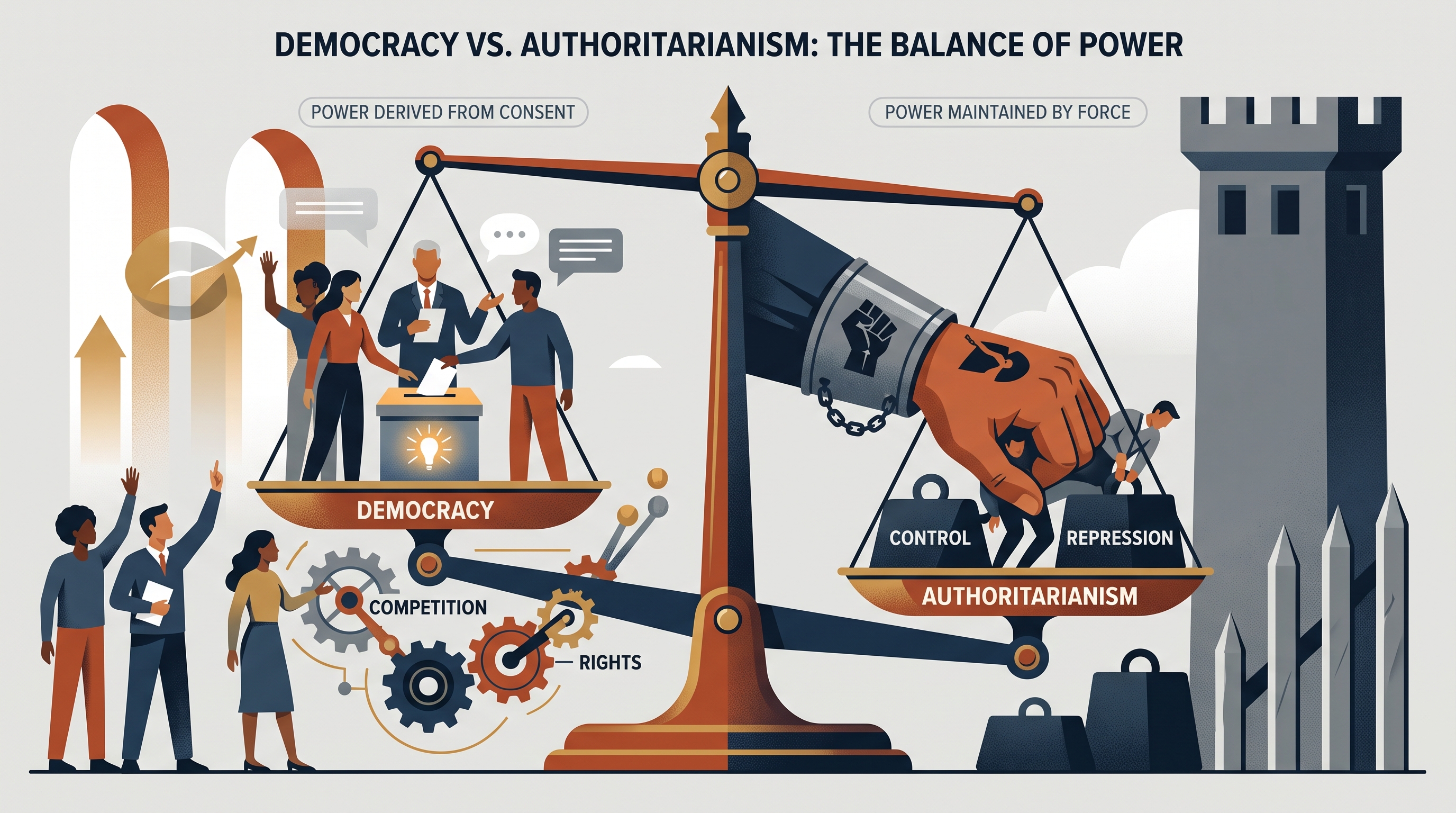
A government can claim power through elections yet maintain power by restricting competition, controlling information, or weakening opponents. The central comparative question is therefore not merely Who governs? but How is power claimed, exercised, and maintained?
Democracy is a system in which political authority is grounded in popular participation and meaningful competition, supported by institutions that protect political rights and limit government power.
Authoritarianism is a system in which political power is concentrated in one leader, one party, a military establishment, or a small governing group, while political competition and civil liberties are significantly restricted.
The institutional difference
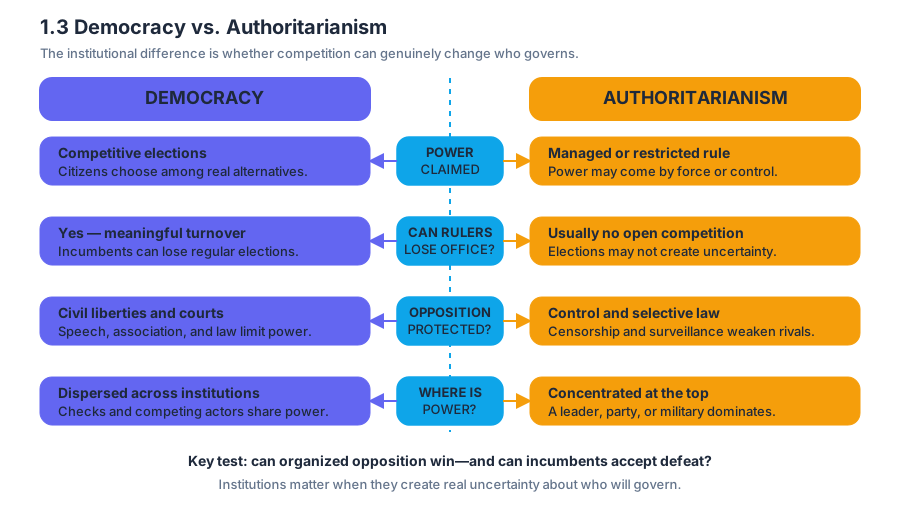
In a democracy, leaders claim power through procedures that allow citizens to choose among competing alternatives. Elections must be more than ceremonies: opposition candidates must be able to organize, voters must have meaningful choices, and the rules must permit incumbents to lose. Democratic government also depends on protections such as freedom of expression, freedom of association, an independent judiciary, and the rule of law.
In an authoritarian system, leaders may use elections, constitutions, legislatures, and courts, but these institutions do not necessarily create genuine uncertainty about who will govern. The ruling group may restrict opposition parties, censor criticism, manipulate electoral rules, control the media, or use state institutions against political rivals.
| Question | Democracy | Authoritarianism |
|---|---|---|
| How is power claimed? | Competitive elections and recognized constitutional procedures | Appointment, inherited authority, military takeover, dominant-party control, or tightly managed elections |
| Can rulers lose office? | Yes, through regular and meaningful elections | Usually not through open competition |
| What protects opposition? | Civil liberties, independent courts, and legal limits | Surveillance, censorship, restrictions, or selective enforcement of law |
| Where is power concentrated? | Dispersed among institutions and competing political actors | Concentrated in a leader, party, military, or ruling elite |
| What makes rule durable? | Institutional legitimacy and peaceful succession | Coercion, patronage, ideology, performance, or controlled participation |
Claiming and maintaining power
The distinction between claiming and maintaining power is essential. A leader may claim authority constitutionally but maintain it through practices that undermine democratic competition. Conversely, an authoritarian government may claim power through a revolution or military takeover but later maintain it by creating a dominant-party system, distributing patronage, or delivering economic growth.
Coercion means using force or the threat of force to secure obedience. Patronage means distributing jobs, contracts, money, or other benefits to supporters. Authoritarian governments often combine coercion with patronage: repression raises the cost of opposition, while rewards encourage loyalty.
A useful analysis asks four questions:
- Who may participate in politics?
- Can organized opposition realistically challenge the government?
- Are political rights protected even when citizens criticize leaders?
- Can institutions remove or constrain those currently in power?
Exam insight: Do not classify a regime from one feature alone. The presence of elections does not automatically make a country democratic, and the presence of strong executive power does not automatically make it authoritarian. Analyze the entire pattern of competition, rights, institutional constraints, and leadership turnover.
Religious influence in a democracy
Religious influence does not by itself make a country nondemocratic. A democracy may have a religious majority, religious political parties, or public policies shaped partly by religious beliefs. The decisive issue is whether citizens retain political equality and whether government institutions protect participation and rights for people who hold different beliefs—or no religious belief.
Nigeria illustrates why this distinction matters. Nigeria is a democracy with religious influence, including substantial Christian and Muslim populations. Religious identities can shape voting behavior, party appeals, public debates, and policy preferences. Yet religious influence alone does not determine the regime type; the analysis must examine elections, political competition, civil liberties, and the functioning of institutions.
Misconception check — “A religiously influenced country cannot be democratic.” False. Religion may influence democratic politics in the same way that ethnicity, region, class, or ideology can influence political preferences. Democracy requires inclusive and meaningful political competition, not the absence of religious beliefs from public life.
Worked comparison
Suppose Country A has regular elections, several parties, independent news organizations, and courts that sometimes rule against the president. Religious organizations influence campaigns, but minority parties may compete and citizens may criticize the government. Country A is more consistent with democracy.
Country B also holds elections, but the ruling party controls television, prevents major opponents from organizing, and uses courts to disqualify challengers. Even if voting occurs, Country B is more consistent with authoritarianism because competition is not genuinely open.
AP skill connection
1.A — Define and explain political concepts and processes is assessed when you identify democracy or authoritarianism and connect the label to observable evidence. A strong response does not merely state “Nigeria is democratic” or “Country B is authoritarian”; it explains the classification using competition, rights, institutional limits, and the process by which leaders claim and maintain power.
Retrieval check: A country has elections, but the governing party controls media access, bans major opposition groups, and makes peaceful turnover nearly impossible. Which feature matters most in classifying the regime, and why? The best answer identifies the lack of meaningful competition and explains that elections alone do not establish democracy.
1.4 Democratization
Key concepts: Democratization · Press freedom · Press Freedom Index · Quantitative analysis of political data · Relationship between largest-party seat share and democratization in Nigeria · Press-freedom trends · Drawing conclusions from data · Mexico’s level of democratization · Iran’s regime type · Competitive elections and political actors
Democratization is the process through which a political system becomes more democratic by expanding meaningful political participation, competitive elections, accountability, and protected freedoms. It is not a switch that moves a country permanently from “authoritarian” to “democratic”; it can advance, stall,…
1.4 Democratization
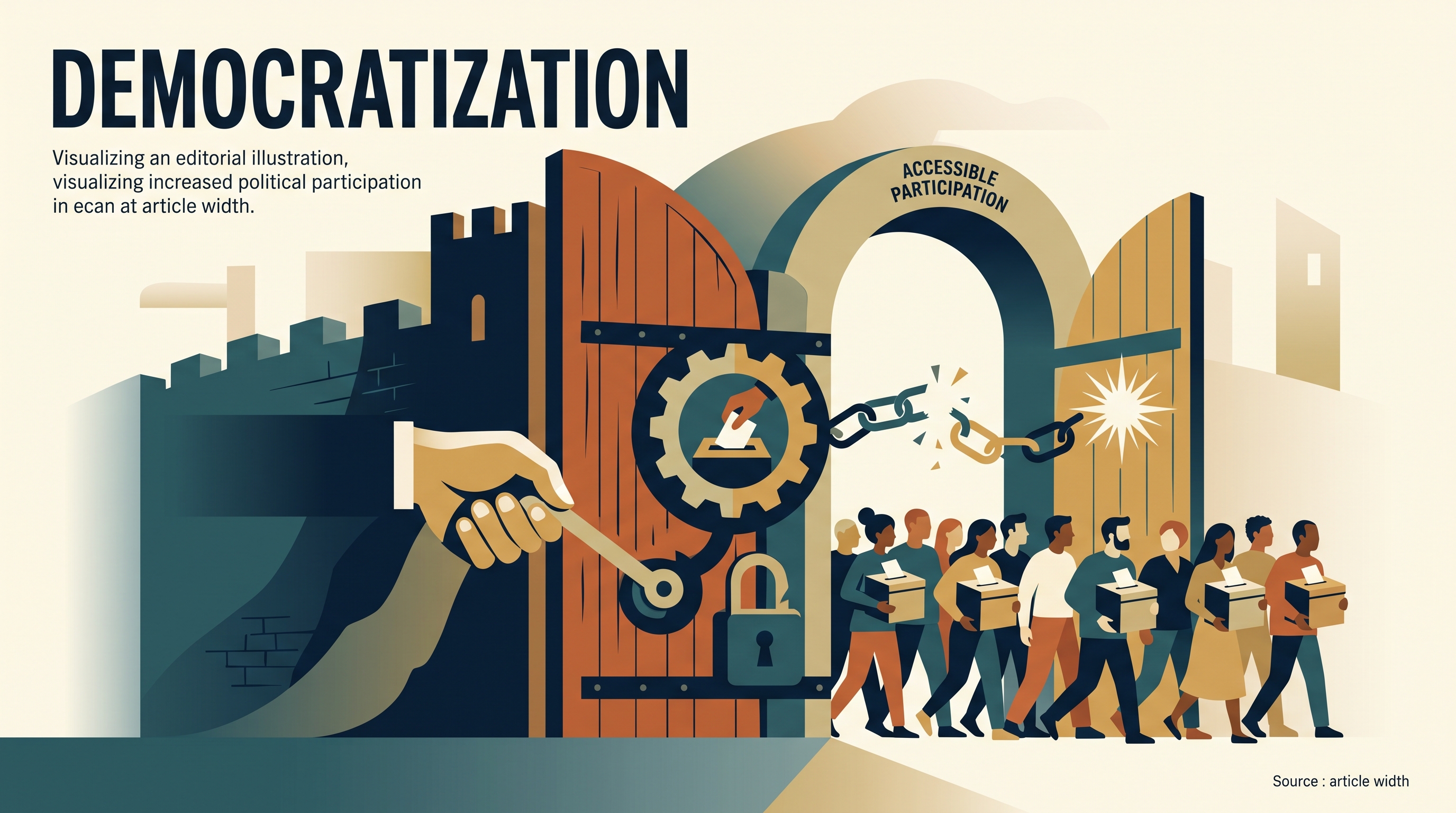
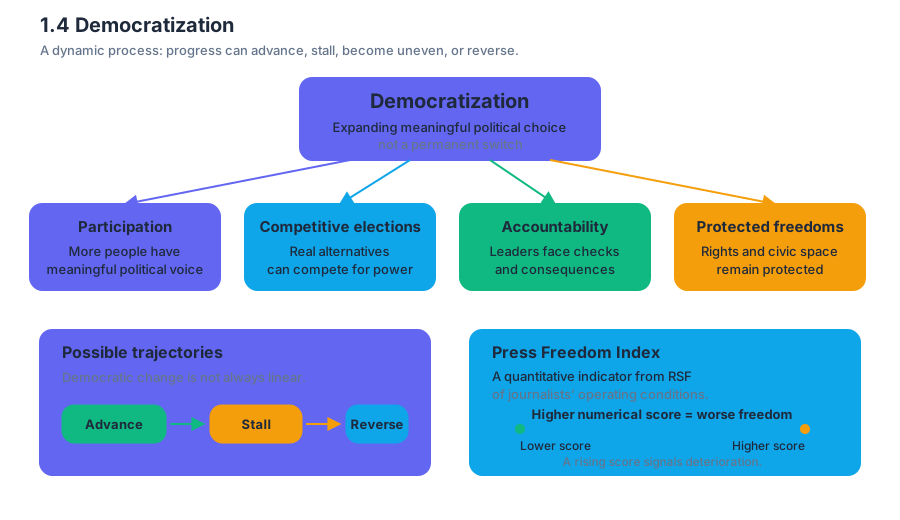
Democratization is the process through which a political system becomes more democratic by expanding meaningful political participation, competitive elections, accountability, and protected freedoms. It is not a switch that moves a country permanently from “authoritarian” to “democratic”; it can advance, stall, become uneven, or reverse.
Key idea: Elections may become more competitive while other democratic conditions—especially press freedom—remain weak.
The Press Freedom Index, produced by Reporters Without Borders, provides a quantitative indicator of how freely journalists and news organizations can operate. When interpreting its scores, read the scale carefully: a higher numerical score generally indicates worse press freedom, so a rising score represents deterioration rather than improvement.
Democratization is multidimensional
A country’s democratization should be judged across several dimensions rather than from one indicator alone:
| Dimension | Evidence of democratic development |
|---|---|
| Elections | Opposition parties can organize, compete, and win |
| Political participation | Citizens can vote, organize, protest, and influence policy |
| Accountability | Leaders and institutions face meaningful oversight |
| Civil liberties | Speech, association, and political opposition receive protection |
| Press freedom | Journalists can investigate and criticize those in power |
This distinction matters because a country can make progress in one dimension while losing ground in another. Competitive elections are important evidence of democratization, but they do not automatically guarantee free media, an independent judiciary, or equal political rights.
Worked data analysis: Nigeria
Suppose the table shows Nigeria’s largest-party share of legislative seats increasing from approximately 52 percent in 2011 to 54 percent in 2015, reaching 56 percent in 2018, and remaining near 56 percent in 2020. Over the same general period, Nigeria’s Press Freedom Index results show worsening press freedom, reflected in a higher numerical score.
The relationship can therefore be described in three steps:
- Describe the seat-share trend: Nigeria’s largest party gained legislative strength, including a largest-party seat share of approximately 56 percent in 2018.
- Describe the press-freedom trend: Nigeria’s Press Freedom Index score increased, indicating declining press freedom.
- Connect the indicators cautiously: Greater legislative dominance occurred alongside weaker press freedom, suggesting that Nigeria’s democratization was limited or uneven.
This is a correlation, not proof of causation. The data show that the trends occurred together; they do not establish that the largest party’s growing seat share directly caused restrictions on journalists. A strong explanation would identify a possible mechanism—such as reduced legislative opposition limiting oversight—while acknowledging that other forces, including intimidation by state or non-state actors, may also affect press freedom.
Exam distinction: “The score increased” describes a trajectory. “The ruling party restricted critical media through its legislative dominance” explains a cause or mechanism—and requires evidence beyond the number itself.
Worked conclusion: Mexico
Mexico’s data support a clear, qualified conclusion: Mexico has experienced partial or uneven democratization rather than complete democratic consolidation. Competitive elections demonstrate meaningful democratic development because opposition parties can compete and voters can alter political leadership.
However, Mexico’s press-freedom trend shows that democratization has not advanced uniformly. State actors or non-state actors may undermine journalists and media organizations even when elections remain competitive. The best conclusion is therefore that Mexico’s democratization is uneven and potentially stalled in some areas: electoral competition has expanded, but press freedom has not been secured to the same degree.
Iran and regime type
Iran’s very low level of press freedom is consistent with its authoritarian theocratic regime. Political authorities control or influence major media institutions, and criticism of religious or political leadership can be restricted. The supreme leader’s influence over institutions that regulate broadcasting helps explain why Iran receives a poor Press Freedom Index result.
Do not argue that the index score alone proves Iran’s regime type. Instead, use country knowledge to connect the quantitative evidence to institutional practice: authoritarian control over media reduces the ability of journalists to criticize leaders, which produces a low level of press freedom.
Skill focus and retrieval check
This topic develops 1.A Define and describe political concepts and processes, especially democratization; 1.B Explain political concepts and processes, by linking press freedom to regime characteristics; 3.A Identify the information presented, 3.B Describe the data, and 3.C Explain patterns and trends in quantitative data; and 5.A Develop an argument, by drawing a qualified conclusion from evidence. It also uses 2.A Describe similarities and differences when comparing democratic development across countries.
Retrieval check: If a country’s elections become more competitive but its Press Freedom Index score worsens, what is the strongest conclusion? The country is experiencing uneven democratization: electoral competition has improved, while press freedom has deteriorated. The data establish the pattern; country-specific political knowledge is needed to explain why.
1.5 Sources of Power and Authority
Key concepts: sources of power and authority · political systems and regimes · dynamic balance of power between government and citizens · legitimacy · elections · governmental transparency · constitutional provisions · checks and balances · unitary systems · federal systems
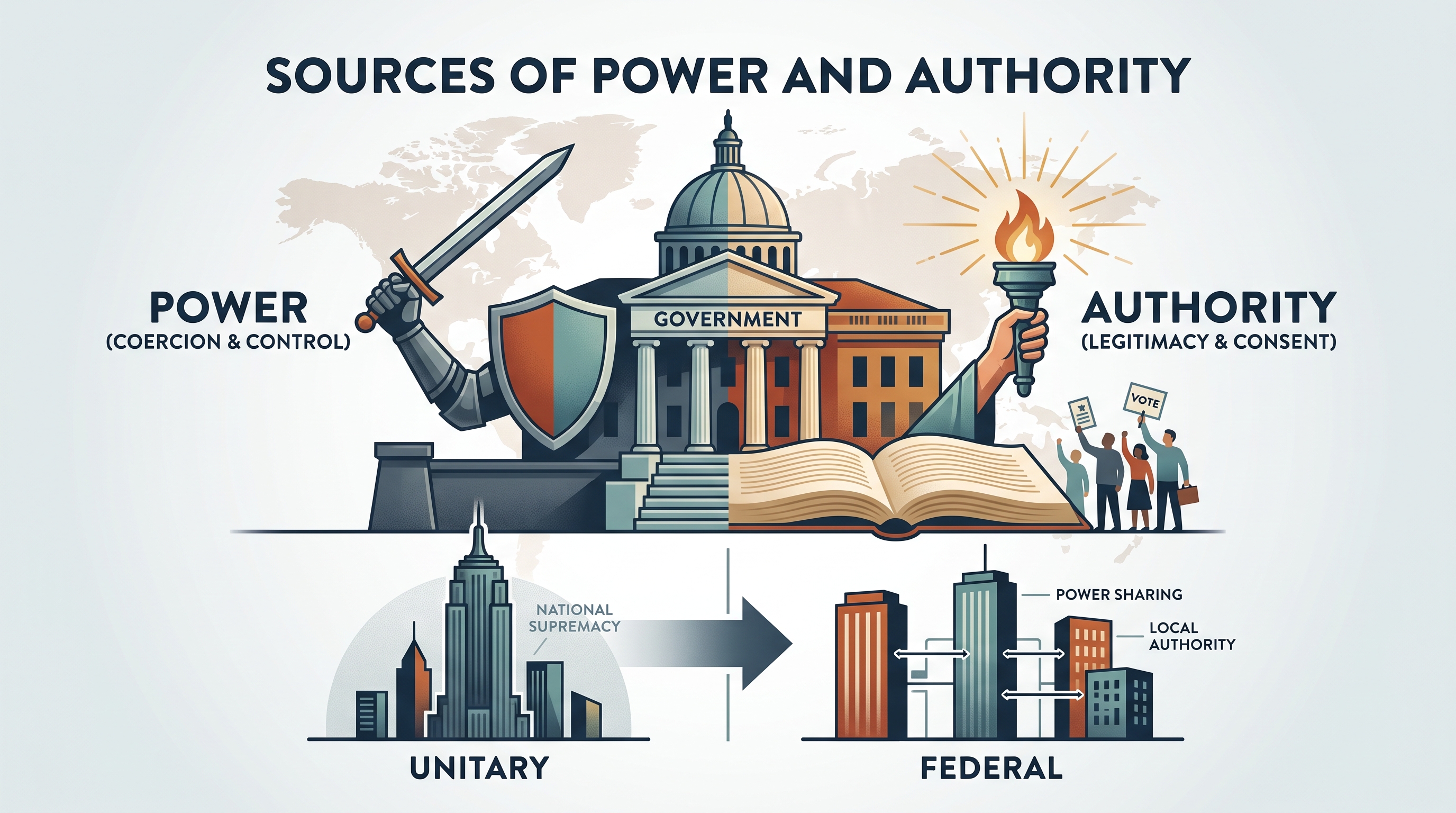
A government may possess laws, offices, and police forces yet still struggle to make citizens obey. Power is the ability to influence behavior or produce an outcome; authority is power regarded as rightful or accepted.
1.5 Sources of Power and Authority
A government may possess laws, offices, and police forces yet still struggle to make citizens obey. Power is the ability to influence behavior or produce an outcome; authority is power regarded as rightful or accepted. The central question is therefore not simply Who controls the state? but Why do people, institutions, or organizations accept that control?
PAU-1.D — Explain sources of power and authority in political systems.
The dynamic balance between government and citizens
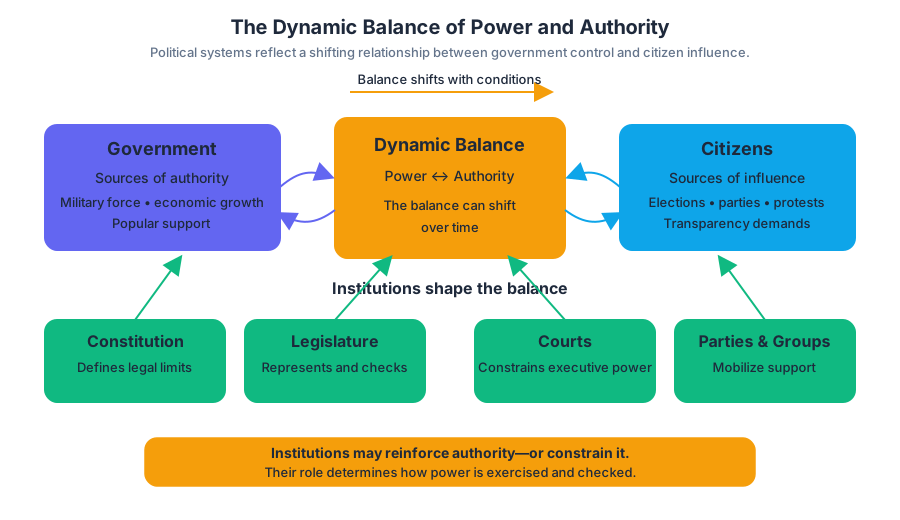
Political systems and regimes reflect a dynamic balance of power between the government and its citizens. “Dynamic” means that the balance can shift: a government may strengthen its control through military force, economic growth, or popular support, while citizens may gain influence through elections, political parties, legislatures, protests, or demands for greater transparency.
The balance is not a simple government-versus-citizens contest. Political parties, legislatures, courts, constitutions, religious organizations, and military forces can either reinforce government authority or constrain it. In China, for example, the Communist Party’s control over the military supplies the regime with power and authority that can help maintain stability; in another system, an independent legislature or judiciary may limit executive power.
Sources of authority
Legitimacy refers to the people’s belief that a government has the right to rule. Legitimacy is different from raw coercion: a government can force compliance without being widely viewed as rightful, but legitimate authority makes obedience more durable because citizens recognize the government’s rule as acceptable.
Common sources of legitimacy include:
| Source | How it can support authority |
|---|---|
| Elections | Leaders gain authority through a process citizens recognize as representative. |
| Governmental transparency | Public access to information can make decisions appear accountable rather than hidden. |
| Constitutional provisions | A government can claim authority by following established legal rules. |
| Economic growth | Improved living conditions may strengthen popular support. |
| Tradition | Long-established institutions may be accepted because they are familiar and historically rooted. |
| Charisma | A leader’s personal appeal can generate loyalty. |
| Religious heritage or organization | Religious traditions or institutions can provide moral justification for political rule. |
These sources can overlap, but they are not interchangeable. A government may hold elections without being viewed as fully legitimate if citizens believe the elections are unfair. Likewise, economic growth may increase support without creating constitutional authority. A source of legitimacy explains why rule is accepted; it does not automatically prove that rule is democratic.
Formal structures: unitary and federal power
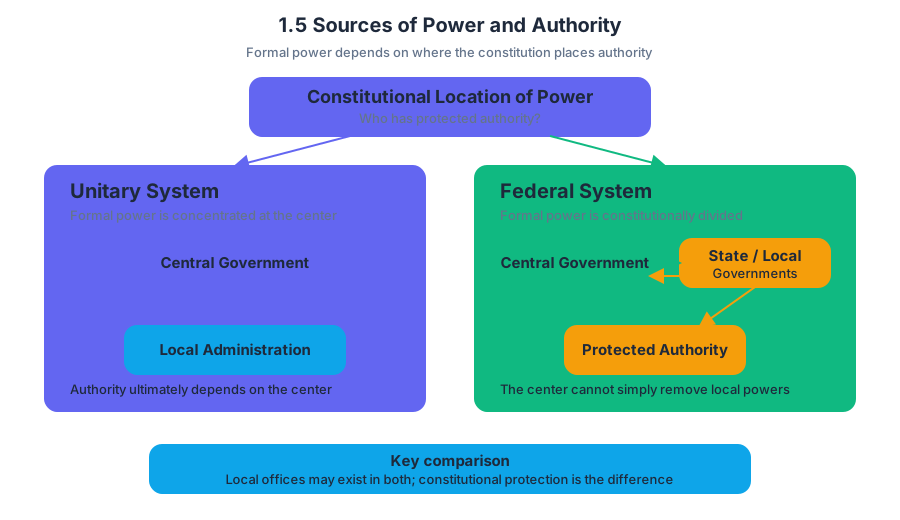
A unitary system places all formal power in the central government, with no constitutional authority given to state or local governments. Local officials may administer policies, but their authority ultimately depends on the center.
A federal system distributes formal power between a central government and state or local governments. The subnational governments possess constitutionally recognized authority, so the central government cannot simply eliminate their powers through an ordinary administrative decision.
The distinction concerns the constitutional location of formal power, not whether a country has local offices. A unitary country can decentralize administration, and a federal country can have a powerful central government. The key comparison is whether state or local authority is constitutionally protected.
Accountability and checks
Judicial power and the ability to carry out checks and balances among government branches can enhance governmental accountability. Courts may interpret laws, review governmental action, protect rights, and help prevent one branch from exercising unlimited authority. Legislatures can also scrutinize executives, control legislation, and express political disapproval.
The United Kingdom illustrates how authority can be checked even without a fixed election schedule. The prime minister’s power is constrained by Parliament, which can remove the prime minister when there is sufficient disapproval. The example shows why identifying a system’s formal rules is not enough: analysts must also ask which institutions can withdraw support or compel an officeholder to leave power.
Worked comparison: explaining authority
Imagine comparing China and the United Kingdom. China’s regime can draw authority from the Communist Party’s control of the military, constitutional and institutional arrangements, economic performance, and claims of political stability. The United Kingdom’s government can draw authority from elections, parliamentary accountability, constitutional practices, and traditions associated with its political institutions.
A strong comparison does more than list differences:
- Identify the source: military-party control in China; elections and parliamentary accountability in the United Kingdom.
- Explain the mechanism: control of coercive institutions can preserve regime stability, while parliamentary disapproval can remove a prime minister.
- State the significance: both systems seek effective rule, but authority is organized and constrained through different institutional relationships.
Country Comparison — PAU-1.D.1? / Practice 2: Compare countries by explaining a meaningful similarity or difference in their political systems, institutions, processes, policies, or behaviors—not by merely naming two countries.
Misconception check — “Power and legitimacy are the same.” They are not. Power describes the capacity to get an outcome; legitimacy describes the belief that rule is rightful. A government may possess power through coercion while facing weak legitimacy, or it may combine coercive capacity with broad acceptance.
Retrieval check
A country’s constitution grants local governments protected authority, but the national government controls the military and citizens distrust national elections. Is the country more likely unitary or federal, and which two sources of power or authority are present? Explain in two sentences, naming the constitutional structure and distinguishing power from legitimacy.
1.6 Change in Power and Authority
Key concepts: Change in power and authority · Centralization and decentralization of power · Unitary systems of government · Federal systems of government · Distribution of power between national and regional governments · Peaceful versus violent political change · Sovereignty · Social cleavages · Policy-making efficiency · Sources of power and authority
Power rarely stays in one place forever. A government may pull authority toward the national capital, transfer responsibilities to provinces or states, or lose control through rebellion, revolution, or external pressure.
1.6 Change in Power and Authority
Power rarely stays in one place forever. A government may pull authority toward the national capital, transfer responsibilities to provinces or states, or lose control through rebellion, revolution, or external pressure. Change in power and authority refers to shifts in who can make, enforce, and sustain binding political decisions.
Investigative question: When authority moves between national and regional governments—or changes hands entirely—does the state become more stable, more responsive, or more vulnerable?
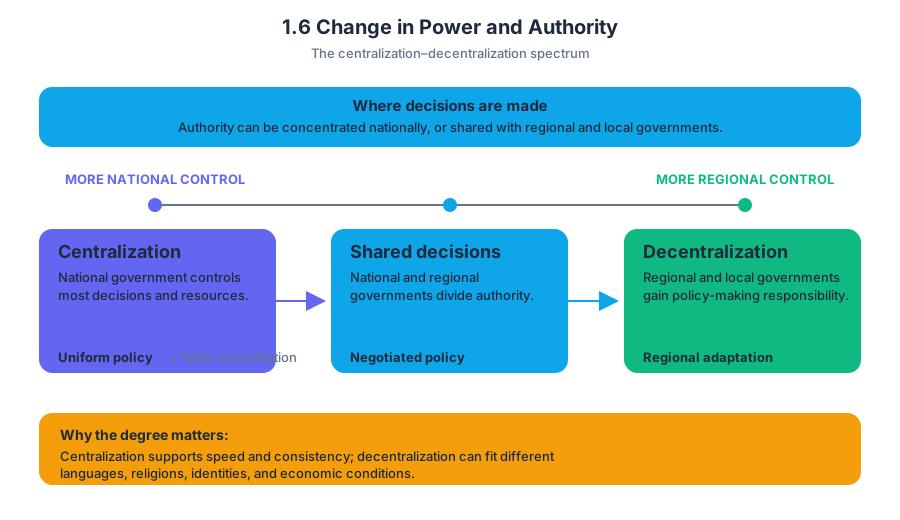
The centralization–decentralization spectrum
Centralization means that political authority is concentrated primarily in the national government. National officials set broad policies and may control the resources, laws, and institutions that regional governments need in order to act. Decentralization means that authority is distributed downward to regional or local governments, which gain greater responsibility for policy making.
The degree of centralization affects both government authority and policy making. A centralized government may implement a nationwide policy quickly, while a decentralized government may allow different regions to respond to distinct languages, religions, ethnic identities, or economic conditions.
A useful way to visualize the relationship is:
national government controls most decisions → centralization → uniform policy and faster coordination
national and regional governments share decisions → decentralization → regional adaptation and divided authority
Unitary and federal systems
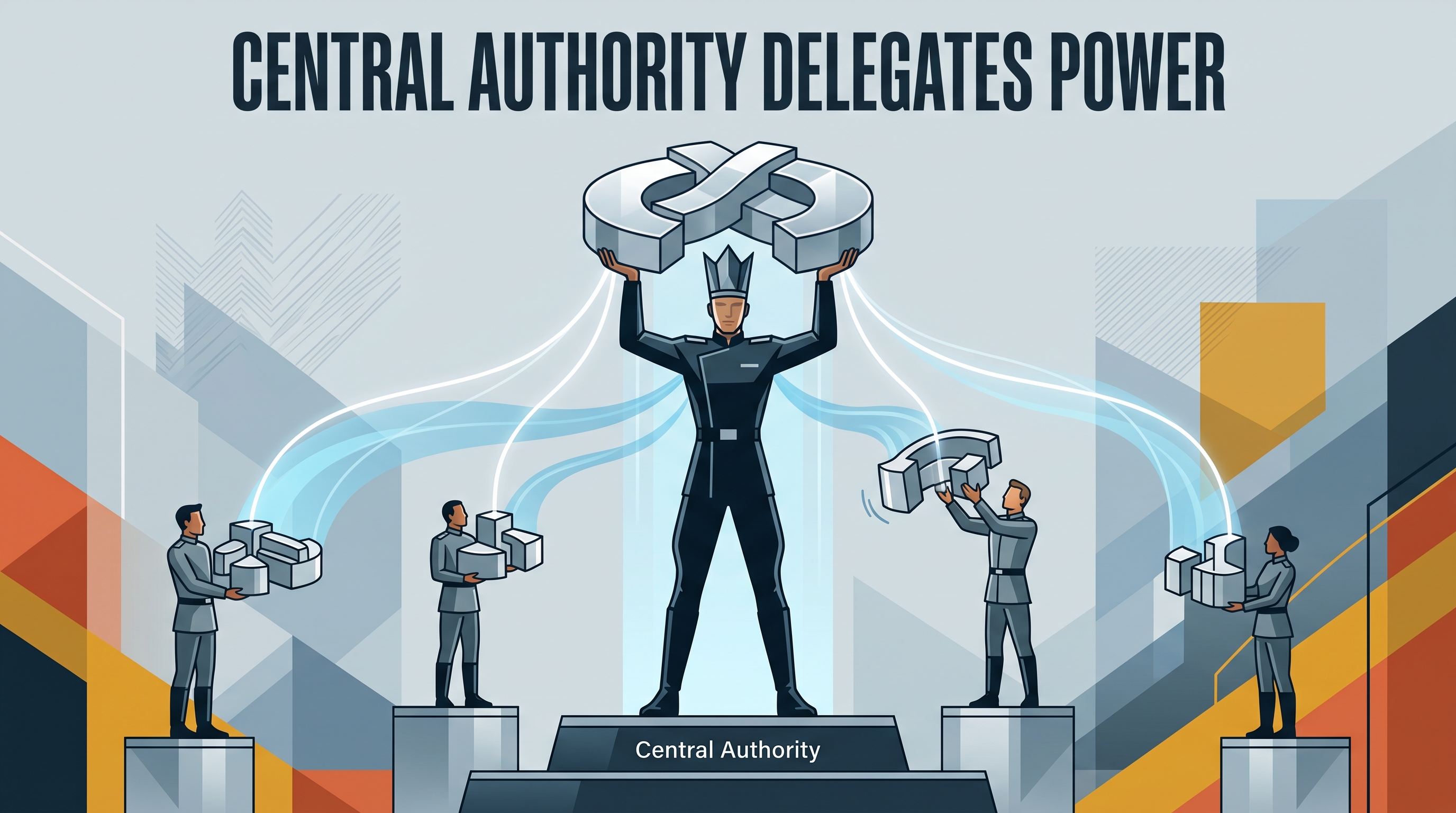
A unitary system is one in which power rests primarily at the national level. Regional governments may exist, but they do not possess constitutionally guaranteed power; the national government can create, reorganize, or limit their authority.
The United Kingdom illustrates a centralized unitary system. The central government retains the greatest authority, while regional institutions receive powers from it. Those powers may be politically important, but they are granted rather than constitutionally guaranteed in the same way that regional powers are protected in a federal system.
A federal system divides power between national and regional governments. The constitution guarantees at least some regional authority, so the national government cannot simply abolish or reclaim every regional responsibility through ordinary political action.
Nigeria uses federalism partly to address challenges created by social cleavages. Its division of authority allows regional governments to respond more directly to local communities, including communities shaped by important religious differences. Federal arrangements therefore can provide recognition and political space for groups that might resist complete control from the national government.
| Question | Unitary system | Federal system |
|---|---|---|
| Where is authority concentrated? | Primarily at the national level | Divided between national and regional levels |
| Are regional powers constitutionally guaranteed? | No | Yes |
| Example emphasized here | United Kingdom | Nigeria |
| Possible advantage | Coordinated, uniform policy | Regional adaptation and representation |
| Possible challenge | Regional groups may feel overcontrolled | Conflicting national and regional policies |
Worked comparison: why the distinction matters
Imagine that two countries contain sharp religious and regional differences. Country A uses a unitary system: the national government designs one education policy and gives regional offices authority to administer it. Country B uses a federal system: regional governments possess constitutionally protected responsibility for education and can adapt policy to local conditions.
The comparison does not prove that Country B will be more democratic or stable. It shows how the distribution of power can address a social cleavage differently. Nigeria’s federal structure can give distinct communities meaningful regional authority; by contrast, describing the United Kingdom’s unitary system as eliminating social cleavages would confuse centralized coordination with automatic social unity.
Exam-ready distinction: Explain the governmental structure first, then connect it to the specific challenge. “Federalism helps Nigeria address religious differences because regional governments have codified authority to respond to different communities” is stronger than merely saying that federalism “creates representation.”
Peaceful and violent political change
Changes in power and authority may occur peacefully or violently. Peaceful change can result from elections, constitutional amendments, negotiated settlements, devolution, or legislation that transfers responsibilities to regional governments. Violent change can result from coups, revolutions, civil wars, separatist movements, or the use of force by a regime to preserve sovereignty.
Sovereignty is the state’s supreme authority to govern within its territory and maintain independence from outside interference. Political regimes use different methods to maintain sovereignty, including legal institutions, security forces, ideological appeals, control of territory, and negotiation with internal groups. A regime may therefore preserve the state through accommodation—or through coercion.
Misconception check
Misconception: “Federal means weak national government, and unitary means no regional government.” Neither statement is correct. Federalism concerns constitutionally divided authority, not the total strength of the national government; unitary states can have powerful regional institutions, but their authority ultimately depends on the national government.
CED traceability and skill application
Learning Objective PAU-2.A: Explain how power and authority are distributed and how they are affected by internal and external factors. Essential Knowledge PAU-2.A.1 and PAU-2.A.2 support analysis of how the distribution of power affects regime stability and how centralization or decentralization can change over time in response to internal and external actors, including ethnic cleavages.
This topic is assessed through Practice 1: Concept Application, when you define or apply unitary, federal, centralization, decentralization, or sovereignty; Practice 2: Country Comparison, when you connect a structural difference to the United Kingdom and Nigeria; and Practice 5: Argumentation, when you defend a claim about whether a distribution of power reduces conflict or improves policy making. In a source-based task, Practice 4: Source Analysis may require you to explain how an author’s perspective on regional authority reflects a political system.
Retrieval check
A country permits provinces to make education policy, but the national legislature can abolish those powers whenever it chooses. Is the system federal or unitary? Unitary: regional authority exists, but it is not constitutionally guaranteed. Now add the reason Nigeria’s federal structure can matter politically: it can give groups divided by social cleavages protected regional space to govern themselves.
1.7 Federal and Unitary Systems
Key concepts: Federal systems · Unitary systems · Decentralization and local autonomy · Division of power between national and regional governments · Social cleavages · Federalism as a response to regional needs · Centralized government and uniform policies · Political systems in Mexico, Nigeria, Russia, and the United Kingdom
A federal system divides political power between a national government and regional governments, while a unitary system concentrates ultimate authority in the national government. The key question is not whether regions have offices or local officials, but whether they possess constitutionally protected powers or…
1.7 Federal and Unitary Systems
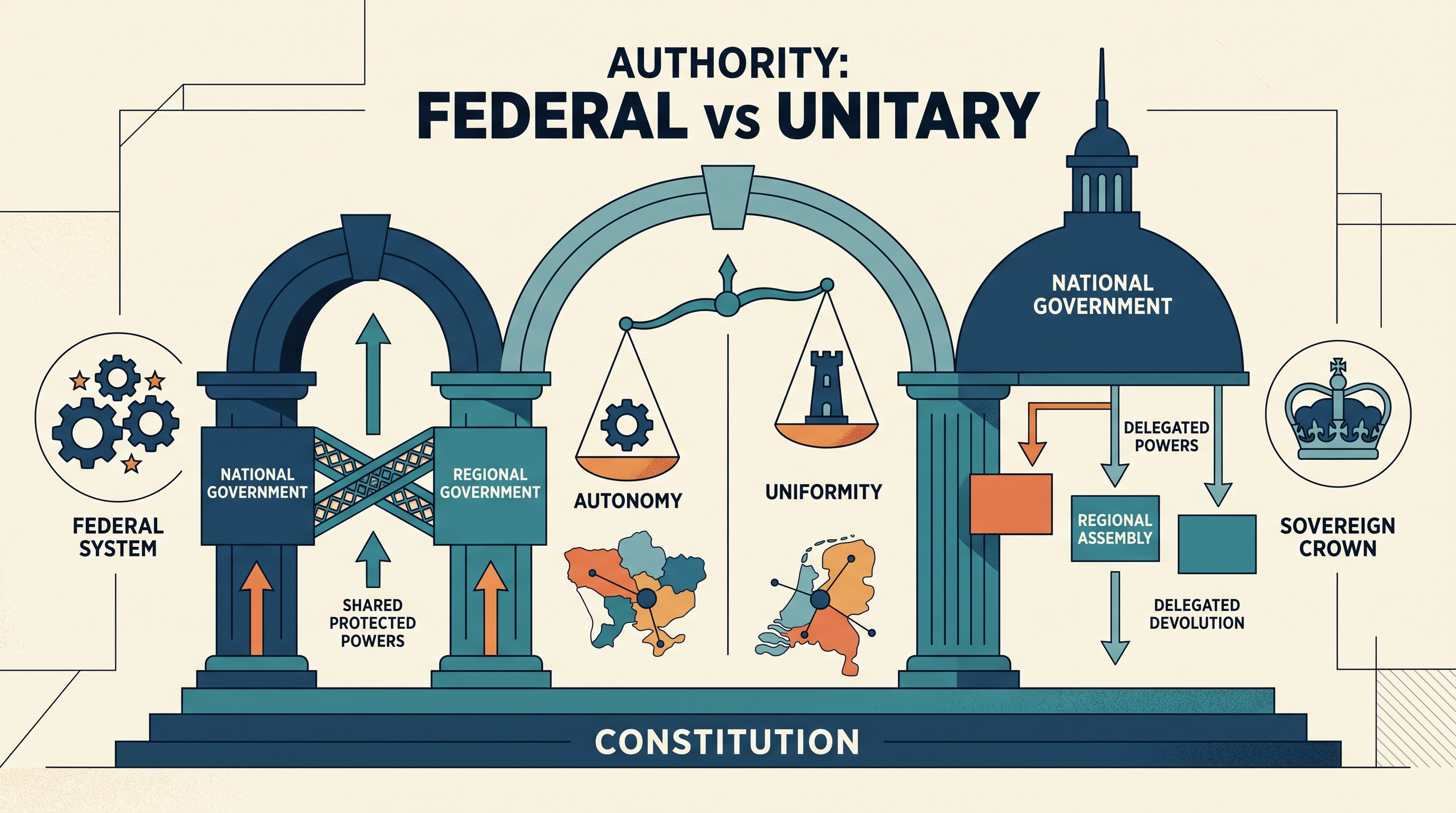
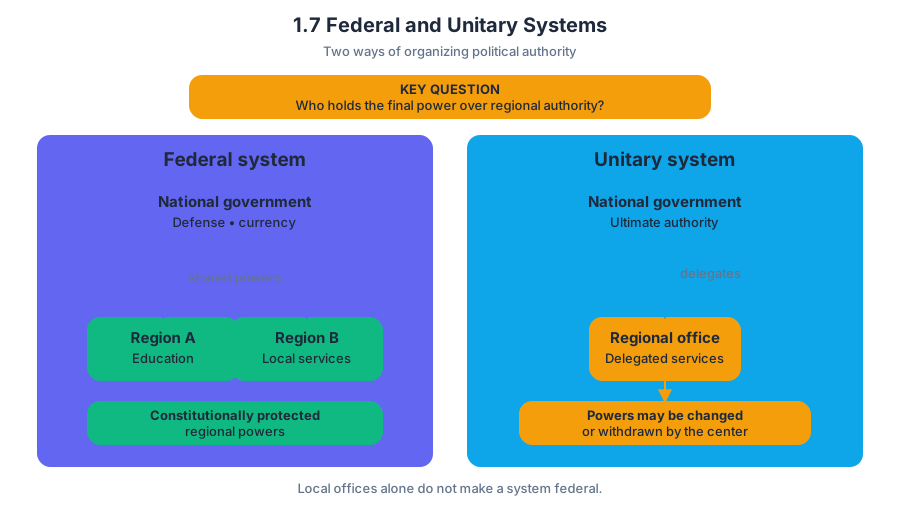
A federal system divides political power between a national government and regional governments, while a unitary system concentrates ultimate authority in the national government. The key question is not whether regions have offices or local officials, but whether they possess constitutionally protected powers or merely exercise authority delegated by the center.
Imagine a building with two managers. In a federal system, the national manager controls some responsibilities—such as defense or national currency—while regional managers retain authority over other matters, such as education or local services. In a unitary system, the national manager may allow regional offices to make decisions, but can generally define, alter, or withdraw those powers.
Two ways to distribute governmental power
| Feature | Federal system | Unitary system |
|---|---|---|
| Main distribution of power | Power is divided among national and regional governments | Power is concentrated at the national level |
| Regional autonomy | Regional governments retain a degree of local autonomy | Regional governments exercise authority delegated by the center |
| Policy variation | Different regions may adopt different policies | Policies are more likely to be uniform nationwide |
| Course-country examples | Mexico, Nigeria, and Russia | China, Iran, and the United Kingdom |
| Central advantage | Regional governments can respond to local conditions | National authorities can coordinate and standardize policy more easily |
| Central risk | Regional differences can complicate national coordination | Uniform policies can marginalize groups with distinctive needs |
This distinction is summarized in PAU-2.A.1: federal states divide power among levels of government, reserving some powers for the national government while granting regional autonomy; unitary states concentrate power nationally and may produce more uniform, potentially more efficient policymaking.
Federal systems: autonomy with reserved national powers
Federalism does not mean that regional governments are independent countries. The national government still reserves important powers, but regional governments possess meaningful authority within their jurisdictions. Federal arrangements are especially useful when a country contains substantial regional, ethnic, religious, linguistic, or economic differences.
Mexico illustrates how federalism can accommodate regional needs. Northern Mexican states have different economic patterns and connections to trade than southern states, where different social and economic conditions may require different governmental priorities. Allowing regional governments to shape some social, educational, and economic policies can produce a better fit than imposing one identical policy across the entire country.
Nigeria also uses a federal system to manage major regional and religious differences. Dividing authority among national, state, and local levels gives geographically concentrated groups some ability to influence policies affecting their communities while preserving national powers. Federalism therefore can reduce the pressure for every group to win complete control of the national government.
Russia demonstrates an important caveat: a country may formally be federal while power remains highly concentrated at the national level. The label “federal” describes the constitutional structure, but the actual distribution of power depends on how much autonomy regional governments can exercise in practice.
Unitary systems: national authority and delegated power
In a unitary system, regional governments do not possess the same constitutionally protected share of sovereignty found in a federal system. They may administer local services, but their authority originates from the national government. China and Iran are unitary systems in which subnational governments cannot make major policies without approval from central political or theocratic authorities.
Centralization can make nationwide action faster and more consistent. A national government can establish one educational standard, one legal rule, or one social-service policy rather than negotiating separate arrangements with every region. However, the same uniformity can harm minority groups when a national policy ignores distinct languages, religions, identities, or local economic conditions.
The United Kingdom is a unitary system, yet its central government has devolved—delegated—varying powers to regional assemblies in places such as Scotland, Wales, and Northern Ireland. Devolution can address regional demands without changing the fact that ultimate authority remains concentrated in the central state. Thus, decentralization exists on a spectrum: a unitary state may become more decentralized without becoming federal.
Federalism, devolution, and social cleavages
A social cleavage is a politically significant division within society, such as a conflict based on ethnicity, religion, language, national identity, or region. The division of governmental power can respond to a cleavage by allowing a concentrated regional group to influence policies that directly affect its members.
Consider a country in which one region has a distinct national identity and demands greater control over education and cultural policy. A federal system could grant that region constitutionally protected powers. A unitary system could instead use devolution, as the United Kingdom has done, giving a regional assembly authority to address local preferences while retaining national sovereignty.
The trade-off is clear: autonomy may improve representation, but too much regional independence can make national coordination difficult or encourage separatism. Excessive centralization may preserve uniformity and territorial control, but it can deepen resentment when minority groups believe that national institutions do not represent them.
Misconception check: “If a country has regional governments, it must be federal.” Not necessarily. The decisive issue is whether regional powers are constitutionally protected and independently retained, or whether the national government has simply delegated them and can reclaim them.
Retrieval check: Mexico and Nigeria are federal because regional governments retain meaningful powers alongside national authorities. The United Kingdom is unitary because its central government remains ultimately sovereign, even though it has devolved powers to regional assemblies. Russia shows why analysts must compare formal structure with actual political practice.
1.8 Political Legitimacy
Key concepts: political legitimacy · devolution and delegation of power · regional governments · corruption perception · Transparency International Corruption Perception Index · transparency · democracy · rule of law · judicial independence · checks and balances
A government can possess power without possessing political legitimacy. Legitimacy is the public acceptance that a government has the right to rule, not merely the ability to make people obey.
1.8 Political Legitimacy
A government can possess power without possessing political legitimacy. Legitimacy is the public acceptance that a government has the right to rule, not merely the ability to make people obey. A regime with legitimacy can often govern with less coercion because citizens regard its decisions as rightful or appropriate.
CED alignment: 1.8 The Practice of Political Scientists — Learning Objective 1.8.A: Explain the sources of political legitimacy. Political legitimacy is part of the Big Idea LEG: Legitimacy and Stability.
Legitimacy has multiple sources
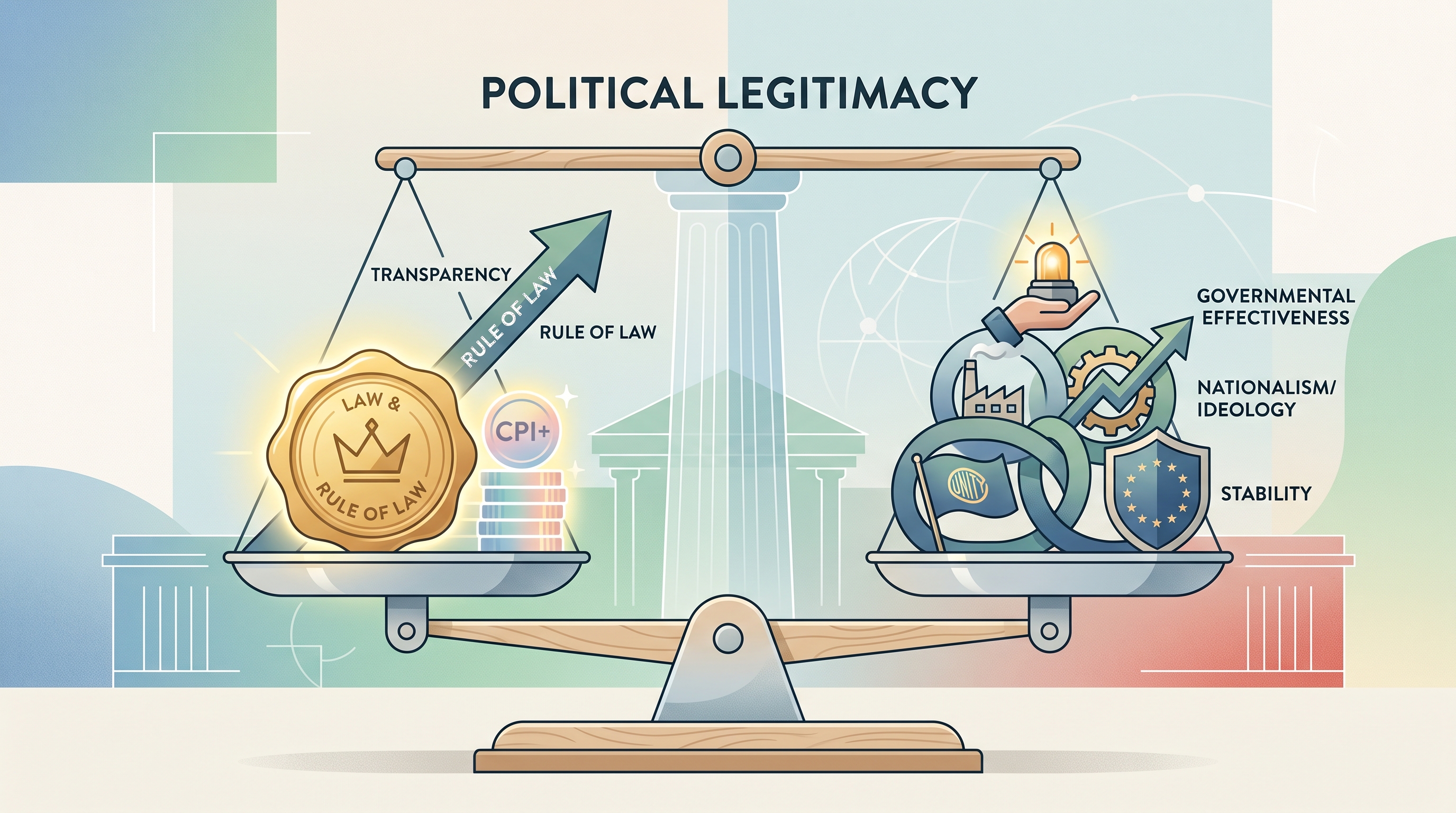
Political legitimacy may come from charisma, religious heritage or organization, reduced governmental corruption, governmental effectiveness, institutionalized laws, peaceful transfers of power, nationalism, ideology, endorsement by a dominant political party, or citizens’ sense of political efficacy—the belief that ordinary people can influence government.
The sources can reinforce one another, but they do not have to appear together:
| Source of legitimacy | Why it may persuade citizens |
|---|---|
| Charisma | A leader appears personally compelling or heroic |
| Religious heritage or organization | Rule is connected to sacred tradition or institutions |
| Governmental effectiveness | The state provides security, services, or economic growth |
| Reduced corruption | Public resources appear less likely to be stolen or misused |
| Institutionalized laws | Rules constrain officials as well as citizens |
| Peaceful transfer of power | Political competition occurs without violence |
| Nationalism or ideology | The regime presents itself as the defender of a shared identity or purpose |
| Dominant-party endorsement | A powerful party supplies organization and political justification |
| Political efficacy | Citizens believe participation can affect government |
Legitimacy can therefore increase a regime’s power. A government that is viewed as rightful may collect taxes, enforce laws, and implement reforms with greater cooperation. The reverse is also important: an authoritarian government may remain in office while losing legitimacy if citizens increasingly view its rule as corrupt, arbitrary, or unlawful.
Transparency and the Corruption Perceptions Index
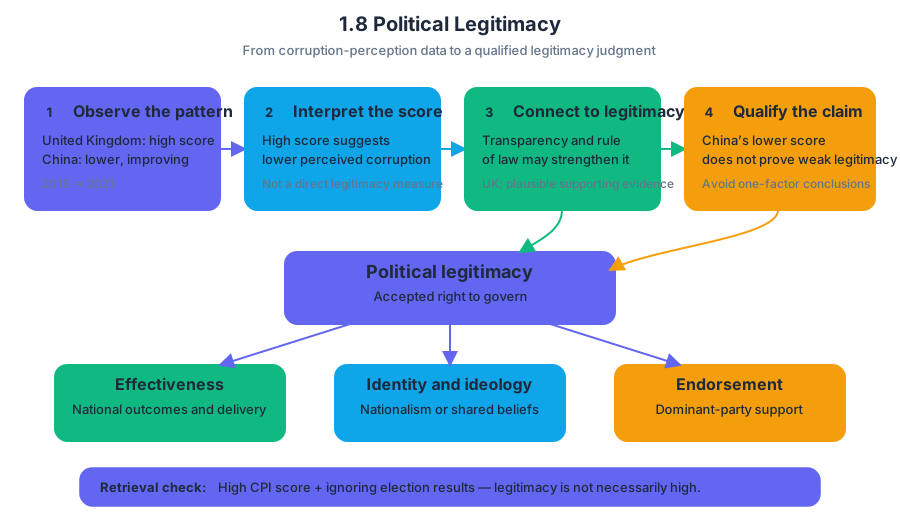
Transparency means that government decisions, spending, procedures, and information are sufficiently open for citizens and institutions to examine them. One commonly used indicator is Transparency International’s Corruption Perceptions Index, which measures perceived public-sector corruption on a scale from $0$ to $100: a score of $100$ indicates no perceived corruption, while a score of $0$ indicates the highest possible perceived corruption.
The 2014–2021 comparison of the United Kingdom, China, and Nigeria illustrates how to read the index:
- The United Kingdom records the highest scores among the three countries across the period, indicating comparatively low perceived corruption.
- Nigeria records the lowest score in 2015, indicating the highest perceived corruption among the countries shown that year.
- China’s score changes only modestly from 2018 through 2021, with a slight overall increase. Because a higher score means less perceived corruption, this represents a small improvement in perceived corruption rather than a worsening.
- A trend statement must identify both direction and time period: “China’s score increased slightly between 2018 and 2021” is stronger than “China changed.”
The index does not directly measure legitimacy. It measures perceptions of corruption, so it can support an argument about transparency or accountability without proving that citizens accept a government’s right to rule.
Why corruption and legitimacy do not perfectly match
A country may have low perceived corruption but weak political legitimacy, or high perceived corruption but strong political legitimacy. Citizens may accept a regime because of nationalism, ideology, effective economic management, religious authority, or a dominant party even while criticizing corruption. Conversely, a government may operate relatively cleanly but lack legitimacy if it came to power through an illegitimate process, suppresses civil liberties, or ignores election results.
Named misconception — “The corruption score is a legitimacy score.”
A high Corruption Perceptions Index score may strengthen legitimacy by suggesting transparency and accountability, but it cannot establish legitimacy by itself. Always connect the data to an additional source of legitimacy or illegitimacy.
Courts, rule of law, and legitimacy
An independent judiciary can strengthen legitimacy by maintaining checks and balances and enforcing the rule of law, the principle that government officials and citizens are subject to publicly known laws. For example, the United Kingdom’s Supreme Court can check government action by requiring public authorities to follow law. Mexico’s Supreme Court can similarly support legitimacy when it holds executive institutions accountable and makes clear that legal rules apply to the government as well as the public.
Judicial independence can also create political difficulty. If a court’s decision conflicts with an executive ruling, citizens may become confused about which decision is lawful. Thus, an independent judiciary generally supports legitimacy through accountability, but its legitimacy-building effect depends on public trust, legal clarity, and acceptance of judicial authority.
Devolution and reform
Devolution is the transfer of authority from a central government to regional governments; delegation is the assignment of responsibilities to lower-level institutions. These arrangements can enhance legitimacy when regional officials understand local needs, deliver services more effectively, and give communities a meaningful role in governance.
They can also weaken legitimacy. Regional governments may distribute resources unfairly, become corrupt, resist national reforms, or make government responsibility unclear. The analytical question is not simply whether power moved downward, but whether the change improved effectiveness, accountability, transparency, and citizens’ acceptance of rule.
Worked interpretation
Suppose a graph shows the United Kingdom with a consistently high corruption-perception score and China with a lower but slightly improving score from 2018 to 2021. A strong conclusion would be: The United Kingdom’s relatively high score suggests lower perceived governmental corruption and may support legitimacy through transparency and rule of law; however, China’s lower score does not by itself prove weak legitimacy, because legitimacy may also derive from governmental effectiveness, nationalism, ideology, or dominant-party endorsement.
This reasoning uses SP3: Data Analysis by identifying a pattern and interpreting its meaning; SP1: Concept Application by applying political legitimacy and transparency; SP2: Country Comparison by distinguishing the United Kingdom and China; and SP5: Argumentation when the conclusion acknowledges that corruption is only one possible source of legitimacy.
Retrieval check: If a government has a high Corruption Perceptions Index score but repeatedly ignores election results that remove the ruling party, would its political legitimacy necessarily be high? Explain using one legitimacy source and one legitimacy-damaging action.


1.9 Sustaining Legitimacy
Key concepts: Sustaining legitimacy · Thesis about sustaining legitimacy · Alternate perspective · Simplifying complex issues · Providing people with answers
A government can sustain legitimacy not only by being effective, but by making political life feel understandable and answerable: citizens must be able to interpret events, identify who is responsible, and believe that the system offers credible answers to major problems.
1.9 Sustaining Legitimacy
A government can sustain legitimacy not only by being effective, but by making political life feel understandable and answerable: citizens must be able to interpret events, identify who is responsible, and believe that the system offers credible answers to major problems.
Learning Objective 1.9.A: Explain how governments sustain legitimacy.
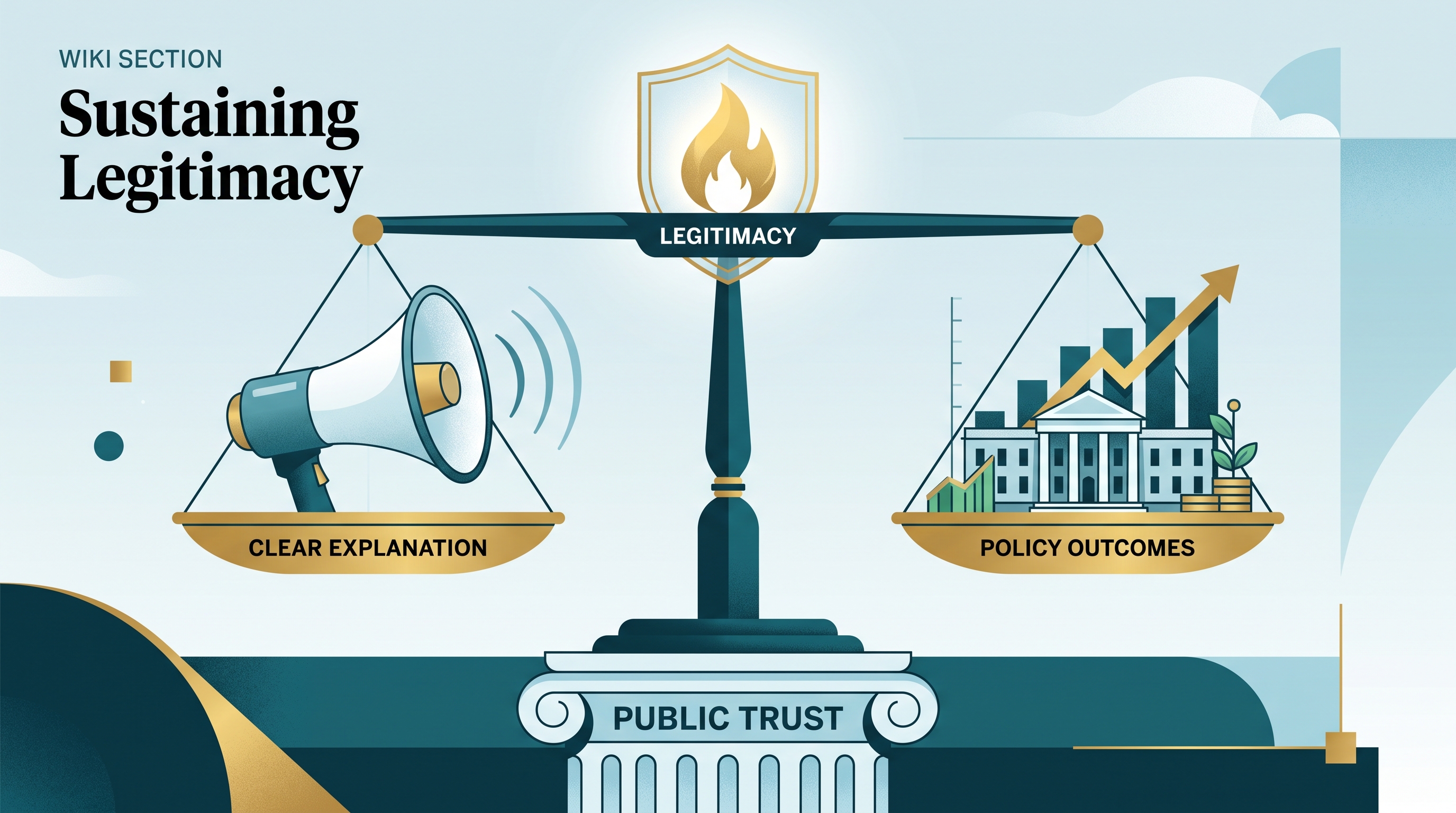
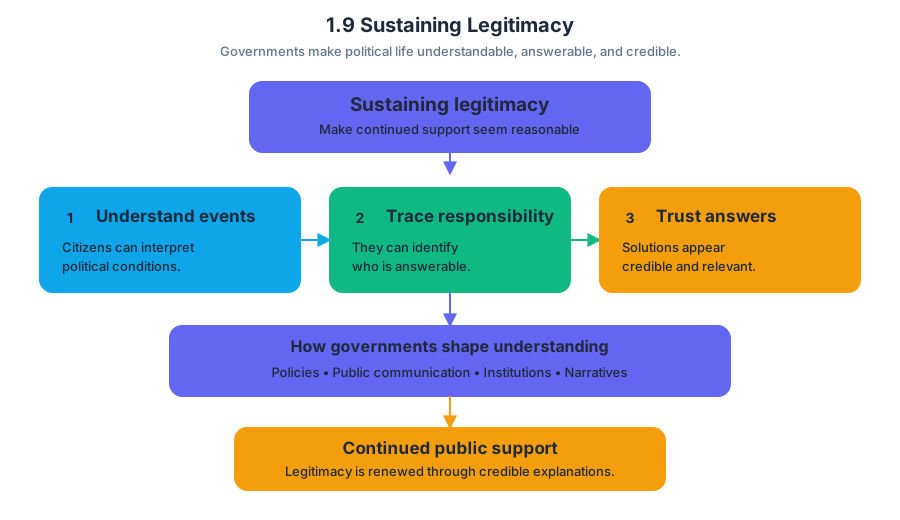
The central thesis is that governments sustain legitimacy by shaping how people understand political conditions and by providing explanations or solutions that make continued support seem reasonable. This can occur through policies, public communication, institutions, or narratives that connect government action to citizens’ expectations.
The legitimacy-maintenance cycle
The process can be represented as a cycle:
Problem or uncertainty → Government simplifies the situation → Government provides an explanation or answer → Citizens interpret the government as capable or necessary → Support for the political system is reinforced
The cycle does not require every citizen to be satisfied with every policy. Sustaining legitimacy means preserving enough acceptance that people continue to recognize the government’s authority rather than treating it as fundamentally unacceptable.
Simplifying complex issues
Simplifying complex issues means presenting difficult political, economic, or social conditions in a form that people can quickly understand. Governments may identify a clear cause, assign responsibility, emphasize a shared national goal, or frame a complicated choice as a straightforward decision.
Simplification can help sustain legitimacy because uncertainty is politically costly. When citizens cannot understand why prices rise, why security threats occur, or why reforms take time, they may conclude that the government is incompetent or indifferent. A simple narrative can reduce confusion and make government action appear purposeful.
Worked example: Imagine that a government faces a sudden shortage of food. The actual causes may include drought, disrupted transportation, international prices, poor planning, and corruption. If the government explains the shortage only as the result of an external crisis and announces a national distribution program, it has simplified the issue and provided a recognizable response. Some citizens may therefore view the government as protecting the public during an emergency, even though the underlying causes are more complicated.
The analytical point is not that simplification proves the government is effective. It shows how controlling the explanation of a problem can influence whether citizens regard the government as competent, necessary, or responsible.
Providing people with answers
Governments also sustain legitimacy by providing people with answers—clear accounts of what is happening and what the government intends to do. Answers may take the form of policy announcements, public explanations, official statistics, speeches, or visible action.
Answers matter because political legitimacy depends partly on expectations. If citizens ask, “Who is responsible?” or “What will happen next?” and the government responds clearly, the state can appear more capable and predictable. If officials remain silent, contradict one another, or offer no remedy, the same crisis may weaken confidence in the political system.
In the food-shortage example, announcing where supplies will be distributed, who qualifies for assistance, and when the program will begin gives citizens specific answers. The government is not merely communicating; it is demonstrating that it can define a problem and organize a response.
Alternate perspective: simplification can weaken legitimacy
An alternate perspective challenges the thesis: simplification and official answers do not always sustain legitimacy. They can also damage it when citizens recognize that the explanation is misleading, when promised solutions fail, or when the government uses a simple narrative to avoid responsibility.
For example, blaming the food shortage entirely on foreign actors may initially produce unity, but continued shortages can expose the explanation as incomplete. Citizens may then interpret simplification as propaganda rather than competent leadership. In this view, legitimacy is sustained more securely by accurate information and effective outcomes than by persuasive presentation alone.
Exam-ready contrast: A strong alternate perspective does not merely say “some people disagree.” It explains why the opposing view could be valid and identifies the condition under which it becomes stronger.
Named misconception — “Simplification equals manipulation.” Simplification can be manipulative, but it can also make complex conditions understandable and permit coordinated action. The key question is whether the simplified explanation helps citizens evaluate government performance or hides failures and suppresses competing interpretations.
AP skills and reasoning processes
Skill 3.C — Explain the significance of a source’s point of view, purpose, audience, and/or context. When analyzing a government statement about a crisis, ask who produced it, what audience it targets, and how its purpose may shape the explanation. A speech aimed at reassuring citizens may emphasize unity and progress rather than uncertainty.
Skill 1.E — Compare political concepts and processes. Compare sustaining legitimacy through clear explanations with sustaining legitimacy through successful policy results. Both can reinforce acceptance, but they operate differently: communication shapes interpretation, while outcomes shape citizens’ direct experience.
Retrieval check: A government gives citizens a simple explanation for a crisis and announces a detailed response, but the crisis continues. Explain one way this could sustain legitimacy and one way it could weaken legitimacy. Which answer identifies the alternate perspective, and why?
1.10 Political Stability
Key concepts: Political stability · Fragile States Index · State fragility · Rule of law · Rule by law · Judicial independence · Institutional trust · Economic liberalization · Nationalism and patriotism · Social movements and political change
A state is politically stable when its governing institutions maintain order, manage conflict, and continue functioning without frequent crises, coups, violent challenges, or breakdowns in authority.
1.10 Political Stability
A state is politically stable when its governing institutions maintain order, manage conflict, and continue functioning without frequent crises, coups, violent challenges, or breakdowns in authority. Stability is not the same as public happiness or democracy: an authoritarian government may preserve order through censorship and coercion, while a democracy may experience protest yet remain institutionally stable.
LEG-1.C — Explain how internal actors influence and interact with state authority and either enhance or threaten stability.
Stability, fragility, and trust
The Fragile States Index measures how vulnerable a state is to political, social, and economic breakdown. Its scale runs from $0$ to $120$: a score of $0$ indicates the least fragility and greatest stability, while $120$ indicates the greatest fragility and least stability.
The index compares Nigeria, Iran, China, and Russia from 2014 to 2024. To interpret a line graph, do not merely identify which country has the highest score in one year. Track both level and trend: a country can remain relatively fragile while becoming more stable if its score falls over time.
A second measure, the Trust Index Barometer, records mass-population trust in government, business, media, and nongovernmental organizations from $2015$ to $2021$ in China, Mexico, the United Kingdom, and Russia. Here, higher scores indicate greater public trust in institutions. Trust can support stability because people are more likely to obey decisions, use established channels, and accept temporary sacrifices when they believe institutions are credible.
Possible explanations for higher trust or greater political stability include economic growth, effective media censorship, combating corruption, and encouraging patriotism. These explanations do not have identical political meanings. Economic growth may improve living conditions; anti-corruption campaigns may increase confidence; censorship may suppress criticism without creating genuine consent; and patriotism may unify citizens but also marginalize dissenters.
Rule of law versus rule by law
The rule of law means that laws constrain government officials as well as citizens. It requires predictable legal procedures, legal equality, protection of rights and liberties, and courts capable of judging government action. Rule by law, by contrast, occurs when authorities use laws and courts as instruments of government control; laws exist, but they do not meaningfully limit those who rule.
The United Kingdom Supreme Court illustrates an independent judiciary. Using common law, the court can uphold the rule of law and protect rights and liberties by applying legal principles even when doing so limits government action. Judicial independence means that judges can make decisions without improper control by executives, legislatures, political parties, or other powerful actors.
China, Iran, and Russia are presented as lacking independent judiciaries. Judicial rulings may strengthen governmental control rather than restrain it, making these examples of rule by law rather than rule of law. The key comparison is not whether courts exist; it is whether courts can impose meaningful legal limits on state authority.
Misconception check: “A country has rule of law because it has many laws and courts.”
Correction: Rule of law depends on constraint, independence, and legal equality, not simply on the number of statutes or court buildings.
Internal actors and the stability trade-off
Internal actors—including courts, civil society groups, political parties, protest movements, media organizations, and separatist groups—can either reinforce or threaten stability. Social movements can produce political change by organizing citizens, publicizing grievances, pressuring officials, and forcing policy reform; unlike political parties, however, they do not necessarily possess an organized structure for contesting elections or governing.
State responses create a central stability trade-off. Repression, censorship, or restrictions may reduce visible unrest in the short term, but unresolved grievances can weaken long-term stability. Reform, transparency, legal equality, and protection of civil liberties may invite criticism initially while strengthening institutions and public trust over time.
Brexit demonstrates that stability involves more than sovereignty. Brexit may have increased British sovereignty by returning authority from the European Union to the United Kingdom, yet it may also have decreased political stability by encouraging Scottish independence movements. A state can therefore gain authority in one dimension while facing greater internal contestation in another.
Economic policy can produce a similar trade-off. A state may prefer economic liberalization—such as reducing state control over national industry—because private investment and economic growth can support stability. However, liberalization can also create inequality, weaken protected industries, or generate opposition from groups that lose state support.
AP skill application
This topic most directly develops Practice 1: Concept Application, especially 1.A Define and explain concepts and processes, by distinguishing political stability, state fragility, rule of law, rule by law, and judicial independence. It also develops Practice 2: Country Comparison, 2.A Describe similarities and differences, and Practice 3: Data Analysis, including identifying patterns, describing trends, and drawing conclusions from the Fragile States Index and Trust Index Barometer. In written responses, Practice 5: Argumentation requires a defensible claim, specific country evidence, causal reasoning, and attention to an alternate perspective.
Retrieval check: A country’s Fragile States Index score falls from $82$ to $74$, but it still has the highest score among four countries. What two conclusions are justified?
Answer: Its fragility decreased over the period, indicating improving stability, but it remained the most fragile of the countries compared. A falling score does not automatically mean the country became stable.
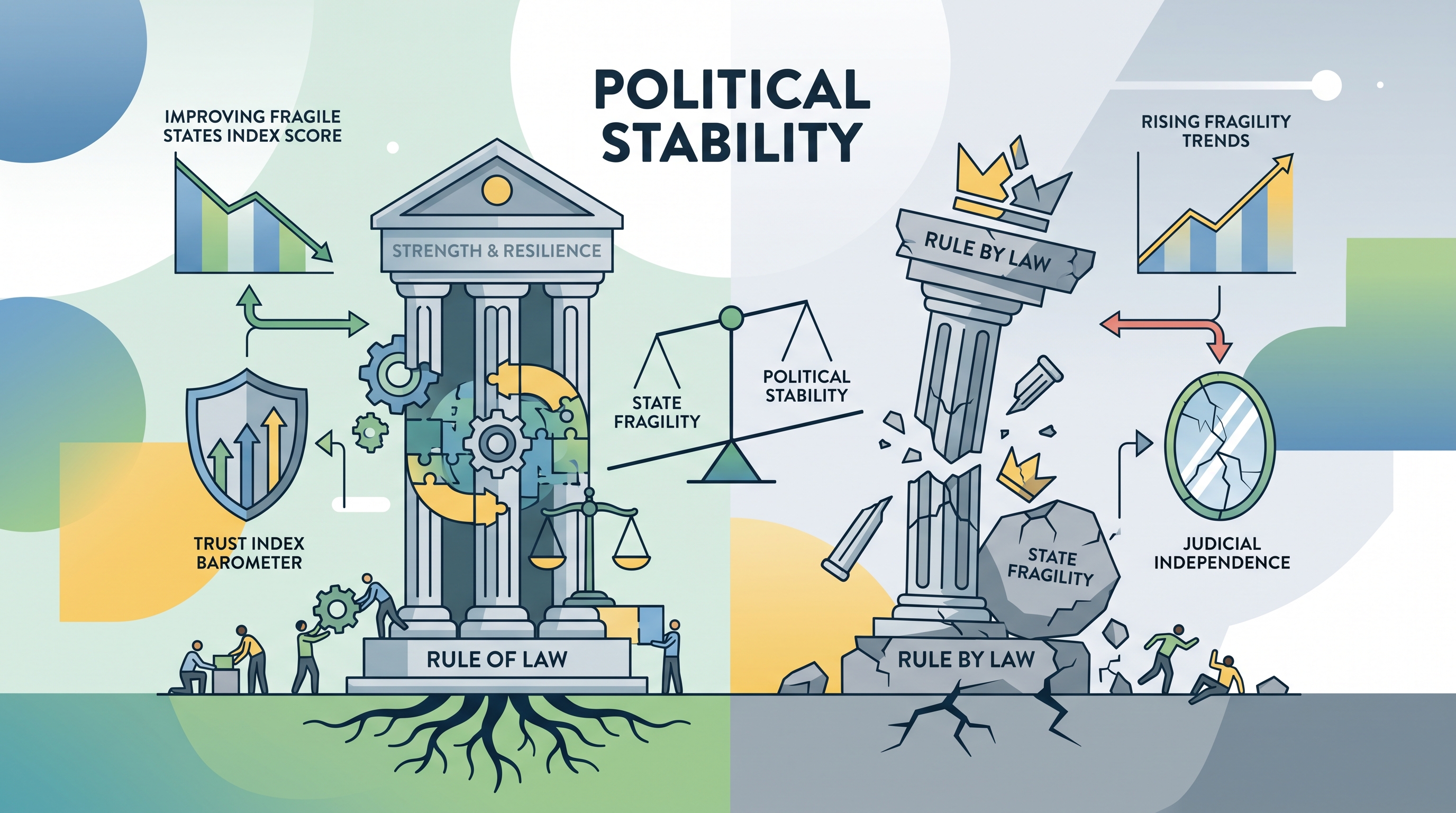
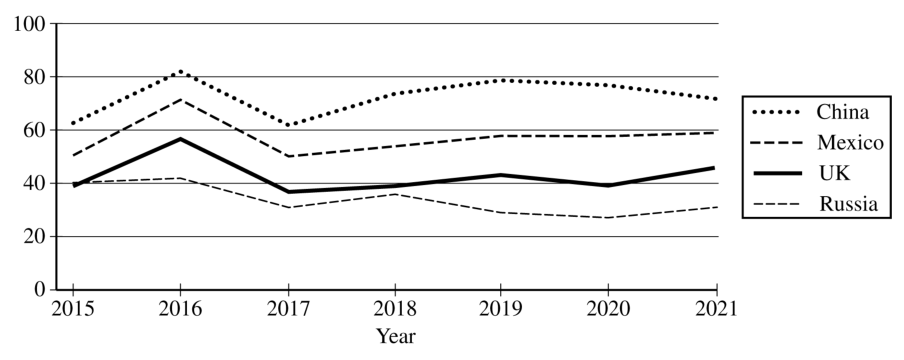
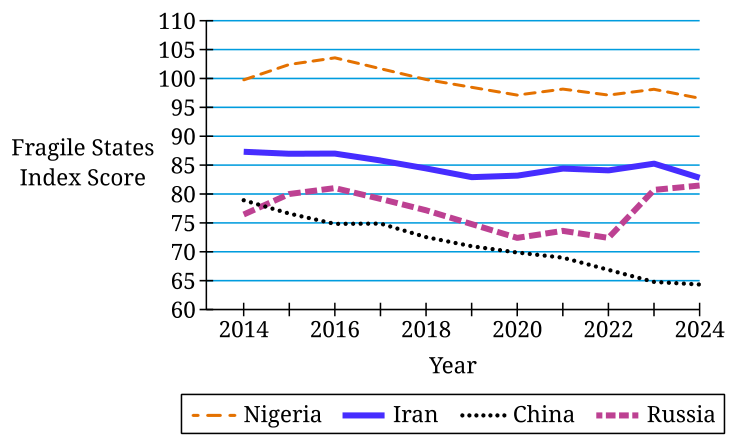
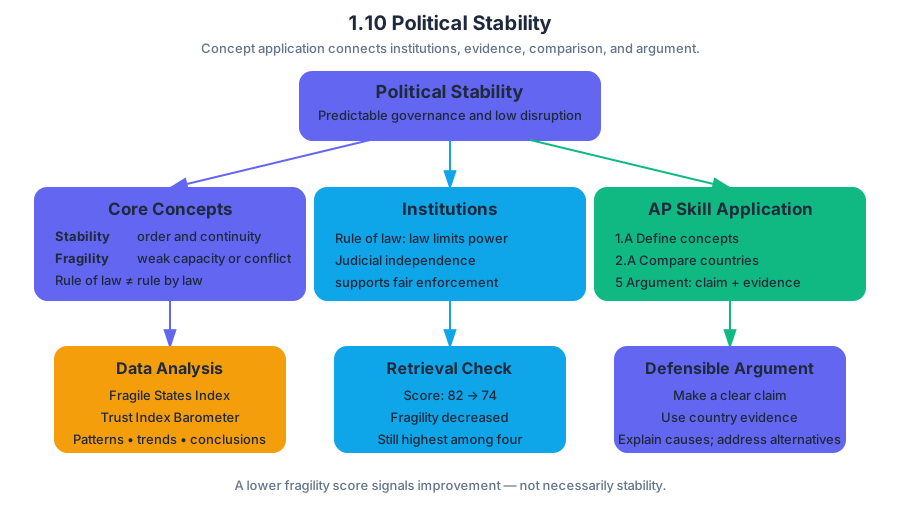
2.1 Parliamentary, Presidential, and Semi-Presidential Systems
Key concepts: Parliamentary systems · Presidential systems · Semi-presidential systems · Head of state · Head of government · Executive-legislative relations · Cabinet accountability · Fixed-term elections · Impeachment · Allocation of political power
A political system answers a deceptively practical question: who gets to choose, supervise, and remove the executive? The answer reveals how power is allocated among the legislature, the executive, and—in many systems—the voters.
2.1 Parliamentary, Presidential, and Semi-Presidential Systems
A political system answers a deceptively practical question: who gets to choose, supervise, and remove the executive? The answer reveals how power is allocated among the legislature, the executive, and—in many systems—the voters.
PAU-3: The structure and function of political institutions reflect the allocation of power within a political system.
PAU-3.A: Describe parliamentary, presidential, and semi-presidential systems.
The executive has two possible jobs
Head of state is the official representative of the country. This role may involve national symbolism, diplomacy, and command of the armed forces.
Head of government directs the daily work of governing: proposing policies, coordinating ministries, and leading the cabinet. In some systems, one person performs both jobs; in others, the roles are divided.
| System | Executive structure | Election relationship | Legislative control | Example |
|---|---|---|---|---|
| Parliamentary | Head of government is usually selected from the legislature; head of state may be separate | Legislature determines who leads the government | Legislature can question the executive and remove the cabinet through a vote of no confidence | United Kingdom |
| Presidential | President serves as both head of state and head of government | President and legislature have separate, fixed-term, popular elections | Legislature generally removes cabinet members or the president only through impeachment | Mexico, Nigeria |
| Semi-presidential | President is head of state and commander in chief; prime minister is head of government | President and legislature have separate popular elections | Prime minister must be approved by the legislature; cabinet is accountable to both president and legislature | Russia |
Parliamentary systems: the legislature and executive are connected
PAU-3.A.1: Parliamentary systems, such as the United Kingdom, combine lawmaking and executive functions, allowing the national legislature to select and remove the head of government and cabinet.
In a parliamentary system, the executive normally emerges from the legislature rather than being elected separately by the entire country. The legislature can question the executive and cabinet ministers, making oversight a routine part of governing. If the government loses legislative support, the legislature may pass a vote of no confidence, a formal declaration that it no longer accepts the cabinet’s authority.
Worked example: the United Kingdom
Suppose the governing party or coalition in the United Kingdom loses the support of enough legislators to control a majority. The legislature can challenge ministers, reject government proposals, and ultimately remove the cabinet through a vote of no confidence. The executive therefore depends directly on continuing legislative confidence.
The key mechanism is not simply that Parliament makes laws. It is that Parliament helps determine who governs and can withdraw that support. Executive-legislative relations are therefore closely fused.
Presidential systems: separate electoral mandates
PAU-3.A.2: Presidential systems, such as Mexico and Nigeria, feature a cabinet mostly responsible to the elected executive, separate fixed-term popular elections for the national legislature and president, and a top executive leader who serves as both head of state and head of government.
A presidential system separates the electoral bases of the executive and legislature. Voters elect the president and the national legislature in distinct elections, and both generally serve fixed terms. The president leads the cabinet, directs the bureaucracy, and holds authority over the military.
Because the president and legislature possess separate mandates, the legislature does not ordinarily remove the cabinet simply because it disagrees with policy. Removal generally requires impeachment, a formal process for charging and potentially removing a public official for serious misconduct.
Worked example: Mexico
Mexico illustrates the presidential model identified in the required content. The president serves as both head of state and head of government, and the presidency has a single-term limit. The legislature and president receive their authority through separate popular elections, so neither institution automatically controls the other.
Semi-presidential systems: divided executive authority
PAU-3.A.3: Semi-presidential systems, such as Russia, feature separate popular elections for the president and national legislature. The president can nominate a prime minister, who must be approved by the legislature; cabinet members are accountable to both the president and the legislature.
A semi-presidential system divides executive power. The president serves as head of state and commander in chief, while the prime minister serves as head of government. This arrangement creates two executive centers rather than one.
The division can provide checks on executive power, but it can also produce tension when the president and legislative majority disagree. Political stability depends partly on whether the president, prime minister, and legislature can coordinate authority rather than compete for it.
Misconception check: “Separate branches always mean equal power”
Misconception: A system is presidential whenever it has a president, or parliamentary whenever it has a legislature.
Correction: The decisive issue is the relationship among institutions. A president may be mainly head of state in a semi-presidential system, while the prime minister leads government. In a parliamentary system, the legislature can select and remove the head of government. In a presidential system, the president and legislature are separately elected and normally serve fixed terms.
Skill 1.B: Concept Application — Explain political systems, principles, institutions, processes, policies, and behaviors. Apply it by identifying the institutional rule that allocates power, then connecting that rule to executive-legislative relations and possible political stability.
Retrieval check
A country elects its president and legislature separately for fixed terms. The president leads the cabinet, serves as both head of state and head of government, and can generally be removed only through impeachment. Which system is this, and what evidence proves it?
Answer: A presidential system; the evidence is the separate fixed-term elections, unified executive roles, and impeachment-based removal process.
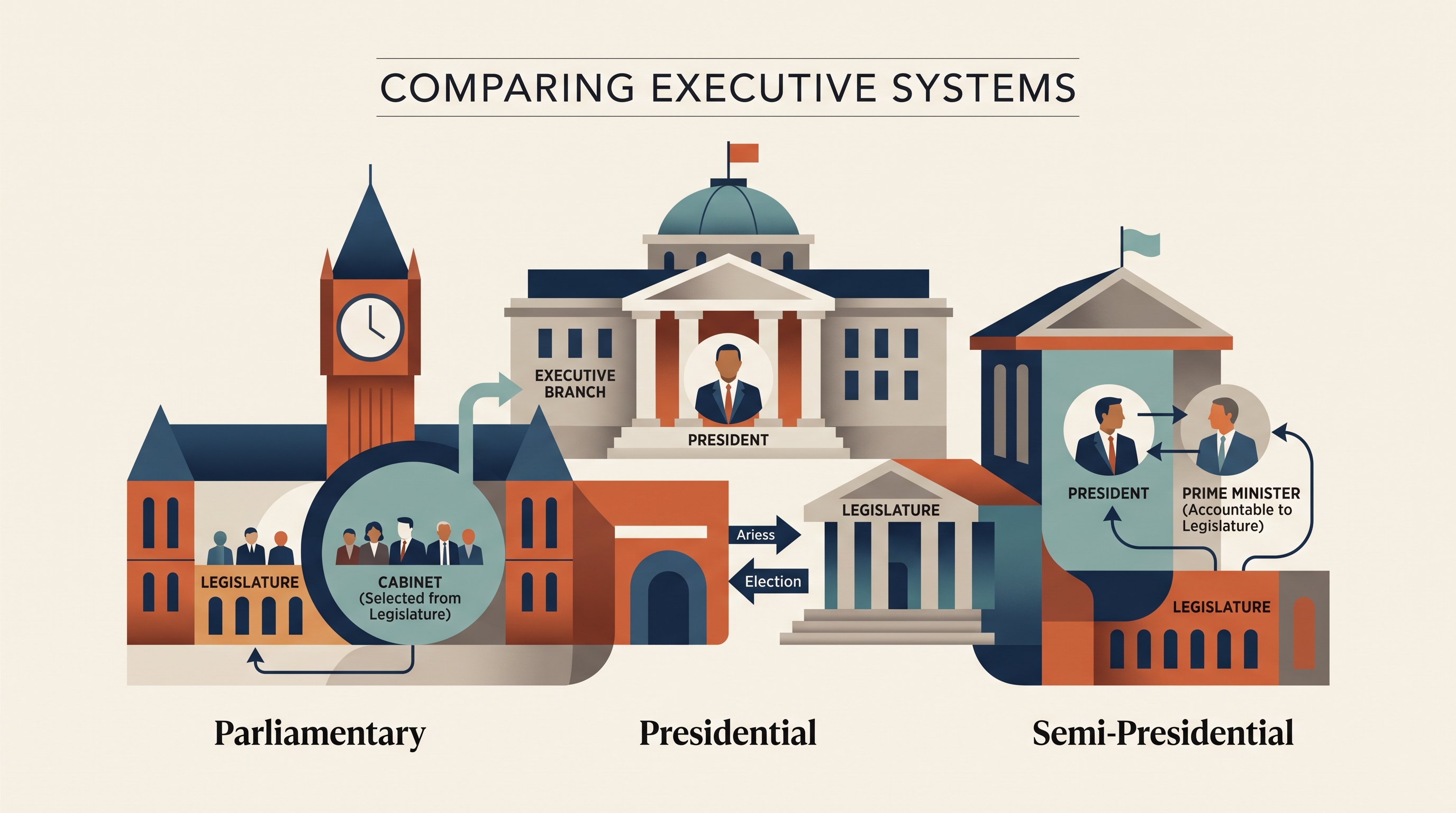
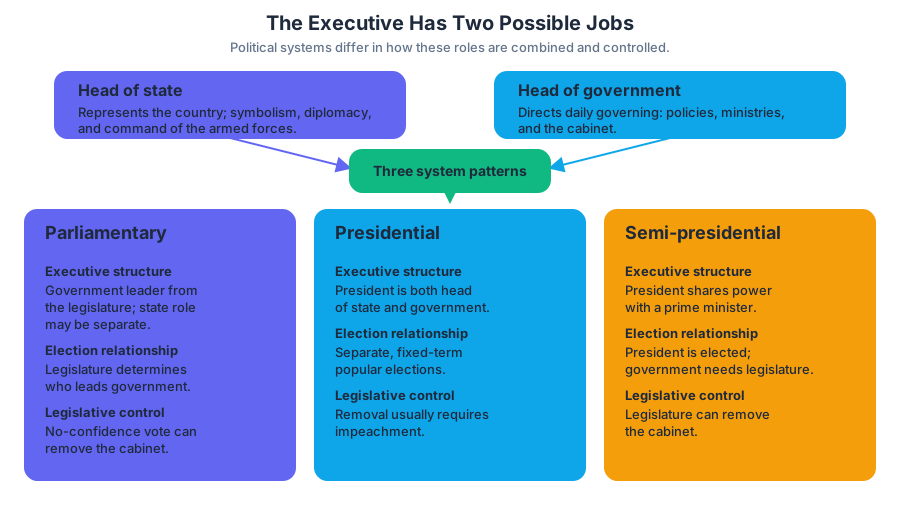
2.2 Comparing Parliamentary, Presidential, and Semi-Presidential Systems
Key concepts: Parliamentary systems · Presidential systems · Semi-presidential systems · Country comparison · Institutional obstacles to policymaking · Divided branch powers · Executive-legislative relations · Prime minister approval by the legislature · Cabinet accountability · Comparing course countries by relevant categories
The central comparative question is not simply who leads, but how many institutional obstacles stand between leadership and policy. A parliamentary government usually concentrates executive and legislative authority, while a presidential government divides those powers; a semi-presidential government deliberately…
2.2 Comparing Parliamentary, Presidential, and Semi-Presidential Systems
The central comparative question is not simply who leads, but how many institutional obstacles stand between leadership and policy. A parliamentary government usually concentrates executive and legislative authority, while a presidential government divides those powers; a semi-presidential government deliberately combines both arrangements.
PAU-3.B: Compare institutional relations among parliamentary, presidential, and semi-presidential systems.
The institutional comparison
| Category | Parliamentary system | Presidential system | Semi-presidential system |
|---|---|---|---|
| Head of government | Prime minister, normally selected from the legislative majority or coalition | President | Prime minister and president share executive responsibilities |
| Legislative relationship | Prime minister normally must be approved by, or retain the confidence of, the legislature | President has a separate electoral mandate from the legislature | President nominates a prime minister who must be approved by the legislature |
| Cabinet accountability | Cabinet is accountable primarily to the legislature through the prime minister | Cabinet is accountable primarily to the president | Cabinet members are accountable to both the president and the legislature |
| Terms and removal | Government may fall if it loses legislative confidence; elections may follow | President and legislature usually serve separately elected, often fixed terms | President and legislature have distinct mandates; the prime minister depends on legislative approval |
| Typical policymaking obstacle | Fewer institutional obstacles when the governing party controls the legislature | More obstacles because executive and legislative branches are divided | Obstacles vary according to the relationship among president, prime minister, and legislature |
| Course-country model | United Kingdom | Mexico and Nigeria | Russia |
Parliamentary systems: streamlined, but not unchecked
In the United Kingdom, the prime minister normally emerges from the party or coalition able to command a majority in the House of Commons. That means the prime minister does not possess a completely separate electoral mandate: the government depends on continuing legislative confidence. If governing legislators withdraw their support, the prime minister may be forced to resign, form a new coalition, or call an election under the applicable rules.
This arrangement can make policymaking comparatively efficient. When the governing party controls both the cabinet and the legislature, executive proposals often face fewer veto points than they would in a presidential system. However, fewer obstacles does not mean no checks. Under PAU-3.B.1 and PAU-3.B.2, a parliament may censure cabinet ministers, refuse proposed legislation, question the executive and ministers, and impose deadlines related to calling new elections.
Presidential systems: separate mandates, divided powers
Mexico and Nigeria illustrate presidential arrangements in which the president serves as both head of state and head of government. The president receives a mandate separate from that of the legislature, and the executive branch does not normally depend on a legislative confidence vote to remain in office. This separation can provide stability during legislative disagreement, but it can also produce gridlock.
A presidential system has divided branch powers: the president leads the executive branch, while the legislature makes laws and may control funding, investigate officials, or reject executive proposals. These independent sources of authority create more institutional obstacles to policymaking. A president may win an election and still lack the legislative support needed to enact a program.
Semi-presidential systems: two executive centers
Russia is treated in the course comparison as a semi-presidential system because it combines presidential and parliamentary features. The president has an important independent mandate, but the system also includes a prime minister and cabinet connected to the legislature.
In the described arrangement, the president nominates a prime minister, and the prime minister must be approved by the legislature. This is the crucial distinction from a purely presidential system: the president cannot simply treat the prime minister as an entirely independent presidential appointee. Cabinet members are accountable to both the president and the legislature, creating the possibility of divided responsibility or conflict between the two executive centers.
Worked country comparison
Suppose all three governments propose the same education reform. In the United Kingdom, a majority government may move the bill through Parliament relatively quickly, although legislators can question ministers or reject the proposal. In Mexico or Nigeria, the president may support the reform while the legislature delays or rejects it. In Russia, the president may nominate a prime minister who must secure legislative approval, so policymaking depends on the interaction of presidential authority, parliamentary support, and cabinet accountability.
The comparison earns analytical credit only when it explains the implication: institutional design shapes the likelihood of rapid action, legislative resistance, executive accountability, and policy conflict. This is the purpose of Country Comparison (2.C): Explain the implications of the similarities and differences between countries with different political systems, principles, institutions, processes, policies, and behaviors.
Misconception check
Misconception: “Parliamentary systems have no checks and balances because the executive and legislature are connected.” The correction is that parliamentary systems may have fewer obstacles to enacting policy, but legislatures still check executives through censure, refusal to pass legislation, questioning ministers, and control over confidence and election timing.
Retrieval check
A president in Mexico has a separate electoral mandate, while the United Kingdom’s prime minister normally must retain legislative confidence. In Russia’s semi-presidential arrangement, who nominates the prime minister, who must approve that nomination, and to whom are cabinet members accountable? A complete answer should identify the president, the legislature, and both institutions, then explain how that dual accountability can create a different policymaking relationship from either the British or Mexican model.
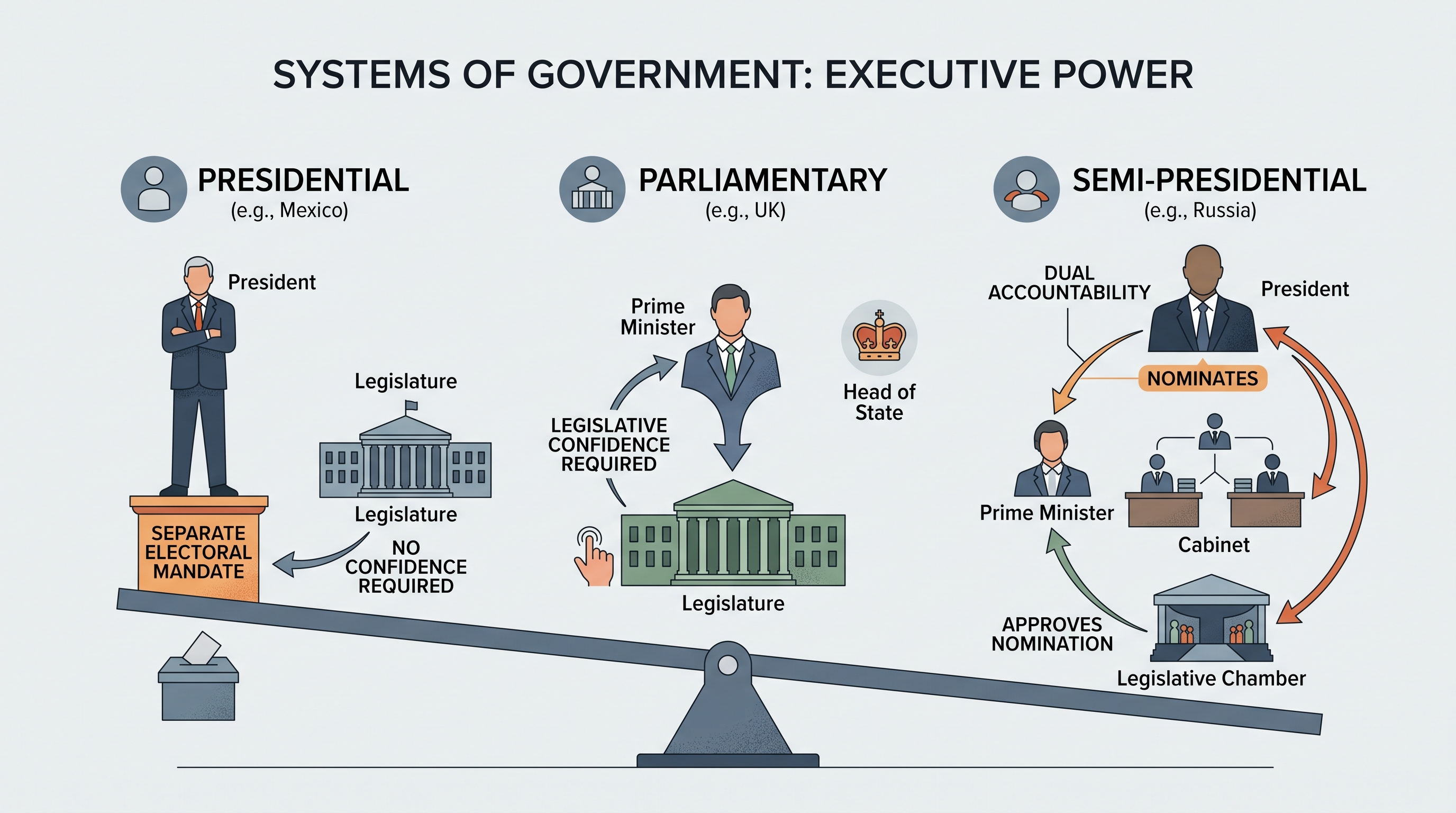
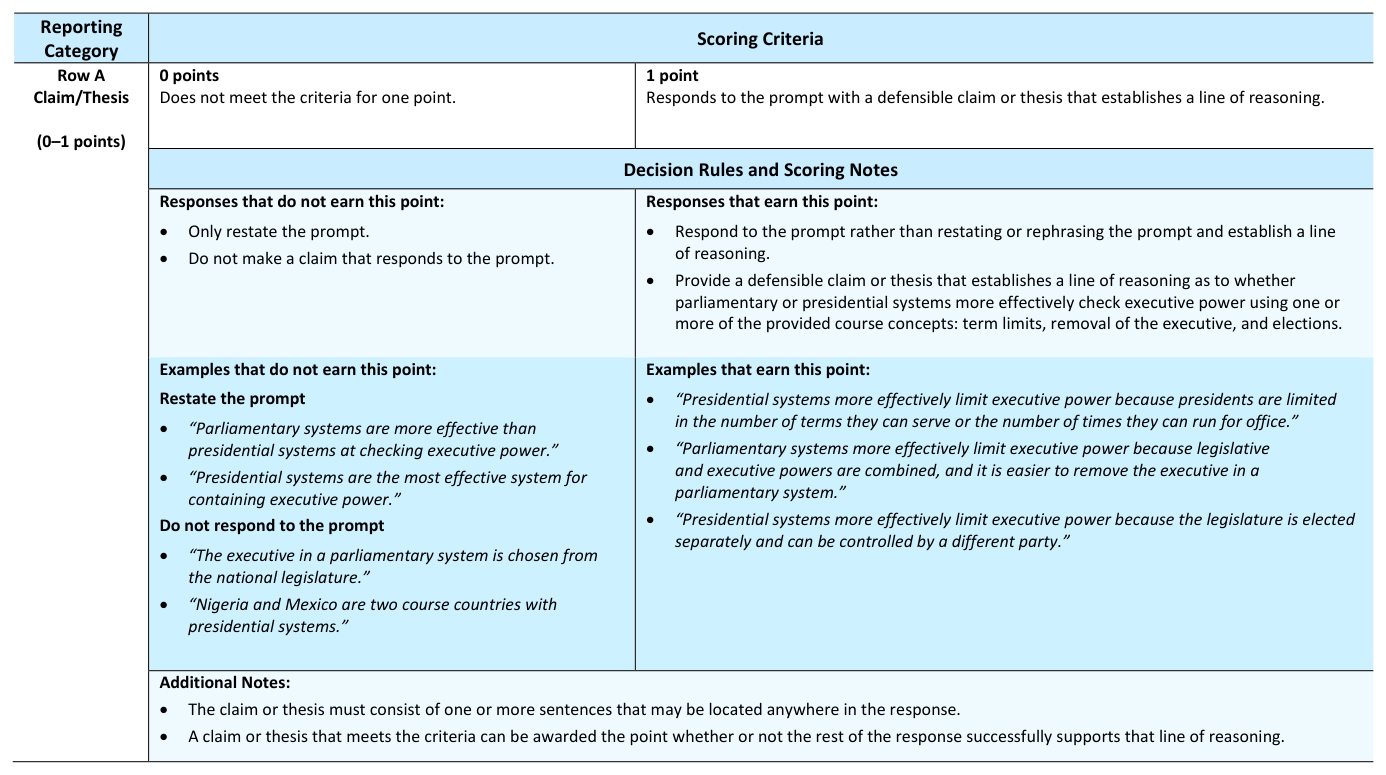
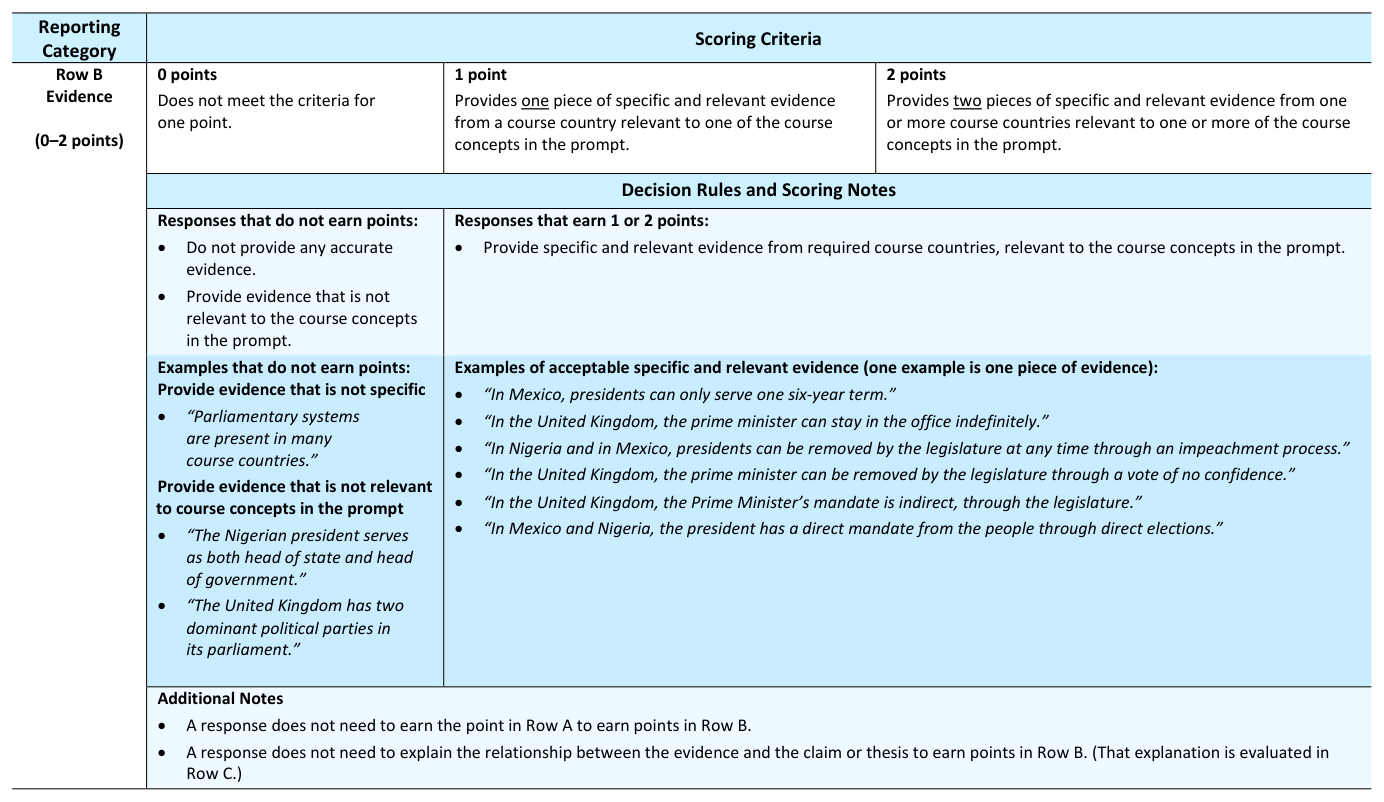


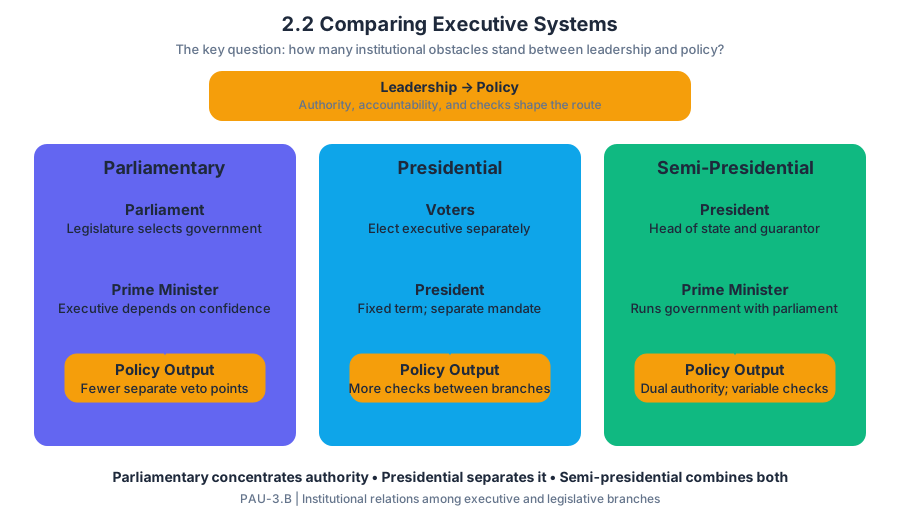
2.3 Executive Systems
Key concepts: Mexico’s mixed system · Limits on judicial power · United Kingdom judiciary · Common law · Rule of law · Judicial removal for misconduct · Judicial age limits
A judiciary can be powerful without being unlimited. Mexico and the United Kingdom illustrate two different ways a political system places boundaries around courts: Mexico uses institutional balance in a mixed political system, while the United Kingdom relies on common law, removal procedures, and age limits to…
2.3 Executive Systems
A judiciary can be powerful without being unlimited. Mexico and the United Kingdom illustrate two different ways a political system places boundaries around courts: Mexico uses institutional balance in a mixed political system, while the United Kingdom relies on common law, removal procedures, and age limits to keep judges within defined legal and constitutional roles.
Key question: Why would a government limit the power of the institution responsible for interpreting and applying the law?
Mexico: judicial power within a mixed system
Mexico’s mixed system combines institutions associated with both presidential and representative government. Its executive and legislative branches possess substantial authority, while the judiciary operates within a constitutional structure designed to prevent any single branch from becoming dominant.
The central idea is checks and balances: each branch has some ability to limit the others. Judicial power is therefore not unlimited. Courts may interpret laws, resolve disputes, and review government actions, but their authority remains bounded by the constitution, legislation, institutional procedures, and the powers of the elected branches.
This limitation does not necessarily mean that Mexico’s judiciary is powerless or merely controlled by the executive. Rather, its power is constrained so that one branch does not become more powerful than the others. Limiting judicial authority can preserve a balance among the branches and reduce the risk that judges, rather than elected institutions, determine all major public policies.
Worked comparison
Imagine that Mexico’s highest court invalidates a government policy. Judicial review gives the court a meaningful check on executive or legislative action. However, the court cannot automatically govern, write the national budget, or replace elected officials. Its authority is significant but specialized: it applies constitutional and legal standards rather than exercising unlimited political power.
| Country | How judicial power is limited | Why the limit exists |
|---|---|---|
| Mexico | Constitutional and institutional checks restrict the judiciary’s reach | To prevent one branch from becoming more powerful than the others |
| United Kingdom | Common law, defined removal procedures, and judicial age limits constrain judges; the Supreme Court lacks broad judicial review | To preserve the rule of law and keep judicial authority within established legal boundaries |
United Kingdom: common law and the rule of law
The United Kingdom’s judiciary must abide by common law, a legal tradition in which judicial decisions and precedents help shape the law over time. A precedent is an earlier judicial decision that guides later cases with similar facts. Common law gives judges interpretive influence, but it also binds them to accumulated legal principles rather than allowing each judge to decide entirely from personal preference.
This supports the rule of law, the principle that government officials and ordinary citizens are subject to publicly known laws applied through established procedures. The rule of law differs from rule by law: under rule by law, authorities may use legal rules as instruments of state power, even when courts lack genuine independence. In the United Kingdom, adherence to common law helps make judicial decisions more predictable and limits arbitrary judicial action.
The United Kingdom also limits judicial power through institutional boundaries. Its Supreme Court does not possess the same broad power of judicial review found in some constitutional systems. Judges therefore interpret and apply law, but they do not possess unlimited authority to strike down every act of Parliament.
Accountability without ordinary political control
Judges in the United Kingdom can be removed for misconduct, meaning serious behavior that violates the standards expected of judicial office. This process creates accountability while distinguishing misconduct from an unpopular ruling: a judge should not be removed simply because a government dislikes a legally defensible decision.
Judges also face age limits. Mandatory retirement rules prevent judicial office from becoming indefinite and create a regular point at which new judges can enter the system. Together, misconduct procedures and age limits limit tenure-based power without making judges directly dependent on changing political majorities.
The comparative logic
The two countries limit judicial power for related but distinct reasons. Mexico emphasizes interbranch balance: judicial authority must not allow the judiciary to dominate the political system. The United Kingdom emphasizes legal constraint and institutional accountability: judges must follow common law, operate within defined powers, and remain answerable for misconduct.
Misconception check: “Limiting judicial power means the courts are not independent.”
Not necessarily. A judiciary can be independent in deciding cases while still being limited by constitutional jurisdiction, legal precedent, removal standards, retirement rules, or the absence of broad judicial review.
AP skill connection and retrieval check
This topic most directly uses Practice 1: Concept Application, especially 1.A Define and/or describe a concept or political process and 1.B Explain how a political concept or process relates to a political scenario. It also uses Practice 2: Country Comparison, especially 2.A Describe similarities and differences between countries and 2.B Explain similarities and differences between countries.
Retrieval check: A response states that Mexico limits judicial power to prevent one branch from becoming dominant, while the United Kingdom limits it through common law, misconduct procedures, age limits, and restricted judicial review. Which country’s explanation primarily reflects checks and balances, and which primarily reflects legal and procedural constraint?
Answer: Mexico primarily reflects checks and balances; the United Kingdom primarily reflects legal and procedural constraint.
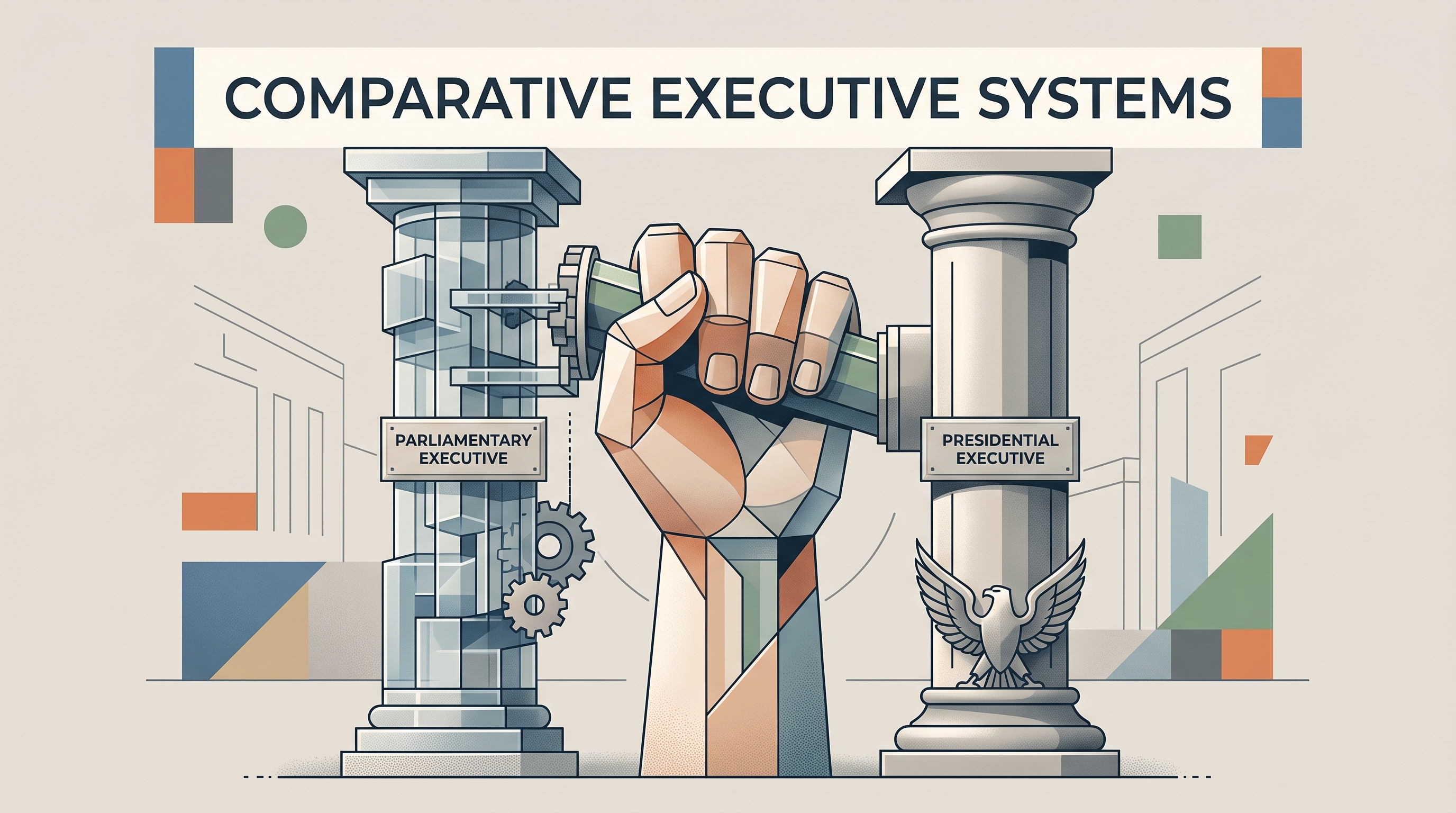
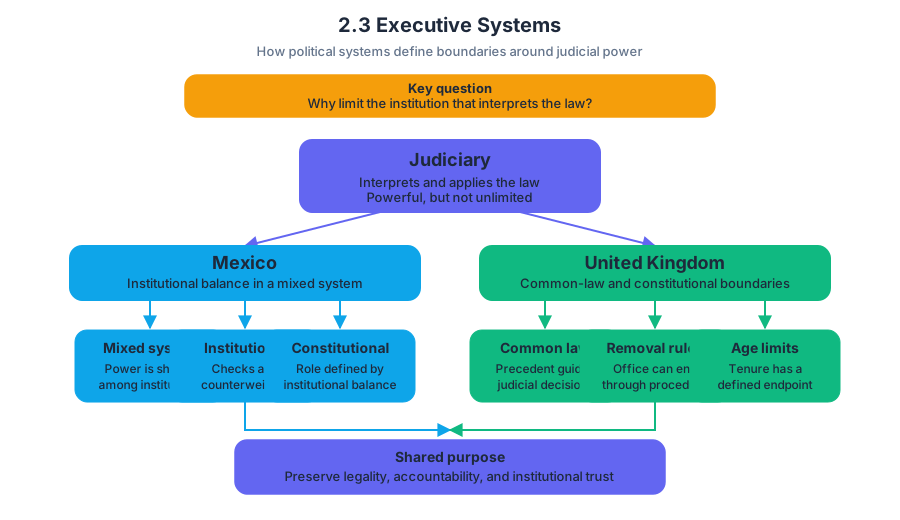
2.4 Executive Term Limits
Key concepts: Executive term limits · Advantages of term limits · Focus on governing rather than winning elections · Opportunities for new leaders · New ideas and policies · Political institutions reflect the allocation of power · Defensible claim or thesis about executive term limits
Executive term limits determine whether a successful executive may keep seeking office—or must eventually hand power to someone else. The central question is not simply whether limits are “good” or “bad,” but whether replacing leaders improves accountability and policy stability more than it disrupts effective…
2.4 Executive Term Limits
Executive term limits determine whether a successful executive may keep seeking office—or must eventually hand power to someone else. The central question is not simply whether limits are “good” or “bad,” but whether replacing leaders improves accountability and policy stability more than it disrupts effective government.
Investigative question: Do executive term limits protect political systems, or prevent effective leaders from finishing their work?
Formal definition and political purpose
Executive term limits are legal restrictions on the number of terms, or total amount of time, an executive may serve in office. They are an institutional way to distribute power over time: even a popular executive cannot legally remain in office forever.
The enduring understanding PAU-3 states that the structure and function of political institutions reflect the allocation of power within a political system. The relevant learning objective is PAU-3.C: Explain the structure, function, and change of executive leadership in course countries. Essential knowledge PAU-3.C.3 requires analysis of both the advantages and disadvantages of executive term limits in promoting stability and effective policies.
Advantages: limiting power and opening political space
Term limits can check executive power by preventing one officeholder from converting repeated electoral victories into permanent personal rule. They inhibit the emergence of dictators and personality rule, in which loyalty to an individual becomes more important than loyalty to political institutions.
A second advantage is that term limits can help an officeholder focus on governing rather than winning elections. If reelection is impossible, the executive has less reason to shape every policy around campaign advantages, donors, polling, or short-term popularity. The executive may instead devote attention to implementing difficult policies whose benefits appear only after several years.
Term limits also create opportunities for new leaders to enter office. New leaders may bring different ideas, policies, or goals, allowing institutions to respond to changing social conditions. Leadership turnover can broaden representation and prevent political offices from becoming the permanent property of one family, faction, or personality.
Disadvantages: turnover can weaken effective government
The same rule that prevents a harmful executive from staying can force a capable executive to leave. Term limits may therefore remove a good leader even when citizens still support that leader’s performance.
They may also allow insufficient time to achieve major goals. A policy requiring long-term investment—such as institutional reform, infrastructure construction, or economic restructuring—may be interrupted when a new executive takes office. This can impede policy continuity, especially when the successor wants to reverse the predecessor’s agenda.
Term limits can weaken accountability because citizens cannot use reelection to reward or punish the executive directly. Near the end of a final term, a lame-duck period may develop: the executive remains in office but has reduced political influence because cannot seek another term. The executive may also have less incentive to respond to public preferences.
Frequent turnover can prevent an executive from building experience as chief executive. It can also encourage poorly designed policy if new leaders prioritize visible, rapid changes over careful administration. A new executive may need to spend valuable time learning how to manage institutions rather than pursuing substantive goals.
Pros and cons at a glance
| Advantages of executive term limits | Disadvantages of executive term limits |
|---|---|
| Check executive power | Force good executives to leave office |
| Inhibit dictators and personality rule | Allow insufficient time to achieve goals |
| Encourage governing rather than constant reelection campaigning | Impede policy continuity |
| Provide opportunities for new leaders | Weaken electoral accountability |
| Introduce new ideas, policies, and goals | Create a lame-duck period |
| Reduce the risk of permanent personal rule | Limit the development of executive experience |
| — | Can contribute to poorly designed policy |
Worked argument: making a defensible claim
Imagine Country A limits its president to two terms. During the first term, the president begins an education reform program that requires a decade to produce results. The president cannot seek a third term, so reelection pressure will not distort the final years of the administration. However, a successor may cancel the program before its effects appear, producing policy instability.
A defensible thesis must answer the question while recognizing the competing consequence:
Claim: Executive term limits are generally beneficial because they check executive power, discourage personality rule, and create opportunities for new leaders; however, they can reduce policy continuity and remove effective executives before long-term goals are completed.
This claim satisfies PAU-35.A: Articulate a defensible claim/thesis because it takes a clear position and identifies a condition that complicates it. A weak response merely lists advantages and disadvantages; a strong response explains why the institutional trade-off matters.
Misconception check
Misconception: “Term limits automatically make a country democratic.” Term limits can restrain executive power, but they do not by themselves guarantee competitive elections, an independent legislature, an independent judiciary, or meaningful political participation. They are one institutional limit on power—not a complete democratic system.
Retrieval check
If an executive cannot seek reelection, identify one reason that executive might govern more effectively and one reason the country might experience less effective policy. Then write a one-sentence thesis deciding whether the advantages outweigh the disadvantages. Tie your answer to PAU-3.C.3 and the idea that institutions reflect the allocation of power.
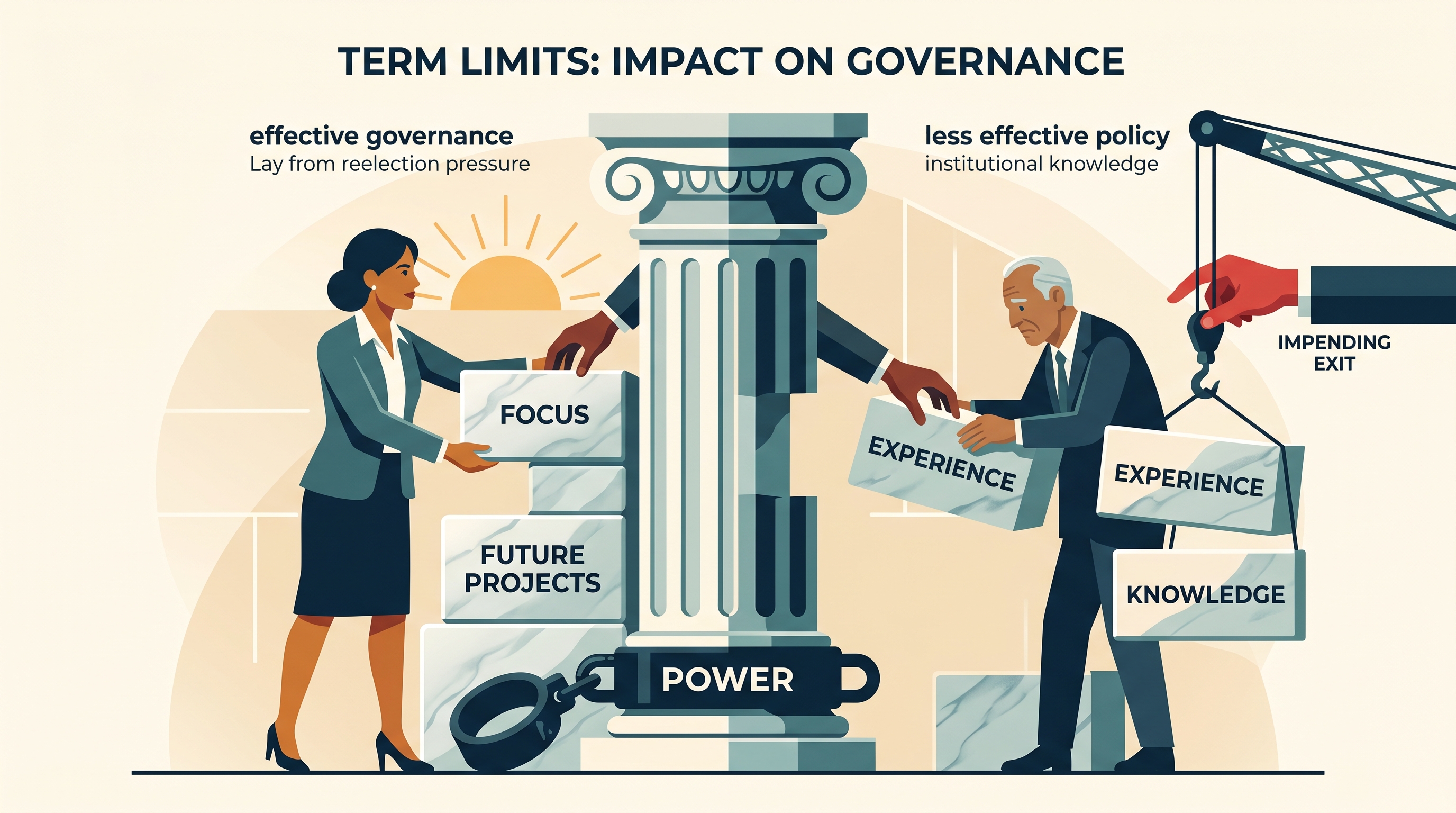



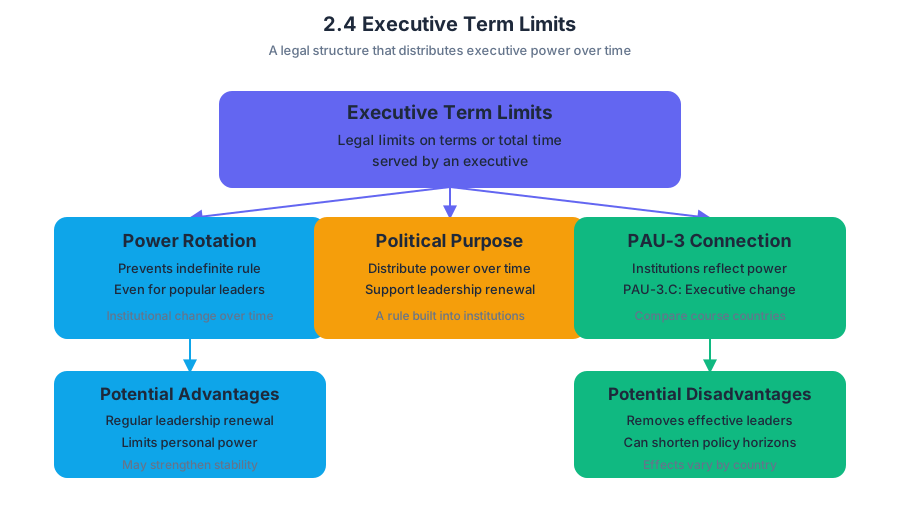
2.5 Removal of Executives
Key concepts: Removal of Executives · Forces
A president can lose office without losing an election, and a prime minister can fall without a national vote. Removal of executives means ending an executive’s authority before the normal end of the officeholder’s term through a constitutional or political procedure.
2.5 Removal of Executives
A president can lose office without losing an election, and a prime minister can fall without a national vote. Removal of executives means ending an executive’s authority before the normal end of the officeholder’s term through a constitutional or political procedure. The central question is not simply who leads, but who has the power to force that leader out—and under what conditions?
The removal toolkit
The mechanism depends heavily on the executive system. In a parliamentary system, the executive usually depends on legislative confidence; in a presidential system, the executive normally has a separately defined term and cannot be removed merely because legislators dislike a policy. Semi-presidential systems combine these possibilities: a prime minister may be vulnerable to legislative removal while a president faces a distinct constitutional process.
| Removal mechanism | Who initiates or decides? | Most associated with | What it demonstrates |
|---|---|---|---|
| Vote of no confidence | Legislature | Parliamentary systems | The executive must retain legislative support |
| Impeachment | Legislature, often with judicial or upper-chamber involvement | Presidential systems | Constitutional violations can trigger formal removal |
| Recall election | Citizens through a petition and vote | Some presidential or subnational systems | Voters can terminate an official before the next election |
| Succession | Constitutional successor or designated institution | Any system | Authority transfers when an executive resigns, dies, or is removed |
Learning Objective 2.5.A — Explain how executives can be removed from office.
Essential Knowledge 2.5.A.1: Executives can be removed through constitutional procedures, including legislative votes of no confidence, impeachment processes, and recall elections. These procedures differ in their legal thresholds, political actors, and consequences for the broader political system.
Parliamentary removal: confidence is the hinge
In a parliamentary system, the prime minister and cabinet are politically connected to the legislature. A vote of no confidence is a legislative decision declaring that the government no longer has sufficient support to continue. If the motion passes, the prime minister may resign, a new government may be formed from the existing legislature, or parliament may be dissolved and new elections held, depending on the constitution.
Worked example — the United Kingdom: Imagine the government loses the support of enough members of the House of Commons that an opposition motion of no confidence succeeds. The prime minister cannot simply insist on completing a fixed presidential-style term. The government must respond through resignation, the formation of an alternative government, or an election under the applicable rules. The removal mechanism therefore reinforces legislative accountability: executive survival depends on maintaining a parliamentary majority or governing coalition.
Presidential removal: a formal constitutional breach
In a presidential system, the president usually receives an independent electoral mandate and serves a constitutionally specified term. Legislators therefore cannot ordinarily remove the president through an ordinary disagreement over legislation. Impeachment is a formal accusation that the executive committed serious constitutional or legal wrongdoing; it is not automatically the same as removal. A legislature may impeach, but another institution—often a senate or constitutional court—may conduct the trial or make the final determination.
Worked example — Nigeria: Nigeria’s president operates within a presidential system in which removal is tied to a constitutional process rather than an ordinary parliamentary confidence vote. The legislature must follow formal steps and meet a high threshold. This design makes removal possible when grave misconduct is alleged while making it difficult for a temporary legislative majority to overturn the result of a presidential election.
Recall: direct popular removal
A recall election allows citizens to petition for a vote on whether an elected executive should leave office before the regular election date. Recall differs from impeachment because the decisive actor is the electorate rather than the legislature. It also differs from a regular election because it is triggered during the official’s current term and focuses on early termination rather than routine succession.
Why removal rules matter
Removal procedures balance two competing goals. Accountability requires a way to punish abuse of power, corruption, or serious constitutional violations. Stability requires protection against constant attempts to remove an executive whenever opponents lose a policy dispute. A low threshold may encourage legislative responsiveness but produce unstable governments; a high threshold may protect continuity but allow an executive to remain in office despite declining legitimacy.
Practice 2: Country Comparison
Practice 2: Country Comparison is assessed when you identify a relevant similarity or difference between countries and explain it with accurate political reasoning. Compare the United Kingdom and Nigeria: a successful no-confidence vote can directly threaten the United Kingdom’s prime minister because the government depends on parliamentary support, whereas Nigeria’s president is protected by a fixed presidential mandate and requires a formal constitutional removal process. The strongest comparison names the mechanism, identifies the institutional difference, and explains the causal connection.
Key insight: Removal rules reveal where executive authority comes from. If authority depends on the legislature, legislative confidence is central; if authority comes from a separately elected mandate, removal usually requires a special constitutional threshold.
Misconception check
Misconception: “Impeachment means the executive has been removed.”
Correction: impeachment is generally the charging or accusing stage. Removal requires the next constitutionally required decision, such as conviction by a legislative chamber or judgment by another authorized institution. Also avoid treating every resignation as impeachment: an executive may resign because of scandal, coalition collapse, protest, or declining support without completing a formal removal proceeding.
Retrieval check
A prime minister loses a legislative confidence vote, while a president is accused of serious constitutional misconduct. Which removal mechanism best fits each case, and why would applying the parliamentary mechanism to the president produce an inaccurate comparison? A complete answer identifies no confidence for the prime minister, impeachment for the president, and connects the difference to parliamentary dependence versus a separately elected presidential mandate.
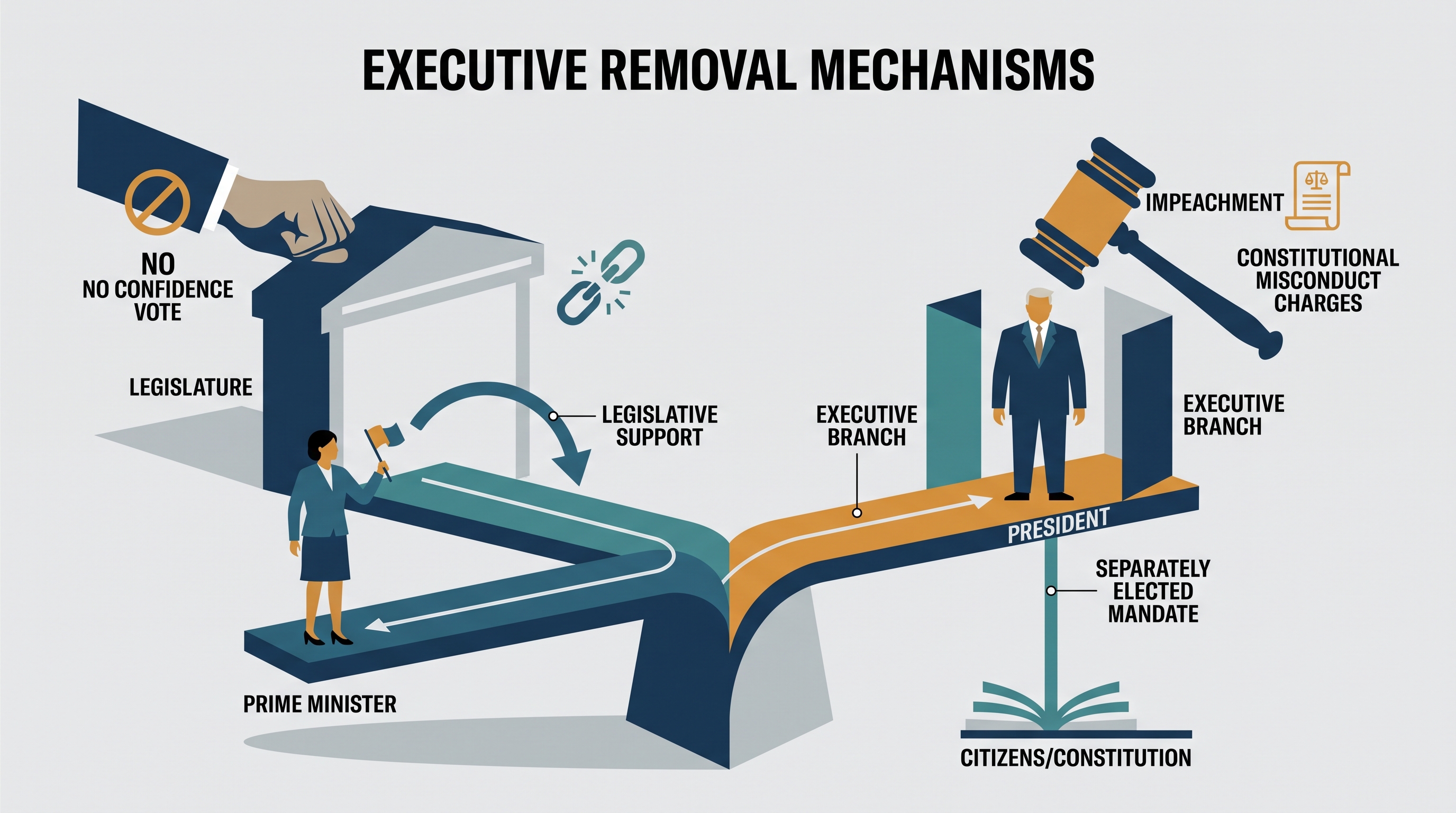
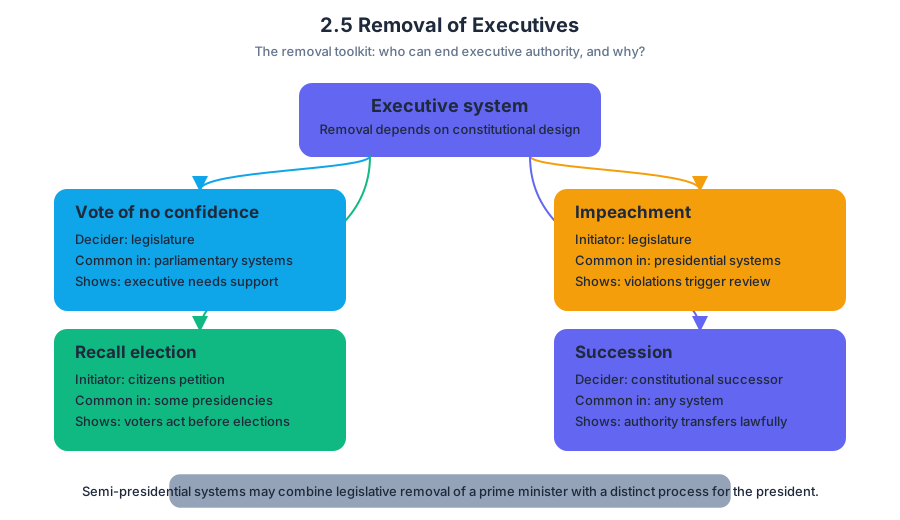
2.6 Legislative Systems
Key concepts: Legislative systems · Legislative selection processes · Restrictions on legislative power · Formal constraints on the legislative branch · Effectiveness of formal constraints · Indirect elections · Direct elections with ideological vetting · Single-member district plurality systems · Mixed electoral systems · Proportional representation
A legislature does more than vote on bills: it converts political demands into laws, represents citizens or organized interests, approves public spending, and may supervise the executive branch.
2.6 Legislative Systems
A legislature does more than vote on bills: it converts political demands into laws, represents citizens or organized interests, approves public spending, and may supervise the executive branch. The central comparative question is not simply whether a country has a legislature, but who selects legislators, what powers the legislature formally possesses, and whether those powers operate in practice.
Topic 2.6 — Legislative Systems: Legislative systems vary according to their selection processes and the formal restrictions placed on legislative power.
How legislators are selected
A legislative selection process is the method by which members of a legislature gain their seats. The most important distinctions are whether elections are direct or indirect and whether votes are translated into seats through plurality, proportional representation, or a mixed formula.
| Selection process | How it works | Course-country example |
|---|---|---|
| Indirect election | Citizens may choose lower-level representatives, who then help select national legislators. | China |
| Direct election with ideological vetting | Citizens vote directly, but candidates must first satisfy ideological or institutional screening rules. | Iran |
| Single-member district plurality | Each district elects one representative; the candidate with the most votes wins, even without a majority. | Nigeria and the United Kingdom |
| Mixed system | Some legislators are elected in districts while others receive seats through proportional representation. | Mexico and Russia |
China illustrates an indirect legislative election system. The National People’s Congress, China’s national legislature, is not selected through a single nationwide direct election in which voters choose every national legislator. Instead, representation moves upward through layers of lower-level congresses. This process gives the Chinese Communist Party substantial influence over who reaches the national legislature.
Iran combines direct elections with ideological vetting. Voters directly elect members of the Islamic Consultative Assembly, or Majlis, but candidates must be approved through a vetting process associated with the Guardian Council. Direct voting therefore does not mean unrestricted electoral competition: the electorate chooses among candidates who have already passed institutional and ideological screening.
Nigeria and the United Kingdom use single-member district plurality systems for their lower legislative chambers. Each geographic district selects one representative, and the candidate receiving the largest number of votes wins. A candidate can therefore win with $40%$ of the vote if three or more candidates divide the remaining $60%$.
Mexico and Russia use mixed systems. District representatives provide geographic accountability, while proportional-representation seats allow parties to gain legislative representation based on their overall vote share. The result is a legislature that combines two principles: local representation and broader party representation.
Restrictions on legislative power
A formal constraint is an explicit legal or institutional limit on what a legislature can do. Examples include constitutional review, executive vetoes, judicial review, upper chambers, party rules, candidate restrictions, limited legislative sessions, and requirements that legislation conform to constitutional or ideological principles.
The same formal institution can have different effects in different political systems. A constitution may grant a legislature authority to make laws, but that authority is weaker when another institution controls candidate selection, controls the policy agenda, or can block legislation.
China demonstrates the difference between formal authority and effective power. The National People’s Congress formally passes laws, but the Chinese Communist Party is the actual center of political power. The NPC’s short session—approximately two weeks—also limits extended independent debate and encourages it to approve policies already shaped by the CCP. The legislature therefore possesses formal lawmaking authority but is strongly constrained in exercising independent power.
In Iran, legislative power is constrained by ideological vetting and review by institutions such as the Guardian Council. The Majlis may debate and pass legislation, but laws can be rejected if they conflict with constitutional or Islamic principles as interpreted by the reviewing institution. The constraint is effective when it prevents the legislature from acting outside those boundaries.
In more electorally competitive systems, formal constraints may operate through institutional checks rather than ideological screening. A legislature may face executive vetoes, judicial review, constitutional rules, federal arrangements, or pressure from governing-party leaders. In the United Kingdom, for example, the executive is drawn from Parliament, so party control can limit legislative independence even when Parliament has substantial lawmaking authority.
Worked comparison: from description to explanation
Imagine comparing China and the United Kingdom. A description identifies that China uses indirect legislative elections while the United Kingdom uses single-member district plurality elections. An explanation goes further: China’s selection process reinforces party control over national representation, while the United Kingdom’s district elections create a direct electoral connection between voters and individual members of Parliament.
The comparison must then evaluate constraints. China’s NPC is formally a lawmaking body, but CCP dominance and the short legislative session restrict independent action. The United Kingdom’s Parliament can legislate and scrutinize government, yet the governing party and cabinet often control the parliamentary agenda. Thus, both legislatures face constraints, but the source and degree of constraint differ.
Misconception check
Misconception: “Direct elections automatically make a legislature powerful.”
Direct elections describe how legislators are chosen, not how much authority they exercise after taking office. Iran has direct elections, but ideological vetting limits the range of candidates and legislative outcomes. Conversely, an indirectly selected legislature may possess formal authority in some circumstances. Always separate selection process from legislative power.
Skill connection and retrieval check
This topic develops Concept Application by applying legislative-system concepts to country cases and Country Comparison by explaining meaningful similarities and differences. It also requires the descriptive and explanatory reasoning assessed in legislative-system comparisons: identify the institution, describe its operation, and explain how that operation affects legislative power.
Retrieval check: A country allows voters to choose legislators directly, but an appointed council can reject candidates before the election and invalidate legislation afterward. What are the two separate concepts you should analyze? The answer is the legislative selection process and the formal constraints on legislative power—and neither concept alone proves how independent the legislature is.
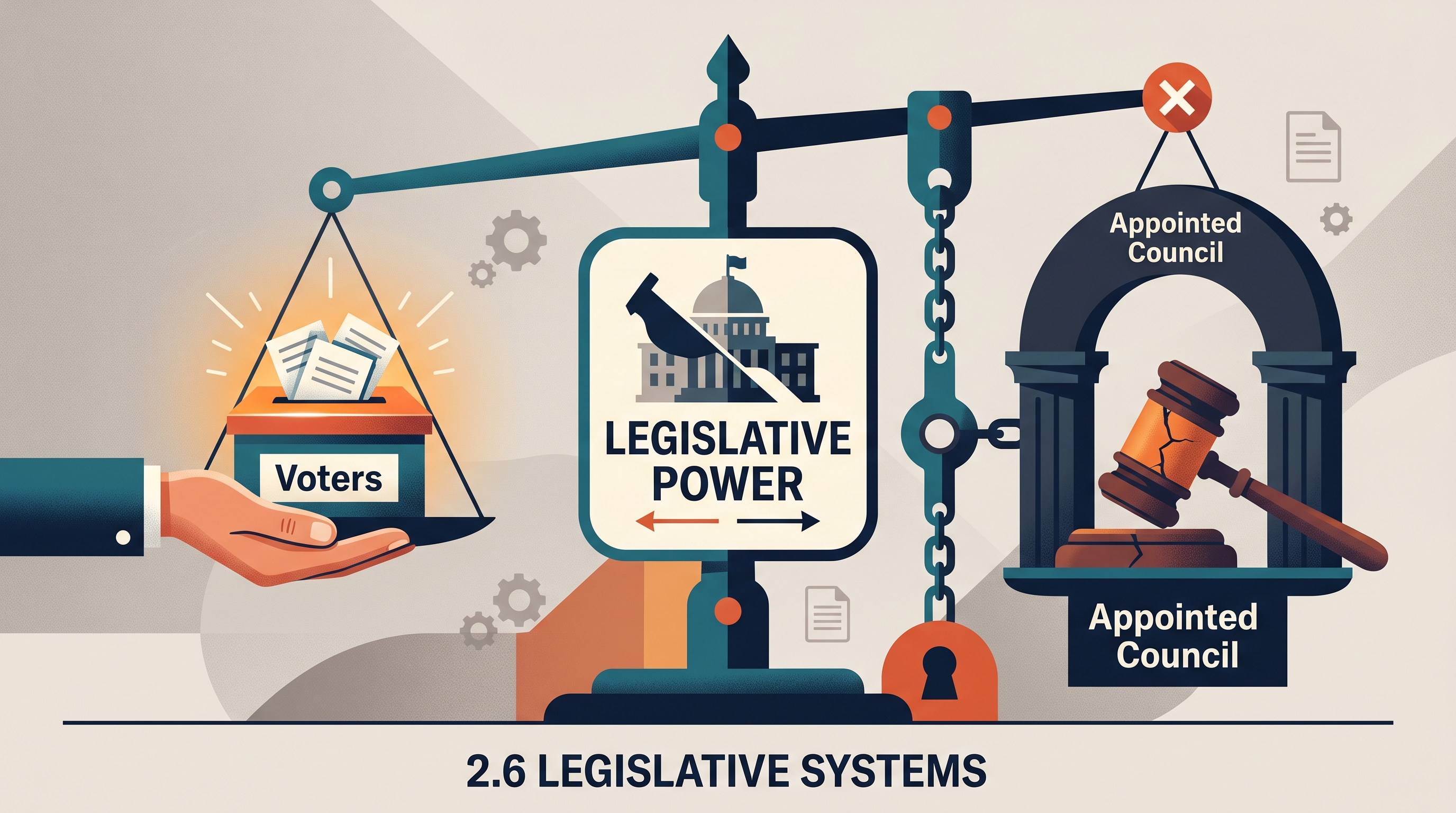
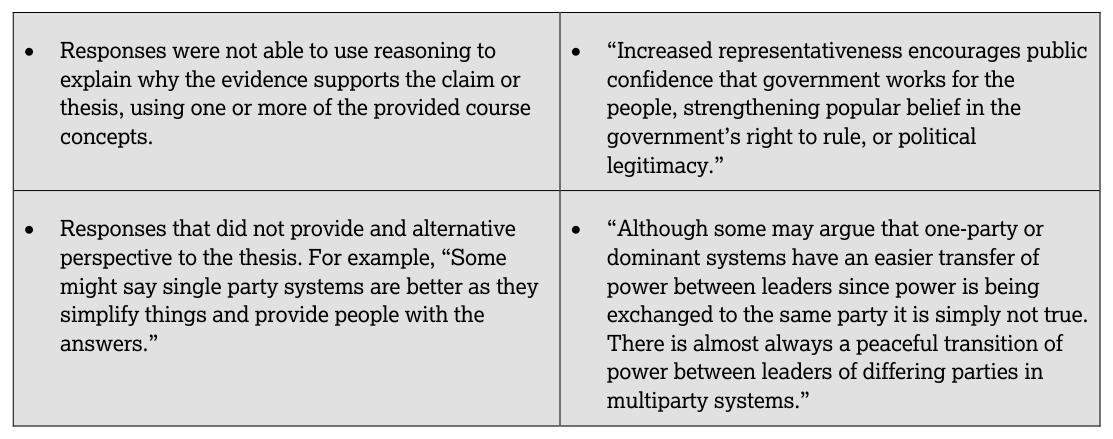
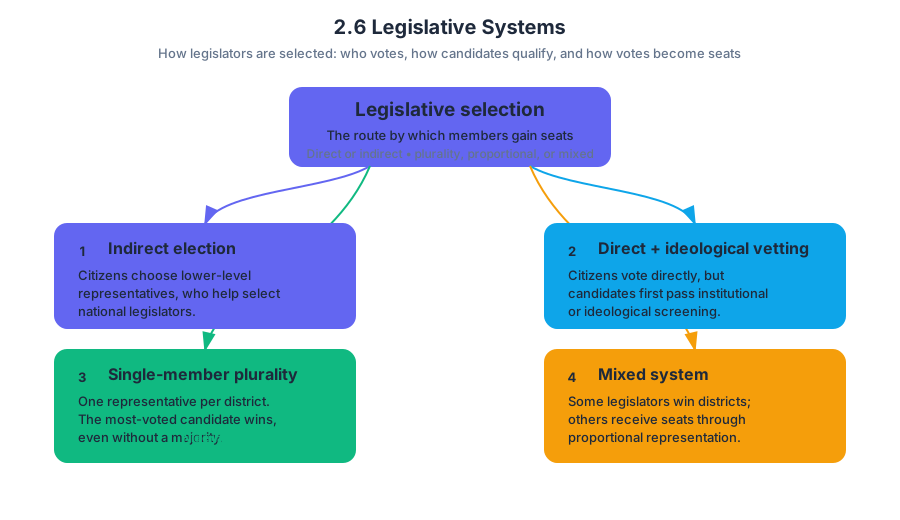
2.7 Independent Legislatures
Key concepts: Independent legislatures · Liberties · Progression of topics within each unit
A legislature is independent when it can debate, amend, reject, and oversee government action without being controlled by the executive. The key question is not whether a country has a parliament or congress—it is whether that institution can make meaningful choices when the executive disagrees.
2.7 Independent Legislatures
A legislature is independent when it can debate, amend, reject, and oversee government action without being controlled by the executive. The key question is not whether a country has a parliament or congress—it is whether that institution can make meaningful choices when the executive disagrees.
In the progression of Unit 2, the analysis therefore moves from structure to capacity: after identifying how legislative systems are organized in Topic 2.6, ask whether legislators possess enough institutional power, resources, and political freedom to act independently. That question prepares the analysis of another institutional check without treating the legislature as automatically powerful simply because it exists.
Independent legislature: a legislature that has sufficient authority and autonomy to create laws, represent interests, oversee the executive, and protect liberties rather than merely approve decisions already made by executive leaders.
What makes a legislature independent?
Legislative independence has several dimensions. A legislature may possess formal constitutional authority but lack practical independence if the executive controls the governing party, intimidates opposition members, restricts debate, or controls access to information.
The most useful test is to examine what happens when the legislature and executive disagree. An independent legislature can investigate executive conduct, alter proposed laws, control or scrutinize public spending, represent organized interests, and force public justification of government decisions.
| Dimension of independence | Question to ask | Evidence of stronger independence |
|---|---|---|
| Law-making authority | Can legislators amend or reject executive proposals? | Bills change substantially during legislative debate |
| Oversight | Can the legislature investigate officials? | Committees request documents or summon ministers |
| Budgetary authority | Can legislators influence public spending? | The executive must obtain legislative approval |
| Institutional resources | Do legislators have staff, research, and information? | Committees can evaluate complex policies independently |
| Political autonomy | Can members disagree without retaliation? | Governing-party legislators sometimes vote against the executive |
| Representation | Can competing interests enter debate? | Opposition and minority groups participate meaningfully |
Formal power versus practical power
A constitution may grant a legislature the power to pass laws, approve budgets, or remove officials. Those powers are formal powers: authority written into legal rules. Practical power is the ability to use those authorities effectively under real political conditions.
For example, a legislature may legally reject a presidential proposal, yet remain dependent on the president if the president’s party holds nearly every seat, controls committee leadership, and can punish dissenters by denying renomination. The legislature is formally active but practically subordinate.
Exam distinction: Do not equate “has a legislature” with “has an independent legislature.” Independence is demonstrated through behavior, not merely institutional design.
Worked example: evaluating legislative independence
Imagine Country A. Its constitution allows the National Assembly to amend bills and investigate ministers. However, the president’s party controls $85%$ of the seats, opposition members receive limited media access, and committee chairs are appointed directly by the president. When the president proposes a security law, the Assembly approves it without changes after a single short debate.
A strong analysis would separate the evidence:
- The Assembly has formal law-making and oversight powers.
- The president’s overwhelming party majority reduces the likelihood of legislative resistance.
- Presidential control over committee leadership limits independent investigation.
- The brief, unamended debate suggests that the Assembly is not exercising meaningful policy influence.
- Therefore, Country A has a legislature with constitutional authority but low practical independence.
The conclusion should not be that the legislature is completely powerless. It may still represent local interests or provide administrative approval. The precise claim is that executive dominance prevents it from functioning as an effective independent check.
Independent legislatures and liberties
The connection to Liberties is direct. Civil liberties—basic freedoms such as expression, association, religious practice, and protection from arbitrary government action—are more vulnerable when no institution can challenge executive overreach.
An independent legislature can protect liberties by requiring public debate, revising restrictive laws, exposing abuses through hearings, and representing groups that executive officials overlook. This protection is not guaranteed: a legislature can also pass repressive laws. Independence creates an opportunity for scrutiny and opposition; it does not automatically produce liberal policy.
Named misconception: “An elected legislature is independent”
Correction: Elections may improve representation, but they do not by themselves guarantee institutional independence. A legislature can be elected yet constrained by executive control of parties, unequal electoral rules, censorship, patronage, intimidation, or emergency powers.
A second misconception is that disagreement always proves independence. Occasional criticism may be symbolic. To establish independence, look for repeated evidence: legislators changing proposals, investigating officials, controlling resources, and protecting dissent even when those actions impose political costs.
Skill application
Topic 2.7 is associated with 2.A and the concept of Liberties, and its skill pairing includes 4.C. In practice, 4.C requires explaining how evidence from a political source supports a claim. If a source reports that a legislature rejected an executive bill, do not stop at “the legislature is independent.” Explain the mechanism: rejection demonstrates that legislators could oppose the executive and exercise law-making authority.
A country comparison should also distinguish degree rather than force a binary label. One legislature may control the budget but lack freedom from the governing party; another may represent opposition groups but possess little authority over national security. Independence is multidimensional.
Retrieval check
A constitution grants parliament the power to investigate ministers, but the executive appoints committee chairs, controls legislative information, and punishes governing-party members who vote against executive bills. Is parliament formally independent, practically independent, both, or neither? Explain using one piece of evidence and the mechanism connecting it to legislative independence.
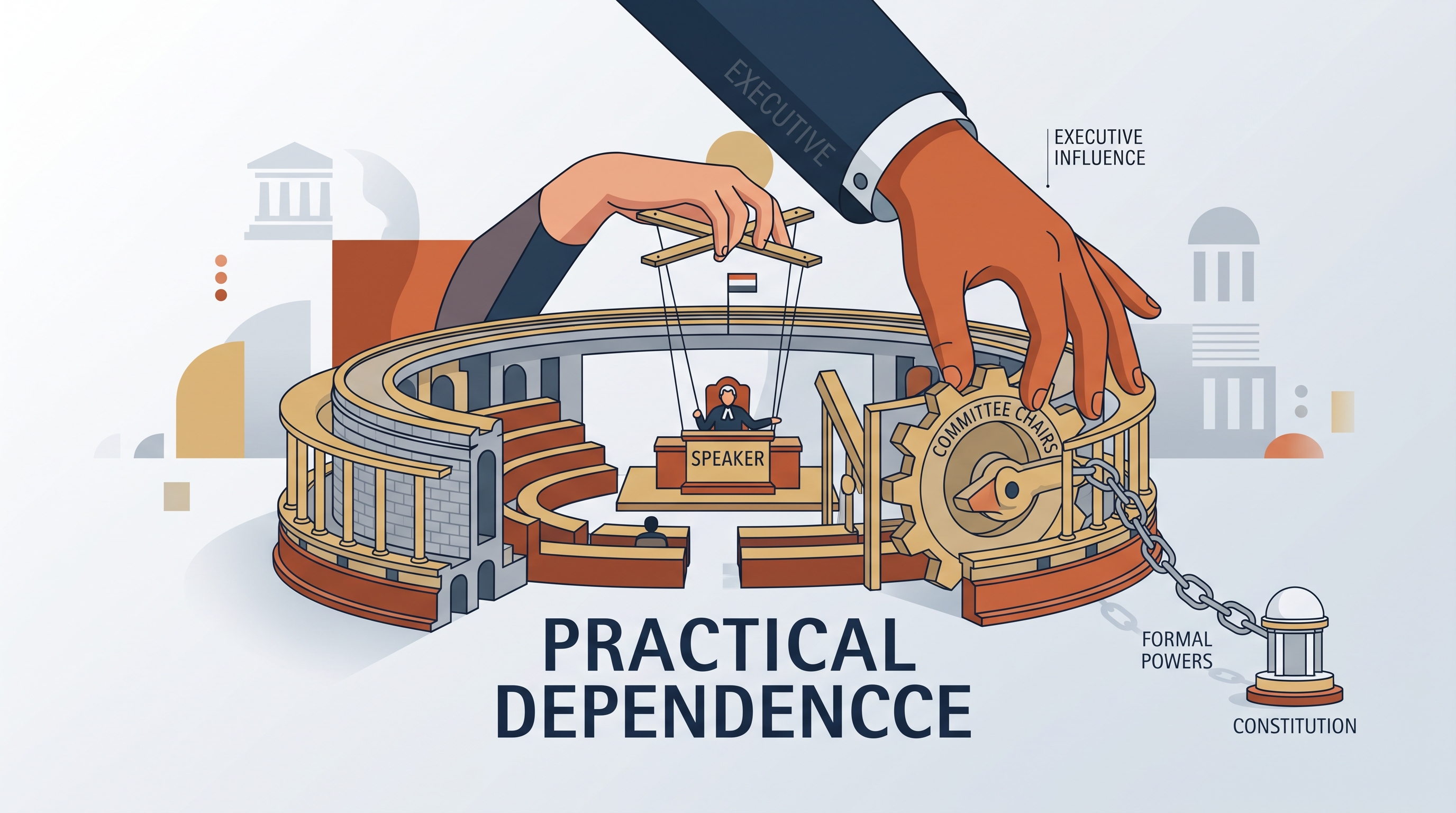
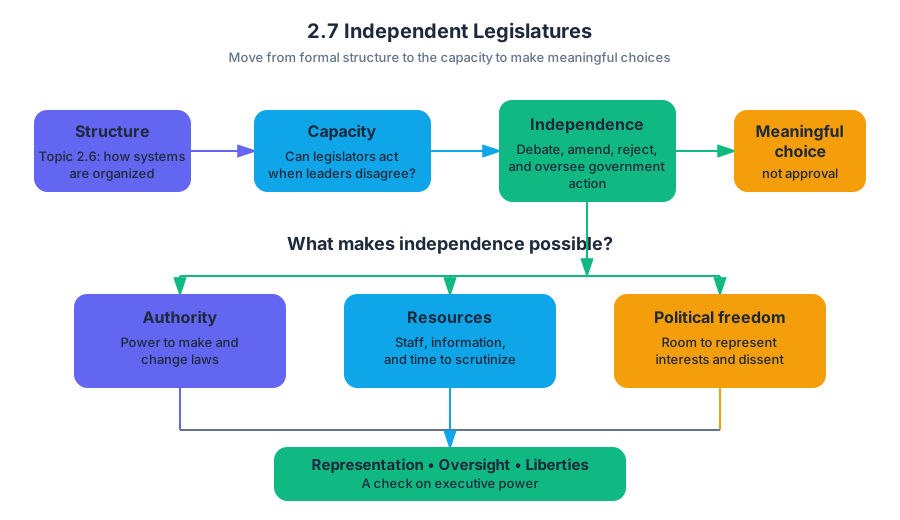
2.8 Judicial Systems
Key concepts: Judicial power · Checks and balances · Separation of powers · Rule of law · Rule by law · Limits on judicial power · Executive or political control of law · United Kingdom · Mexico · Preventing branch overreach
A judicial system does more than punish lawbreakers: it interprets laws, resolves disputes, reviews government action, and helps prevent any one branch from becoming politically dominant.
2.8 Judicial Systems
A judicial system does more than punish lawbreakers: it interprets laws, resolves disputes, reviews government action, and helps prevent any one branch from becoming politically dominant. Its power must therefore be strong enough to enforce legal limits—but limited enough to remain part of a broader system of checks and balances.
Judicial power is the authority of courts to interpret and apply law, resolve disputes, assess whether government actions comply with constitutional rules, and protect legal rights.
Judicial power inside the balance of government
Separation of powers divides governmental authority among executive, legislative, and judicial branches. Checks and balances then give each branch tools to restrain the others. A court may review an executive order, a legislature may control funding for courts, and constitutional rules may limit what judges themselves can decide.
The key point is that judicial limitation is not automatically anti-democratic. If judges could overrule every elected institution without legal boundaries, the judiciary could become an overbearing branch. Limiting judicial power can preserve balance by ensuring that courts exercise authority within a constitution, statutes, jurisdictional rules, and established procedures.
Mexico: limitation as a balancing mechanism
Mexico illustrates the comparative logic. Constitutional and institutional limits on judicial power can prevent the judiciary from displacing the elected branches and becoming more powerful than the executive or legislature. The purpose of such a limit, in this interpretation, is not to eliminate courts but to keep judicial authority within a system where no branch possesses unlimited power.
A strong AP explanation must identify both parts of the relationship: what limits judicial power and why the limit exists. “Mexico limits the judiciary” is incomplete; “Mexico limits judicial power to help prevent one branch from becoming overbearing and thereby maintain checks and balances” explains the political function.
Important distinction: Limiting judicial power can support checks and balances when it restrains judicial overreach. The same idea can undermine checks and balances when an executive controls courts to prevent them from reviewing executive conduct.
Rule of law and rule by law
The rule of law means that government officials and ordinary citizens are subject to publicly established, consistently applied legal rules. Law is intended to constrain political power rather than serve merely as the government’s weapon.
The United Kingdom provides a concrete example. British courts interpret legislation and review executive action, helping ensure that ministers and public authorities act within legal limits. At the same time, the principle of parliamentary sovereignty limits the courts’ ability to invalidate an Act of Parliament. This arrangement combines judicial oversight of executive action with a legal boundary on judicial power, linking the judiciary to both the rule of law and checks and balances.
Rule by law is different: the government uses law as an instrument of political control. Under rule by law, legal rules may exist and courts may operate, but the law primarily helps authorities discipline opponents, restrict dissent, or legitimize decisions already made by political leaders. Russia illustrates this danger when the executive constrains the judiciary and prevents meaningful judicial review so that courts can help control opposition rather than independently check government power.
| Concept | Central question | Political effect |
|---|---|---|
| Rule of law | Does law constrain those who govern? | Limits arbitrary power |
| Rule by law | Is law being used by those who govern to control others? | Can legitimize repression |
| Checks and balances | Can branches restrain one another? | Prevents branch dominance |
Applying the concept
Use Disciplinary Practice 1: Concept Application by connecting a country fact to a precise concept. Use Disciplinary Practice 2: Country Comparison by comparing not merely whether courts are “powerful,” but how their authority is limited and whether those limits constrain or empower political actors. Use Disciplinary Practice 5: Argumentation by explaining the consequence: a limitation may preserve institutional balance, or it may weaken accountability.
Misconception check — “A limited judiciary is always independent.” Independence concerns whether courts can decide without improper political pressure. A judiciary may have formally limited jurisdiction yet still be independent; conversely, it may possess broad legal authority but be controlled by the executive.
Retrieval check: A country restricts courts from invalidating legislative acts but allows them to review executive decisions. Explain how this arrangement could support both the rule of law and checks and balances. A strong answer should identify the legal limit on judges, the court’s continuing oversight of executive action, and the way the arrangement prevents any single branch from becoming dominant.
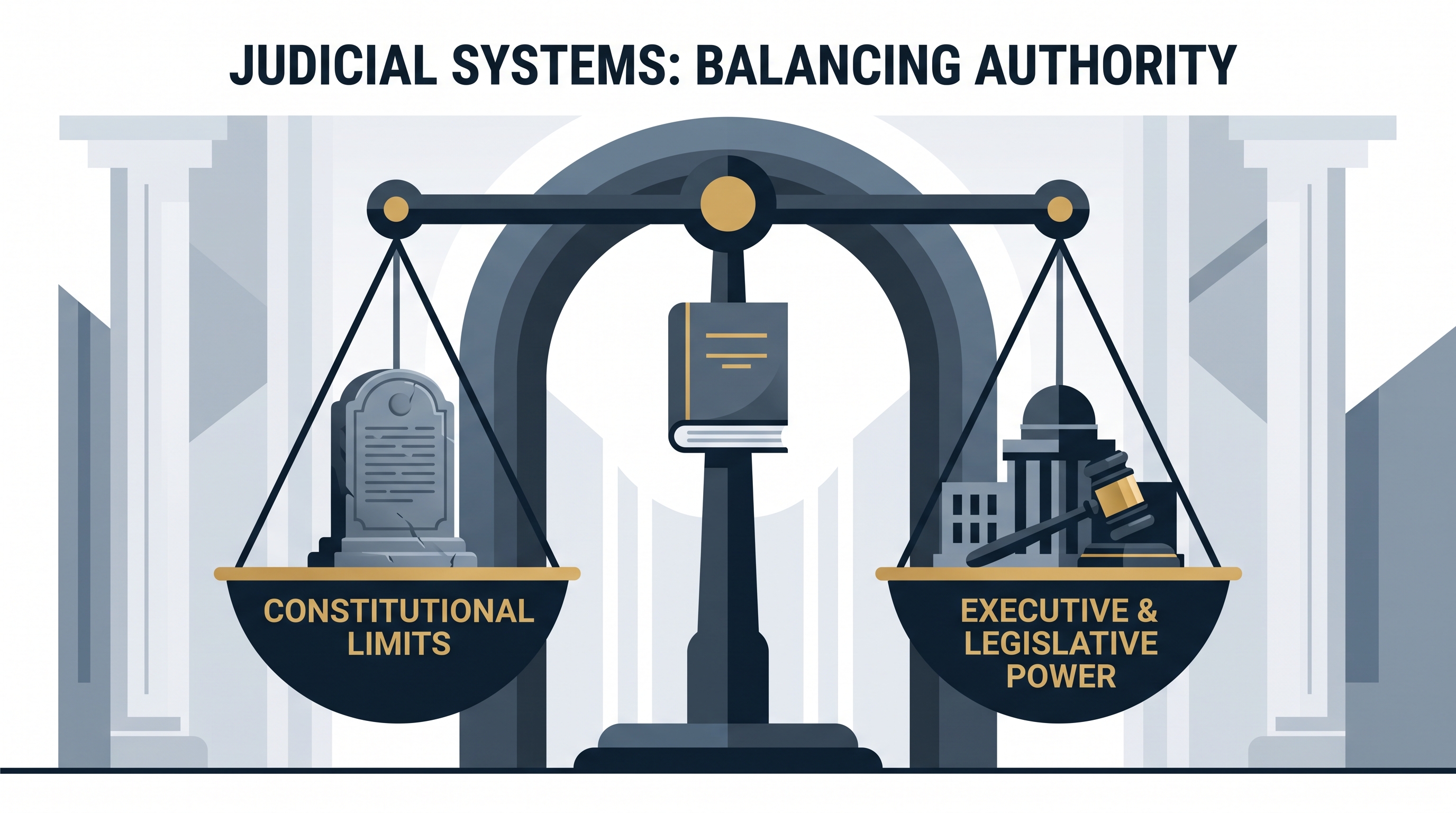
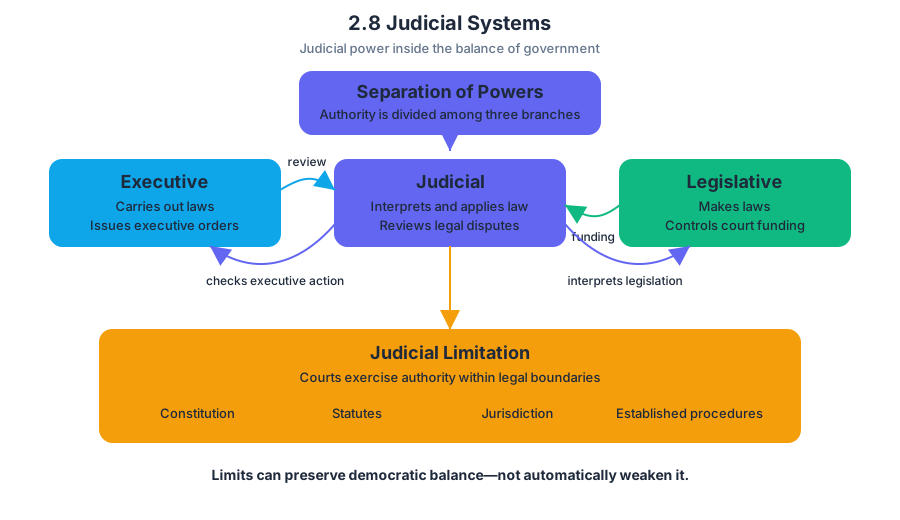
2.9 Independent Judiciaries
Key concepts: Independent judiciaries · Separation of powers · Checks and balances · Fundamental rights and liberties · Judicial independence · Corruption and judicial reform · Striking down unconstitutional laws · Political stability · Government control of the judiciary · Judicial rulings strengthening government power
A court can exist without being independent: the decisive question is whether judges can apply the law even when their ruling threatens the interests of the executive, legislature, ruling party, or military.
2.9 Independent Judiciaries
A court can exist without being independent: the decisive question is whether judges can apply the law even when their ruling threatens the interests of the executive, legislature, ruling party, or military. Judicial independence means that courts possess meaningful freedom from political control when interpreting law, reviewing government action, and protecting rights.
Learning Objective 2.9.A: Explain how judicial independence impacts the political system.
Essential Knowledge 2.9.A: Independent judiciaries can check the power of other branches of government.
Essential Knowledge 2.9.B: Judicial independence helps ensure that government action does not infringe on fundamental rights and liberties.
The institutional logic: courts as a counterweight
The United States uses separation of powers, a system that distributes governmental authority among executive, legislative, and judicial branches. Checks and balances then give each branch tools to limit the others. Judicial review—the power to assess whether a law or government action violates a constitution—allows an independent court to invalidate unconstitutional action.
The key relationship is:
$$ \text{Independent judiciary} \rightarrow \text{judicial review} \rightarrow \text{check on other branches} $$
The United Kingdom illustrates a related but distinct pathway. Its Supreme Court uses common law to enforce the rule of law and help ensure that government does not infringe on fundamental rights and liberties. The institutional arrangements differ from those of the United States, but the political principle is similar: government officials are constrained by law rather than permitted to act solely according to personal or partisan power.
Independence and rights
An independent judiciary matters because political majorities can violate rights. If judges depend on the government for their jobs, salaries, or legal authority, they may hesitate to protect unpopular individuals or groups. Judicial independence therefore supports fundamental rights and liberties, such as fair legal treatment, freedom from arbitrary government action, and protection against unconstitutional laws.
A useful test is to ask what happens when a court’s decision conflicts with the government’s preferences. If the government must obey the ruling, the judiciary has demonstrated a meaningful check. If judges instead use rulings to enforce the government’s preferred outcome, the courts may function as instruments of control rather than as independent protectors of rights.
Comparative evidence: independence varies
Mexico provides an example of judicial independence strengthening political stability. An independent Mexican judiciary has been used to strike down unconstitutional laws. This kind of ruling can increase stability because political actors have a lawful mechanism for resolving institutional conflict, and citizens can see that constitutional limits have practical force.
Nigeria has worked to enhance judicial independence by addressing corruption and implementing reforms. Corruption can weaken independence when judges or court officials are vulnerable to bribery, political pressure, or unequal access to justice. Reform efforts seek to make judicial decisions more credible and reduce the ability of powerful actors to purchase outcomes.
China, Iran, and Russia do not have independent judiciaries. In these countries, judicial rulings are used to strengthen government control rather than consistently counter the power of other branches or protect the rights of people. This is an example of rule by law, in which authorities use legal institutions to govern and control society, rather than rule of law, in which the law meaningfully constrains government itself.
| Judicial independence | Political use of courts without independence |
|---|---|
| Courts can check executive or legislative action | Courts reinforce government decisions |
| Unconstitutional laws may be struck down | Laws are applied to strengthen government control |
| Rights can be protected against political majorities | Rights protection depends heavily on government preferences |
| Supports rule of law | Illustrates rule by law |
Misconception check
Misconception: “A country has an independent judiciary whenever it has courts or a supreme court.” Courts are formal institutions; independence is a condition of their decision-making. China, Iran, and Russia have judicial branches, but the source evidence identifies them as lacking independent judiciaries because their rulings strengthen government control rather than constrain it.
Worked comparison
Suppose two legislatures pass laws restricting public criticism of the government. In Mexico, an independent judiciary could review the laws and strike them down as unconstitutional, creating a lawful check and potentially increasing stability. In a country without an independent judiciary, courts may uphold the restrictions because the ruling strengthens government control. The comparison is not simply “court versus no court”; it is independent legal constraint versus politically controlled enforcement.
AP skills and reasoning processes
This topic develops the following official skills:
- Skill 1.A — Describe and explain political concepts and processes: Define judicial independence, separation of powers, checks and balances, rule of law, and rule by law.
- Skill 1.B — Explain how political concepts and processes relate to one another: Connect judicial independence to judicial review, rights protection, legitimacy, and political stability.
- Skill 2.A — Describe causes and effects of political phenomena: Explain how corruption and political control weaken judicial independence, and how reforms or independent rulings can strengthen stability.
- Skill 3.A — Compare political concepts and processes: Compare Mexico or Nigeria with China, Iran, or Russia by identifying how judicial independence changes the relationship between courts and government.
- Skill 5.A — Use evidence to support a claim: Pair a country-specific example with a precise claim, such as “Mexico’s courts striking down unconstitutional laws demonstrates a judicial check.”
Retrieval check: Why is Mexico’s example evidence of both judicial independence and political stability? Why would the same legal ruling in China, Iran, or Russia be less likely to function as a check on government power? A strong answer must identify the court’s action, its independence from political control, and its effect on constitutional limits or government authority.
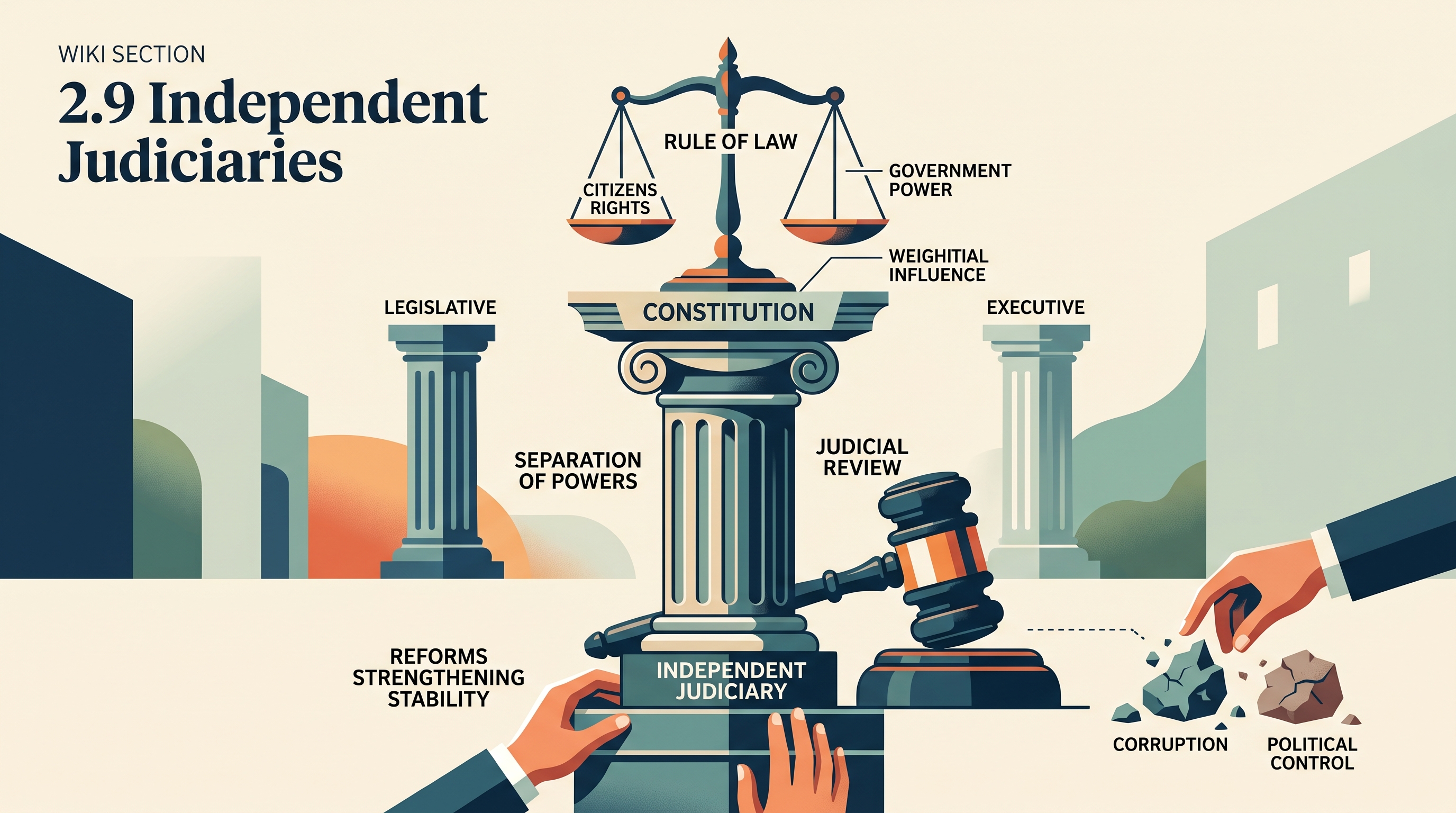
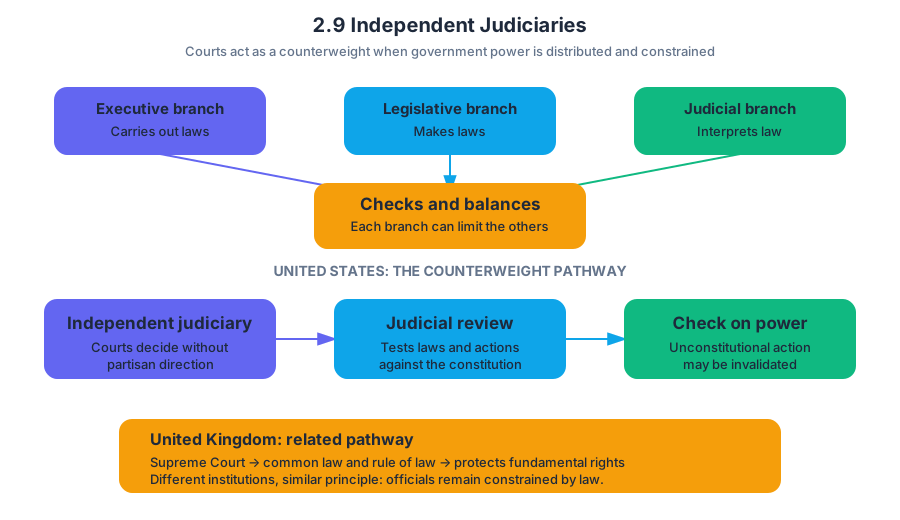
3.1 Civil Society
Key concepts: Civil society · Civil society organizations as nongovernmental groups formed by citizens to promote an agenda · Monitoring and lobbying government · Exposing government corruption · Representing members’ interests · Providing members with organizational experience · State protections and legal constraints on civil society · Civil society advocacy for human rights and environmental issues · Ethnic-minority and regional-interest advocacy · Causal analysis linking government policies to civil society activity
A government may control laws and institutions, but citizens can still organize outside the state to influence what government does. Civil society is the sphere of voluntary, nongovernmental activity in which citizens form groups to promote an agenda, represent interests, monitor officials, or demand rights.
3.1 Civil Society
A government may control laws and institutions, but citizens can still organize outside the state to influence what government does. Civil society is the sphere of voluntary, nongovernmental activity in which citizens form groups to promote an agenda, represent interests, monitor officials, or demand rights.
Civil society: Nongovernmental organizations and voluntary associations made up of citizens who act independently of the state to promote shared goals.
A civil society organization is not simply “any group of people.” Its defining feature is organized activity that connects citizens to public decisions without being part of the government itself. A neighborhood association, environmental organization, labor group, human-rights organization, or ethnic-minority movement can all belong to civil society.
How civil society connects citizens and government
Civil society organizations create a communication and pressure channel between individuals and the state. They can monitor or lobby government, expose corruption, represent members’ interests, and give members organizational experience—skills such as recruiting supporters, conducting meetings, raising funds, communicating demands, and negotiating with officials.
The same organization may perform several roles at once. For example, an environmental group might document pollution, publish evidence, lobby legislators for stricter regulation, represent affected communities, and train local residents to participate in public affairs.
The important causal question is not merely whether civil society exists, but whether government rules allow it to operate. Legal protection for speech, association, assembly, and lobbying lowers the risk of organizing. Registration requirements, censorship, surveillance, or punishment raise the cost of organizing and can force groups to limit their goals.
A country-by-country mechanism
| Country | Civil society activity | Policy or legal condition and effect |
|---|---|---|
| Russia | Groups monitor or lobby government, expose corruption, represent members, and provide organizational experience. | Government restrictions and monitoring can make independent advocacy more difficult. |
| Mexico | Organizations represent members and may advocate on public issues. | Constitutional protection for civil society activity encourages organization by reducing fear of government retaliation, except in severe cases of violence. |
| Nigeria | MEND and MOSOP advocate for ethnic-minority rights, expose abuses, and protest unjust oil-related policies in the Niger Delta. | Democratic-regime protections have supported civil society activity, allowing groups to organize around human-rights and environmental concerns. |
| United Kingdom | Organizations represent members, develop civic skills, and lobby Parliament. | Legal protection for free speech and the right to lobby Parliament gives organizations a secure channel for advocacy. |
| China | Groups advocate for human rights, environmental protection, and opposition to damage caused by the oil industry. | As an authoritarian regime, China restricts organizations through registration requirements, monitoring, censorship, and punishment when activism threatens Communist Party authority. |
The Nigeria example shows why civil society is more than peaceful volunteering. In the Niger Delta, the Movement for the Survival of the Ogoni People (MOSOP) and the Movement for the Emancipation of the Niger Delta (MEND) have advocated for ethnic-minority rights and challenged oil-related policies viewed as unjust. Their actions connect environmental damage, economic grievances, and political representation.
The United Kingdom illustrates the enabling effect of law. When organizations have protected free speech and a recognized right to lobby Parliament, they can turn members’ concerns into policy proposals without treating every act of criticism as a threat to the regime. Members also gain practical organizational experience that can strengthen broader political participation.
China illustrates the opposite mechanism. Civil society groups may advocate locally against corruption or environmental damage, but registration rules, monitoring, censorship, and the possibility of repression constrain independent organization. The key explanation is not simply “China is authoritarian”; it is that authoritarian institutions restrict the communication and organizational space groups need to challenge state policy.
Misconception check
Misconception: “Civil society means opposition to the government.” Civil society organizations may criticize government, cooperate with it, provide services, or represent members without seeking to overthrow the regime. The defining distinction is independence from the state, not permanent hostility toward it.
Misconception: “Naming a regime type explains civil society automatically.” A strong explanation identifies the mechanism: democratic legal protections can encourage organization by protecting speech and lobbying, while authoritarian registration requirements or surveillance can restrict organization and punish independent participation.
Retrieval check
A citizens’ environmental group documents oil pollution, trains local members, and petitions legislators. Identify two roles of civil society it performs, then explain how a legal right to lobby would affect its ability to advocate. A complete answer should name the roles—such as exposing government or corporate harm, representing members, or providing organizational experience—and connect the legal protection to lower risks and greater access to policymakers.

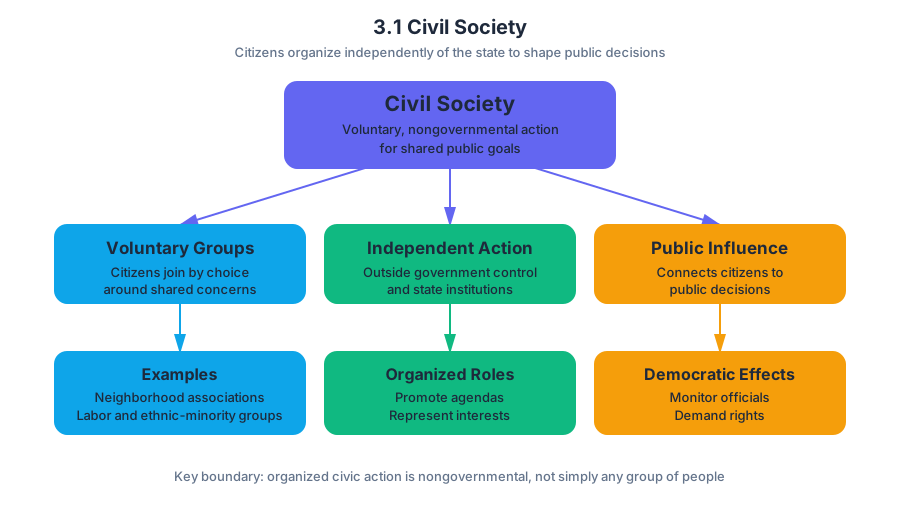
3.2 Political Culture
Key concepts: Political Culture · Political Culture and Participation · Political Socialization · Citizen Behavior · The State · Political Systems
Political culture is the pattern of political values, beliefs, attitudes, and behaviors that shapes how people understand government and decide whether—and how—to participate in politics.
3.2 Political Culture
Political culture is the pattern of political values, beliefs, attitudes, and behaviors that shapes how people understand government and decide whether—and how—to participate in politics. Two citizens may face the same election, law, or protest but interpret it differently because their political cultures teach them different expectations about authority, rights, and civic responsibility.
A useful analogy is a society’s political “operating system.” Formal institutions are the visible hardware—constitutions, legislatures, courts, and executives—but political culture supplies many of the default settings: whether citizens expect government to listen, whether disagreement is viewed as legitimate, and whether political participation feels like a right, a duty, or a risk.
Political socialization: how political culture is learned
Political socialization is the process through which individuals develop political values, beliefs, attitudes, and behaviors. It explains how political culture connects to both citizen behavior and the state: people learn what government is, what it should do, and how they should respond to it.
The major agents of political socialization include family, schools, peers, media, religion, and government. These agents do not necessarily communicate the same message. A family may emphasize obedience, a school may stress constitutional rights, peers may normalize protest, and media may portray government as either protective or corrupt.
| Agent | Political messages it may transmit | Possible behavioral effect |
|---|---|---|
| Family | Trust, loyalty, obedience, or skepticism | Support for or distrust of authorities |
| Schools | Civic duties, national identity, rights | Voting, civic engagement, or conformity |
| Peers | Group expectations and shared grievances | Protest, activism, or political withdrawal |
| Media | Narratives about leaders and institutions | Opinion formation and agenda-setting |
| Religion | Moral duties and social priorities | Support for policies or movements |
| Government | Ideology, national identity, acceptable conduct | Compliance, participation, or fear |
The agents exist in both democratic and authoritarian regimes, but the state’s role differs. In a democratic regime, schools and government may promote constitutional values while citizens retain space for competing beliefs. In an authoritarian regime, the government may take a more concerted role in directing education, media, public symbols, and political messaging so that citizens’ beliefs conform to the state’s ideology.
Political culture and participation
Political culture is connected to political participation, meaning the ways citizens attempt to influence government. Participation can include voting, joining parties or interest groups, contacting officials, attending demonstrations, discussing politics, or supporting government campaigns. The same action can have different meanings in different political systems.
For example, imagine two governments organizing a large public rally. In a democratic system, attendance might reflect voluntary support, party mobilization, or organized civil society. In an authoritarian system, attendance might demonstrate genuine approval, but it could also result from state pressure, employment requirements, or fear of appearing disloyal. Therefore, visible participation does not automatically prove that citizens freely support the regime.
Key distinction: Political participation measures what citizens do; political culture helps explain why they do it and what they believe participation means.
Worked contextual example: Suppose a government introduces a national service program. In a society where political culture emphasizes collective responsibility, citizens may interpret service as a civic duty and participate willingly. In a society shaped by distrust of government, citizens may view the same program as coercive and resist it. The policy is identical, but political socialization produces different citizen responses.
Applying the concept to political systems
To apply political culture to a political system, trace a three-step relationship:
$$ \text{Agents of socialization} \rightarrow \text{Political beliefs} \rightarrow \text{Citizen behavior and state legitimacy} $$
A state that successfully socializes citizens into accepting its authority may gain compliance and political stability. However, political socialization is not permanent or uniform. Economic crisis, generational change, new media, migration, repression, or exposure to alternative ideas can alter political attitudes and produce new forms of participation.
Misconception check
Misconception: “High participation means a government is democratic.” Not necessarily. Authoritarian regimes may permit, encourage, or compel mass political participation, while restricting meaningful competition, dissent, or independent organization. The key question is whether participation is voluntary and capable of influencing political decisions—not merely whether many people appear politically active.
AP skill connection and retrieval check
This topic develops Concept Application, especially 1.A: Describe concepts and processes and 1.E: Explain how political systems, principles, institutions, processes, policies, and behaviors apply in a course country. A strong response defines political socialization, identifies an agent, and explains the resulting effect on behavior within a specific political system rather than merely naming a country.
Retrieval check: A government controls school curricula, state media, and youth organizations to promote loyalty, while opposition groups are discouraged from organizing. Identify the process involved, name two agents of political socialization, and explain one likely effect on citizen behavior. A complete answer should connect political socialization to a political attitude or behavior and then to the regime’s effort to sustain authority.
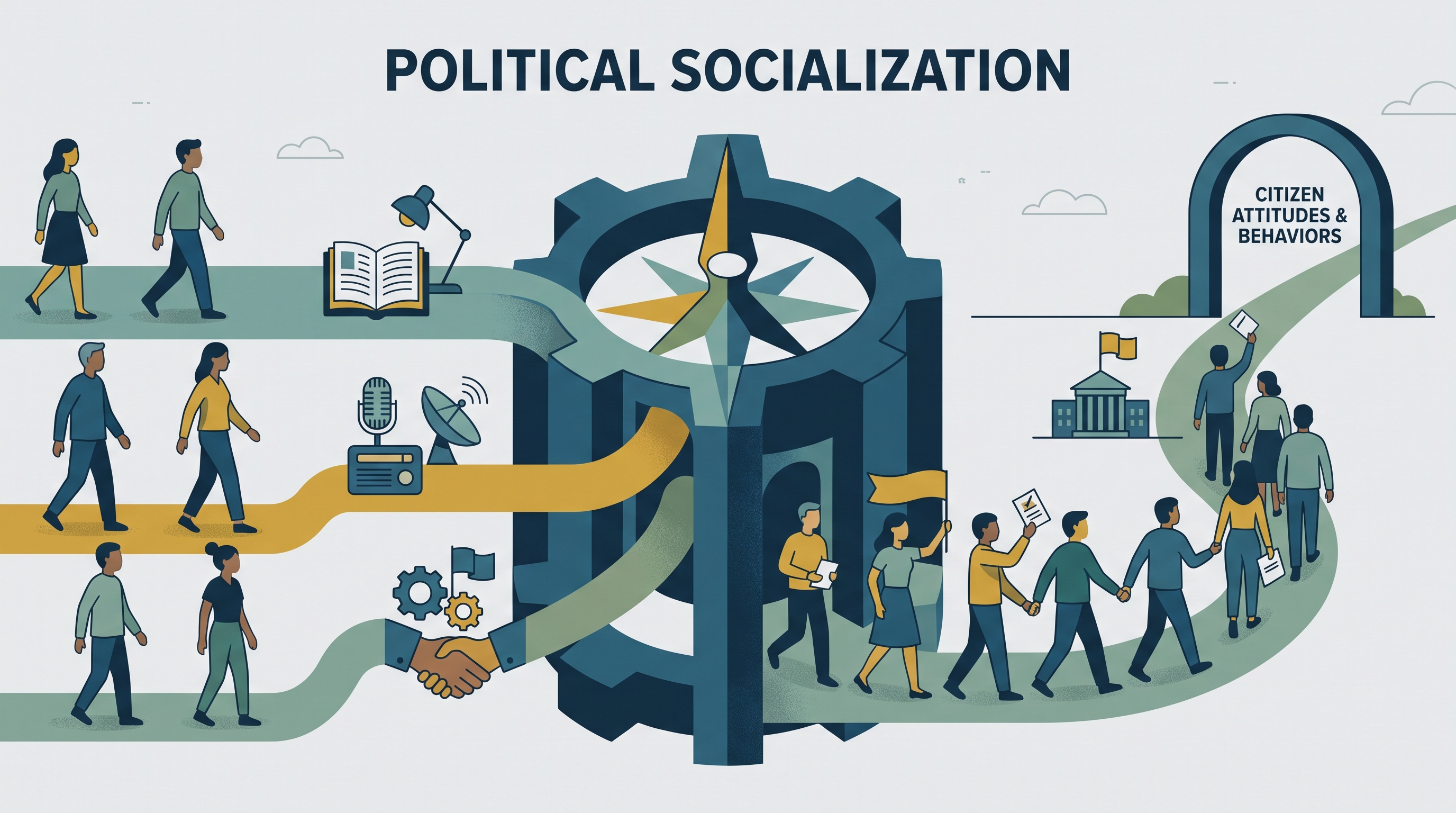
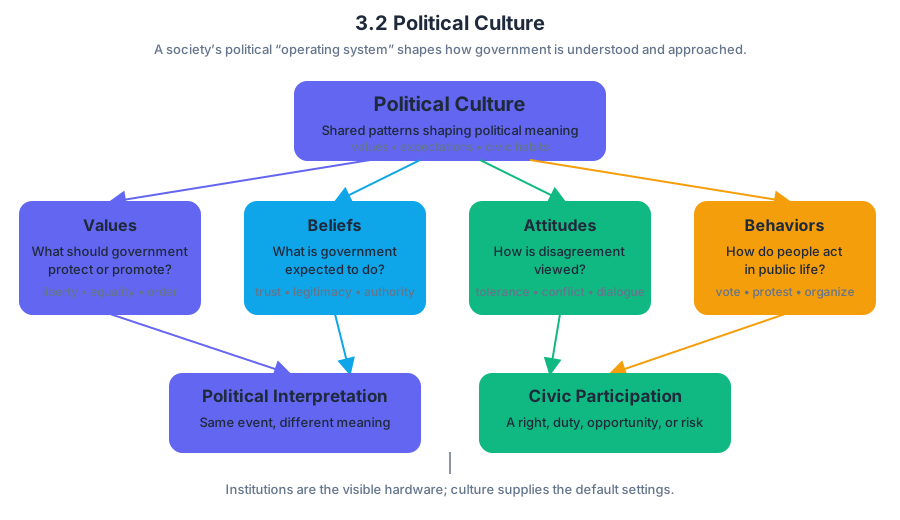
3.3 Political Ideologies
Key concepts: Political platforms · Political ideologies · Social movements · Political parties · Political tactics · Protests · Legislative processes · Political change
Political ideologies turn broad beliefs about society and government into political action: they help parties decide what policies to support, while social movements pressure institutions from outside them.
3.3 Political Ideologies
Political ideologies turn broad beliefs about society and government into political action: they help parties decide what policies to support, while social movements pressure institutions from outside them.
Political ideology is an organized set of ideas about how political, economic, and social life should be arranged.
An ideology is more than a personal opinion. It connects goals to explanations and strategies: What is wrong? What should government do? Who should make the decision? How quickly should change occur? A political platform is the specific set of policies a political party presents to voters; an ideology supplies the wider principles that make those policies seem coherent.
How ideology becomes a party platform
Under Essential Knowledge 3.3.A.1, political parties are associated with platforms or ideologies. For example, a market-oriented party might emphasize private enterprise, lower taxes, and limited economic regulation. A socialist-oriented party might support stronger labor protections, expanded public services, and greater redistribution of wealth. The contrast is not merely a difference in policy preferences: each platform reflects a different answer to the question of how resources and responsibilities should be distributed.
The same ideology can shape both a party’s policy position and its political tactic. A market-oriented party may seek tax reductions through legislation and argue that economic freedom encourages investment; a socialist-oriented party may seek higher taxes on wealth and expanded public programs through legislation and argue that public authority should reduce inequality. Neither example predicts every policy a real party will adopt, because parties also respond to voters, institutions, crises, and coalition pressures.
Parties and social movements: two routes to change
A political party is a formal organization that seeks to win elections and exercise government power. A social movement is a more informal organization of people pursuing social or political change around a particular cause or issue. A movement may endorse a candidate, but a party is the organization that formally selects candidates and builds a broad governing platform.
The central difference is tactical. Social movements may use unconventional tactics, such as protests, rallies, boycotts, civil disobedience, or—sometimes—violence. Political parties rely more heavily on conventional methods, especially elections, coalition-building, legislative bargaining, and executive policymaking.
| Organization | Main objective | Typical policy scope | Common methods |
|---|---|---|---|
| Social movement | Promote change around a cause or issue | Often narrower or more focused | Protests, demonstrations, lobbying, endorsements |
| Political party | Win elections and govern | Broad platform or ideology | Campaigns, candidate selection, legislation, voting |
The distinction is not absolute. A movement can lobby officials or support candidates, and a party can organize demonstrations. The useful comparison is which method is more central: movements generally apply pressure from outside formal institutions, whereas parties generally seek control of those institutions.
Legislative processes: how demands become policy
A legislative process is the institutional route through which a policy proposal becomes law. A bill is introduced, referred for consideration, debated, amended, and voted on; if approved by the required legislative chambers and executive authority, it is enacted and implemented.
This process explains why parties use conventional tactics. A party converts an ideological goal into bill language, persuades legislators or coalition partners, negotiates amendments, wins votes, and secures enactment. A social movement can affect every stage indirectly: protests may place an issue on the agenda, public demonstrations may increase electoral pressure, and lobbying may persuade officials to introduce or revise a bill.
Worked example: Suppose a movement demands stronger protections against workplace discrimination. It might organize demonstrations to attract public attention, contact legislators, and endorse candidates who support the cause. A political party may then include the demand in its platform, sponsor a bill, debate its provisions, compromise over enforcement, and seek enough votes for passage. The movement supplies pressure and visibility; the party uses institutional access to pursue lawmaking.
Misconception check
Misconception: “Social movements and political parties are interchangeable.” They are not. Both can influence political change, but their organizational form, goals, and usual tactics differ. A movement does not need to win elections to influence policy, while a party normally must build electoral support and govern through formal institutions.
AP skill connection
This topic most directly develops Practice 1: Concept Application, especially defining a social movement, distinguishing it from a political party, and explaining how each affects political change. It also supports Practice 5: Argumentation, because a strong argument can connect ideology, organizational strategy, legislative action, and political outcomes. When comparing countries, Practice 2: Country Comparison requires identifying a meaningful similarity or difference rather than merely naming two examples; Practice 4: Source Analysis may require inferring an ideology or tactic from a speech, platform, or description of protest activity.
Retrieval check
A movement stages rallies, contacts legislators, and endorses a candidate who supports its cause. The candidate’s party introduces a bill, accepts amendments during debate, and wins a legislative vote. Which action is most clearly a conventional party tactic, and how did the movement contribute to the policy change? The party’s introduction, negotiation, and passage of the bill are conventional legislative tactics; the movement contributed by creating public pressure, lobbying, and mobilizing electoral support.
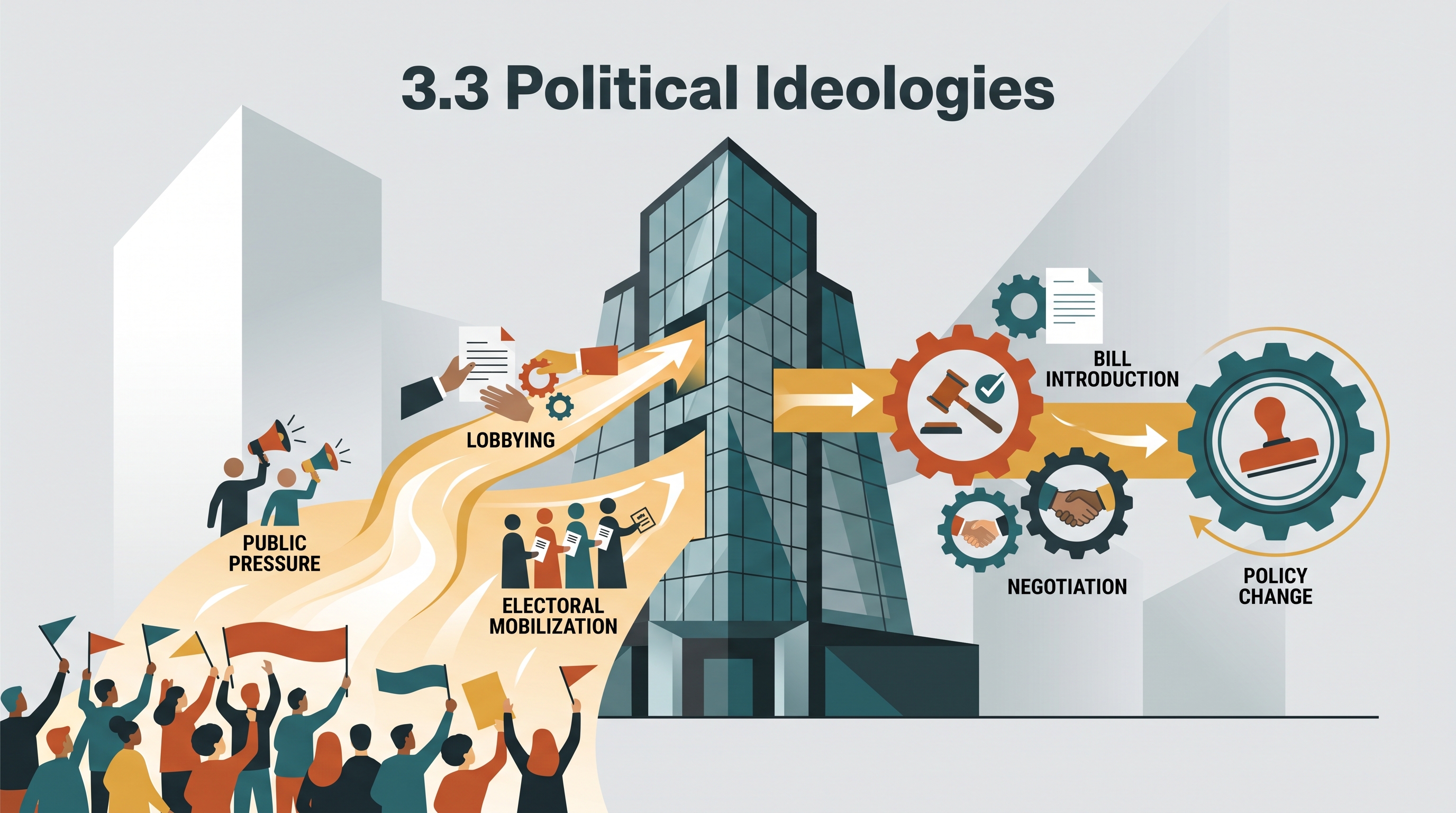
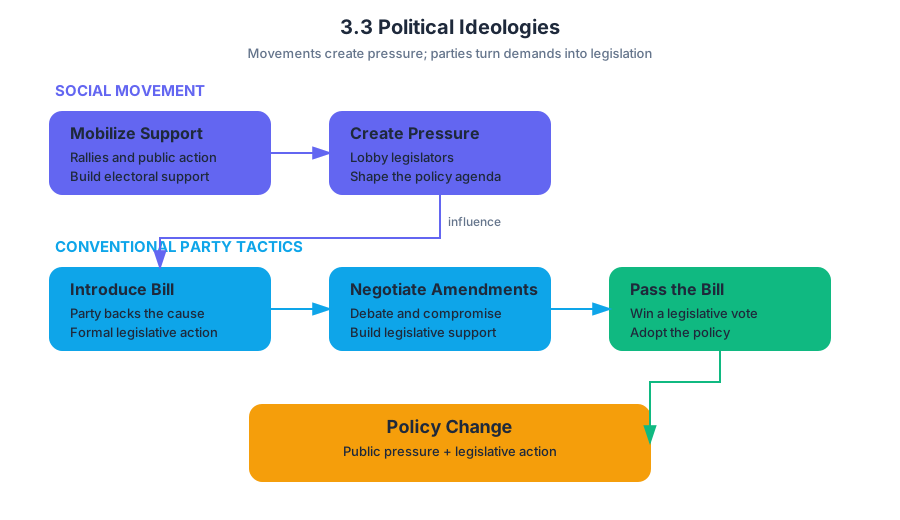
3.4 Political Values and Beliefs
Key concepts: Political culture · Political values and beliefs · Political ideology · Tension between social order and individual liberty · State–citizen relationships · Citizen control of government policymaking · Political socialization · Rule of law · Civil society and democratization · Polling-data analysis of political attitudes
A government can protect individual freedom, enforce social order, or attempt both—but citizens’ political culture determines what they expect that balance to look like. Building on the ideological commitments examined earlier, political culture develops when those commitments shape citizens’ expectations,…
3.4 Political Values and Beliefs
A government can protect individual freedom, enforce social order, or attempt both—but citizens’ political culture determines what they expect that balance to look like. Building on the ideological commitments examined earlier, political culture develops when those commitments shape citizens’ expectations, behavior, and judgments about legitimate state action.
IEF-1 — Enduring Understanding: Political culture, including core beliefs and values that address the tension between order and liberty, shapes the relationship between a state and its citizens.
Political culture as a political “operating system”
Political culture is the collective attitudes, values, beliefs, and norms of behavior held by citizens within a political system. It is not simply whether people like or dislike a particular leader. It establishes deeper expectations: Who should exercise power? What limits should apply to government? How much authority should citizens have over policymaking?
IEF-1.C.1 — Essential Knowledge: Political culture includes the core beliefs and values that address the tension between social order and individual liberty. Social order means stability, security, and predictable rules; individual liberty means freedom from unjustified government restrictions. Every political system must manage this tension, even when its citizens disagree about the correct balance.
A useful comparison is to imagine two societies responding to a public-security threat:
- A society that places greater weight on order may accept expanded surveillance, strict public regulations, or limits on protest if these measures appear to prevent disorder.
- A society that places greater weight on liberty may demand stronger protections for speech, privacy, assembly, and opposition—even when those protections make government responses slower or less uniform.
Neither preference automatically identifies a regime as democratic or authoritarian. The analytical question is how political values shape expectations about the legitimate exercise of power and whether institutions actually honor those expectations.
State–citizen relationships
IEF-1.C — Learning Objective: Explain how political culture relates to citizen behavior and the role of the state.
Political culture shapes the relationship between the state and its citizens in two directions. Citizens’ values influence what they demand from government, while government institutions reinforce—or violate—the norms citizens have learned to expect. Political values therefore affect voting behavior, public-policy preferences, trust in institutions, and willingness to accept government authority.
The rule of law illustrates this relationship. It means that laws apply to government officials and ordinary citizens alike; the state is limited by the same legal rules that govern the population. If citizens believe officials are above the law, elections or courts may appear performative rather than legitimate. If citizens expect impartial enforcement, corruption or arbitrary punishment can produce especially sharp losses of trust.
Civil society—nongovernmental organizations, business and professional associations, religious groups, and other voluntary organizations—can mediate this relationship. These groups give citizens ways to organize, communicate demands, monitor officials, and press for reforms, making civil society an important potential agent of democratization.
Transmission and political behavior
Political culture is transmitted through political socialization, the process by which people develop political values, beliefs, attitudes, and behaviors. Families may teach views about authority; schools may model participation or obedience; peers and media may normalize protest or political cynicism; religious institutions may shape ideas about justice, community, and the state.
Worked contextual example: interpreting a policy preference
Suppose polling data show that younger citizens in Country A strongly support freedom of expression but also favor strict penalties for public disorder. A careful conclusion is not that the respondents are “contradictory.” Their answers suggest a political culture attempting to balance liberty with order: expressive freedoms are valued, but citizens also expect the state to preserve security.
To analyze the pattern, compare multiple variables—such as age, education, urban or rural residence, and trust in government. If highly educated urban respondents support free expression at higher rates, that pattern may indicate that social location influences political values. It does not, by itself, prove that education caused the belief. A comparison with another course country can reveal whether the pattern is country-specific or more widespread.
Misconception check
Misconception: political culture is identical to political ideology. Political ideology is a set of values and beliefs about government, policy, or politics; political culture is broader. It includes ideologies, but also shared norms, expectations, historical memories, socialization patterns, and assumptions about citizen–state relations.
Misconception: strong government means no liberty. A state may claim that restrictions protect liberty by producing security, while citizens may judge those restrictions excessive. AP analysis requires identifying the competing values and explaining how they shape behavior or policy—not labeling one side automatically “correct.”
Retrieval and interpretation check
A poll finds that citizens who report high trust in courts are also more likely to support government enforcement of environmental regulations. What should a strong interpretation identify? It should connect the pattern to political culture: confidence in lawful, impartial institutions may increase citizens’ willingness to accept state action. The data show an association, however—not definite proof that trust in courts caused support for regulation. This applies Concept Application and Data Analysis, especially identifying patterns, comparing variables, and drawing evidence-based conclusions.
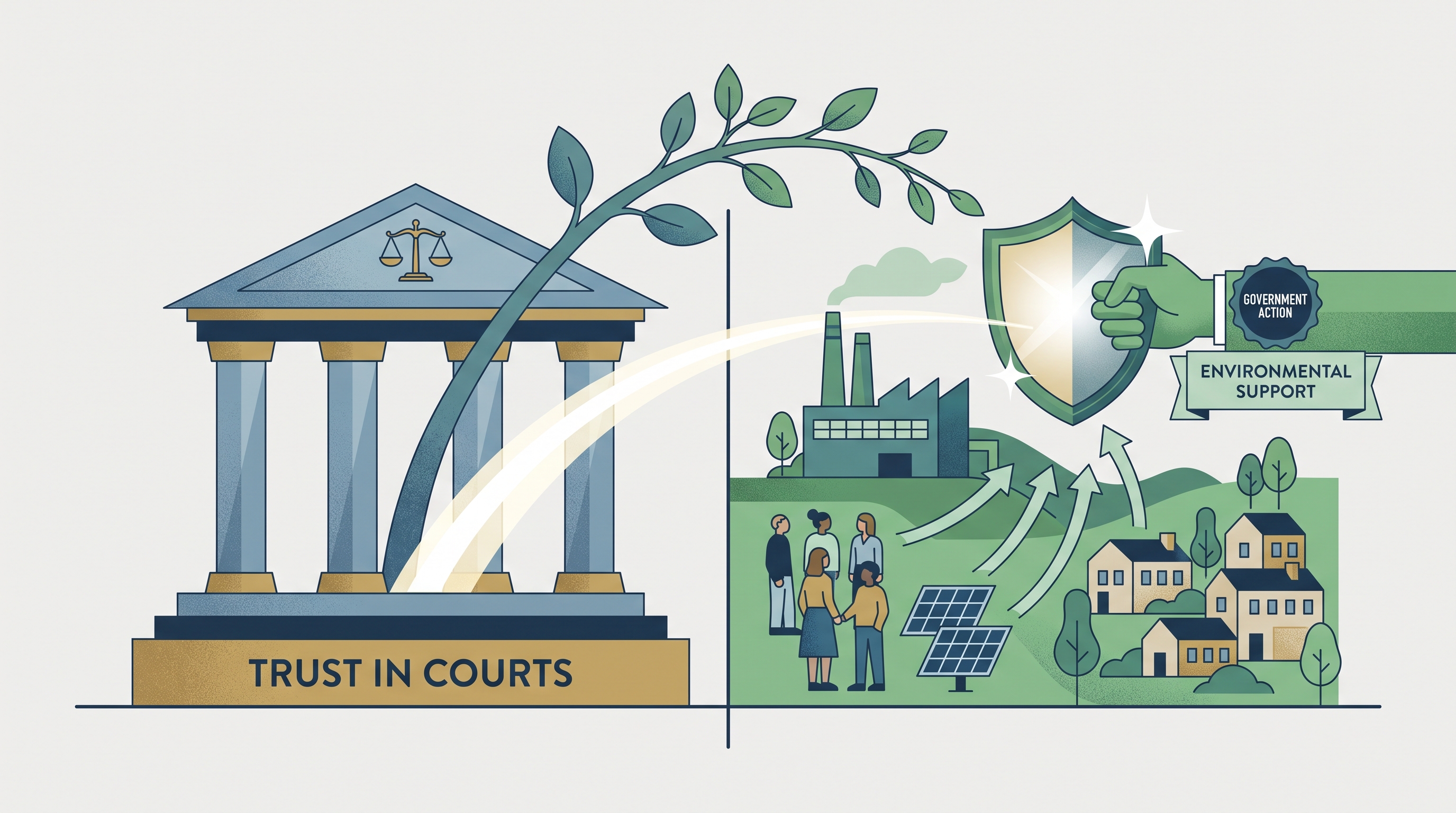
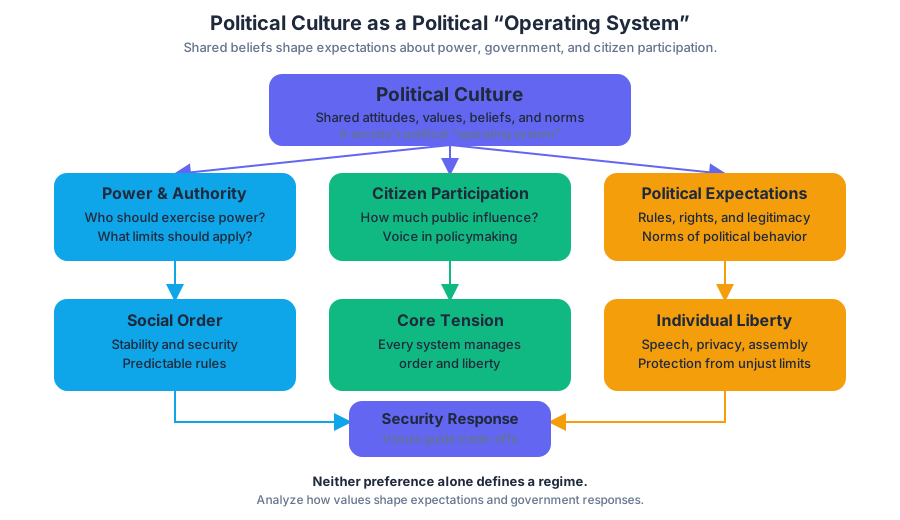
3.5 Nature and Role of Political Participation
Key concepts: Nature and role of political participation · Conventional political participation · Violent political behavior · Political participation under authoritarian regimes · Government management and limitation of citizen participation · Environmentalism as a political value linked to participation · Social and economic equality as political values linked to participation · Applying pressure on governments · Using data to analyze political systems, principles, institutions, processes, policies, and behaviors
Political participation is the set of actions through which citizens try to influence government decisions, public policies, or the distribution of political power. It can look routine—casting a ballot, joining a party, contacting a representative—or confrontational, including protest and, when legal avenues seem…
3.5 Nature and Role of Political Participation
Political participation is the set of actions through which citizens try to influence government decisions, public policies, or the distribution of political power. It can look routine—casting a ballot, joining a party, contacting a representative—or confrontational, including protest and, when legal avenues seem closed, violent political behavior.
Investigative question: When does citizen participation strengthen a political system, and when does the regime manage, restrict, or provoke participation?
A spectrum of participation
Political participation is not a single activity. It ranges from formal participation inside established institutions to informal collective action outside them.
| Form of participation | Typical action | Political purpose |
|---|---|---|
| Formal participation | Voting in elections, joining a political party, contacting officials | Select leaders, communicate preferences, or influence policy |
| Conventional participation | Campaigning, petitioning, attending lawful demonstrations, lobbying | Apply pressure while using recognized political channels |
| Collective civic participation | Working through civil society organizations or social movements | Represent interests and mobilize citizens |
| Violent political behavior | Rioting, insurgency, or political violence | Challenge authority when other avenues appear ineffective or unavailable |
Formal political participation can serve several regime purposes. Elections may enhance legitimacy, gather information about public preferences, provide a “safety valve” for dissatisfaction, or create a limited check on government power. However, the existence of elections does not automatically mean that citizens can meaningfully change policy or leaders.
Why conventional channels matter
Conventional political participation uses methods that a political system officially recognizes or generally tolerates. Voting, campaigning, lobbying, petitioning, and peaceful protest allow citizens to communicate demands without directly rejecting the political order.
The connection between conventional and violent participation is conditional, not automatic. Citizens may engage in violent political behavior when they believe conventional options are ineffective or unavailable—for example, when elections are manipulated, opposition parties are banned, peaceful demonstrations are violently suppressed, or officials refuse to respond to repeated demands.
Worked contextual example
Imagine a government that permits elections but disqualifies serious opposition candidates, controls major media outlets, and blocks peaceful demonstrations. A citizen who votes has used a conventional channel, but if every available channel produces no policy response, some citizens may conclude that conventional participation cannot work. The analytical chain is:
$$ \text{restricted conventional access} \rightarrow \text{political frustration} \rightarrow \text{pressure outside formal institutions} $$
This pattern does not mean that repression inevitably causes violence. Economic conditions, leadership, social cleavages, state capacity, and beliefs about political effectiveness also matter. The precise claim is narrower: ineffective or unavailable conventional channels make violent political behavior more likely.
Participation under authoritarian regimes
Authoritarian regimes manage and limit citizen participation to a much greater extent than less authoritarian regimes. They may permit carefully controlled elections, state-approved organizations, patriotic demonstrations, or online consultation while censoring criticism, monitoring activists, requiring organizations to register, or punishing unauthorized collective action.
This creates a crucial distinction between participation and political influence. A government can encourage citizens to attend rallies or vote while preventing them from freely choosing leaders, organizing opposition, or changing policy. Participation may therefore strengthen regime legitimacy without substantially increasing citizen control.
Misconception check — “Authoritarian means no participation.”
Authoritarian systems often allow participation, but they shape its timing, acceptable topics, organizational forms, and consequences. The key comparative question is not simply whether citizens participate, but whether participation is autonomous, competitive, and capable of constraining authority.
Participation and political values
Political participation can also apply pressure concerning environmental issues and social and economic equality. Citizens may organize around pollution, climate policy, land use, unequal access to resources, labor conditions, or distribution of wealth. Environmentalism therefore operates as a political value when it becomes a demand directed at government action rather than remaining only a personal preference.
For example, residents who petition a ministry to reduce industrial pollution, organize a demonstration against a proposed pipeline, or lobby legislators for environmental regulation are participating politically because they are attempting to alter public policy. Similarly, a movement demanding expanded social services is participating when it pressures government to reduce social or economic inequality.
AP skill: reading participation data
3.D — Explain what the data implies or illustrates about political systems, principles, institutions, processes, policies, and behaviors. When interpreting participation data, identify the pattern first, then connect it to a political mechanism. A graph showing high turnout but low opposition success may illustrate managed participation rather than strong democratic competition; a graph showing declining turnout may suggest disengagement, barriers to participation, or declining trust, but it does not prove one cause by itself.
A strong interpretation separates observation from inference:
- Describe the evidence: “Turnout is high, while independent opposition representation remains low.”
- Explain the implication: “This pattern may indicate that the regime encourages formal participation but limits meaningful competition.”
- State the caveat: “Turnout alone cannot establish whether participation is free or influential.”
Retrieval check: A government permits voting but bans unsanctioned organizations and censors criticism. Is this evidence that citizens do not participate? Explain why the better answer is that participation exists but is managed and politically constrained.
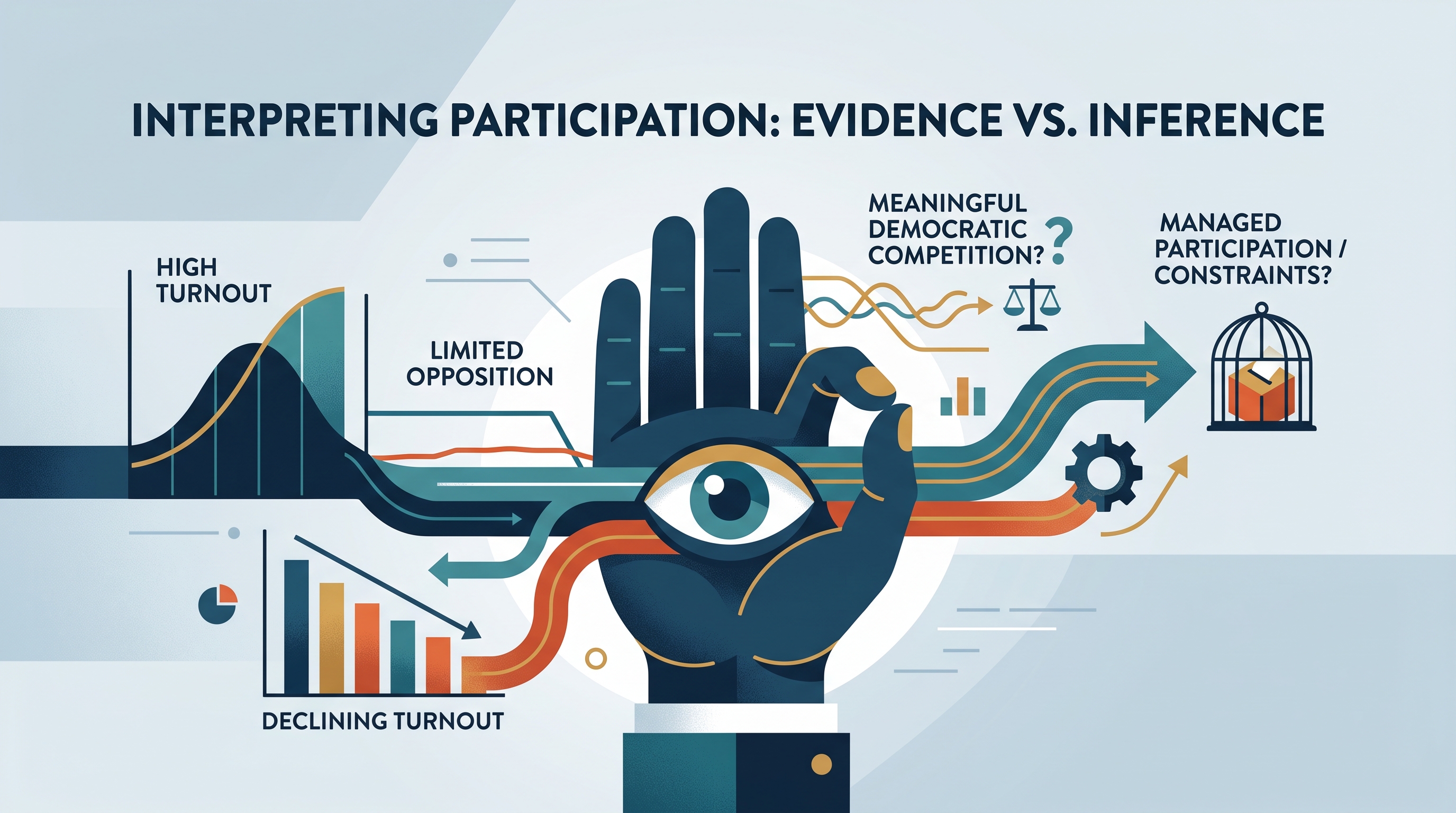
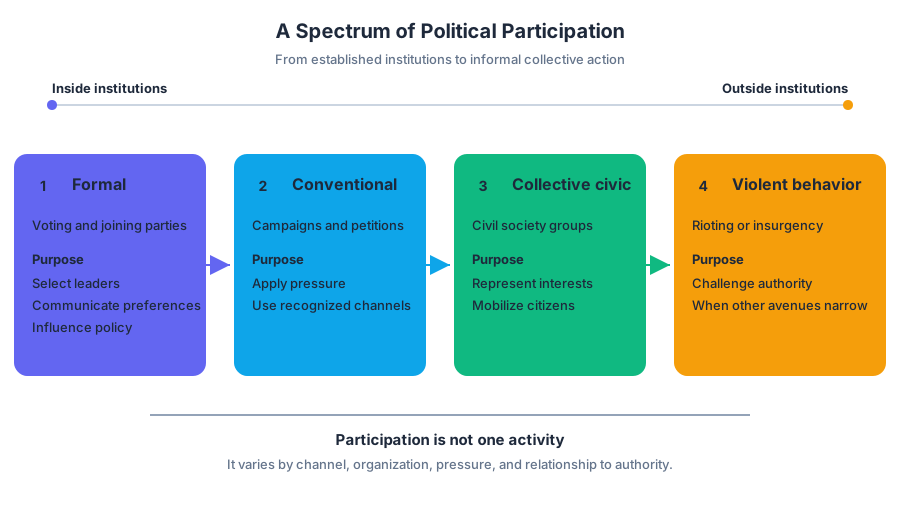
3.6 Forces that Impact Political Participation
Key concepts: Political participation by individuals and groups · State–society interactions · Population characteristics and demands shaping political patterns · Social cleavages such as ethnicity, religion, and class · Perceived legitimacy of government · Political opposition and electoral competition in authoritarian regimes · Globalization and neoliberalism as influences on political participation · Cultural influences, including Western influences, on domestic politics · Devolution and delegation of power to regional governments · Political participation as an effect of decentralization
Political participation changes when citizens decide whether the government is responsive, legitimate, and worth engaging—or when social divisions, economic pressures, and regime rules make participation easier or riskier.
3.6 Forces that Impact Political Participation
Political participation changes when citizens decide whether the government is responsive, legitimate, and worth engaging—or when social divisions, economic pressures, and regime rules make participation easier or riskier. The same population may vote, protest, organize, or remain silent depending on how the state structures political opportunity.
Learning Objective 3.6.A: Explain the factors that impact political participation. The essential knowledge for this topic is organized under DEM-3.F, with connections to LEG-1.B.5 and IEF-4.A: participation is shaped by population characteristics, state–society relations, perceived legitimacy, globalization, political opposition, and the distribution of authority within a country.
The state and society shape one another
State–society interactions are the ways governments and populations respond to one another. Citizens participate both individually—for example, by voting, contacting officials, or joining a protest—and collectively through political parties, interest groups, labor unions, religious organizations, ethnic associations, and other civil-society groups.
A government does not face a politically uniform population. Population characteristics and demands influence political patterns: a country with large religious, ethnic, linguistic, regional, or class divisions may experience different forms of participation from a more socially homogeneous country. These divisions are called social cleavages—important lines of difference within a population.
The political importance of a cleavage depends on whether institutions, leaders, or policies activate it. Ethnicity, religion, or class may remain mostly private identities, but a cleavage becomes politically significant when citizens organize around it, parties campaign through it, or governments distribute resources in ways that favor one group.
Worked example: when a cleavage becomes political
Imagine a country with two major religious communities. If both communities receive equal access to schools, public employment, and political representation, religious identity may not dominate elections. If the government consistently favors one community, the other may respond through protests, opposition organizations, demands for regional autonomy, or support for a different party.
The causal chain is:
- Population characteristic: religious difference exists.
- Government action: public benefits are distributed unevenly.
- Group response: the disadvantaged community organizes.
- Political pattern: participation becomes more religiously polarized.
- State–society consequence: legitimacy may decline if the government appears unfair.
Legitimacy changes the willingness to participate
Perceived legitimacy is the belief that a government has the rightful authority to rule. Legitimacy affects participation in two directions: citizens may participate because they trust institutions to respond, or they may participate against the government because they believe it has lost its right to rule.
High perceived legitimacy can encourage voting, civic association, and cooperation with public policies. Low perceived legitimacy can produce apathy, protest, civil disobedience, or support for opposition movements. However, low participation does not automatically prove legitimacy: people may be satisfied, politically powerless, afraid of repression, or excluded from elections.
Key distinction: Participation answers what citizens do. Legitimacy answers whether citizens regard authority as rightful. A protest can indicate active participation and declining legitimacy at the same time.
Authoritarian regimes and controlled competition
Regime type strongly influences the available forms of participation. In authoritarian regimes, few or no opposition candidates may be allowed to run for office. When opposition candidates are permitted, they advocate views that differ from those of the controlling party or elite, but censorship, surveillance, registration requirements, or electoral restrictions may limit their effectiveness.
An election therefore does not automatically demonstrate democratic participation. A ruling party may use elections to measure public opinion, distribute patronage, create an appearance of legitimacy, or identify dissatisfied regions while preventing genuine competition. Citizens may participate strategically—supporting an opposition candidate, boycotting an election, or using the campaign period to publicize grievances.
Globalization, neoliberalism, and participation
Globalization increases the movement of goods, investment, ideas, technology, and people across borders. It can expand political demands by exposing citizens to new cultural influences—often Western—and by connecting domestic activists to international organizations and information networks.
Neoliberalism, an approach emphasizing market competition, privatization, reduced regulation, and limited government economic intervention, can also provoke conflict. Economic reforms may attract investment and increase efficiency, but they can place new demands on governments when workers lose protections, prices rise, or regional inequalities widen. Citizens may then organize against the policies or demand compensation from the state.
Devolution: participation closer to home
Devolution is the transfer of authority from a central government to regional or local governments. It can increase participation because decisions occur closer to citizens, make policies more responsive to local needs, encourage policy innovation, improve representation for religious, ethnic, or minority groups, and check central power.
Devolution is not automatically stabilizing. Regional governments may create contradictory policies, implement programs unevenly, compete for resources, or intensify ethnic and local tensions. If citizens blame fragmented authority for poor outcomes, devolution can weaken legitimacy and make social, political, and economic problems harder to resolve.
Misconception check: Devolution is not the same as independence. A devolved region receives authority within the state; it does not necessarily possess sovereignty or the legal right to leave the country.
AP skill application
This topic is especially suited to Practice 1: Concept Application—1.A Define and describe political concepts and processes and 1.B Explain how political concepts and processes relate to one another—because a strong response must connect legitimacy, cleavages, globalization, devolution, and participation rather than merely define them.
It also develops Practice 2: Country Comparison, especially 2.A Describe similarities and differences in political systems and 2.B Explain how political processes relate to political systems. Practice 5: Argumentation—5.A Make a claim with evidence, 5.B Support a claim with evidence, and 5.C Use reasoning to organize and analyze evidence—is required when judging whether a policy such as devolution increases or decreases participation.
Retrieval check
A government permits opposition candidates but restricts campaign media and arrests organizers after demonstrations. Identify one way regime type affects participation and explain how the restrictions could affect perceived legitimacy. A complete answer should connect controlled electoral competition to limited participation and then to a possible decline in the government’s perceived right to rule.

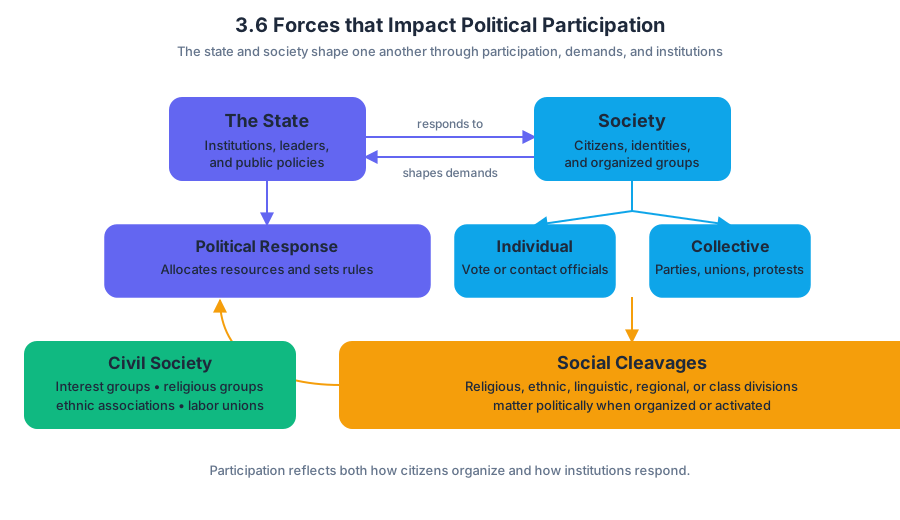
3.7 Civil Rights and Civil Liberties
Key concepts: Civil rights · Civil liberties · Government protection and restriction of liberties · Democratization · Democratic consolidation · Authoritarian and democratic regime placement · Media constraints · Political participation and voting access · Mass political protests and social movements · Rule of law and judicial protection
A government can call an election while restricting speech, limit protests while protecting due process, or expand voting while weakening press freedom. The key question is not whether a regime imposes any limits, but which rights it protects, which liberties it restricts, and how extensively it controls political…
3.7 Civil Rights and Civil Liberties
A government can call an election while restricting speech, limit protests while protecting due process, or expand voting while weakening press freedom. The key question is not whether a regime imposes any limits, but which rights it protects, which liberties it restricts, and how extensively it controls political participation.
Rights, liberties, and regime power
Civil rights are protections that require government to treat people equally and prevent discrimination. Civil liberties are freedoms from unjustified government interference, such as freedom of expression, association, press activity, and peaceful assembly.
Key distinction: Civil rights concern equal treatment; civil liberties concern protected individual freedoms.
Both democratic and authoritarian regimes regulate political behavior. A democratic government may require voter identification, limit campaign financing, or prohibit violent protests. An authoritarian government may impose similar formal rules but usually adds broader censorship, surveillance, repression, and restrictions on opposition organizations.
The difference is therefore one of scale and political purpose. Democratic regimes generally accept criticism and organized opposition as legitimate parts of politics, even when they restrict particular actions. Authoritarian regimes value public order and regime control more heavily than individual liberties and civil rights, so they tolerate mass political protests and movements far less (DEM-1.B.4).
A useful comparison is a volume control:
- Democratic regime: restrictions are usually narrower, publicly justified, and subject to legal challenge.
- Authoritarian regime: restrictions are broader, less accountable, and more likely to target opposition or independent organizations.
- Both regimes: may regulate voting, media, and public demonstrations.
A common misconception is that democracy means unlimited freedom. It does not. Democratic regimes may restrict voting access or prohibit disruptive and violent protests while still protecting substantially more civil liberties than authoritarian regimes (DEM-1.B.3). The stronger comparison asks whether restrictions are limited and contestable or systematic and politically coercive.
Democratization is uneven
Democratization is the transition from an authoritarian regime to a democratic regime. Its goals include more competitive, fair, and transparent elections; wider participation in policymaking; universal adult suffrage; greater governmental transparency; protected civil rights and liberties; equal treatment; and the rule of law (PAU-1.C.1).
Democratization is not a one-way staircase. It can stall, producing partial reforms without deeper accountability, or be reversed, as governments weaken election rules, restrict civil liberties, intimidate journalists, or limit opposition participation. Election reform and civil-liberties protection can therefore support democratization, while exclusionary election rules and repression can impede it.
Worked example: interpreting press freedom. Suppose a country holds increasingly competitive elections but its press-freedom score falls over several years. The correct conclusion is not automatically “the country is authoritarian.” Instead, the evidence suggests that democratization is uneven, stalled, or regressing. Mexico illustrates this reasoning: competitive elections may coexist with declining press freedom when state or non-state actors, including criminal organizations, undermine journalists.
In a data-based response, build the reasoning in three steps:
- Identify the trend: press freedom declines over time.
- Connect the measure to the concept: weaker press freedom signals reduced governmental transparency or civil-liberties protection.
- Draw a qualified conclusion: democratization may be incomplete, stalled, or reversed rather than wholly absent.
Democratic consolidation
Democratic consolidation is the process through which a democratic regime matures and becomes more durable. Consolidation depends on reliable election rules, separation of powers, and protection of civil liberties (PAU-1.C.2).
These institutions reinforce one another. Fair election rules allow citizens to replace leaders; separation of powers prevents one institution from monopolizing authority; and protected liberties allow citizens, journalists, parties, and courts to criticize government. Without these safeguards, a country may retain democratic labels while becoming increasingly illiberal.
The United Kingdom as a rule-of-law example
The United Kingdom uses common law, a legal system in which judicial decisions and established precedents help enforce the rule of law. Its Supreme Court is the final court of appeals, protects human and civil rights and liberties, and rules on disputes involving devolution—the distribution of authority among the UK’s national governments.
The UK example shows that civil-liberties protection is connected to institutions, not merely official promises. Courts, legal precedent, legislative rules, and devolved governments create multiple sites at which government action can be challenged.
AP reasoning in action
This topic most directly develops Practice 1: Concept Application (CON-1) by applying civil liberties, democratization, and democratic consolidation to a country or scenario. It develops Practice 2: Country Comparison (COMP-1) when contrasting the UK’s legal protections with restrictions in authoritarian regimes, Practice 3: Data Analysis (DAT-1) when interpreting press-freedom trends, Practice 4: Source Analysis (SOUR-1) when evaluating evidence about censorship or protest, and Practice 5: Argumentation (ARG-1) when defending a claim about whether civil-liberties protections strengthen political stability.
Misconception check: A declining civil-liberties measure does not prove that every institution has become authoritarian. Strong analysis identifies the specific liberty affected, connects the change to regime power, and explains whether the broader democratization process is advancing, stalled, or reversing.
Retrieval check: A country expands voting access and judicial review but bans independent newspapers and violently suppresses peaceful demonstrations. Is democratization complete? Explain why the best answer is no: some democratic features have expanded, but restrictions on press freedom and peaceful participation show incomplete or possibly reversing democratization.
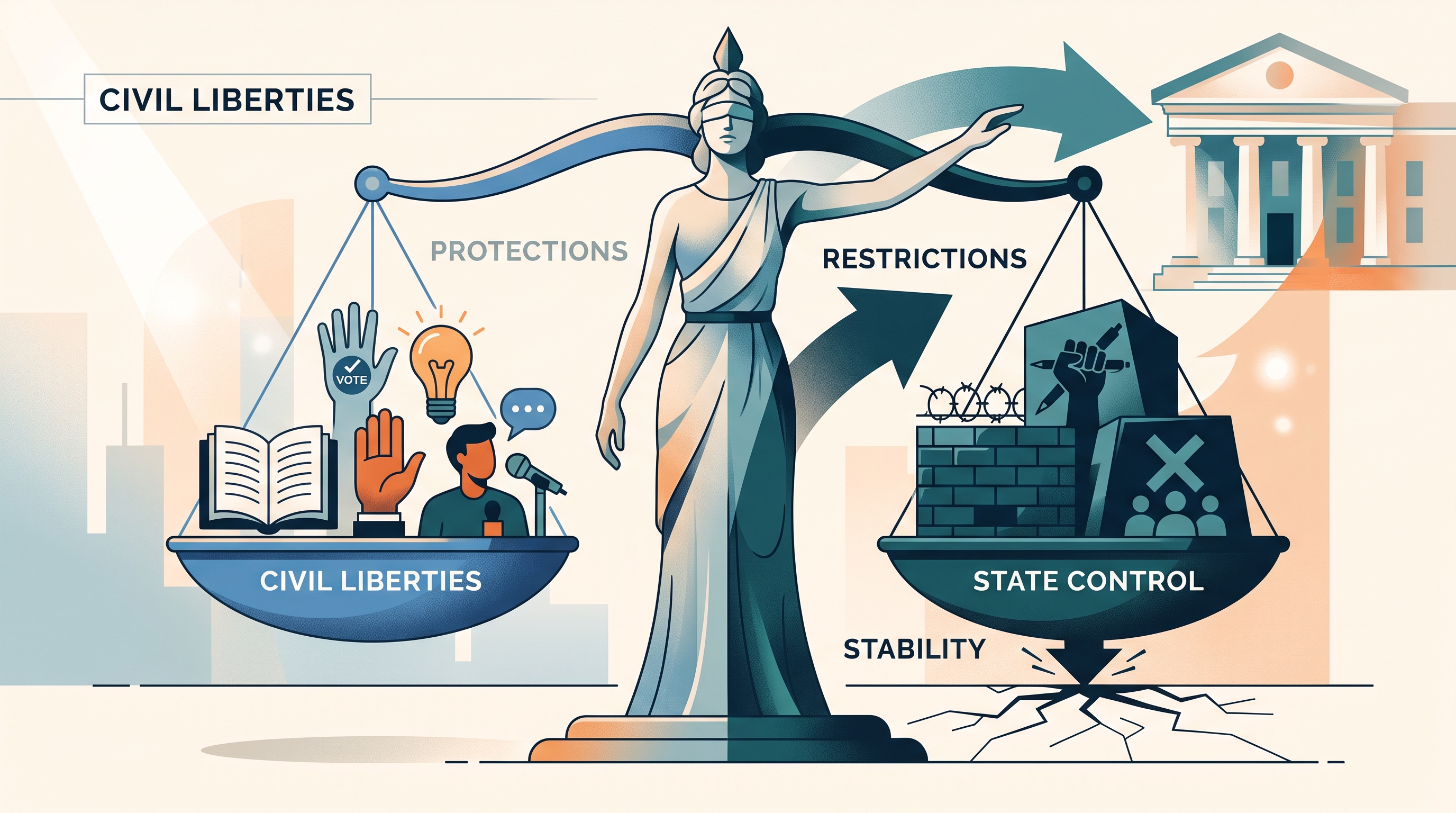
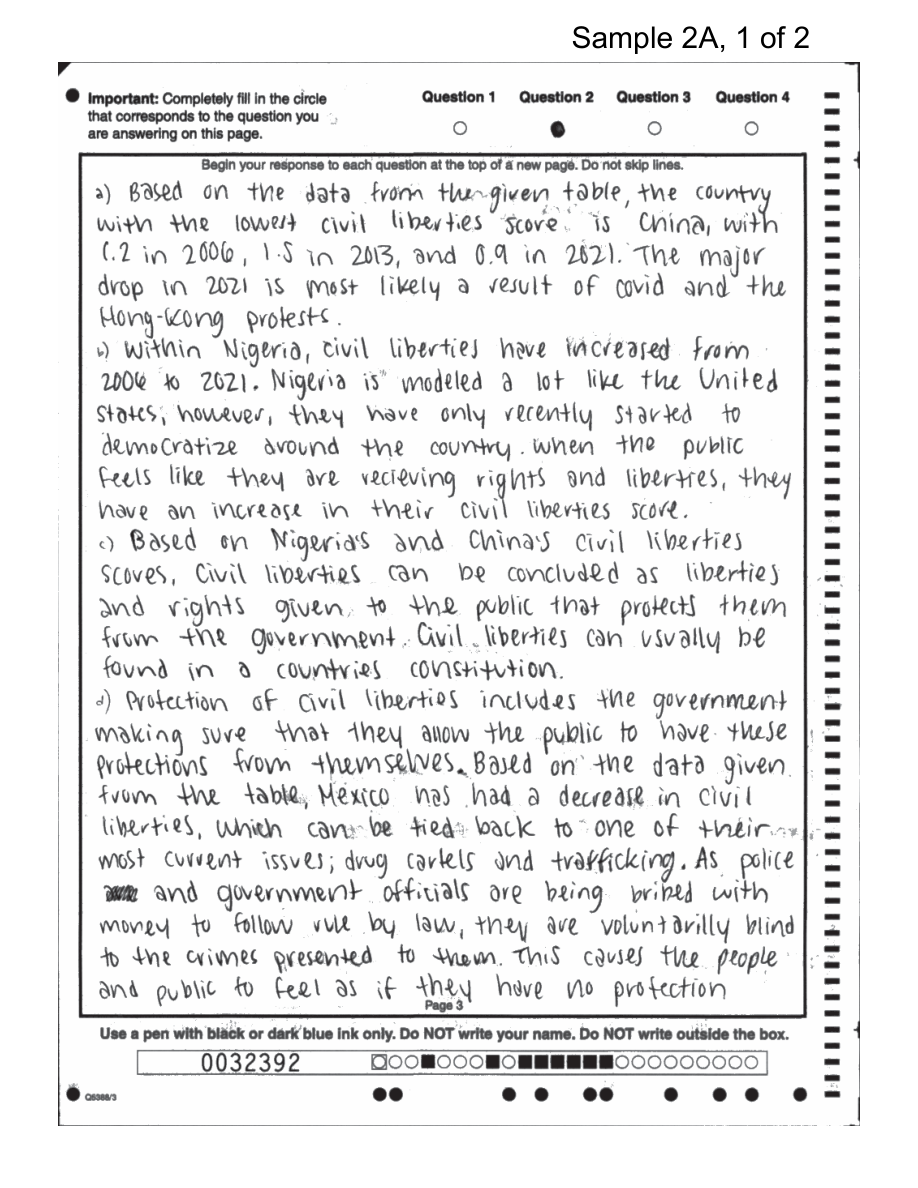

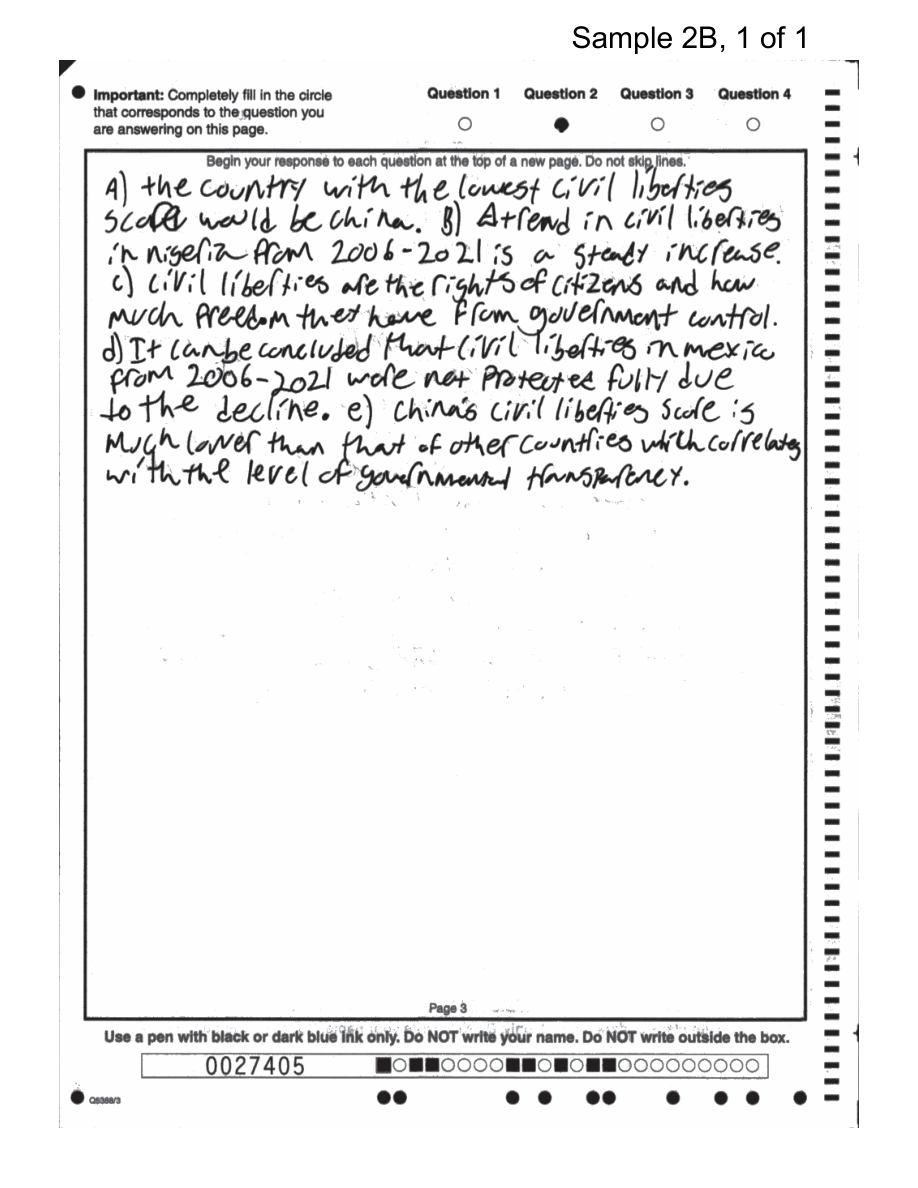

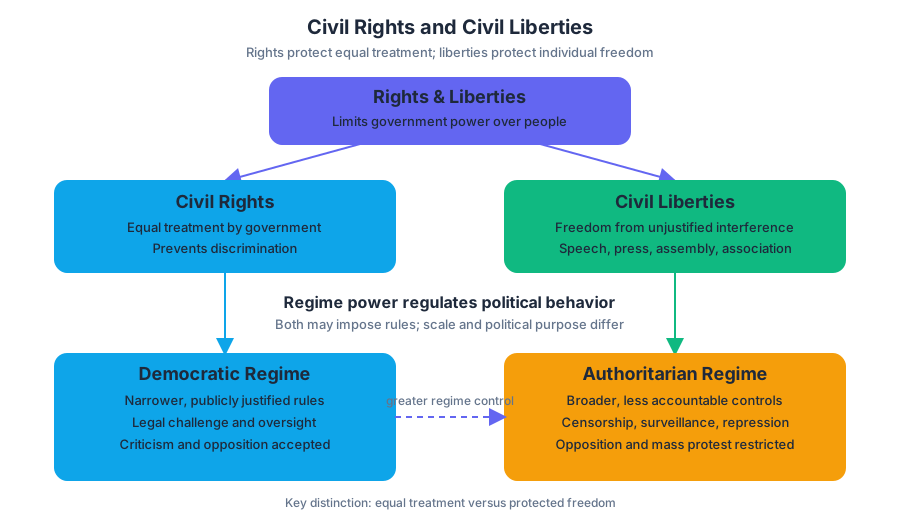
3.8 Political and Social Cleavages
Key concepts: Social cleavages · Political cleavages · Class, ethnicity, religion, and territory as bases of cleavages · Separatist movements · Autonomy movements · Ethnic and regional divisions · Multinational states · Political stability · Long-term regime stability · Comparative analysis of cleavages across countries
A country can have one government, one territory, and one legal citizenship while containing several politically meaningful communities with competing interests. These internal divisions are social cleavages: durable divisions within society that structure how groups understand their interests, organize…
3.8 Political and Social Cleavages
A country can have one government, one territory, and one legal citizenship while containing several politically meaningful communities with competing interests. These internal divisions are social cleavages: durable divisions within society that structure how groups understand their interests, organize politically, and relate to the state.
Social cleavages are internal divisions based on factors such as class, ethnicity, religion, or territory.
A political cleavage is a social division that becomes politically relevant—for example, when an ethnic, religious, regional, or class distinction shapes voting, party competition, demands for resources, or support for and opposition to the government. Not every difference in society is a cleavage. A difference becomes politically significant when it organizes conflict, cooperation, representation, or demands on political institutions.
The main bases of cleavage
Cleavages commonly rest on four overlapping foundations:
| Basis | Political question it can generate | Comparative illustration |
|---|---|---|
| Class | Who receives wealth, services, or economic opportunity? | Conflict between economically advantaged and disadvantaged groups |
| Ethnicity | Which cultural or linguistic group controls the state or public resources? | Han-majority and minority relations in China |
| Religion | Which religious identity or interpretation should influence public authority? | Shi’a majority, Sunni Muslims, and other religions in Iran |
| Territory | Should different regions receive different resources or governing powers? | Regional development differences in China and Mexico |
The categories often reinforce one another. A regional minority may also differ ethnically, linguistically, economically, or religiously from the national majority. That overlap can make a cleavage more politically powerful because a single dispute—such as unequal development—may be experienced simultaneously as economic exclusion, ethnic discrimination, and regional marginalization.
Country comparison: where cleavages appear
In China, ethnic and regional cleavages divide the majority Han population from at least $55$ recognized ethnic minorities, including the Uyghurs in the northwest and Tibetans in the southwest. China also contains regional divisions between areas that have developed at different rates. The political issue is therefore not only identity; it also concerns territory, development, representation, and the distribution of state resources.
In Iran, religious cleavages exist between the Shi’a Muslim majority and members of other religions, including Christianity, Judaism, and Zoroastrianism, as well as between Shi’a and Sunni Muslims. Ethnic cleavages also divide the majority Persian population from groups such as Azerbaijanis and Kurds. These divisions can affect how citizens perceive inclusion, authority, and the legitimacy of national political institutions.
In Mexico, ethnic divisions include differences between the Amerindian, or Indigenous, population and whites and mestizos. Regional cleavages also distinguish the more developed north from the south. However, ethnicity has played a more significant political role in Nigeria than in Mexico because Nigeria has greater diversity and politicization of ethnic and religious identities, shaped in part by different colonial histories.
Separatism versus autonomy
A separatist movement seeks independence: the creation of a separate sovereign state. An autonomy movement seeks self-government within the existing state, without necessarily demanding full independence.
Separatism = leave the state.
Autonomy = govern more of your own affairs while remaining inside the state.
Separatist movements have emerged from social cleavages in China, Iran, Nigeria, Russia, and the United Kingdom. Autonomy movements—demanding self-government rather than independence—have emerged in Mexico and the United Kingdom. The United Kingdom therefore illustrates why the distinction matters: a movement can seek greater control over regional affairs without seeking complete international sovereignty.
Why government responses affect stability
Governments can respond to cleavages through accommodation, decentralization, representation, restriction, or coercion. Accommodation may reduce conflict by recognizing group interests; coercion may suppress visible opposition without resolving the underlying division. The response affects citizen-government relations because groups judge whether the state is fair, authoritative, and legitimate.
Unresolved cleavages can produce three connected problems: conflicting interests and competition among groups and political parties; a perceived lack of governmental authority or legitimacy; and pressure for autonomy or secession. In a multinational state, these pressures can weaken long-term regime stability when citizens increasingly identify with an ethnic, religious, or regional community rather than with the state as a whole.
Worked comparative example
Suppose a regional minority believes that the national government distributes development unevenly and excludes its representatives. A strong response identifies the chain of reasoning:
- Cleavage: territorial and ethnic differences structure political interests.
- Political effect: the group demands greater representation, autonomy, or independence.
- Government response: accommodation may build trust; repression may intensify alienation.
- Stability consequence: if citizens view the government as unable or unwilling to govern fairly, legitimacy and regime stability may decline.
Misconception check — “Every diverse society is unstable.” Diversity alone does not cause instability. The key variables are the political significance of the cleavage and the government’s response. Nigeria and Mexico both contain ethnic divisions, but ethnicity has had a more significant political role in Nigeria because historical conditions produced greater diversity and stronger politicization of ethnic and religious identities.
AP skill focus and retrieval check
This topic develops Country Comparison (COMP-1) by comparing the basis and political effects of cleavages across China, Iran, Mexico, Nigeria, Russia, and the United Kingdom. It also develops Argumentation (ARG-1): a strong claim must connect evidence about a cleavage to a government response and then explain the effect on citizen-government relations or regime stability. The relevant CED identifiers are LEG-2.A, LEG-2.A.1, and LEG-2.B.5.
Retrieval check: A movement demands control over education, language, and local administration but does not seek an independent country. Is it separatist or autonomy-seeking, and why could the government’s response affect political stability?
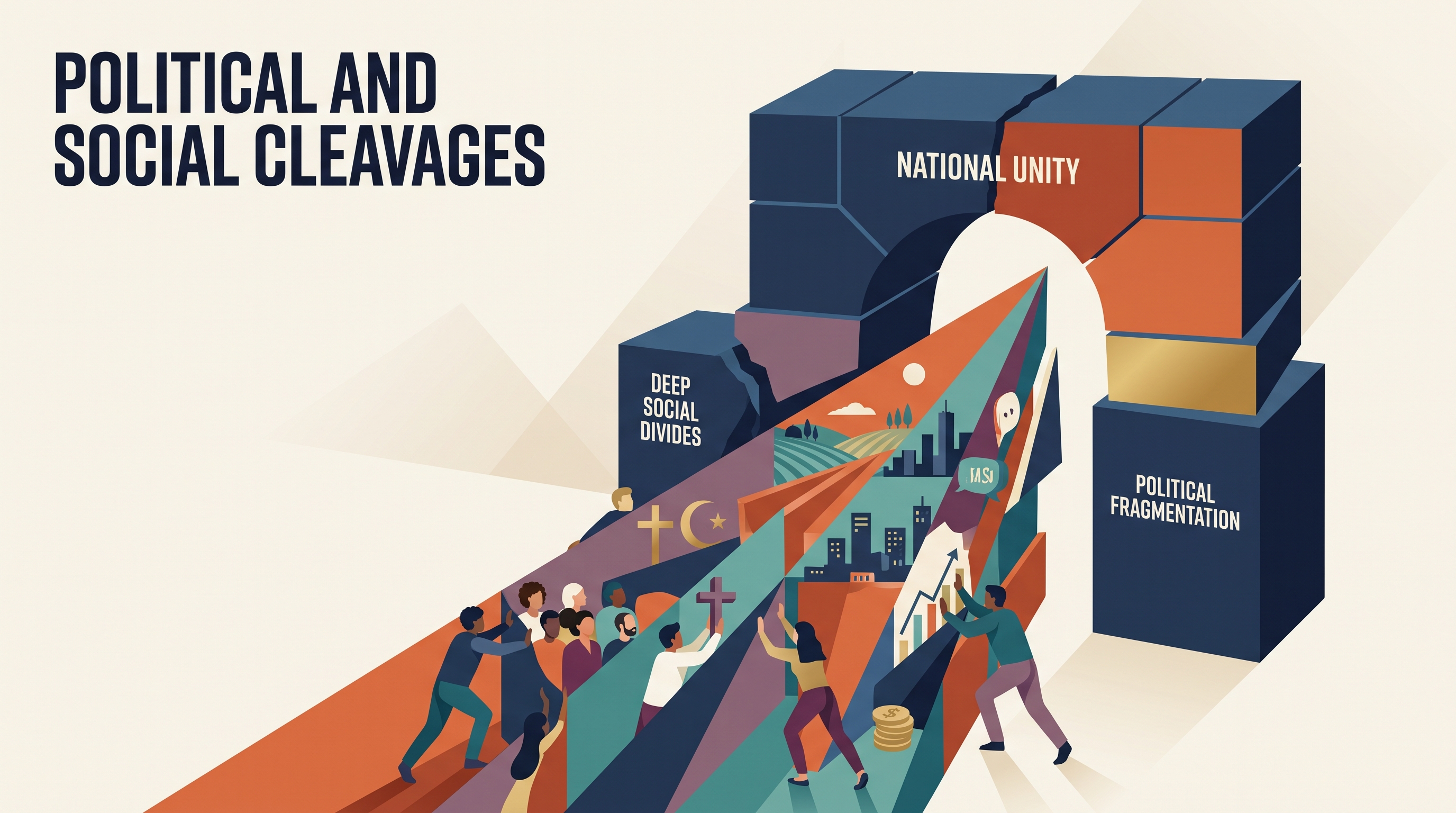
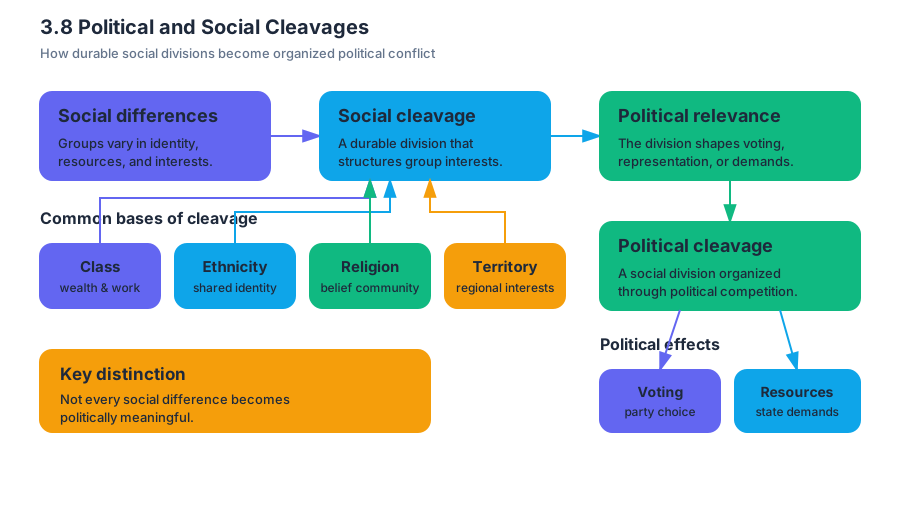
3.9 Challenges from Political and Social Cleavages
Key concepts: Political cleavages · Social cleavages · Government legitimacy · Voting behavior · Party systems · Informal political networks · Ethnicity and identity politics · Religious radicalism and terrorism · Migration and demographic change · Economic liberalization and social divisions
Political and social cleavages become dangerous when governments cannot manage the relationships they create among citizens, groups, and regions. A division that once shaped voting or informal political networks can become a crisis of government legitimacy—the belief that a government has the right to rule—when…
3.9 Challenges from Political and Social Cleavages
Political and social cleavages become dangerous when governments cannot manage the relationships they create among citizens, groups, and regions. A division that once shaped voting or informal political networks can become a crisis of government legitimacy—the belief that a government has the right to rule—when groups experience exclusion, repression, or unequal treatment.
Learning Objective LEG-2.B: Explain how political and social cleavages in course countries affect citizen relationships and political stability.
The key causal chain is:
$$ \text{social division} \rightarrow \text{political competition} \rightarrow \text{state response} \rightarrow \text{legitimacy or instability} $$
LEG-2.B.1 requires attention to consequences, not merely identification. Cleavages differ across countries, so they influence voting behavior, party systems, and informal political networks in different ways. LEG-2.B.2 then asks how governments respond, while LEG-2.B.3 emphasizes the double edge: governments may use cleavages to strengthen legitimacy and retain power, but poorly managed divisions can produce conflict and undermine legitimacy.
When division becomes a political challenge
A cleavage becomes especially destabilizing when citizens believe that political power, public resources, or security are distributed according to identity rather than shared citizenship. Possible outcomes include competition for offices, intergroup conflict, terrorism, civil war, or intervention by neighboring states that perceive a weak or vulnerable government.
Governments have several broad response options. At one extreme is brute repression, which may suppress open opposition without resolving the underlying grievance. Other governments recognize ethnic or religious minorities, create autonomous regions, or provide representation in governmental institutions. These strategies can reduce conflict when groups view participation as meaningful, but they can also formalize identities and encourage further demands for separation.
Nigeria and Mexico: why colonial history matters
Ethnicity is generally a more potent political force in Nigeria than in Mexico because colonial history politicized identity differently. Nigeria’s colonial experience consolidated many distinct ethnic and regional communities within one state while leaving political competition strongly connected to group identity. As a result, ethnic affiliations can shape voting behavior, access to informal networks, and struggles over state resources.
Mexico also contains ethnic and regional differences, but national political institutions and a long period of dominant-party rule historically organized more political competition around national parties and regime structures than around ethnicity alone. The comparison demonstrates an important rule: the existence of an identity difference does not automatically determine its political impact; institutions and historical experiences help convert social difference into political cleavage.
Misconception check: “A country with more ethnic groups must have more ethnic conflict.”
Not necessarily. Conflict depends on politicization, institutional representation, resource competition, and government responses—not simply on the number of identities present.
Russia and the United Kingdom: different routes to stability
Russia illustrates how a government may manage cleavages through centralized authority, selective accommodation, and repression. Regional, ethnic, and religious divisions can challenge the state when groups demand greater autonomy or reject central control. A government may preserve short-term stability by restricting opposition, but repression can weaken legitimacy if citizens interpret state power as coercion rather than rightful authority.
The United Kingdom shows a different pattern. Scottish, English, Welsh, and Irish identities, along with Protestant-Catholic divisions in Northern Ireland and racial tensions connected to colonial history, have influenced party competition and demands for territorial autonomy. Devolution and representation can acknowledge distinct identities while keeping them inside the state’s political system. Institutional recognition may therefore strengthen legitimacy by making citizenship appear more inclusive.
New pressures: migration and economic liberalization
Demographic change and migration can deepen preexisting cleavages. New migration patterns may intensify debates over national identity, religion, employment, public services, and citizenship. Political actors can mobilize these concerns into support for exclusionary parties or policies, especially when economic insecurity makes groups more receptive to identity-based explanations.
Economic liberalization—policies such as privatization, reduced regulation, and expanded market competition—can also reshape cleavages. It may create growth and opportunity for some groups while producing unemployment, regional inequality, or reduced social protections for others. The resulting conflict may be expressed through parties, protests, ethnic networks, or opposition to the national government.
Governments sometimes respond with welfare-state or social-protection policies. By providing income support, health care, education, or targeted assistance, the state can improve citizens’ well-being and bolster political legitimacy. However, if benefits appear to favor one ethnic, regional, or religious group, social policy may reduce one cleavage while intensifying another.
Radical religious elements and regime legitimacy
Even stable regimes can face challenges from radical or terrorist religious elements emerging from long-standing cleavages. Violence directly threatens security, but the larger political danger is legitimacy: if the government cannot protect citizens, or if its counterterrorism response appears indiscriminate, citizens may question its competence or fairness.
For an AP explanation, connect the actor, mechanism, and consequence: a radical group exploits a religious or regional division; the government responds through repression, accommodation, or representation; and that response either strengthens stability and legitimacy or produces further alienation and conflict.
In-flow retrieval check
A government grants an autonomous region to a minority group but simultaneously restricts the group’s political parties. Identify one way the policy could strengthen legitimacy and one way it could undermine legitimacy. A strong answer explains the mechanism: autonomy may recognize identity and improve inclusion, while restrictions may make representation seem symbolic and deepen distrust.
AP skills and reasoning processes: This topic most directly develops Concept Application (1.A: Define and compare political concepts) through legitimacy and stability; Country Comparison (2.A: Describe and explain political concepts and processes in different countries) through Nigeria, Russia, and the United Kingdom; and Argumentation (5.A: Make a claim and support it with evidence and reasoning) by evaluating whether a state response reduces or intensifies conflict. The essential evidence is keyed to LEG-2.B.1, LEG-2.B.2, and LEG-2.B.3.
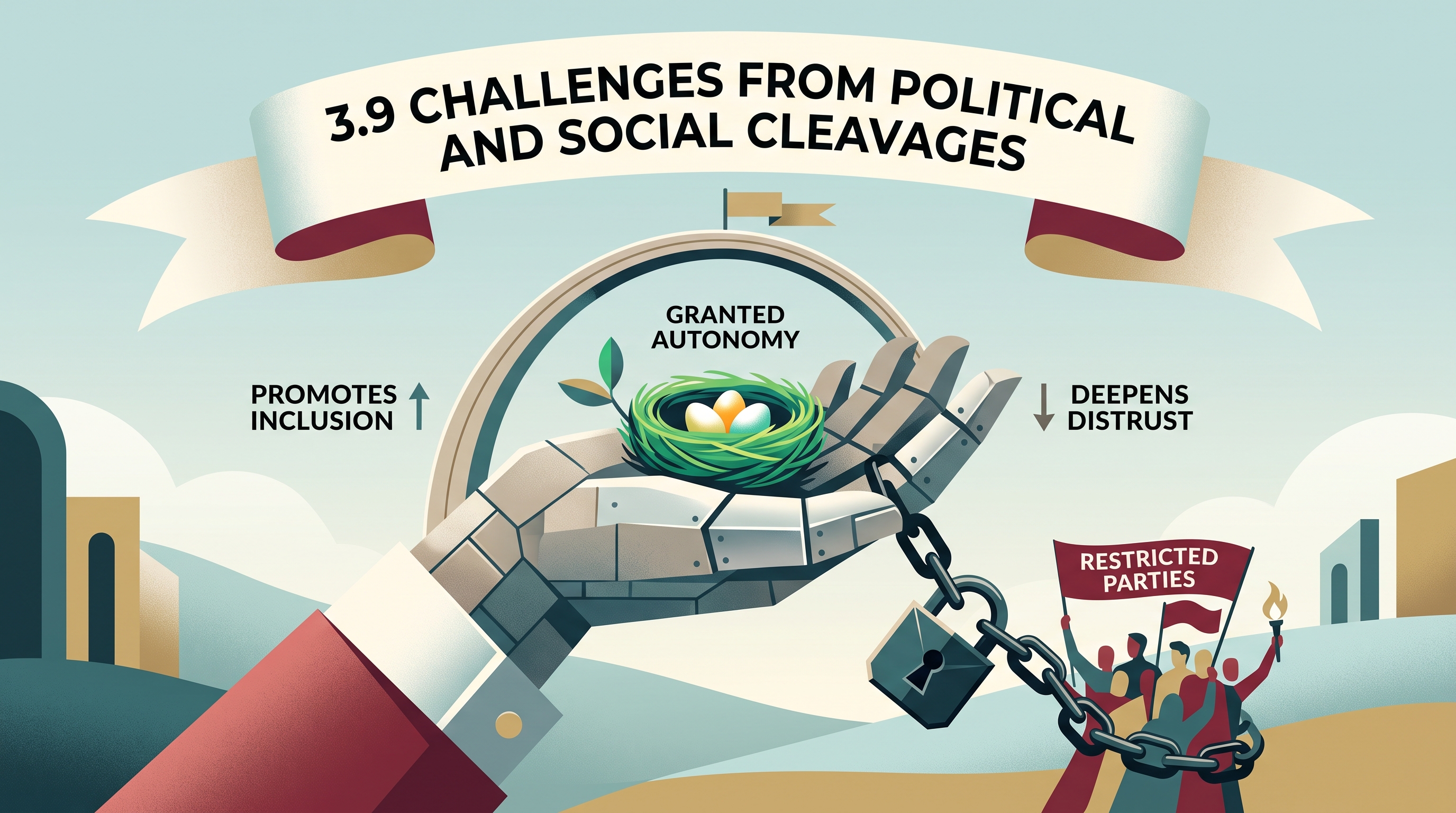
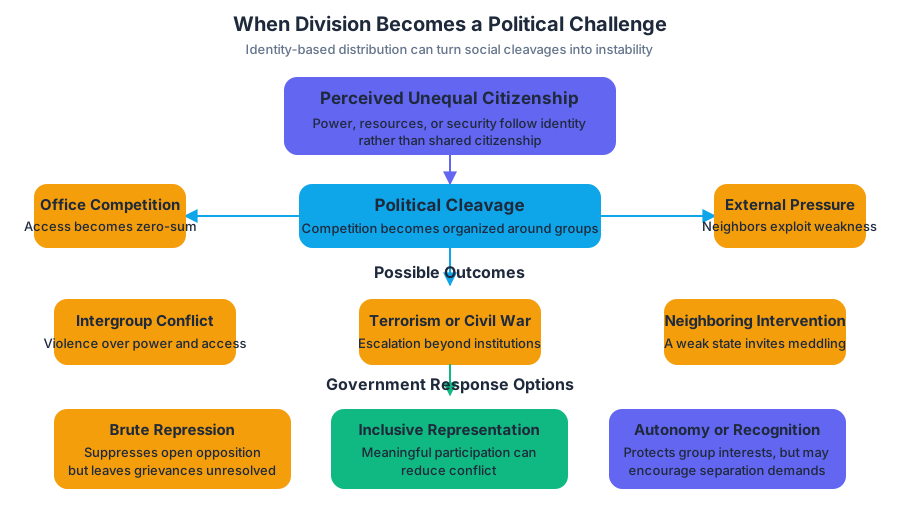
4.1 Electoral Systems and Rules
Key concepts: Electoral systems and election rules · Competitive versus restrictive electoral regimes · Direct and indirect elections · Proportional representation · Single-member district plurality systems · Party-system formation · Representation of minority and women candidates · Constituency accountability and geographic representation · Ballot-access and candidate-selection rules · Term-limit policies
An election can look competitive on paper while the rules quietly decide who may compete, how votes become seats, and whether voters can hold one identifiable representative accountable.
4.1 Electoral Systems and Rules
An election can look competitive on paper while the rules quietly decide who may compete, how votes become seats, and whether voters can hold one identifiable representative accountable. Electoral systems and rules are the procedures that determine ballot access, election winners, legislative representation, and the connection between citizens and elected officials.
DEM-2 — Enduring Understanding: The rules of electoral systems reflect party and legislative control and the level of democratization.
A useful first question is: Who gets onto the ballot, how are votes converted into political power, and who can voters reward or punish? The answer may involve direct or indirect elections, candidate vetting, proportional representation, single-member districts, plurality rules, or combinations of these systems.
Competitive and restrictive electoral regimes
A competitive electoral regime allows multiple candidates or parties a meaningful opportunity to campaign, compete, and win. A restrictive electoral regime limits competition through mechanisms such as candidate disqualification, party-registration barriers, ballot-access thresholds, or indirect selection procedures.
Iran illustrates how elections can be direct but still restricted. Voters directly elect members of the Majles in single-member or multimember districts, yet candidates must first be vetted by the Guardian Council. The election determines among the approved candidates—not necessarily among all citizens who wish to run.
China illustrates a different mechanism. Some national-level representation is selected indirectly through local and regional peoples’ congresses rather than by a single nationwide popular vote. Indirect election can create additional layers of political control between ordinary voters and national representatives.
Misconception check — “Direct” means fully democratic: Direct voting describes how representatives are selected, not how open or fair the competition is. A direct election with extensive candidate vetting may be less competitive than an indirect process with broader internal contestation.
Direct and indirect elections
In a direct election, voters cast ballots for the candidates or party lists that will immediately fill an office or legislative seat. In an indirect election, voters select intermediaries—such as local representatives or an electoral body—that then choose the national official or representative.
The distinction matters because it changes accountability. In a direct election, citizens can more easily connect their vote to a particular officeholder. In an indirect election, responsibility is distributed across several stages, making the chain between voter preference and national representation less immediate.
Two major ways votes become seats
Proportional representation allocates legislative seats in approximate proportion to the votes parties receive. If several parties each win substantial support, several parties may gain seats rather than only the largest party or the candidate who finishes first in each district.
Under single-member district plurality, each geographic district elects one representative, and the candidate with the most votes wins—even without receiving more than half of all votes. This system is also called first-past-the-post.
| Electoral rule | Typical political effect |
|---|---|
| Proportional representation | More parties represented in the legislature; can increase representation of minority and women candidates |
| Single-member district plurality | Tends to promote two-party systems; creates a single identifiable district representative |
| Plurality presidential election | The candidate with the most votes wins, even without an absolute majority |
| Runoff system | A second round may be used to produce a majority winner |
These differences are captured in the required content for DEM-2.B — Explain how election rules serve different regime objectives regarding ballot access, election wins, and constituency accountability. Under DEM-2.B.1, proportional representation can increase both the number of political parties represented in national legislatures and the election of minority and women candidates.
Under DEM-2.B.2, single-member district plurality systems tend to promote two-party systems. Because each district has one representative, voters know whom to contact for constituency service and whom to hold accountable. The system also guarantees geographic representation: every district sends a particular person to the legislature.
Under DEM-2.B.3, presidential systems differ in how they determine winners. Some require a second-round or runoff election to obtain a majority; others use plurality rules. Mexico provides the required example: its president is elected by a plurality of the national popular vote, so the candidate with the most votes wins rather than needing an absolute majority.
Party-system formation
Electoral rules help shape the party system, meaning the number and relative strength of political parties that compete and win representation. Proportional representation lowers the penalty for smaller parties because a party can gain seats by winning a share of the vote. Single-member plurality raises that penalty: a party may receive many votes nationally but win few districts.
For example, Nigeria’s electoral competition has included the People’s Democratic Party, the All Progressives Congress, and a third party with some electoral success. This illustrates that party systems are not determined by electoral rules alone; rules interact with party organization, regional support, political cleavages, and the level of democratization.
Worked interpretation
Suppose Party A wins $42%$ of the national vote, Party B wins $35%$, and Party C wins $23%$. In a proportional system, all three could receive legislative seats roughly reflecting those vote shares. In a single-member plurality system, Party A and Party B might win most districts while Party C finishes second repeatedly and receives few or no seats.
That comparison connects the mechanism to DEM-2: electoral rules reveal who controls access, who can convert votes into legislative power, and how strongly representatives depend on identifiable local constituencies.
Retrieval check: Why might proportional representation produce more parties, while single-member district plurality tends to produce two? Name one advantage of each system and identify one rule that can restrict competition before votes are counted.
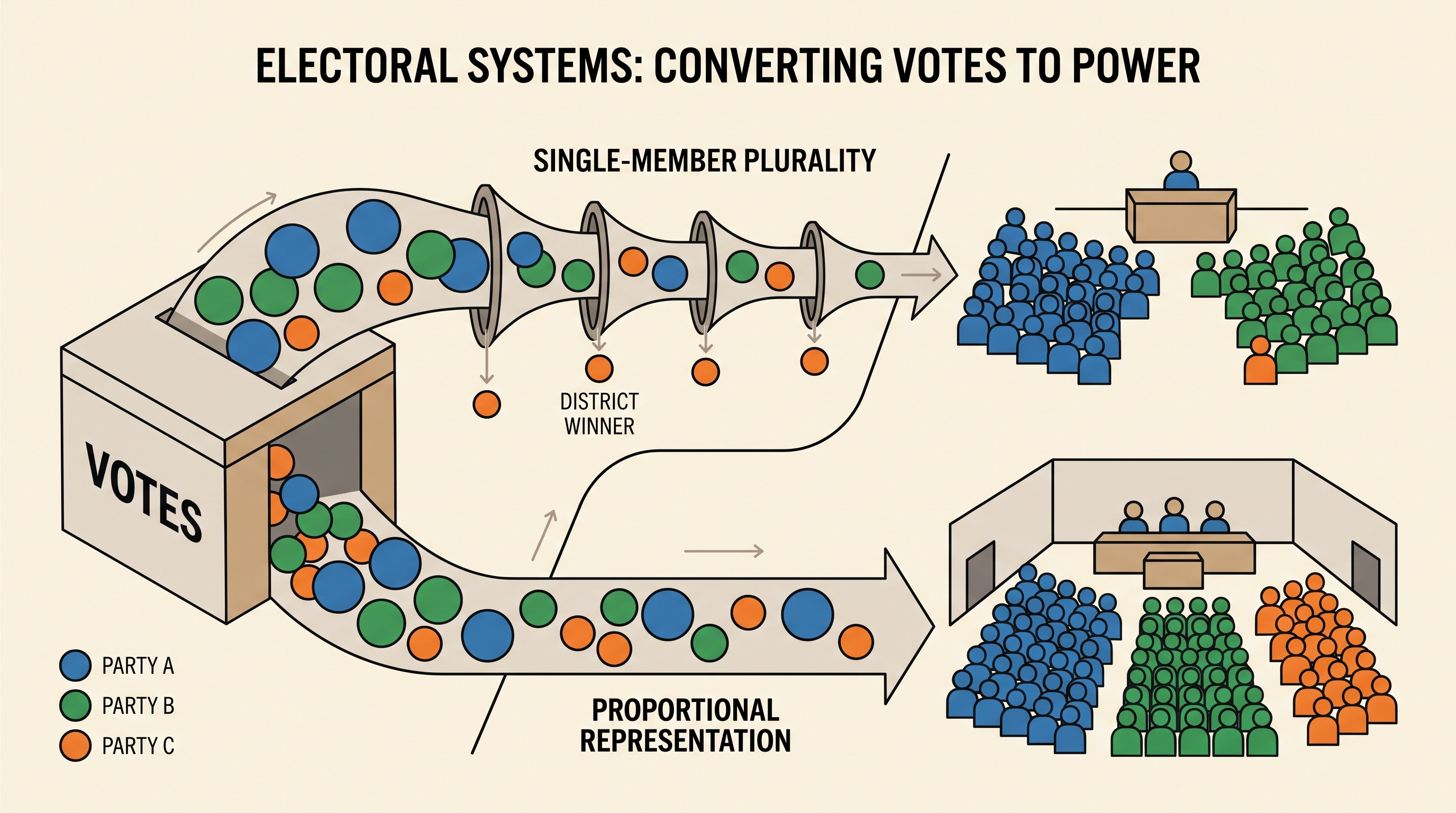
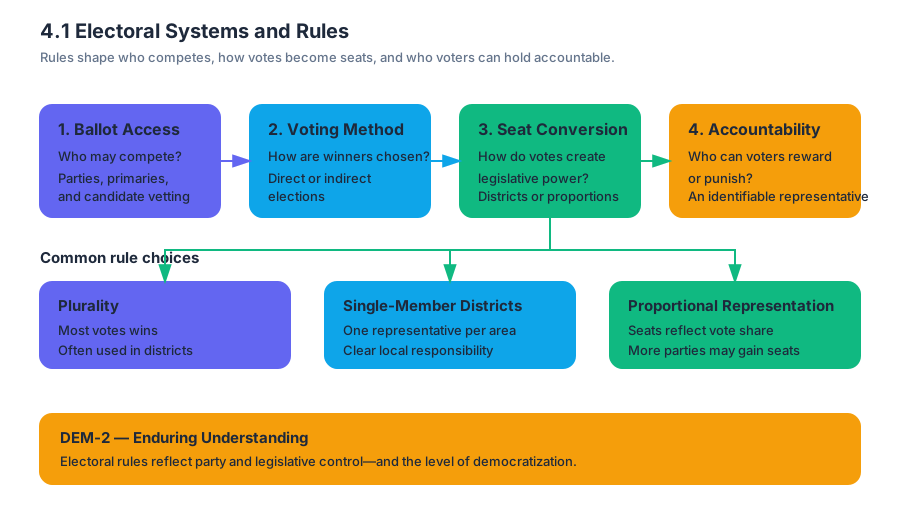
4.2 Objectives of Election Rules
Key concepts: Objectives and functions of election rules · Electoral regulatory organizations · Fairness and efficiency in elections · Enforcement of election rules · Democratic consolidation · Electoral competition · Political representation · Independent election-management bodies · Authoritarian actions and electoral accountability · Effects of election-rule changes
Election rules do more than count votes: they decide who may compete, how votes become representation, and whether citizens can trust the result. A rule that appears administrative—such as requiring an independent election commission—can therefore alter the balance of power between voters, governing elites, and…
4.2 Objectives of Election Rules
Election rules do more than count votes: they decide who may compete, how votes become representation, and whether citizens can trust the result. A rule that appears administrative—such as requiring an independent election commission—can therefore alter the balance of power between voters, governing elites, and opposition groups.
Learning Objective DEM-2.B: Explain how election rules serve different regime objectives regarding ballot access, election wins, and constituency accountability.
Election rules as political instruments
Election rules are the procedures that organize participation and convert political preferences into official outcomes. Their objectives may include expanding ballot access, helping a ruling party win, encouraging accountability to constituents, limiting fraud, or preserving the governing elite’s political agenda.
The same rule can serve different political purposes depending on how it is designed and enforced. For example, an appointment system for some legislative seats may promote a diversity of viewpoints, but appointments can also allow governing elites to select members who advance the regime’s agenda rather than reflect voters’ preferences.
Electoral regulatory organizations
Electoral regulatory organizations are institutions responsible for making sure election rules are followed while an election is taking place. Their work commonly includes administering voting procedures, monitoring compliance, reducing voter fraud and manipulation, and helping elections operate with fairness and efficiency.
Fairness means that candidates and voters operate under rules that are not arbitrarily tilted toward one side. Efficiency means that elections are organized accurately and predictably: eligible citizens can vote, ballots are processed, and results are produced without unnecessary disorder or delay.
Mexico and Nigeria created independent election commissions as part of their democratic transitions. These organizations attempted to reduce fraud and manipulation while enhancing electoral competition. Their significance lies not merely in existing as separate institutions, but in the political function they perform: independent administration can make competition more credible.
Worked example: from institution to democratization
Imagine that an election commission prevents local officials from discarding opposition ballots, publishes consistent voting procedures, and verifies the count. The immediate function is enforcement of election rules. The broader consequence is that citizens have stronger reason to believe that their votes will be counted, opposition candidates have a greater reason to compete, and election results are more likely to reflect citizen preferences.
That chain explains how an electoral regulatory organization can contribute to democratization, the process through which a political system becomes more democratic. It is not enough to write “the commission makes elections fair.” A complete explanation connects the institution to a mechanism and then to a political outcome: independent enforcement limits manipulation, which increases credible competition and makes government more responsive to voters.
Fairness, competition, and representation
Election rules can either widen or narrow representation. Some electoral systems limit the number of candidates on the ballot, reducing electoral competition—the ability of multiple candidates or parties to contest power. Fewer competitors may simplify voting, but it can also reduce the range of viewpoints and weaken voters’ ability to hold leaders accountable.
Changes to election rules therefore affect political representation. A restriction that removes smaller candidates may increase the probability that a major party wins while decreasing the likelihood that minority interests appear in the legislature. This is why election rules must be analyzed by asking whose access, whose victory, and whose accountability the rule promotes.
Enforcement and democratic consolidation
Election rules can prevent executives or legislatures from tolerating ruling-party corruption, reducing civil liberties, or ignoring election results. Enforcement creates institutional limits: leaders cannot simply treat electoral procedures as optional when an independent organization can investigate violations, apply the rules, and protect the credibility of the result.
Democratic consolidation is the process of strengthening and stabilizing democracy so that democratic rules become durable rather than temporary. Election rules and civil liberties can support consolidation when they protect meaningful competition, reliable participation, and acceptance of results; they can impede democratization when they restrict candidates, tolerate manipulation, or make opposition participation ineffective.
Misconception check
Misconception: “An electoral commission automatically makes a country democratic.” An electoral organization matters only if its rules are applied impartially and its decisions have enough independence to constrain manipulation. Naming the institution earns less analytical value than explaining how its enforcement changes competition, representation, or public trust.
AP skill connection: This topic most directly develops Practice 1: Concept Application, by applying electoral regulation, democratization, and democratic consolidation to a political situation; Practice 2: Country Comparison, through comparison of Mexico and Nigeria; and Practice 5: Argumentation, when explaining whether a rule strengthens or weakens democratic competition. A strong response states the function, identifies the mechanism, and links that mechanism to the political consequence.
Retrieval check
A government creates an election commission, but the governing party controls its appointments and the commission ignores violations by ruling-party candidates. Is the organization promoting democratic consolidation? Explain your answer using one function of electoral regulatory organizations and one consequence for electoral competition or representation.
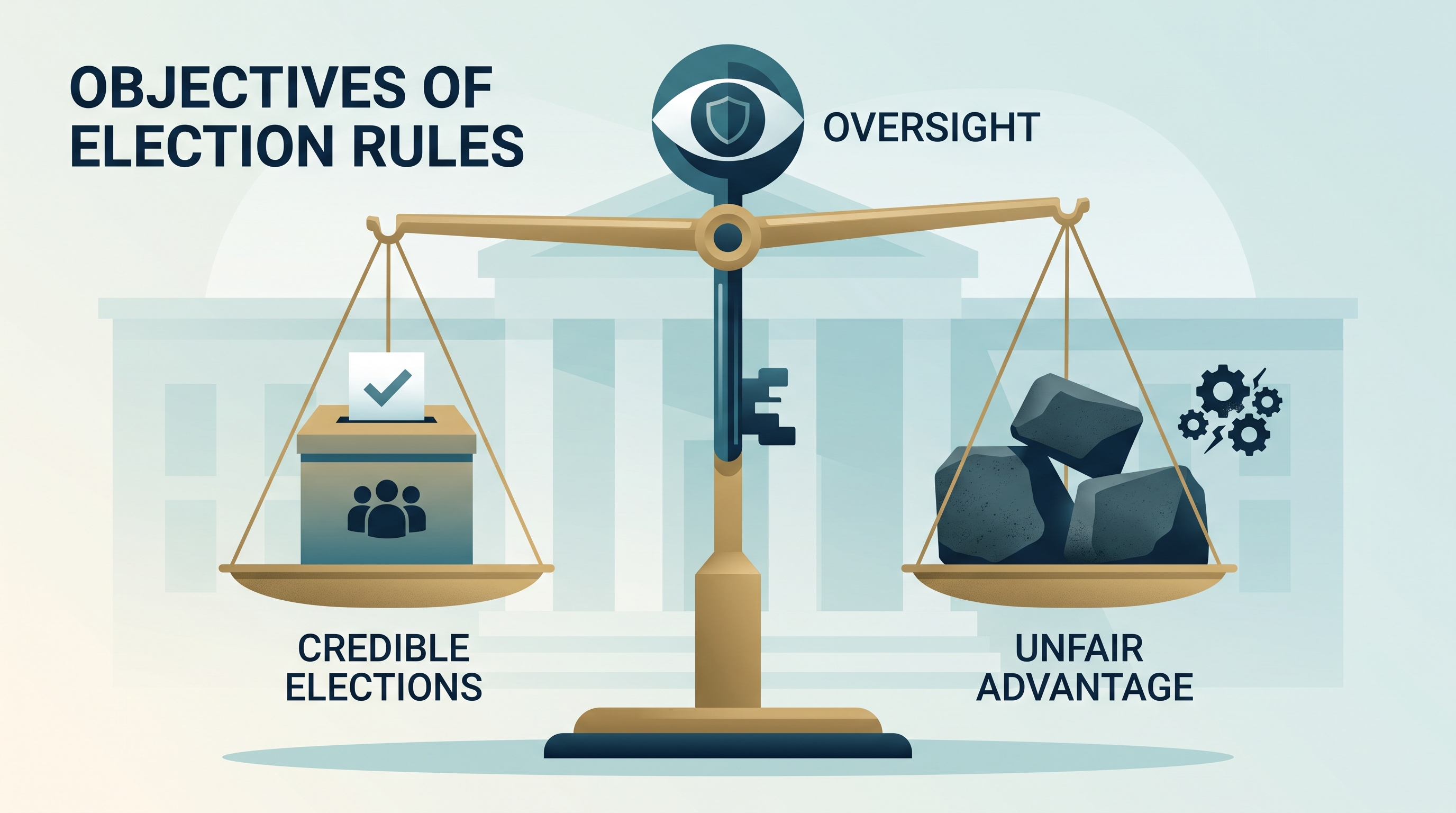
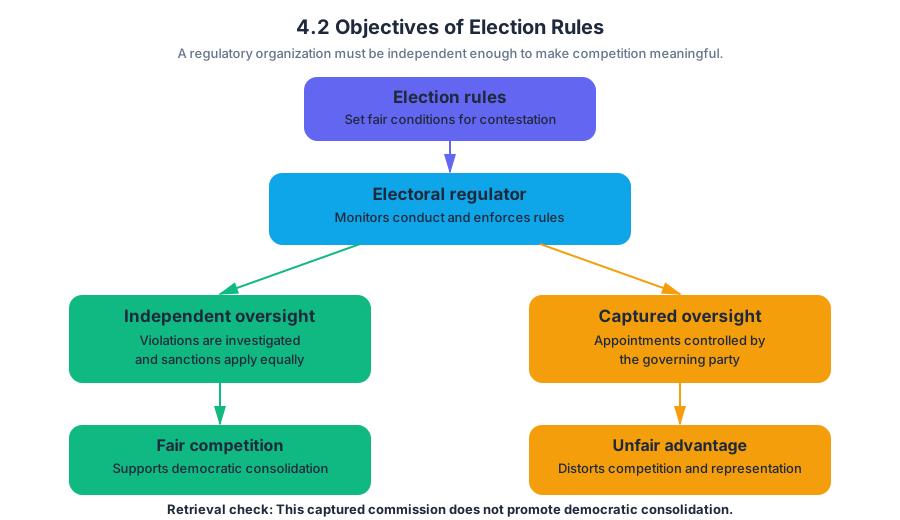
4.3 Political Party Systems
Key concepts: Political party systems · Proportional representation · Multiparty systems · Political party representation in legislatures · Degree of competition · Party structure · Laws regulating political parties · Citizen participation · Political movements · National Electoral Institute (IFE)
A legislature can contain dozens of registered parties yet still be dominated by only two powerful organizations. Nigeria illustrates this distinction: its multiparty system includes about 30 registered parties, but the People’s Democratic Party (PDP) and the All Progressives Congress (APC) have historically been…
4.3 Political Party Systems
A legislature can contain dozens of registered parties yet still be dominated by only two powerful organizations. Nigeria illustrates this distinction: its multiparty system includes about 30 registered parties, but the People’s Democratic Party (PDP) and the All Progressives Congress (APC) have historically been the strongest competitors. The key question is therefore not simply how many parties exist, but how parties compete, win representation, organize citizens, and share governmental power.
What makes a political party system?
A political party system is the pattern formed by the parties that operate in a country and by their relationships with one another and with the state. It includes the number of relevant parties, their ideological or regional bases, their organization, the rules governing them, and the degree of competition among them.
Political party systems reflect the distribution and balance of governmental power.
A one-party system concentrates political power in a single organization. A dominant-party system permits other parties to exist but gives one party a durable advantage. A multiparty system contains several meaningful competitors, although those parties may not possess equal strength. A system with many registered parties can therefore be less competitive than its label suggests.
Representation: why proportional representation matters
Proportional representation is an electoral arrangement in which legislative seats are allocated approximately according to each party’s share of the vote. If a party receives about $20%$ of the vote, it may receive roughly $20%$ of the seats, subject to the country’s specific rules and any electoral threshold.
Because proportional representation can translate smaller vote shares into legislative seats, it can increase the number of political parties represented in a national legislature. By contrast, winner-take-all rules often reward the leading candidate in each district and can make it difficult for smaller parties to gain seats even when they receive substantial support across the country.
Worked example: Imagine a legislature with $100$ seats. Under proportional representation, Party A wins $45%$ of the vote, Party B wins $35%$, and Party C wins $20%$. A plausible result is approximately $45$, $35$, and $20$ seats. Party C becomes part of lawmaking rather than remaining merely an unsuccessful electoral movement.
The important distinction is between votes received and seats won. A party may attract citizens but gain little institutional influence if electoral rules convert its support inefficiently. Political institutions and electoral rules therefore shape both political competition and accountability: voters have more meaningful alternatives when parties can realistically win representation, while governing parties face greater pressure when opposition parties can scrutinize and challenge them.
Competition inside multiparty systems
The degree of competition describes how seriously parties can challenge one another for votes, legislative seats, and control of government. A country may have many parties on the ballot but limited competition if one organization controls state resources, media access, electoral administration, or the rules of participation.
Nigeria provides a useful comparison. Its many registered parties create formal choice, but the presence of two strong parties—the PDP and APC—means that competition is concentrated around major organizations. Smaller parties may represent particular communities or viewpoints without having a realistic path to national power.
Competition affects representation and formal political participation—participation through voting, campaigning, party membership, and candidacy. Strong competition can motivate citizens to vote because electoral outcomes appear consequential. Weak competition can produce withdrawal, especially when citizens believe that opposition parties cannot overcome structural advantages held by the dominant organization.
Misconception check: “A multiparty system is automatically highly democratic.”
Not necessarily. Multiparty describes the number of parties, not the fairness of competition. The decisive issue is whether parties can organize, campaign, obtain votes, and convert those votes into political influence.
Party structure, regulation, and citizen participation
Party structure refers to how a party is organized: who selects candidates, how leaders communicate with local branches, how members participate, and whether decision-making is centralized or internally democratic. Laws regulating political parties may govern registration, campaign finance, ballot access, party membership, advertising, and reporting requirements.
These arrangements influence whether citizens can participate effectively. A party with strong local branches may mobilize voters and connect community concerns to national leaders. A highly centralized party may coordinate campaigns efficiently but give ordinary members little influence over candidates or policies.
Political movements can face two separate obstacles. First, they may struggle to attract and mobilize support among fellow citizens. Second, even after building public support, they may struggle to negotiate with governmental representatives if they lack seats, legal recognition, funding, or access to decision makers.
Mexico’s National Electoral Institute (IFE) is an example of an electoral institution associated with organizing and strengthening electoral competition. An electoral institution can affect party systems by setting registration procedures, supervising elections, and helping establish rules under which parties compete. Its importance depends on how independently and effectively it performs those functions.
Comparative reasoning in one glance
To analyze a party system, connect three layers rather than naming a system and stopping:
| Layer | Question to ask | Political consequence |
|---|---|---|
| Electoral rules | How are votes converted into seats? | Smaller parties may gain or lose representation. |
| Party structure and regulation | Who may organize, compete, and participate? | Citizen influence and accountability may expand or contract. |
| Competition | Can opposition parties realistically challenge governing parties? | Governmental power may be more balanced—or concentrated. |
This is the central analytical chain: rules shape competition; competition shapes representation; representation shapes accountability and participation. The same formal label—“multiparty system”—can therefore describe very different political realities.
Retrieval check: A country has 30 registered parties, but one party controls most legislative seats and opposition parties face severe barriers to campaigning. Is the system multiparty? Yes. Is it highly competitive? Not necessarily. Explain your answer using party number, degree of competition, and legislative representation.
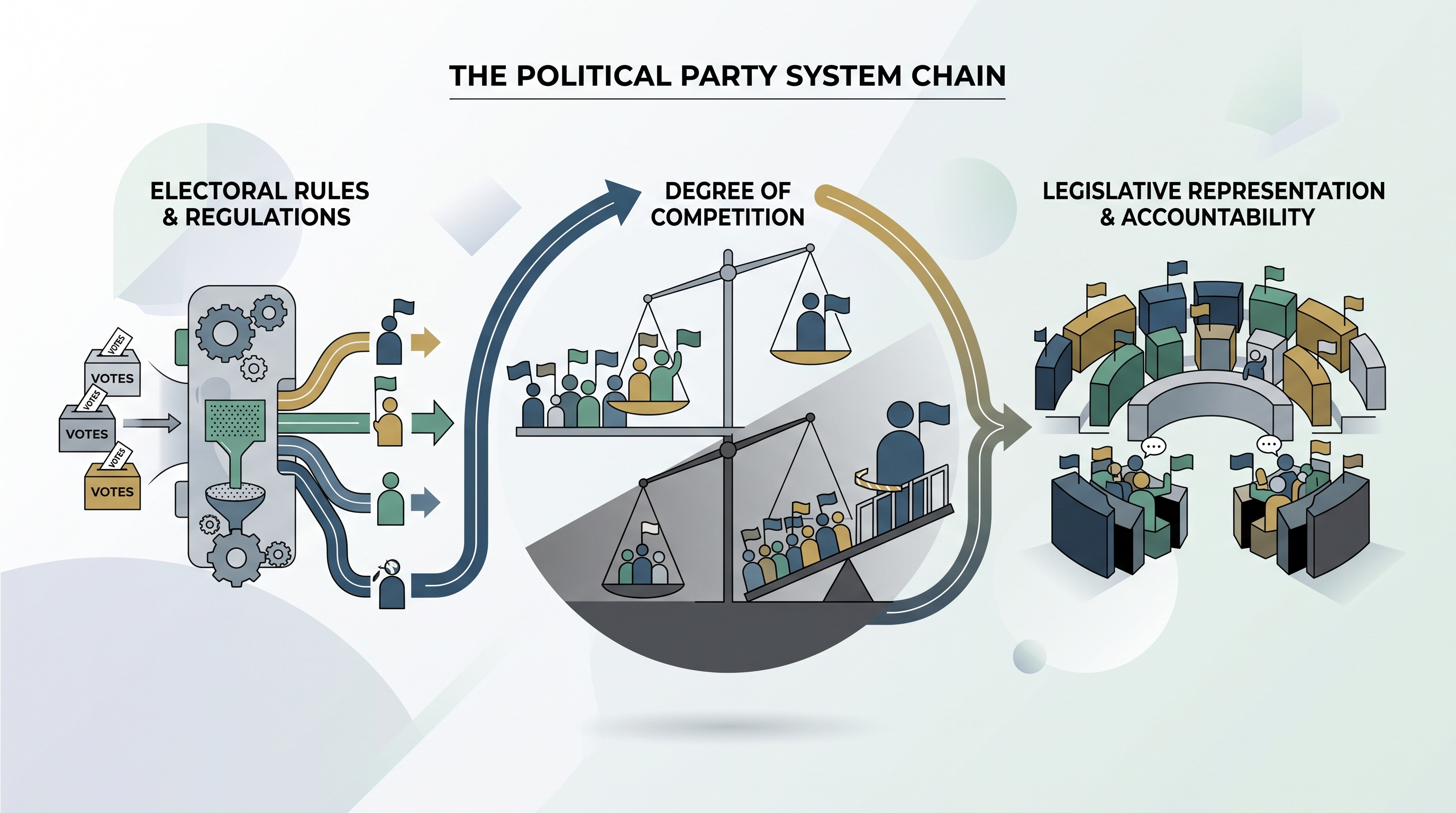
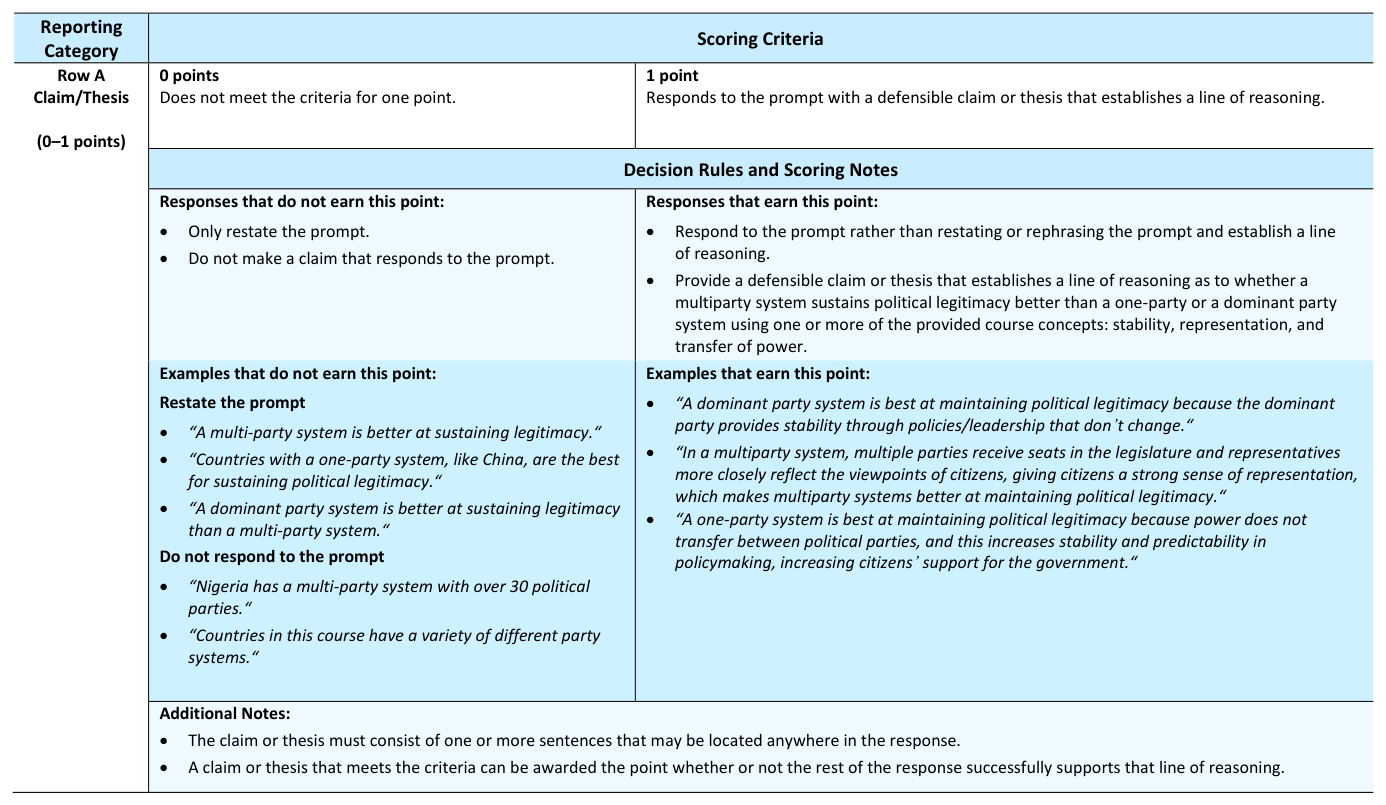
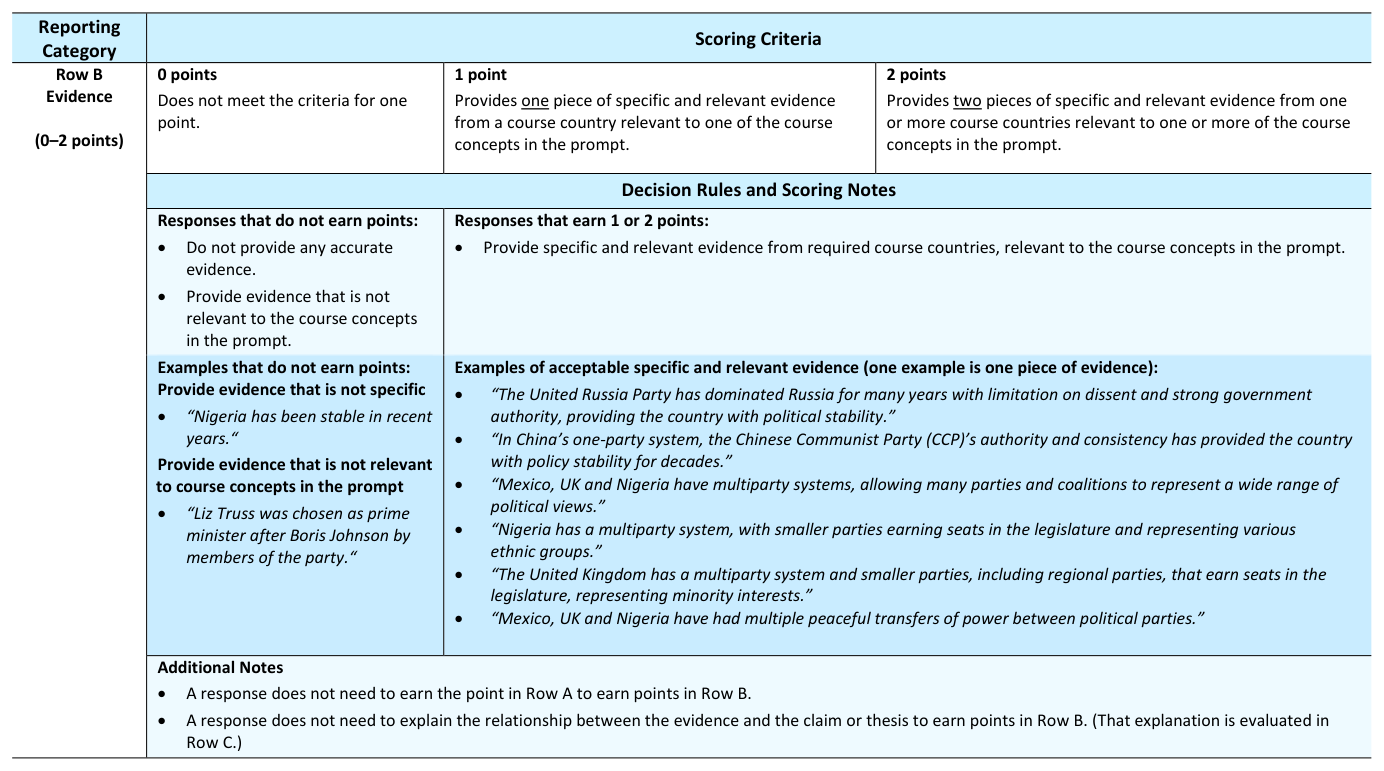
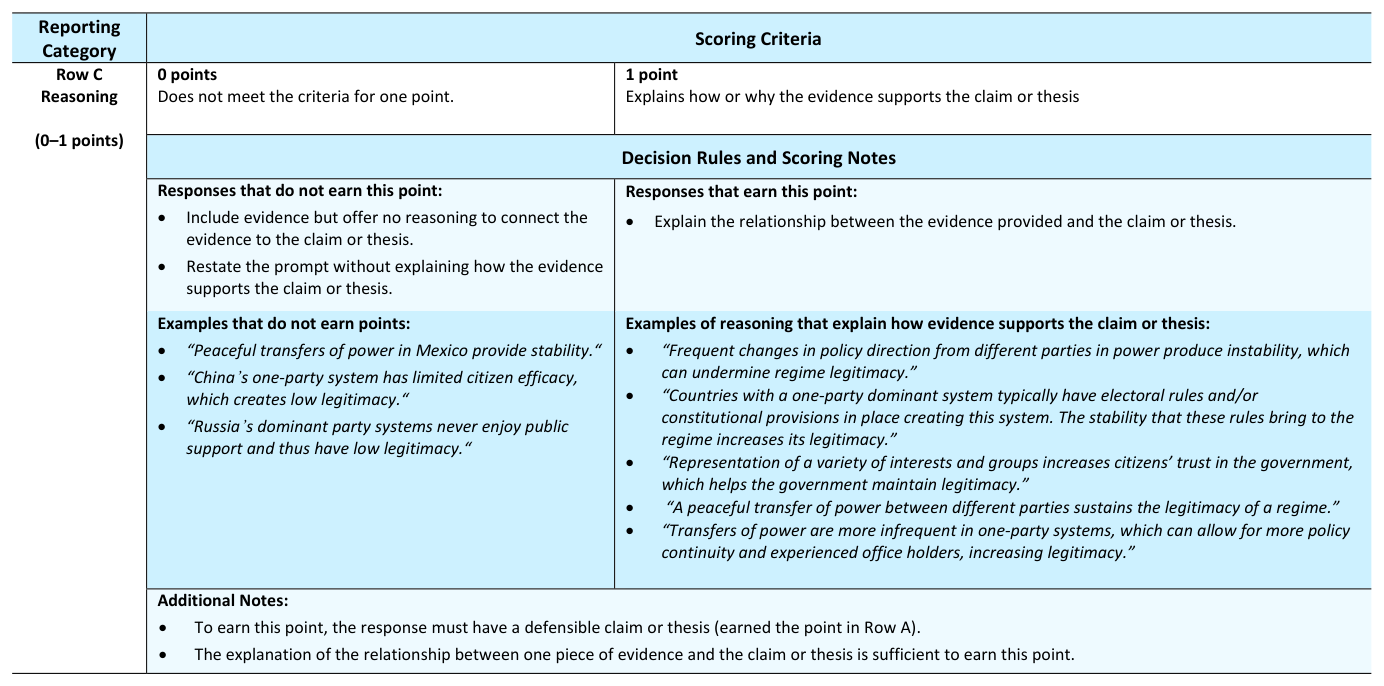
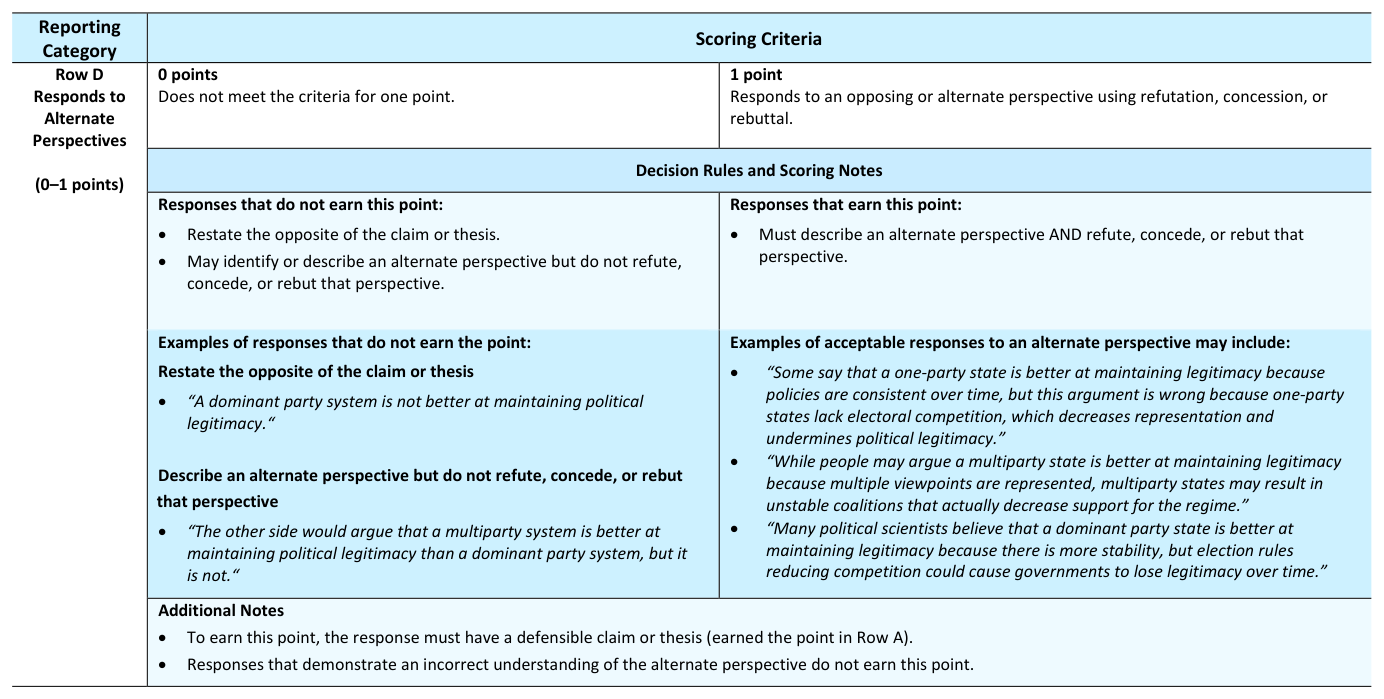
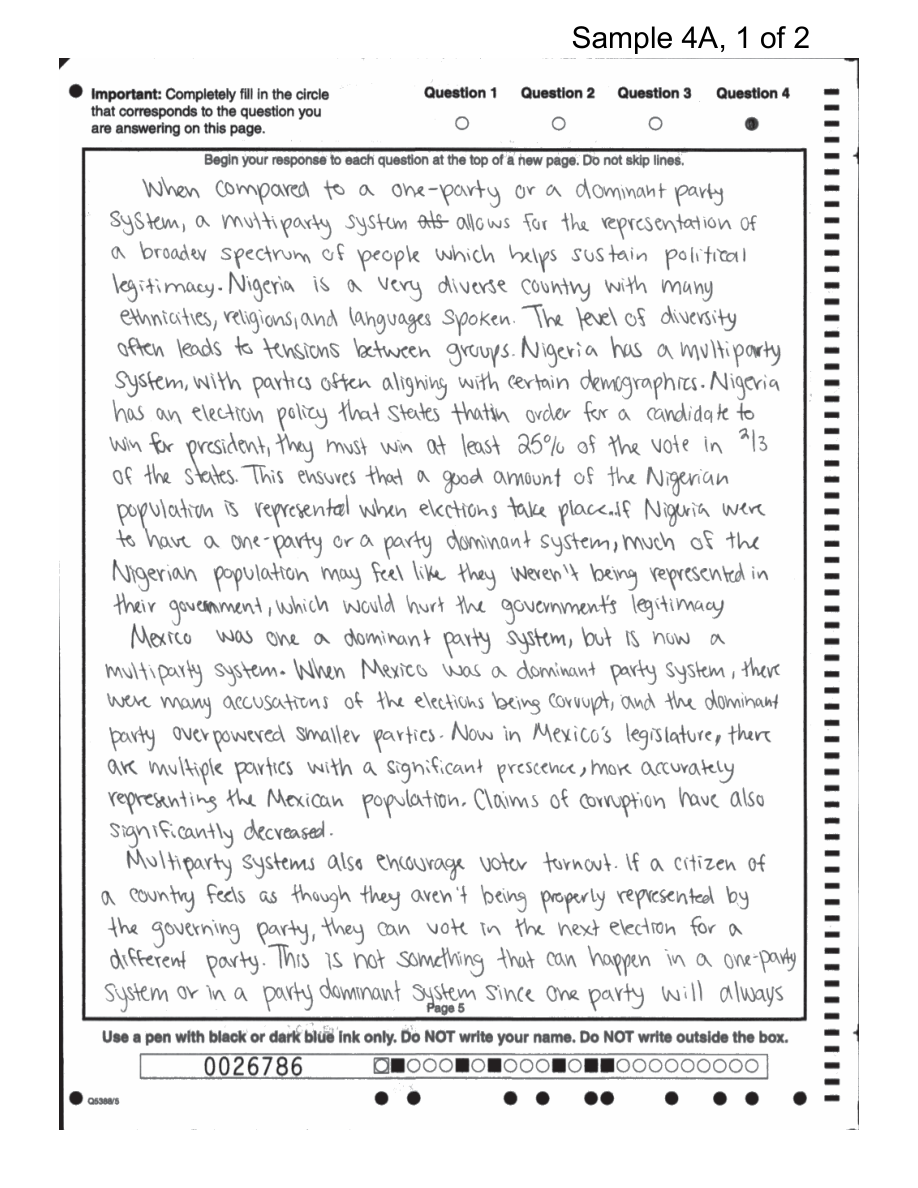
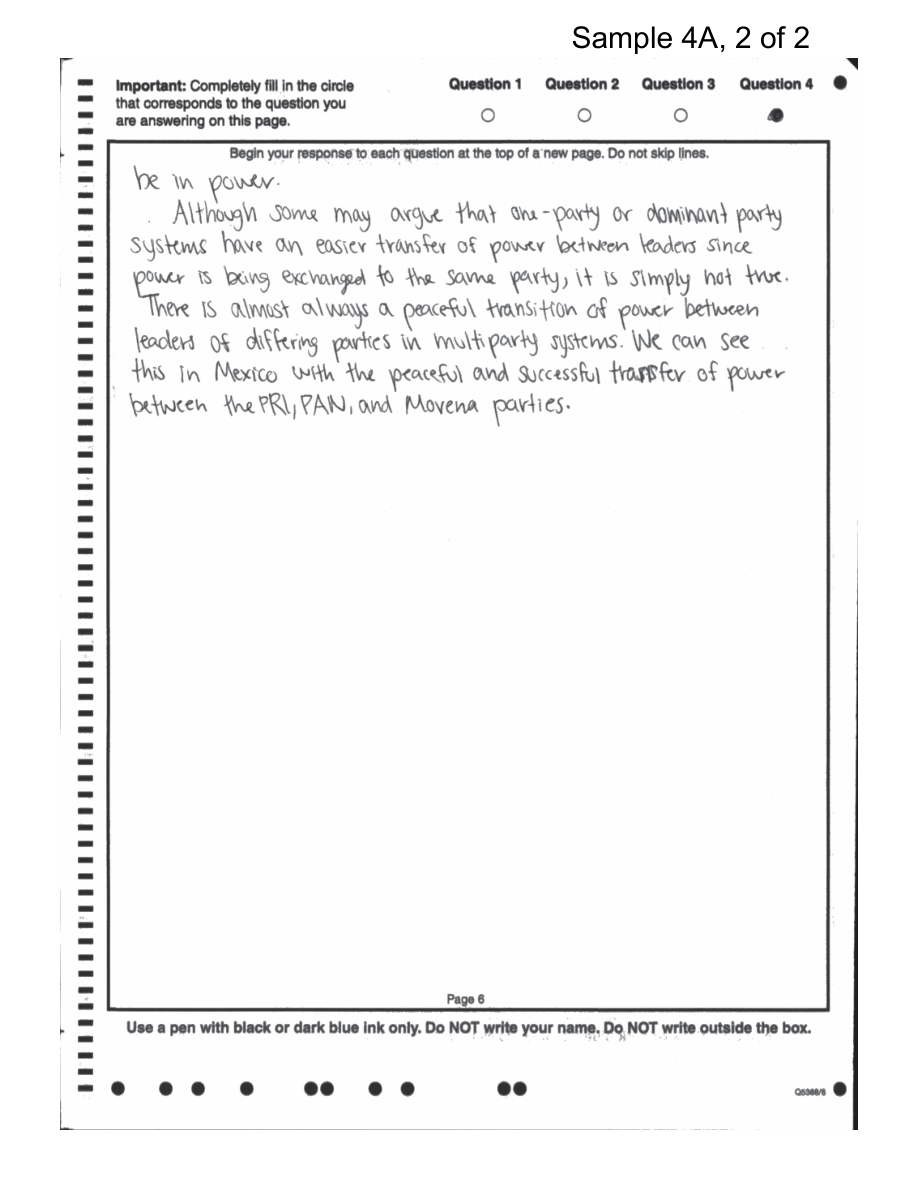
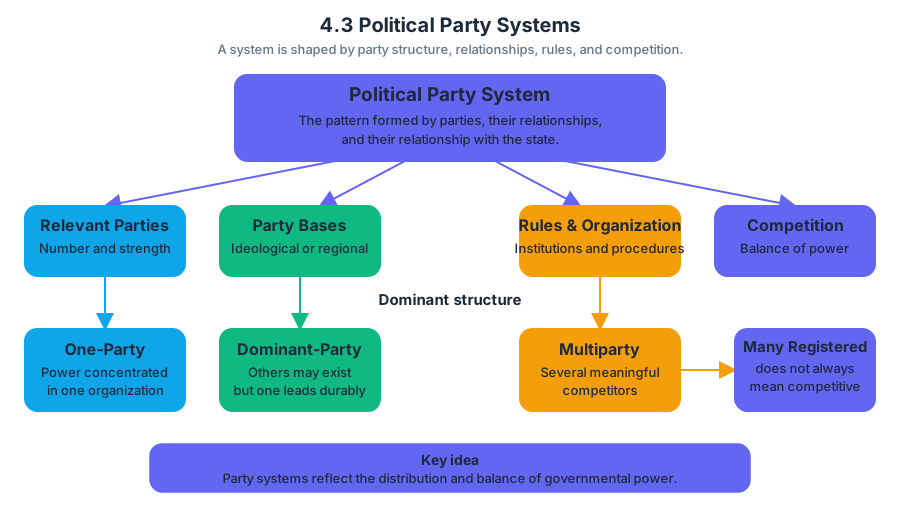
4.4 Role of Political Party Systems
Key concepts: Political party systems ranging from dominant-party systems to multiparty systems · China’s one-party political system and Communist Party of China (CPC) control · China’s use of party-system rules to maintain centralism and order · China’s allowance of eight other political parties despite CPC control · Russia’s dominant-party system · Legal and procedural mechanisms used to suppress opposition in Russia · Election rules as a factor shaping political party systems · Comparing similarities and differences among countries’ party systems · Political culture’s relationship to citizen behavior and the role of the state · Implications of party-system differences for political institutions and processes
China and Russia demonstrate that the decisive question is not simply how many parties exist, but whether party-system rules allow meaningful competition for governing power.
4.4 Role of Political Party Systems
China and Russia demonstrate that the decisive question is not simply how many parties exist, but whether party-system rules allow meaningful competition for governing power. China permits several parties to operate while reserving national governing authority for the Communist Party of China (CPC); Russia permits opposition parties to exist but uses legal and procedural barriers to make replacement of the dominant party extremely difficult.
PAU-4.A: Political party systems shape access to political power, representation, competition, and the relationship between citizens and the state.
From party categories to political consequences
PAU-4.A.1 places party systems on a spectrum ranging from dominant-party systems to multiparty systems. The important comparative task is to connect a country’s location on that spectrum to the rules governing elections, party registration, media access, candidate eligibility, and the distribution of governing authority.
A multiparty system may give voters several credible governing alternatives. A dominant-party system may contain multiple legally recognized parties, yet the governing party’s control of institutions, resources, and electoral procedures prevents genuine alternation in power. Thus, the existence of opposition parties does not automatically prove that political competition is effective.
China: controlled pluralism under CPC leadership
PAU-4.A.2 states that China’s rules allow only the Communist Party of China to control governing power. The CPC justifies this arrangement through the values of centralism—coordinated authority directed from the center—and order. From this perspective, unrestricted party competition could produce conflict or fragmentation, while CPC leadership is presented as necessary for national unity and effective governance.
China nevertheless permits eight other political parties to exist. These parties do not function as opposition parties capable of replacing the CPC in national government; instead, they broaden discussion and consultation within a political system whose governing power remains under CPC control. This creates a crucial distinction between participation in consultation and competition for executive authority.
The system therefore combines limited party diversity with centralized political control. Citizens may encounter organized discussion and consultation, but the party-system rules define the boundaries of acceptable participation and preserve the CPC’s central role in the state.
Russia: dominant-party control through rules
Russia is best treated here as a dominant-party system. Opposition parties may legally exist, but registration requirements, ballot-access rules, media restrictions, candidate disqualifications, and electoral procedures limit their ability to compete effectively or replace the governing party.
PAU-4.A.3 identifies several mechanisms that preserve dominant-party control:
- Increasing party-registration requirements makes it harder for new parties to qualify.
- Allowing only legally registered parties to run for office excludes unregistered opposition movements.
- Selective court decisions can disqualify candidates or parties.
- Restrictions on opposition access to media reduce their ability to present competing viewpoints.
- Higher electoral thresholds limit which parties can gain representation.
- Eliminating gubernatorial elections removes a direct route through which regional voters might challenge central political control.
These mechanisms often appear procedural rather than openly coercive: a registration rule, a court decision, a media restriction, or a threshold requirement. Their combined effect, however, is political. They narrow the field of viable competitors and help the dominant party retain control while preserving the appearance of formal party pluralism.
Comparison: similar outcome, different justification
| Feature | China | Russia |
|---|---|---|
| Party-system pattern | CPC-controlled one-party dominance with eight additional parties | Dominant-party system with legally existing opposition |
| Stated or functional rationale | Centralism, order, discussion, and consultation | Preservation of dominant-party control through legal and procedural rules |
| Role of other parties | Consultation without control of governing power | Opposition may exist but faces barriers to effective competition |
| Key electoral effect | Governing power remains reserved for the CPC | Opposition faces restricted registration, media, candidacy, and ballot access |
The similarity is that neither system permits ordinary party competition to produce an easy transfer of national governing power. The difference is how control operates: China openly institutionalizes CPC leadership while permitting consultative parties, whereas Russia maintains a dominant-party structure in which opposition is formally present but systematically constrained.
Political culture and citizen behavior
Political culture—the shared beliefs and expectations people hold about government—helps explain how citizens respond to these arrangements. In China, a political culture emphasizing centralism and order may make coordinated state authority appear legitimate or desirable. In Russia, restricted competition and limited opposition visibility can encourage citizens to view politics as the domain of the dominant party, reducing expectations that elections will produce alternation in power.
These are analytical relationships, not assumptions that every Chinese or Russian citizen thinks alike. A strong response connects political rules to likely patterns of behavior: participation may take the form encouraged by the state, while citizens may have fewer practical incentives or opportunities to organize around replacing the governing party.
Worked comparison and misconception check
Prompt: Country X allows three opposition parties to register, but only the governing party receives unrestricted national media coverage and opposition candidates are frequently removed from ballots by courts. Country Y permits eight minor parties, but only the CPC may control governing power. Compare the role of party systems in Country X and Country Y.
Reasoning: Country X resembles Russia because opposition parties legally exist but face procedural barriers that prevent meaningful competition. Country Y resembles China because additional parties broaden consultation while the governing party retains exclusive control of governing power. Both systems restrict alternation in power, but Country X does so through dominant-party procedures, whereas Country Y explicitly organizes party participation around CPC centralism and order.
Misconception check: “Several legal parties automatically make a system multiparty and competitive.”
Correction: Count not only the parties, but also whether they can register, campaign, reach voters, appear on ballots, win representation, and replace the governing party.
Skill focus: Country Comparison 2.C
2.C: Explain the implications of the similarities and differences between political systems, principles, institutions, processes, policies, and behaviors. To earn the analytical force of this skill, identify a similarity or difference, name the specific rule producing it, and explain its consequence for governing power or citizen behavior. Saying that China and Russia are “both authoritarian” is only a starting classification; explaining how China’s consultative parties differ from Russia’s restricted opposition demonstrates the implication.
Retrieval check: If opposition parties exist in both countries, what evidence would distinguish China’s CPC-controlled system from Russia’s dominant-party system? Answer by identifying one difference in the formal organization of party power and one difference in the procedures that restrict competition.
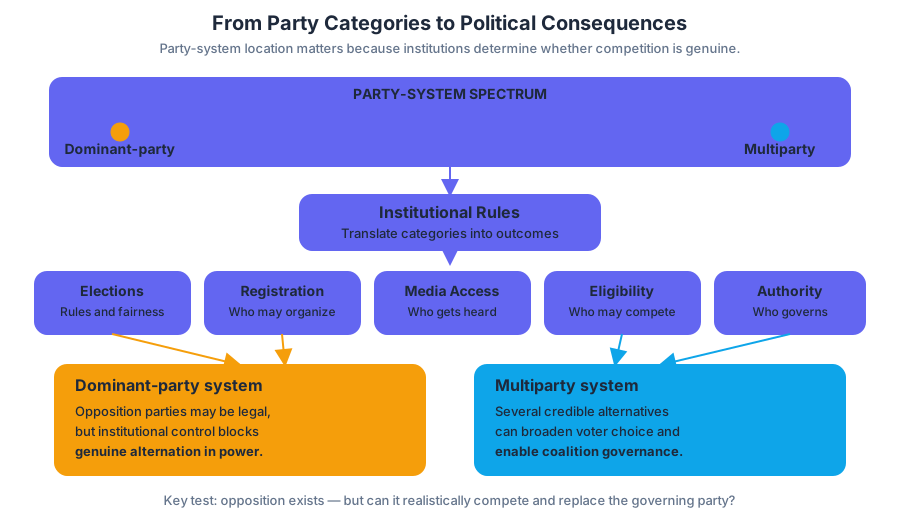
4.5 Impact of Social Movements and Interest Groups
Key concepts: Social movements · Interest groups · Citizen organizations · Grassroots social movements · Civil society organizations · Political and social change · Peak associations (SPAs) · Pluralist interests · Corporatist interests · State control over citizen organizations
A government may win an election and still face powerful political pressure from outside formal institutions. Workers demanding safer conditions, farmers resisting land policies, businesses seeking lower taxes, or citizens campaigning for civil liberties can organize into social movements and interest groups that…
4.5 Impact of Social Movements and Interest Groups
A government may win an election and still face powerful political pressure from outside formal institutions. Workers demanding safer conditions, farmers resisting land policies, businesses seeking lower taxes, or citizens campaigning for civil liberties can organize into social movements and interest groups that reshape public debate and government action.
Enduring Understanding IEF-2: Strong and varied citizen organizations and movements foster and are reinforced by democratization.
Learning Objective IEF-2.B: Describe pluralist and corporatist interest group systems.
Citizen organizations are organized groups through which people pursue shared interests outside the direct structure of the state. They include social movements, labor organizations, business associations, agricultural organizations, and civil society organizations. Their influence depends not only on how many members they have, but also on whether the political regime permits independent organization, protest, lobbying, and access to policymakers.
Social Movements: Broad Change From the Ground Up
A social movement is a collective effort involving multiple groups and individuals who advocate broad social or political change. Unlike a narrow organization focused on one policy benefit, a movement may unite students, workers, religious groups, professional associations, and community organizations around a larger demand.
Grassroots social movements build power from the local level upward. A local campaign may first organize neighborhood meetings, petitions, or demonstrations; then connect with regional organizations; and eventually attract national or international attention. This bottom-up process can make a movement more representative and resilient because its support is rooted in ordinary participants rather than a single national leader.
Worked example — tracing grassroots power: Suppose agricultural communities oppose a proposed land policy. Local farmers first form village associations, share evidence about the policy’s effects, and coordinate regional demonstrations. National labor and environmental organizations then join the campaign, while international civil society organizations publicize the dispute. The movement has expanded from local participation to broader political pressure without becoming a government institution.
Interest Groups and Civil Society Organizations
An interest group seeks to influence public policy for a particular constituency or sector. Interest groups may represent labor, business, or agriculture. A labor federation might lobby for workplace protections; a business association might seek changes to taxation; and an agricultural organization might press for subsidies or land-policy reform.
Civil society organizations operate independently from the state and may monitor governments, represent members, provide services, lobby officials, or mobilize public opinion. Strong and varied citizen organizations can increase accountability and give citizens channels for political participation beyond elections.
The effect of these organizations varies by political regime. Democratic regimes generally provide more room for independent associations, public criticism, and organized advocacy. Authoritarian regimes may restrict organizations through registration requirements, censorship, surveillance, or repression. The state may permit organizations to exist while retaining substantial control over their leaders, funding, membership, or policy access.
Political Change Across Countries
The relationship between citizen organizations and democratization works in both directions. Independent organizations can encourage democratization by demanding rights, monitoring officials, and teaching citizens how to organize. Democratization can then create additional protections that allow more organizations and movements to form.
Mexico illustrates how interest-group systems can change over time. Mexico moved from a more corporatist arrangement, in which the state relied on officially recognized organizations to represent major sectors, toward a more pluralist system with greater competition among autonomous groups. The change did not eliminate organized interests; it altered who could organize and how independently they could influence policy.
| Political environment | Likely organization pattern | Political consequence |
|---|---|---|
| More open democratic system | Many autonomous groups compete and lobby | Broader participation, but possible conflict among groups |
| More controlled authoritarian system | Organizations face state monitoring or approval | Fewer independent channels for opposition |
| Transitioning system | Official groups coexist with newer autonomous movements | Competition over representation and policy access |
Misconception Check
Misconception: “More organizations always mean more democracy.” Variety matters, but organizations must also possess meaningful independence. A state-controlled organization may look participatory while limiting genuine citizen input. Conversely, a large number of competing groups can produce unequal influence if wealthy or well-connected organizations dominate access to policymakers.
AP Skills and Argumentation
This topic is assessed through Practice 4: Source Analysis, especially Skill 4.C: Explain how the implications of the author’s argument or perspective may affect political systems, principles, and institutions. When reading a source about a protest or organization, identify the author’s position, then explain what would follow if that perspective shaped policy—for example, stronger protections for independent associations or tighter state control over them.
It also develops Practice 5: Argumentation. A strong argument makes a defensible claim, uses specific evidence, and explains the connection between evidence and the claim. Advanced responses add a concession, acknowledging a reasonable opposing point, followed by a refutation or rebuttal showing why the original claim remains stronger.
Argument model: “Independent citizen organizations are more likely to produce political change in an open regime because they can organize without state approval.” Evidence might include grassroots mobilization and Mexico’s movement toward a more competitive interest-group system. A concession could recognize that authoritarian governments can sometimes respond to organized pressure; the rebuttal is that state control still limits independent participation and sustained opposition.
Retrieval Check
A government officially recognizes one organization to represent all workers and approves its leaders. Is this closer to a pluralist or corporatist system, and why? Answer: It is closer to corporatism because the state controls access to policymaking through a state-sanctioned organization rather than allowing autonomous groups to compete.
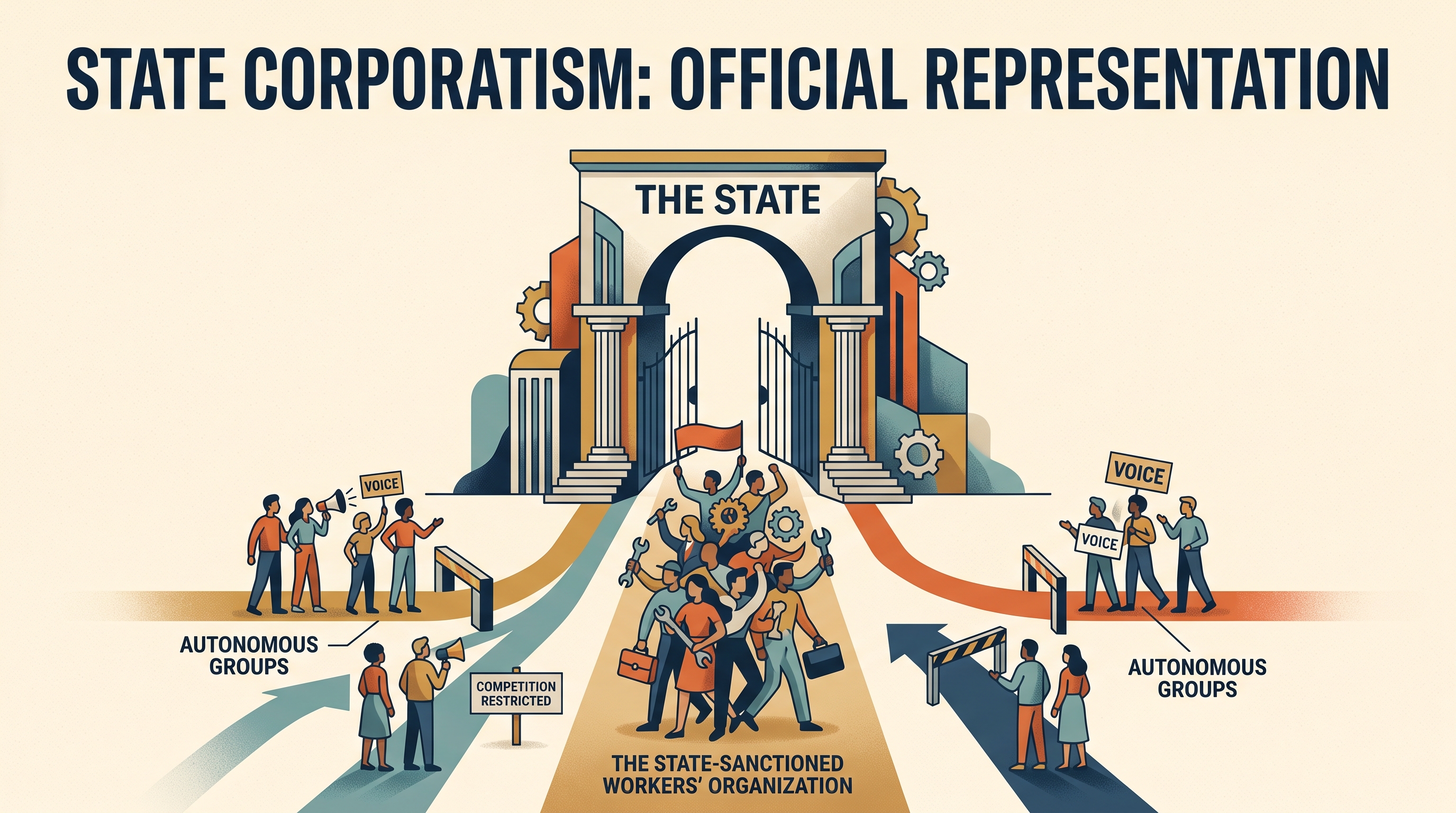


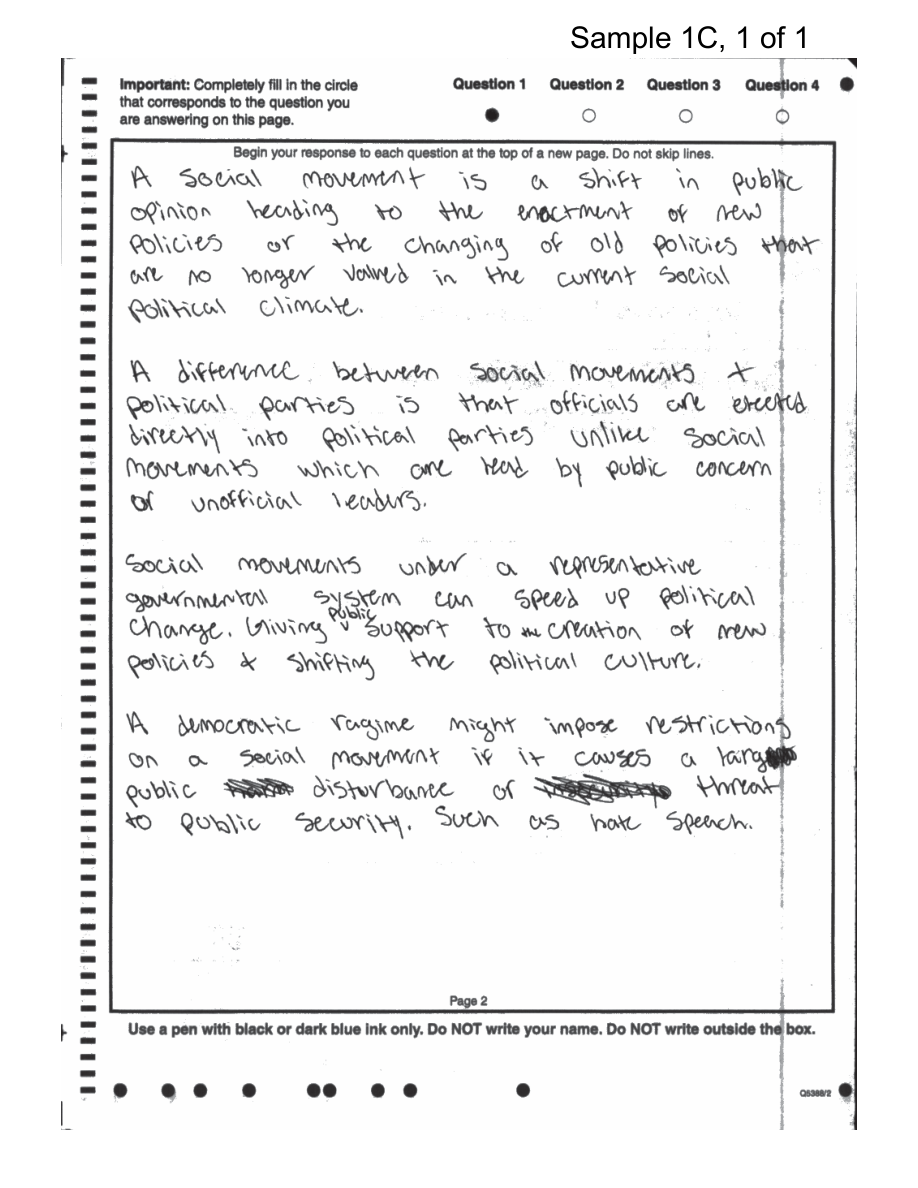
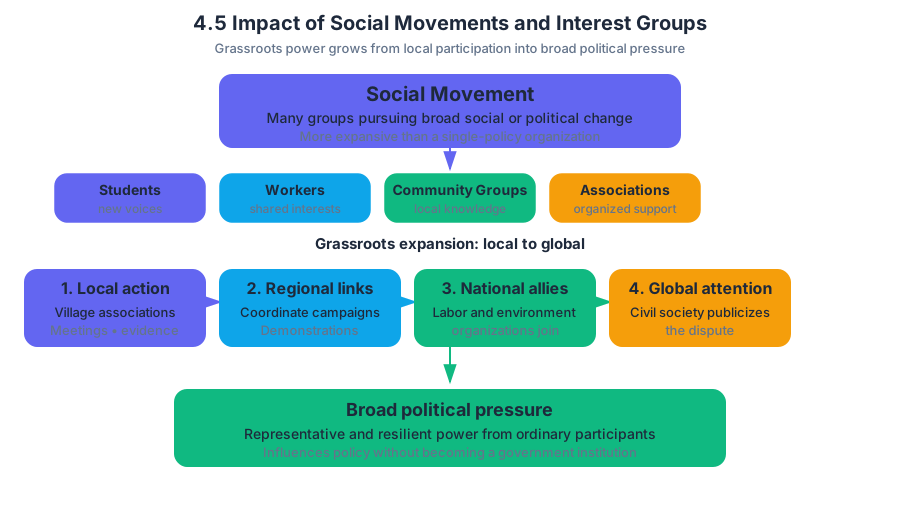
4.6 Pluralist and Corporatist Interests
Key concepts: Pluralist interests · Corporatist interests · Unit 4: Party and Electoral Systems and Citizen Organizations · Topic 4.6 curriculum · Relationships between overarching educational goals and specific content knowledge · Hierarchical curriculum structure
A political system reveals how it treats organized interests: does the state let many groups compete for influence, or does it organize representation through a limited set of officially recognized organizations?
4.6 Pluralist and Corporatist Interests
A political system reveals how it treats organized interests: does the state let many groups compete for influence, or does it organize representation through a limited set of officially recognized organizations? Pluralism and corporatism describe these contrasting relationships between citizen organizations and the state.
Pluralist interests operate in a system where multiple, independent groups compete to influence public policy. Corporatist interests operate in a system where the state recognizes, coordinates, or controls a limited number of major organizations that represent social or economic sectors.
The curriculum’s hierarchy: from big idea to usable knowledge
Topic 4.6 Pluralist and Corporatist Interests belongs to Unit 4: Party and Electoral Systems and Citizen Organizations. Its required-course-content layout moves downward from an Enduring Understanding to a Learning Objective and then to Essential Knowledge. The structure matters: the enduring understanding supplies the political principle, the learning objective states the analytical task, and the essential knowledge supplies the distinctions and examples needed to perform that task.
The relevant organizing idea is IEF-3: economic globalization and other internal or external forces can reshape political systems, institutions, policies, and citizen organizations. In Topic 4.6, the key question is not simply whether interest groups exist. It is how the state structures their access to power.
A useful reading path is:
| Curriculum level | Question it answers |
|---|---|
| Enduring Understanding: IEF-3 | What broad forces shape political organization and policy? |
| Learning Objective: IEF-3.B | How can the organization of interests be explained and compared? |
| Essential Knowledge: IEF-3.B.1 and related content | What distinguishes pluralist from corporatist interest representation? |
Pluralist interests: competition among organizations
In a pluralist system, influence is dispersed among many organizations: business associations, labor unions, professional groups, environmental organizations, religious organizations, and other advocacy groups. These groups may lobby officials, provide policy expertise, mobilize members, use media campaigns, or challenge government decisions through courts and elections.
The state does not necessarily treat every organization equally, because money, expertise, membership, and access vary. However, no single organization is supposed to possess an exclusive legal claim to represent an entire social sector. Political influence therefore resembles a crowded marketplace: groups compete, form coalitions, and try to persuade decision makers.
Corporatist interests: organized representation through the state
In a corporatist system, the government structures political representation through a smaller number of officially recognized organizations. A state may negotiate with a national labor federation, a national business organization, or another designated body rather than responding to dozens of independent groups.
Corporatism can improve coordination. Governments may reach agreements about wages, prices, taxation, or economic planning more quickly when recognized organizations speak for large sectors. The trade-off is political autonomy: organizations may receive privileged access, but they may also face state supervision, restrictions on membership, or pressure to support official policies.
Worked comparison: the same policy problem
Suppose a government proposes a major increase in the minimum wage.
- In a pluralist system, several labor unions, employer associations, poverty organizations, economists, and political parties might submit competing proposals. The final policy would emerge from bargaining among independent actors.
- In a corporatist system, the government might invite a recognized labor federation and a national employers’ organization to negotiate a national agreement. Smaller groups could have less direct access, even if the agreement is easier to implement.
The comparison is not “democracy versus dictatorship.” Pluralist arrangements can exist within democracies, while corporatist arrangements can appear in democratic or authoritarian settings. The decisive issue is the relationship between the state and organized interests: open competition and independent access versus structured recognition and state coordination.
Country application and misconception check
The United Kingdom is commonly analyzed through a largely pluralist pattern because many independent groups seek access to policymakers. Mexico’s political history includes strong corporatist features, especially during the long period of Institutional Revolutionary Party dominance, when major labor, peasant, and business organizations were incorporated into state-linked structures. Contemporary systems can be mixed: a country may permit independent advocacy in some sectors while controlling or coordinating representation in others.
Misconception check — “Corporatism means corporations control the government.”
Corporatism does not simply mean rule by private businesses. It refers to a system of organized representation in which the state recognizes and manages major social or economic groups. Businesses may be included, but labor and other sectors can also be corporatist partners.
AP skill: Source Analysis
The suggested skill for this topic is 4.C, Source Analysis: explain how the implications of an author’s argument or perspective may affect political systems, principles, institutions, processes, policies, and behaviors. A strong response identifies the source’s perspective, connects it to pluralist or corporatist organization, and explains a political consequence.
For example, if a source praises a government for consulting one national labor federation, the evidence may suggest corporatist coordination—but the analysis must also ask what happens to unaffiliated workers. The strongest conclusion identifies both the benefit, such as policy coordination, and the cost, such as reduced independent representation.
Retrieval check: A government permits hundreds of independent organizations to lobby, protest, and compete for access, but wealthy groups receive more attention than smaller ones. Is this pluralist or corporatist, and what feature proves your answer?
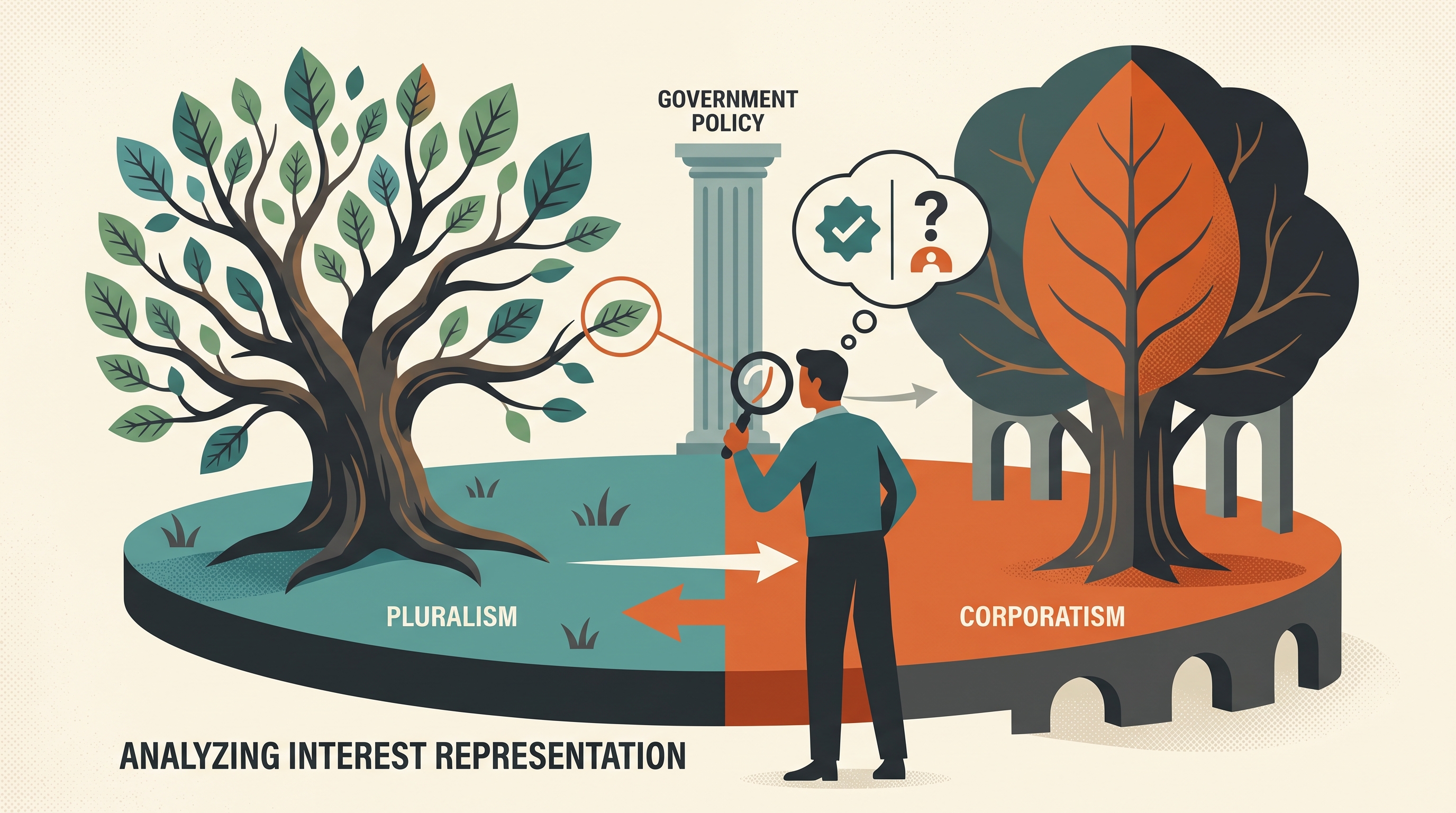
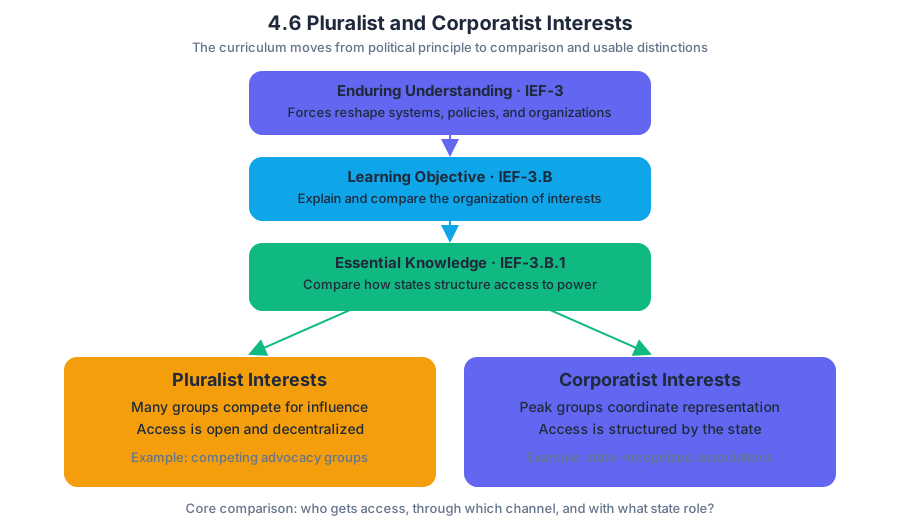
5.1 Impact of Global Economic and Technological Forces
Key concepts: Economic globalization · Technological forces · Sovereignty · Global interconnectedness · Worldwide markets · Economic liberalization · Reduction of state control over economies · International trade institutions · Foreign direct investment · Domestic political backlash
A product assembled in several countries, financed by foreign capital, and sold through a digital platform illustrates a central political reality: economic activity increasingly crosses borders that governments once controlled more directly.
5.1 Impact of Global Economic and Technological Forces
A product assembled in several countries, financed by foreign capital, and sold through a digital platform illustrates a central political reality: economic activity increasingly crosses borders that governments once controlled more directly. Economic globalization is the growth of interconnected economic networks and a worldwide market in which workers, goods, capital, and corporations operate across political borders.
Learning Objective IEF-3.A: Explain how global economic and technological forces influence political policies, behaviors, and culture.
The enduring idea is that economic globalization and economic liberalization have positively and negatively affected political policies and behaviors. Global connections can create growth, investment, and cooperation, but they can also reduce state control, intensify inequality, challenge cultural stability, and provoke resistance.
Economic globalization: connection and reduced control
Under IEF-3.A.1, economic globalization has three connected features: increasingly integrated networks, a worldwide market with actors less constrained by national borders, and a reduction in state control over national economies. Trade and investment deepen cross-national connections, so a policy made in one country can affect workers, consumers, businesses, and governments elsewhere.
Technological forces accelerate this process by making communication, financial transfers, production, and information exchange faster across distance. Technology does not eliminate political borders, but it makes those borders less effective as barriers to economic activity. The result is greater global interconnectedness—and a more complicated relationship between national authority and international markets.
A useful distinction is:
| Concept | Political meaning |
|---|---|
| Sovereignty | A state’s supreme legal authority to govern its population and territory without outside interference |
| Economic globalization | Increasing cross-border movement of workers, goods, capital, and corporate activity |
| Economic liberalization | Reducing state ownership, tariffs, regulations, or other barriers so markets and private actors have greater freedom |
| Worldwide market | An economic arena in which actors operate across national political borders |
Economic liberalization can include privatizing state-owned enterprises, reducing tariffs and subsidies, lowering regulations, joining trade agreements, or creating special economic zones. Membership in the International Monetary Fund (IMF), World Bank, and World Trade Organization (WTO) has promoted liberalization policies, linking domestic economic choices to global economic governance under IEF-3.A.2.
Multinational corporations and state authority
A multinational corporation (MNC) operates in more than one country and may possess resources greater than those available to a local firm or government agency. Under IEF-3.A.3, MNCs can challenge domestic policies concerning labor, environmental protection, land rights, taxation, and public budgets.
The tension is not simply “government versus business.” A government may welcome foreign investment because it creates jobs, expands production, or brings technology. Yet the same government may face pressure to weaken labor rules, reduce taxes, permit land development, or protect corporate profits—choices that can conflict with domestic priorities.
Worked example: tracing the political effect
Imagine that Country A creates a special economic zone to attract an electronics MNC. The government expects factories, employment, and export revenue. Foreign investment arrives, but the company requests lower taxes and fewer environmental restrictions.
The causal chain is:
- Liberalization: Country A reduces barriers to foreign investment.
- Global connection: An MNC enters with capital, technology, and production networks.
- Policy pressure: The company seeks favorable tax, labor, land, or environmental rules.
- Political response: Civil society groups demand stronger regulation.
- Political behavior: Students, workers, or disenfranchised groups protest.
- Authority challenge: If inequality or environmental damage grows, citizens may blame the government for surrendering control.
This example shows why globalization can produce both positive and negative effects. Economic growth may strengthen government legitimacy, while unequal benefits or cultural disruption may weaken it.
Sovereignty, culture, and backlash
Globalization can challenge sovereignty when a government must comply with international trade policies that conflict with national laws. The government formally remains sovereign, but its practical policy choices become more constrained by international commitments, foreign governments, MNCs, and global financial institutions.
Foreign direct investment can also introduce outside values, consumption patterns, and workplace practices that challenge traditions, producing cultural erosion. Economic development may further create inequality or environmental damage, leading to domestic unrest and challenges to government authority.
Under IEF-3.A.4, globalization and neoliberalism can generate internal conflict through increased demands from civil society groups, protests by students and marginalized groups, arrests of protesters, social-media restrictions, and the empowerment of nationalist or populist groups that blame governments for economic and cultural change.
Misconception check: Globalization does not automatically weaken every state or benefit every citizen. Its effects depend on who gains resources, who bears costs, and how governments respond.
In-flow retrieval check
A government joins the WTO, lowers tariffs, attracts an MNC, and later faces protests over pollution and unequal wages. Identify one benefit, one challenge to sovereignty, and one political behavior produced by this sequence. A strong answer connects each effect causally rather than merely listing globalization-related terms.
Suggested skill: Data Analysis — Describe the data presented. When a graph or table shows trade, investment, inequality, or protest trends, first identify the visible pattern accurately; then connect that pattern to IEF-3.A without claiming that the data alone proves a cause.
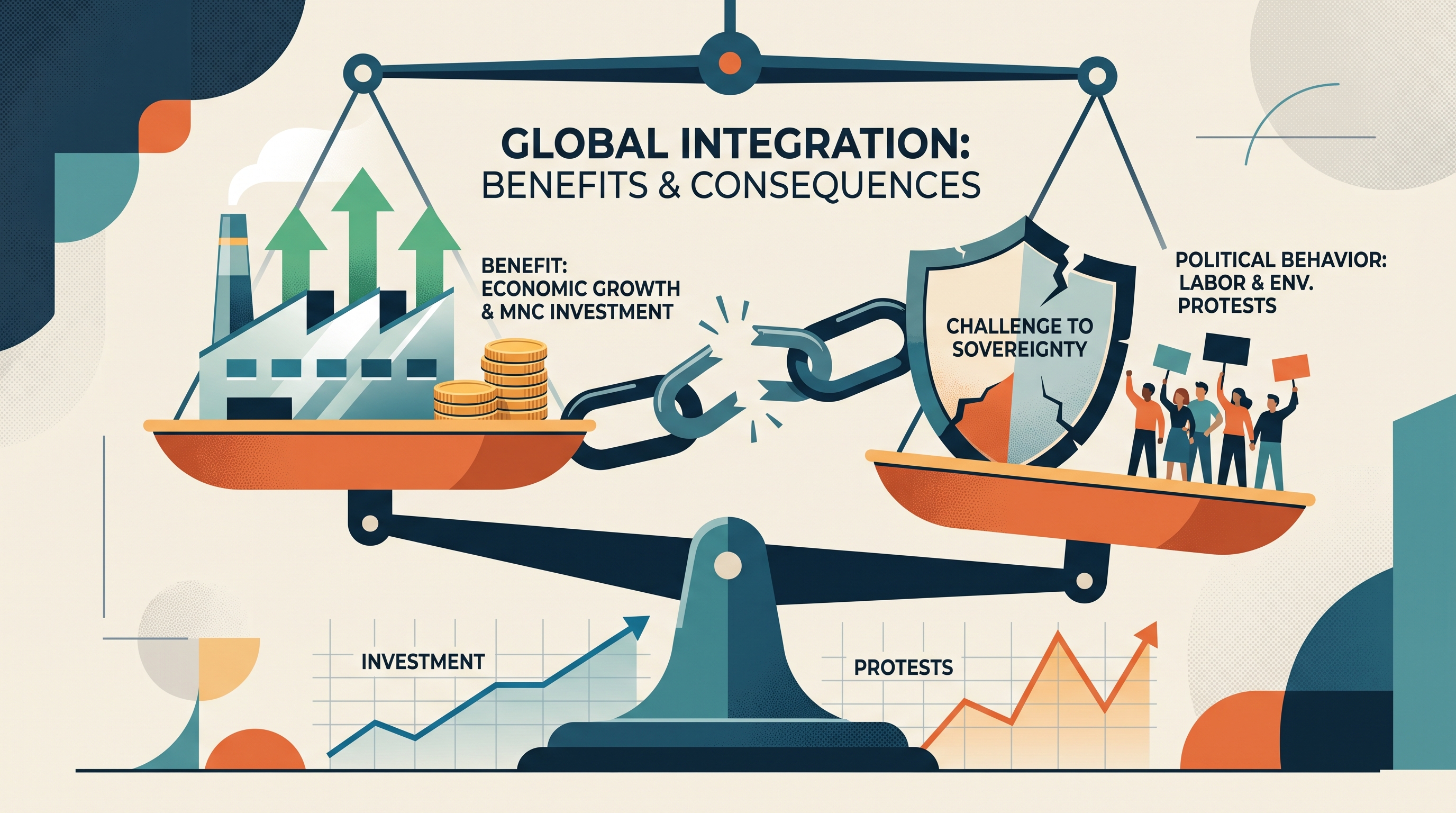
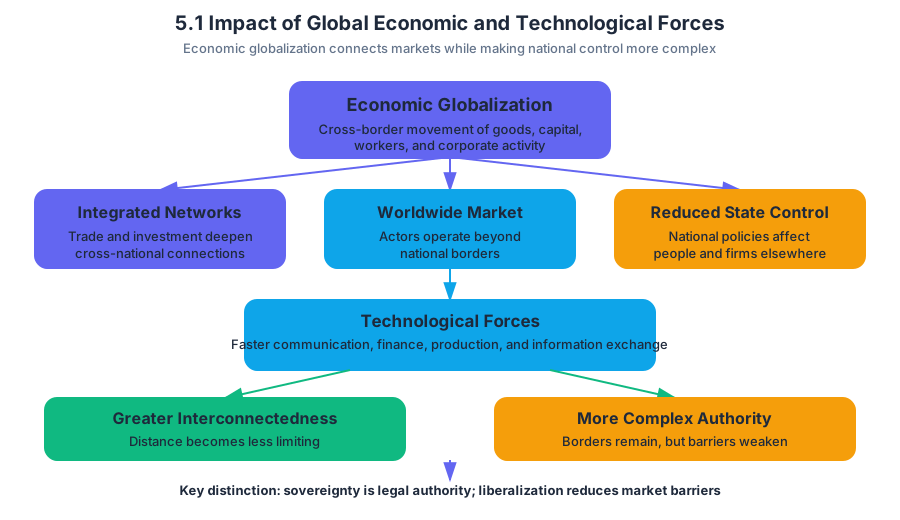
5.2 Political Responses to Global Market Forces
Key concepts: Global market forces · Political responses to economic globalization · Economic liberalization · Private ownership of industry · State ownership and re-nationalization · Joint ventures with foreign companies · Domestic economic conditions · Domestic demands · State control or influence over domestic politics · Oil and natural-gas industries
Governments do not respond to global market forces in one uniform way: they may privatize state industries, invite foreign investment, form partnerships with international companies, or reclaim industries for the state.
5.2 Political Responses to Global Market Forces
Governments do not respond to global market forces in one uniform way: they may privatize state industries, invite foreign investment, form partnerships with international companies, or reclaim industries for the state. The central question is: Who should control economically important resources when domestic needs and international market pressures collide?
Enduring Understanding — IEF-3: Economic globalization and economic liberalization have positively and negatively affected political policies and behaviors.
Learning Objective — IEF-3.B: Compare political responses to global market forces.
The policy choice: open, share, or reclaim control
Global market forces are pressures created by the movement of capital, goods, companies, and investment across national borders. Governments respond to these forces for at least three connected reasons:
- to improve domestic economic conditions, such as employment, investment, production, or government revenue;
- to address domestic demands, including demands for affordable energy, jobs, development, or public services; and
- to control or influence domestic politics by strengthening legitimacy, rewarding supporters, limiting opposition, or protecting national sovereignty.
A useful way to visualize the policy problem is as a three-position spectrum:
At one end, economic liberalization expands private ownership and competition. In the middle, the state shares control with private or foreign firms. At the other end, the government increases state ownership, sometimes through re-nationalization, meaning that industries previously transferred to private or foreign control are brought back under state control.
IEF-3.B.1 — Countries experiment with private ownership and capital
Essential Knowledge IEF-3.B.1 requires comparison of country responses involving private ownership of industry and capital. These policies differ because governments balance economic goals against political control and sovereignty.
| Country or case | Political-economic response | What the government is trying to do |
|---|---|---|
| China | Special economic zones along the coast | Attract investment and encourage production while maintaining broader state authority |
| Mexico | Privatization and increased competition in the oil industry, including Pemex | Reduce exclusive state control and use competition to improve efficiency and investment |
| Nigeria | State-owned Nigerian National Petroleum Corporation, or NNPC, forms joint ventures with foreign companies | Combine state control of a strategic resource with foreign capital and expertise |
| Russia under Putin | Re-nationalization of oil and natural-gas industries and limits on foreign investment | Increase state control over strategic industries and restrict outside influence |
China: selective openness
China’s special economic zones illustrate selective economic liberalization. The government creates designated areas where businesses may face different investment and operating rules, making it easier to attract foreign capital and expand production. The key point is that openness can be geographically and politically managed rather than applied equally throughout the country.
Mexico: privatization and competition
Mexico’s movement toward privatization—the transfer of an industry or enterprise from state ownership to private ownership—and increased competition in the oil industry represents another response. The government uses private participation and competition to seek investment and improved performance, but the policy also changes who controls an important national resource.
Nigeria: joint ventures
Nigeria demonstrates a hybrid response. The state-owned NNPC collaborates with foreign companies in joint ventures, in which two or more organizations share investment, production, risks, and returns. Nigeria therefore does not simply choose between total state ownership and total privatization; it retains a state enterprise while using foreign companies to help extract and produce oil.
Worked comparison: Suppose all three governments want to increase oil or industrial production. Mexico may emphasize privatization and competition; Nigeria may preserve a state-owned corporation but cooperate with foreign firms; China may concentrate liberalized activity in special economic zones. The shared goal is economic improvement, but the political mechanism differs: competition, partnership, or geographically limited openness.
IEF-3.B.2 — Liberalization can help and constrain governments
Essential Knowledge IEF-3.B.2 states that economic globalization and economic liberalization can affect political policies and behaviors both positively and negatively. Foreign investment may bring jobs, technology, production, and revenue, helping a government claim that its policies improve living conditions. However, greater foreign participation can also reduce a government’s control over strategic industries or create political pressure from companies and investors.
Russia under Putin illustrates the opposite direction from liberalization. Re-nationalization of oil and natural-gas industries, combined with limitations on foreign investment, represents state intervention designed to increase government control over resources and reduce foreign influence. This policy may support political authority and sovereignty, but it can also restrict competition and access to outside capital.
Common misconception: “Globalization always means privatization”
Misconception check: Globalization does not require a government to privatize every industry. A country can welcome foreign investment through a special economic zone, cooperate through a joint venture, privatize part of an industry, or restrict foreign ownership while re-nationalizing strategic resources. The AP comparison is not about labeling a country “open” or “closed”; it is about explaining which policy it adopted and why.
AP skill: Country Comparison
The suggested skill for this topic is Country Comparison. To earn comparison credit, identify a meaningful similarity or difference and connect it to a political or economic consequence. For example: Nigeria and Mexico both involve non-state firms in oil production, but Nigeria uses joint ventures with a state-owned corporation, whereas Mexico emphasizes privatization and increased competition; therefore, Nigeria retains more direct state participation in the industry.
A weak comparison merely lists countries. A strong comparison explains the implication: who owns the industry, who receives investment, how much control the state retains, and how the policy may affect legitimacy, sovereignty, or domestic political authority.
Retrieval check
A government keeps its national petroleum company but signs contracts with foreign firms to extract and produce oil. What policy response is this, and how does it differ from Russia’s response under Putin?
Answer: It is a joint venture, like Nigeria’s NNPC collaborations. Unlike Russia’s re-nationalization and foreign-investment limitations, the joint-venture model preserves state participation while inviting foreign capital and expertise.
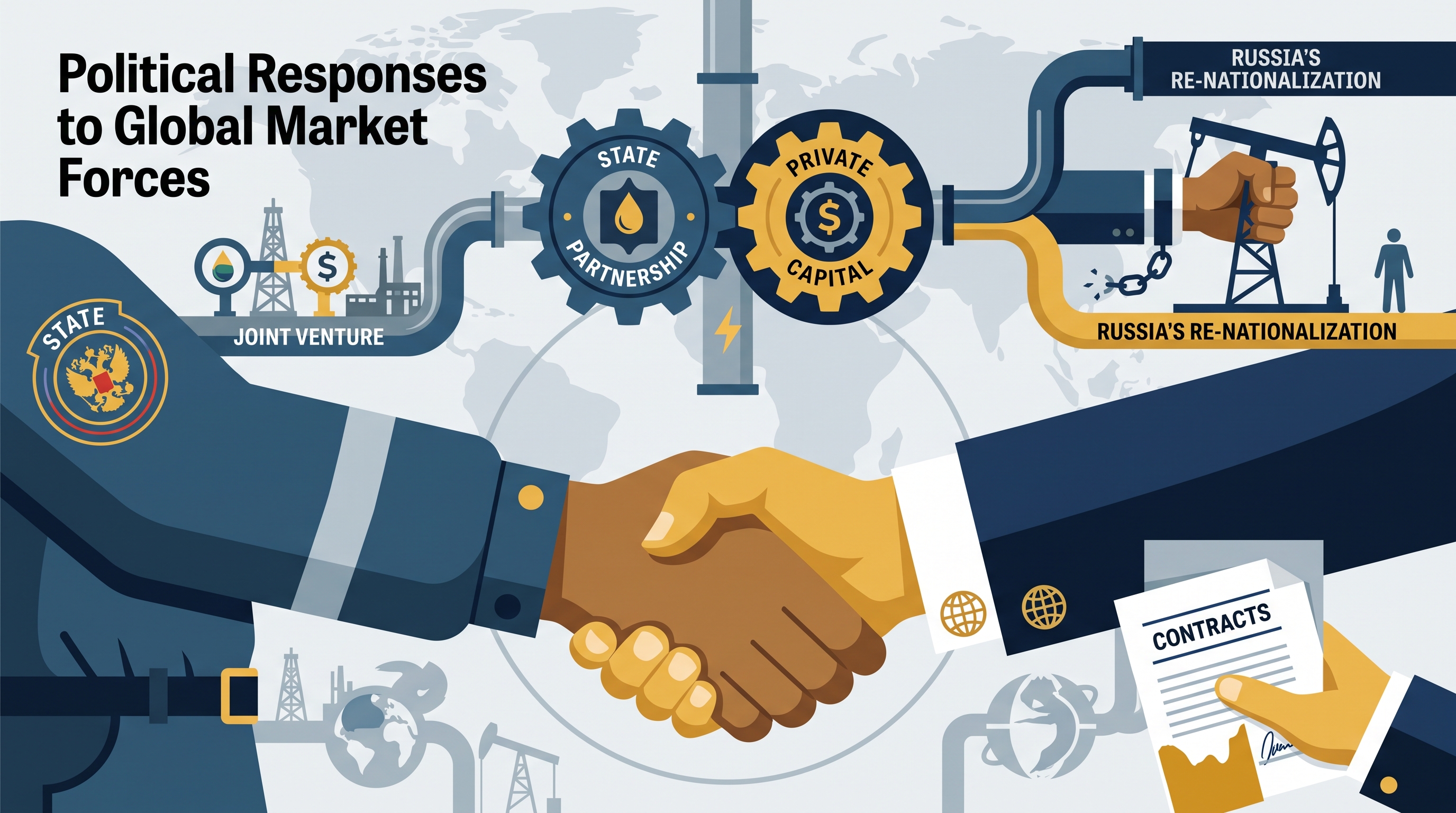
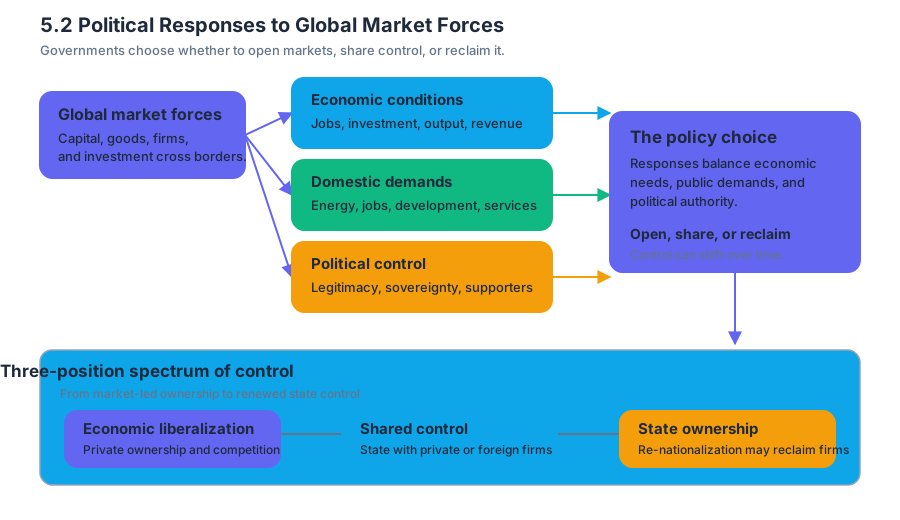
5.3 Challenges from Globalization
Key concepts: Globalization and economic liberalization · Challenges to state sovereignty · Multinational corporations (MNCs) · Economic dependence and loss of autonomy · Government incentives to encourage globalization · Political and economic effects of globalization · Environmental consequences of globalization · Resource extraction and foreign-owned economic interests · Nationalism as a response to globalization · Social conflict and protest movements
Globalization connects economies across political borders, but the same connections that bring investment and jobs can reduce a government’s freedom to regulate its own economy.
5.3 Challenges from Globalization
Globalization connects economies across political borders, but the same connections that bring investment and jobs can reduce a government’s freedom to regulate its own economy. The central tension is simple: How can states gain the material benefits of global integration without surrendering political and economic autonomy?
Sovereignty is a state’s ability to remain independent without outside interference.
Economic globalization links countries through trade, investment, finance, production, technology, and multinational corporations. Economic liberalization is the reduction of government restrictions on economic activity, while globalization describes the wider international network in which goods, capital, companies, and sometimes workers cross borders. The two can reinforce each other, but they are not identical.
The sovereignty trade-off
A government may invite a foreign company to build a factory, extract oil, or provide infrastructure. In return, the company may demand favorable taxes, access to land, relaxed regulations, or protection from future policy changes. The state still possesses formal legal authority, but its practical choices become narrower because reversing the agreement could cost investment, employment, or economic growth.
Multinational corporations (MNCs) are companies that operate in more than one country. MNCs can challenge sovereignty by requiring states to follow corporate rules and regulations in exchange for investment or economic benefits. Their financial resources may allow them to pressure governments, while their goals may conflict with domestic labor protections, environmental rules, land rights, taxation, or public spending priorities.
The challenge is therefore causal, not merely descriptive:
- A state seeks foreign investment.
- An MNC offers capital, production, or employment.
- The MNC negotiates conditions that protect its profits.
- The government accepts limits on regulation or taxation.
- Domestic policy becomes more responsive to corporate demands and less fully controlled by the state.
Worked example: If a government grants an MNC exclusive control over a transportation network, the immediate benefit may be improved infrastructure and jobs. However, if the contract prevents the government from raising safety standards or changing prices, the MNC has influenced domestic policy. That influence demonstrates a challenge to sovereignty.
Who gains—and who loses?
Globalization can limit domestic businesses’ access to markets when foreign firms with greater capital, technology, or economies of scale enter the country. It can also contribute to the privatization of certain industries, shifting services or resources from public control to private ownership. Consumers may receive cheaper goods, but domestic producers and workers may face stronger competition.
Governments may nevertheless encourage economic globalization because it can provide foreign direct investment, economic growth, jobs, infrastructure, and other material benefits. A government may calculate that these gains will raise living standards, increase tax revenue, or strengthen its political legitimacy even when globalization creates risks to sovereignty.
Misconception check — “Privatization equals globalization.” Privatization transfers ownership or management from the public sector to private actors. Globalization increases cross-border economic interdependence. A privatized company may be domestically owned, while a foreign MNC may operate through a publicly owned project; the concepts can overlap, but they are not interchangeable.
Nigeria: globalization, resources, and resistance
Nigeria illustrates how global economic activity can produce political opposition. Economic liberalization and unjust oil-extraction practices contributed to protests and to environmental movements such as the Movement for the Emancipation of the Niger Delta (MEND) and the Movement for the Survival of the Ogoni People (MOSOP). Foreign-owned economic interests motivated groups seeking to preserve Nigerian cultural and economic interests to resist outside control.
The effects extend beyond ownership. Environmental changes connected partly to globalization have contributed to agricultural-production losses and land degradation in Nigeria. Climate-change-related demographic change may also increase conflict as people compete over land, water, and livelihoods. Global economic integration can thus create political effects through environmental damage, displacement, public-health concerns, and nationalist reactions.
China and the human costs of production
In major manufacturing regions of China, severe air pollution has created public-health consequences, including the need for people to wear masks. This example shows why globalization should not be measured only by exports or economic growth: production can generate employment and state revenue while imposing environmental costs on communities.
Skill focus — IEF-3.C, “Explain how globalization creates challenges to regime sovereignty.” The relevant AP disciplinary practice is Concept Application, especially 1.A Define and/or describe concepts or processes, 1.B Explain how political concepts or processes relate to a scenario, and 1.C Explain the causes and effects of political concepts or processes. A strong response defines sovereignty, identifies a specific globalization mechanism, and explains the link between that mechanism and reduced state autonomy.
Retrieval check: A government creates a special economic zone and exempts an MNC from several environmental regulations. What is the strongest explanation of the sovereignty challenge? The answer must connect the investment agreement to the government’s reduced ability to independently make and enforce domestic policy—not merely state that globalization is “bad” or that the company is foreign.
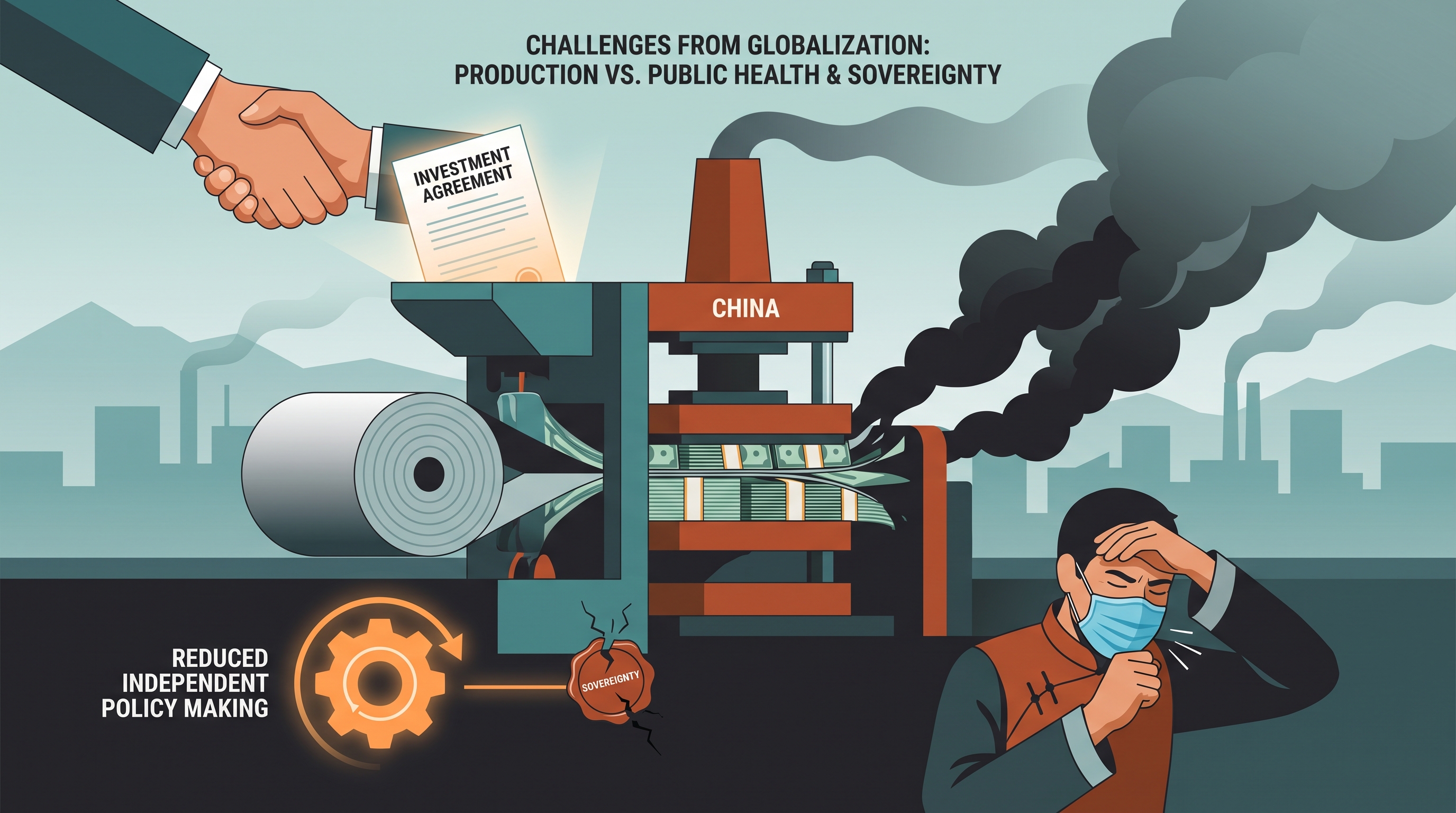
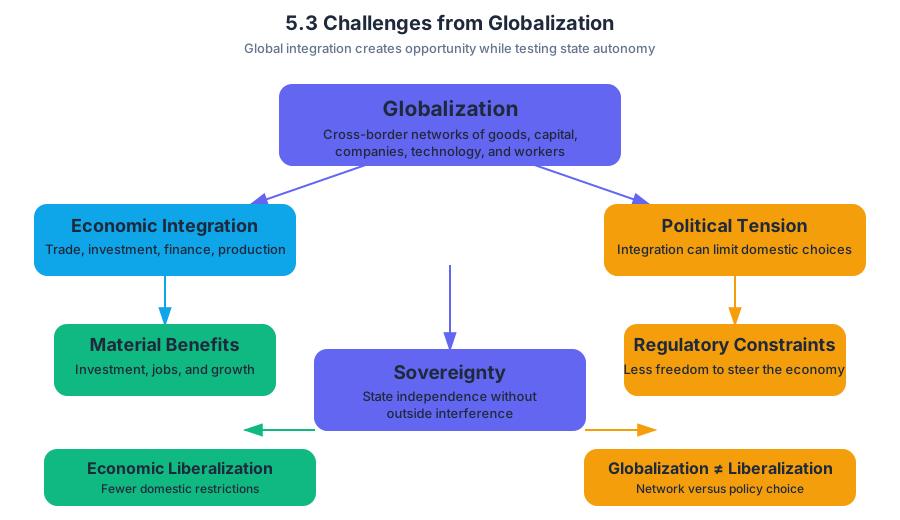
5.4 Policies and Economic Liberalization
Key concepts: Economic liberalization · Economic globalization · Free-market mechanisms · Economic and political equality · Social cleavages · Economic development and growth · Human development, wealth, and inequality · Government responses to separatist violence, drug trafficking, and discrimination · Data analysis and limitations · Effects of liberalization on political policies and behaviors
Economic liberalization occurs when a state reduces its direct control over the economy and expands the role of free-market mechanisms—systems in which prices, production, and investment are influenced more by competition and private decisions than by government direction.
5.4 Policies and Economic Liberalization
Economic liberalization occurs when a state reduces its direct control over the economy and expands the role of free-market mechanisms—systems in which prices, production, and investment are influenced more by competition and private decisions than by government direction.
A government may liberalize by eliminating subsidies and tariffs, privatizing government-owned industries, reducing regulations, and opening the economy to foreign direct investment, meaning investment by foreign companies or individuals in productive activities located inside the country.
What liberalization changes
Imagine a government-owned factory that sells fuel below its production cost because the state pays a subsidy. Liberalization might remove that subsidy, sell the factory to private owners, lower tariffs on imported fuel, and invite foreign companies to build competing facilities. The intended result is greater competition and investment; the immediate result may also be higher prices, layoffs, or pressure on domestic firms.
| Policy | What changes | Intended economic effect | Possible political or social cost |
|---|---|---|---|
| Remove subsidies | The state stops lowering prices or supporting producers | Reduce government spending and market distortion | Higher consumer prices or reduced access |
| Reduce tariffs | Imported goods face fewer border taxes | Increase trade and competition | Domestic industries may lose protection |
| Privatize industries | State-owned firms move into private ownership | Improve efficiency and attract investment | Job losses, corruption, or unequal ownership |
| Expand foreign investment | Foreign firms can build, buy, or finance businesses | Increase capital, technology, and employment | Greater dependence or pressure on state policy |
The policy does not belong exclusively to democracies. Democratic or authoritarian governments may adopt economic liberalization to promote prosperity, economic growth, or economic development. They may also use it to address inflation, attract investment, increase national income, or remedy domestic economic problems.
Freedom, equality, and political consequences
The central political dilemma is that economic freedom does not automatically produce economic or political equality. Neoliberal policies—policies that remove barriers and restrictions on what domestic and foreign economic actors may do—can reduce inflation and increase national income while also widening wealth inequality, preserving corruption, or intensifying existing social tensions.
The benefits and costs may be distributed unevenly across social cleavages, or politically important divisions among groups. A coastal region may gain factories and foreign investment while an inland region loses protected industries. Urban workers may find new employment while rural workers face lower agricultural subsidies. Ethnic, religious, gender, or regional groups may therefore experience the same national policy in sharply different ways.
Economic prosperity can also affect the power of ruling political parties. If liberalization produces visible growth, new jobs, or lower inflation, the governing party may gain support and legitimacy. If it produces unemployment, higher prices, corruption, or environmental damage, opposition movements may portray the same policy as evidence that the government serves investors rather than citizens.
Liberalization may stimulate growth while contributing to environmental pollution, urban sprawl, and uneven development. Economic globalization—cross-border networks involving trade, investment, workers, goods, and capital—can therefore influence political policies and political behavior in both positive and negative ways.
Worked contextual example: reading a liberalization claim
Suppose a report states that Mexico reduced tariffs, privatized several state-owned enterprises, and experienced rising national income after attracting foreign investment.
- Identify the policy: reduced tariffs, privatization, and foreign investment are mechanisms of economic liberalization.
- State the intended outcome: the government may be seeking growth, investment, efficiency, or development.
- Trace a political consequence: if growth creates jobs, the ruling party may gain support; if privatization causes layoffs or corruption, social opposition may increase.
- Check distribution: national income does not reveal whether benefits reached rural, urban, ethnic, gender, or regional groups equally.
- Qualify the conclusion: the report shows an association between liberalization and rising national income, but it does not prove liberalization alone caused the increase.
The same analytical caution applies when examining state responses to separatist group violence, drug trafficking, or discrimination based on gender or religious differences in Iran, Mexico, and Nigeria. Economic policy may alter opportunities and grievances, but a single economic indicator cannot establish the complete political cause of conflict or government behavior.
Data analysis: what the numbers show—and hide
Under Disciplinary Practice 3: Data Analysis, 3.D: Explain what the data implies or illustrates requires a claim tied directly to the evidence. If a graph shows that national income rises after liberalization, an accurate statement is: “The data illustrate an increase in national income during or after the policy change.” A stronger explanation connects that pattern to possible investment, trade, or productivity effects without claiming certainty.
3.E: Explain possible limitations of the data provided requires identifying what the evidence does not show. A national-income measure may omit wealth distribution, inequality, human development, environmental damage, informal employment, regional differences, and the experiences of marginalized groups. The identity and methods of the organization collecting the data may also influence the conclusion.
Misconception check — “Growth proves liberalization succeeded.” Growth measures expansion in economic activity; it does not by itself establish equality, human development, political stability, or improved living conditions. Liberalization can produce higher national income and still deepen inequality or intensify social cleavages.
Retrieval check: A country removes fuel subsidies, lowers tariffs, and permits foreign companies to purchase state-owned factories. Name the economic process, one intended benefit, and one limitation a national-income statistic might conceal. A complete response identifies economic liberalization, explains a possible gain such as investment or growth, and notes that the statistic may hide unequal distribution, unemployment, regional disparities, or environmental costs.
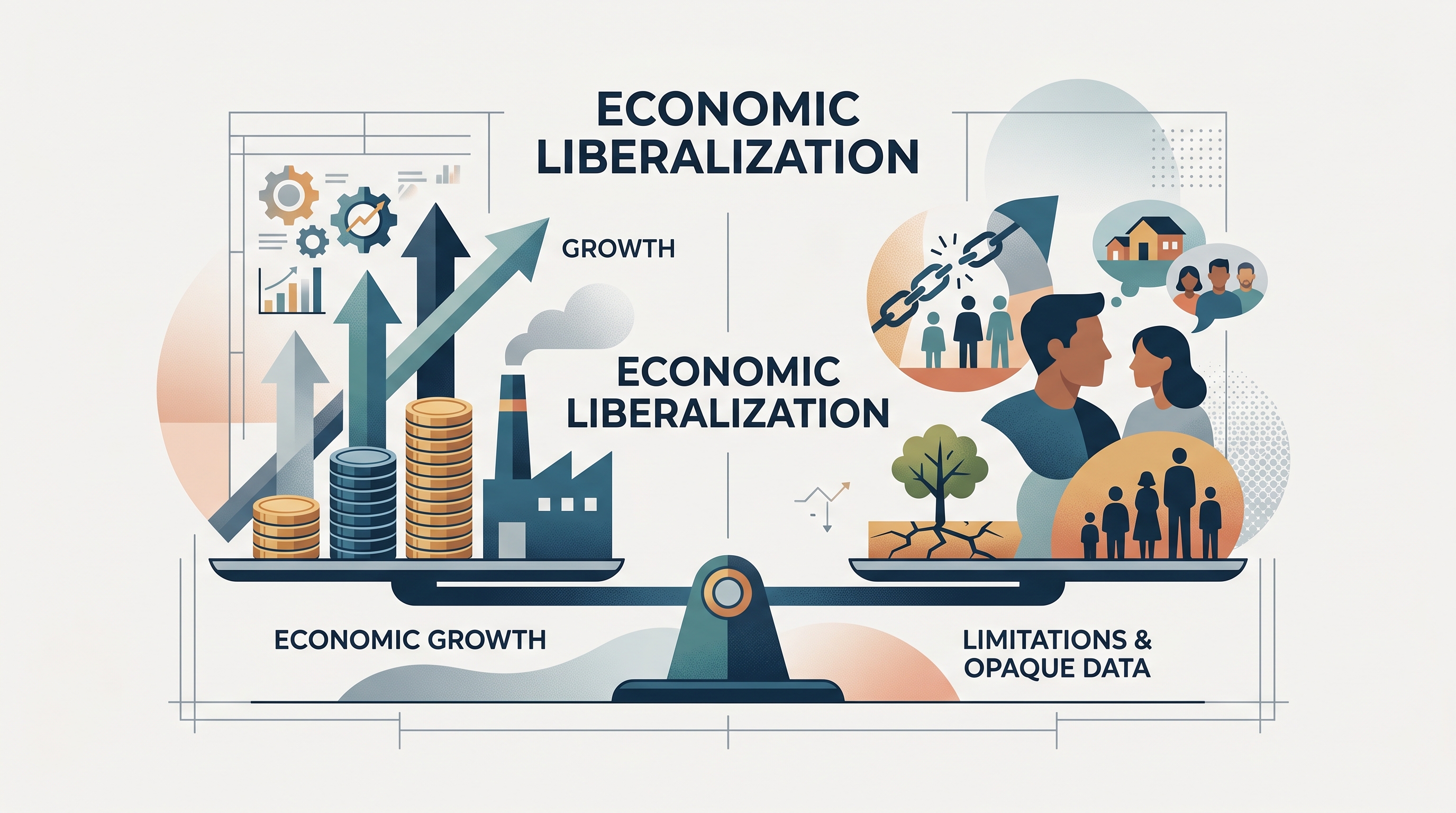




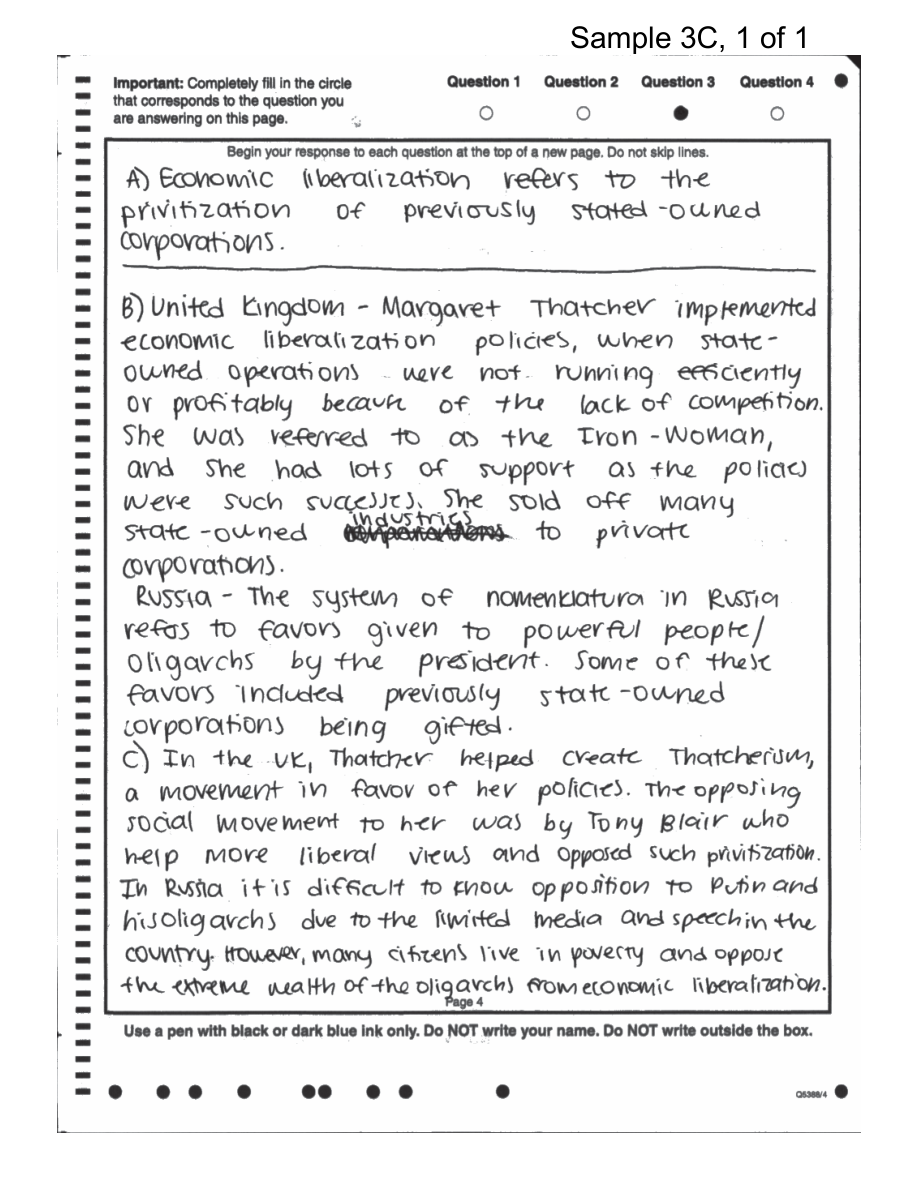
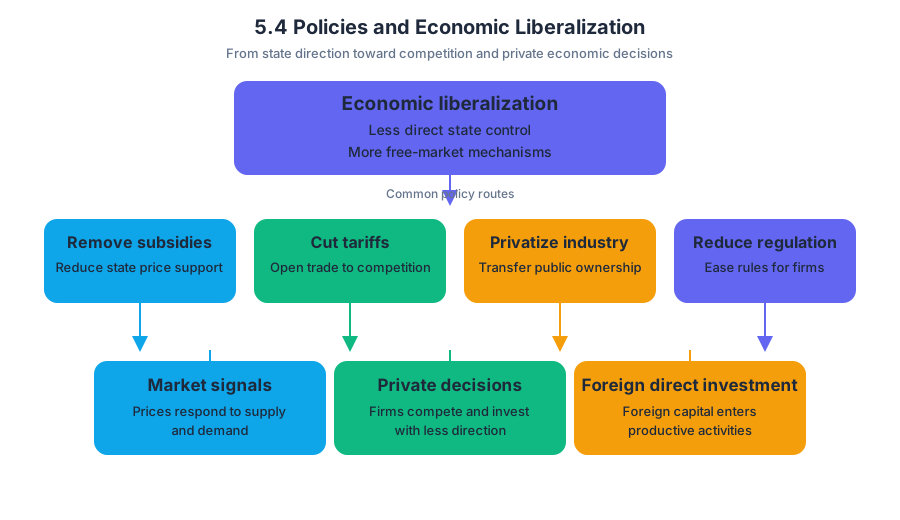
5.5 International and Supranational Organizations
Key concepts: International organizations · Supranational organizations · International Monetary Fund (IMF) · World Bank · Domestic policymakers · National sovereignty · Globalization · Political legitimacy · International agreements and rules · Regime stability
International organizations can influence a government without directly ruling its territory: money, trade rules, and regional agreements can turn international decisions into domestic political choices.
5.5 International and Supranational Organizations
International organizations can influence a government without directly ruling its territory: money, trade rules, and regional agreements can turn international decisions into domestic political choices.
Learning Objective LEG-3.A: Explain how international and supranational organizations influence domestic policymakers and national sovereignty.
Enduring Understanding LEG-3: A government bolsters regime stability by adapting its policies to environmental, political, economic, and cultural conditions.
Three kinds of international influence
An international organization is an institution created by states to coordinate policies, provide resources, or establish shared rules. A supranational organization goes further: member states give the organization some authority that can constrain national governments. National sovereignty is a state’s supreme legal authority to govern its population and territory without outside interference.
| Organization | Best classification | How it influences domestic policymakers |
|---|---|---|
| International Monetary Fund (IMF) | International organization | Attaches conditions to financial assistance, encouraging governments to change economic policies. |
| World Bank | International organization | Uses development loans and their conditions to influence domestic economic and development priorities. |
| European Union (EU) | Supranational organization | Exercises stronger shared authority over member states and can require compliance with common rules. |
| World Trade Organization (WTO) | International rule-setting organization | Establishes trade rules and pressures governments to reduce barriers such as tariffs. |
| Economic Community of West African States (ECOWAS) | Regional organization with limited supranational features | Coordinates regional policies and can pressure members, but its authority is less extensive than the EU’s. |
Financial assistance and domestic sovereignty
The IMF and World Bank influence countries through preconditions attached to financial assistance. A government seeking loans may have to accept policy changes before receiving money or continuing to receive it. IMF assistance, for example, can require a structural adjustment program involving privatization of state-owned companies, reduced tariffs, and reduced government subsidies for domestic industries.
The key political issue is not simply whether the policy is economically useful. It is who gets to choose it. A government may formally retain sovereignty while facing severe financial pressure to adopt policies designed partly by an international organization. Domestic policymakers therefore balance immediate access to capital against reduced freedom to set economic policy independently.
Worked example: Suppose a government cannot pay its debts and requests IMF assistance. The IMF requires privatization and lower tariffs. The government accepts because the loan may prevent a deeper financial crisis. Domestically, however, affected workers and protected industries may accuse leaders of surrendering national sovereignty. The causal chain is:
- Financial crisis creates dependence on outside assistance.
- The IMF attaches policy preconditions to that assistance.
- Domestic policymakers alter economic rules to qualify for support.
- The government gains financial relief but loses some policy autonomy.
Trade rules and national policy choices
The WTO is best understood here as an international rule-setting organization, not as equivalent to the EU. Its trade rules and dispute processes can pressure governments to reduce tariffs and otherwise liberalize trade. The EU possesses stronger supranational authority because member states accept shared rules that can directly constrain national policymaking. ECOWAS promotes regional integration and can exert pressure on members, but its supranational authority is more limited and uneven.
These pressures can conflict with domestic strategies already established in the study of economic policy. Governments that want to protect developing industries may raise tariffs and encourage local production of industrialized products to reduce foreign dependency. International lenders or trade organizations may push in the opposite direction, creating a sovereignty tradeoff: greater access to loans and markets in exchange for narrower policy choices.
Legitimacy, environment, and health
International rules can also strengthen sovereignty indirectly by helping governments solve problems they cannot manage alone. Abiding by international agreements or rules established by supranational organizations may improve citizens’ environment and health. Cleaner air, safer products, or coordinated responses to cross-border pollution can make government authority appear more effective and legitimate.
The reverse is equally important. Environmental crises, including uncontrolled air pollution linked partly to globalization, can decrease political legitimacy—the belief that a government has the right to rule—when citizens see that leaders cannot respond effectively. A government may lose support not because an international organization directly removed its authority, but because domestic failures expose the limits of its capacity.
Globalization as a political force
Globalization increases economic connections among countries through trade, investment, finance, production, and technology. Its political effects differ across countries such as China and Mexico because governments respond according to their institutions, economic goals, and vulnerabilities. International organizations may bring investment and market access, while also increasing exposure to foreign firms, external rules, and environmental pressures.
Misconception check — “International influence always ends sovereignty.” It does not. Sovereignty is challenged when outside conditions constrain domestic choices, but governments often enter agreements voluntarily because the benefits—financial assistance, trade access, regional coordination, or environmental improvement—can strengthen regime stability and legitimacy.
Retrieval check: A government accepts a World Bank loan requiring changes to domestic subsidies. Identify the organization’s category, the mechanism of influence, and one sovereignty tradeoff. A strong answer identifies the World Bank as an international organization, explains that loan preconditions shape domestic policy, and notes that financial assistance is gained while independent policymaking is reduced.

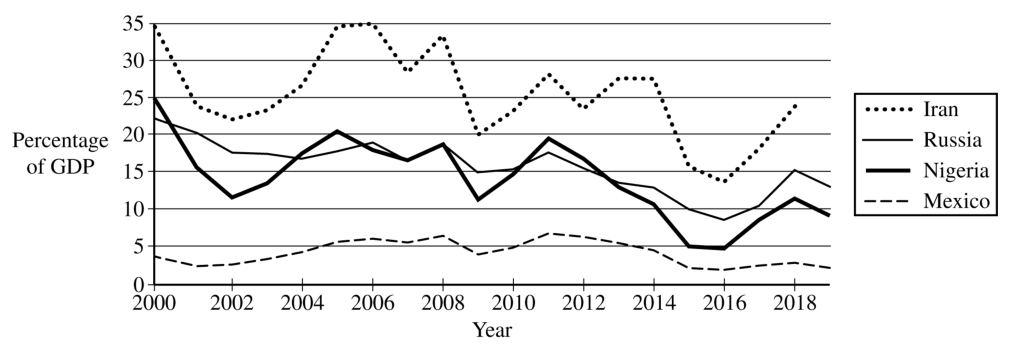
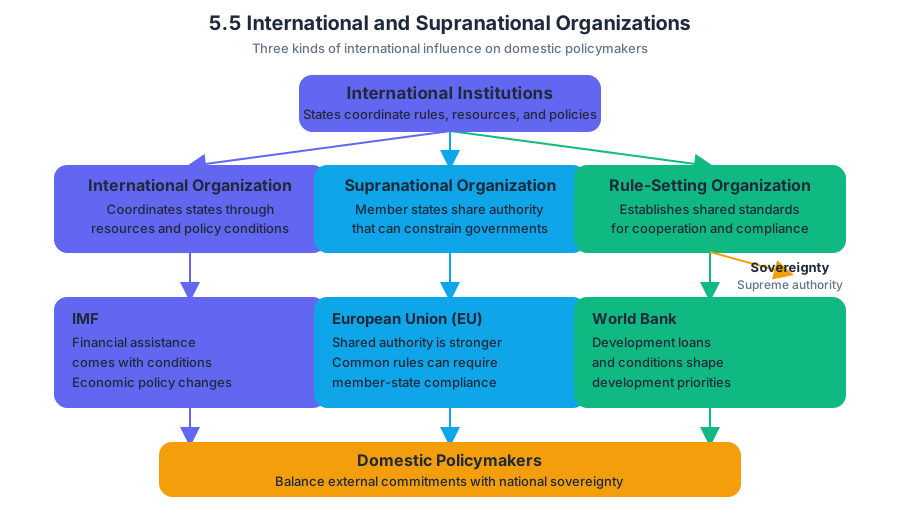
5.6 Adaptation of Social Policies
Key concepts: Adaptation of social policies · Political, cultural, and economic change · Government creation of new social policies · Gender equity · Health care policy · Gender quotas in Mexico · Unequal gender access to education in northern and southern Nigeria
A government’s social policy changes when society changes—or when existing policies no longer solve political problems. Adaptation of social policies means creating or revising government policies to respond to political, cultural, and economic conditions while improving citizens’ lives and often strengthening…
5.6 Adaptation of Social Policies
A government’s social policy changes when society changes—or when existing policies no longer solve political problems. Adaptation of social policies means creating or revising government policies to respond to political, cultural, and economic conditions while improving citizens’ lives and often strengthening political legitimacy.
Essential idea — LEG-3.B.1: In response to political, cultural, and economic changes, governments create new social policies, including policies involving gender equity, health care, and education.
A useful way to picture adaptation is as a policy feedback loop: social conditions create pressure, governments choose a response, and the results affect both citizens’ welfare and the government’s legitimacy.
Why governments adapt social policies
Political change may create new demands for representation or equality. Cultural change may alter public expectations about gender, education, or family life. Economic change may increase poverty, expand access to technology, or create new demands for public health and education. Governments respond by implementing social welfare policies—policies intended to reduce poverty, increase literacy, improve public health, or expand access to political and social opportunities.
The response has two connected purposes:
| Policy purpose | What the government is trying to do |
|---|---|
| Improve citizens’ lives | Expand access to education, health care, political participation, or economic security |
| Maintain or bolster political legitimacy | Demonstrate that the government recognizes social needs and can respond effectively |
This does not mean that every policy is equally effective or equally inclusive. A government may adopt a policy to satisfy public demands, manage conflict, or improve its reputation, yet still leave important inequalities in place.
Gender equity as social policy
Gender equity refers to policies designed to reduce unfair barriers affecting people because of gender. It can involve voting rights, access to elected office, appointment to government positions, education, university programs, sporting events, and reproductive policy.
Iran illustrates why social policy must be examined as a set of related rules rather than reduced to a single label. Iranian policies address women’s voting, election to the Majles, and appointment to cabinet positions. At the same time, disputes concern female access to certain university degree programs and women’s attendance at and participation in sporting events. These examples show that political access in one area does not automatically produce equal access in every other area.
Mexico provides another example. Gender quotas are policies that reserve or require a specified share of candidacies or political positions for women. They are intended to correct unequal representation by changing the rules through which political offices are filled. Mexico also demonstrates that social policy can vary within one country: abortion policies differ among local and state governments.
Worked comparison: Suppose women gain the formal right to vote but remain sharply underrepresented among legislators. Voting rights create political access, but they do not guarantee descriptive representation. A gender quota addresses the second problem by changing recruitment and election rules. The policy therefore adapts the political system to an inequality that the original rule did not solve.
Education and health care
Education and health care are also social-policy areas because governments decide who receives services, under what conditions, and with what level of public support. Education policy can increase literacy and expand opportunity; health care policy can improve public health and reduce preventable inequalities.
Gender access to education is unequal between northern and southern Nigeria. The comparison matters because national policy alone does not guarantee equal outcomes across regions. Local economic conditions, cultural expectations, infrastructure, security, and government capacity can shape whether girls and women can actually attend school.
A similar distinction applies to health care: announcing universal access is not the same as delivering clinics, trained personnel, medicines, and affordable treatment. Policy design states what the government intends; policy implementation determines what citizens experience.
Misconception check
Misconception: “A new social policy automatically creates equality.” A policy is an official response, not proof that the underlying problem has disappeared. To evaluate adaptation, ask three questions: What political, cultural, or economic change produced pressure? What policy did the government create or revise? Did implementation improve access, and did the response strengthen or weaken legitimacy?
CED alignment and retrieval check
Enduring Understanding LEG-3.B: Governments implement social welfare policies to reduce poverty, increase literacy, and improve public health, both to improve citizens’ lives and to maintain or bolster political legitimacy.
Learning Objective LEG-3.B.2: Explain how governments adapt social policies to address political, cultural, and economic changes. Suggested Skill: Country Comparison—especially explaining the implications of similarities and differences between countries with similar political systems, as identified in the CED.
Retrieval check: Nigeria shows unequal gender access to education between its northern and southern regions. Identify one political, cultural, or economic condition that could create pressure for a new education policy, then explain how that policy might improve citizens’ lives and bolster political legitimacy.
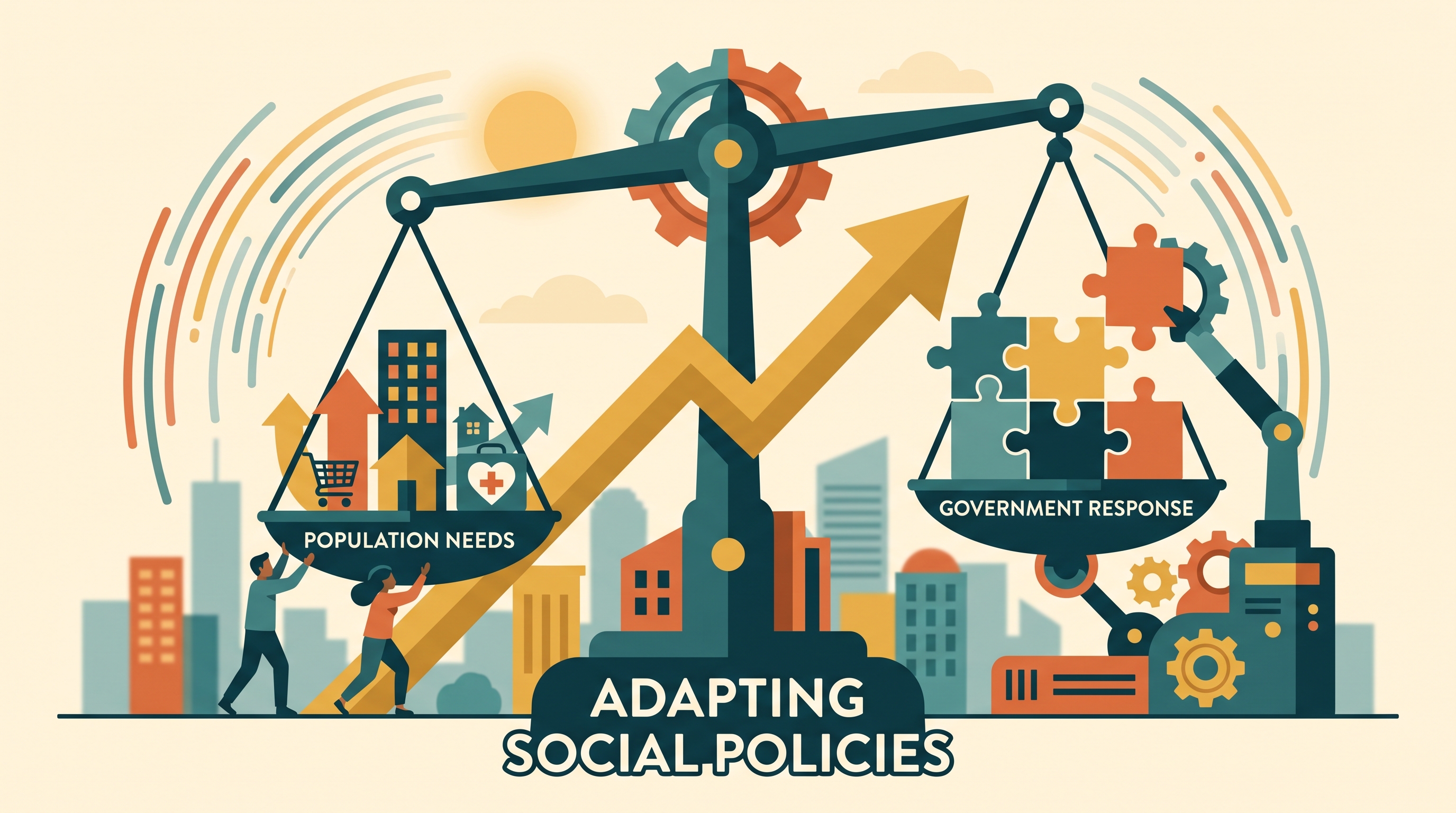
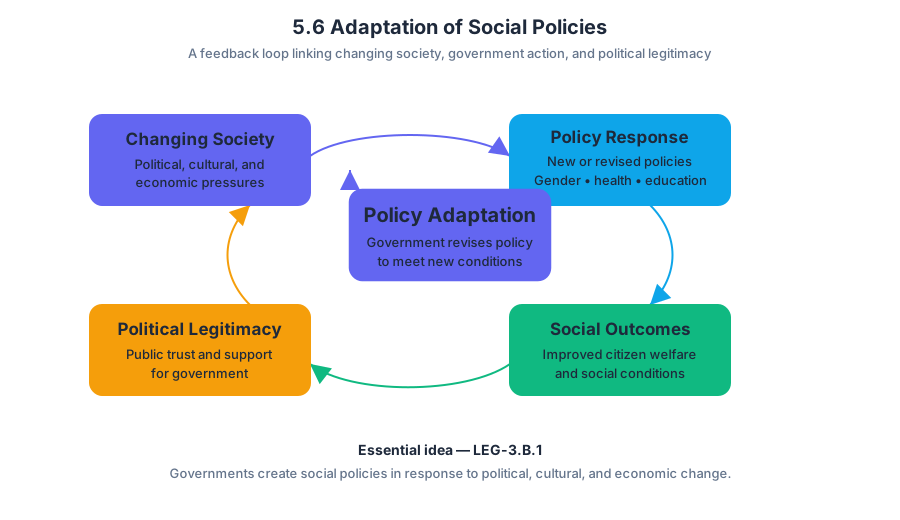
5.7 Impact of Industrialization and Economic Development
Key concepts: Impact of industrialization and economic development · Rapid industrialization · Economic development · Changes in governmental policies · Regime stability · Policy adaptation to environmental, political, economic, and cultural conditions · Argumentation · Refutation, concession, and rebuttal · Political and economic changes and development
Rapid industrialization can force a government to rewrite its policies because factories, cities, energy systems, and social identities change faster than existing institutions can manage.
5.7 Impact of Industrialization and Economic Development
Rapid industrialization can force a government to rewrite its policies because factories, cities, energy systems, and social identities change faster than existing institutions can manage.
LEG-3 — Enduring Understanding: A government bolsters regime stability by adapting its policies to environmental, political, economic, and cultural conditions.
From economic change to policy change
Rapid industrialization is the accelerated growth of factories, mechanized production, urban employment, and infrastructure. Economic development is the broader improvement of productive capacity and living conditions, often involving higher incomes, transportation networks, education, health systems, and technological change. These processes can generate prosperity, but they also create problems that older policies were never designed to solve.
The causal chain is:
Industrial growth increases energy use, pollution, urban crowding, labor demands, and public expectations. As these pressures become politically visible, governments may radically change environmental regulation, infrastructure spending, health policy, industrial incentives, and labor rules. Policy adaptation is therefore not simply an economic choice; it can become a strategy for preserving regime stability, meaning the continued survival and effective operation of a political regime.
LEG-3.C — Learning Objective
LEG-3.C: Explain how rapid industrialization and economic development have produced radical changes in governmental policies.
LEG-3.C.1 — Essential Knowledge: Rapid industrialization and increasing dependence on energy from fossil fuels have created environmental and political problems that governments must address to protect citizens.
Possible government responses include physically moving factories away from densely populated or environmentally vulnerable areas, subsidizing green technologies so industries can comply with new standards, expanding infrastructure, and strengthening environmental regulation. Governments may also require nationwide conversion to hybrid vehicles or develop infrastructure capable of responding to health crises intensified by urbanization and industrial concentration.
Why policy adaptation can stabilize a regime
Industrialization creates winners and losers. Businesses may gain profits, while workers experience dangerous conditions; urban residents may gain jobs but face pollution; citizens may demand cleaner air, safer transportation, and reliable public services. If the government responds effectively, it can demonstrate policy responsiveness—the capacity to address public problems—and strengthen public acceptance of the regime.
If the government refuses to adapt, environmental damage or economic disruption can become evidence that leaders are incompetent, corrupt, or indifferent. Protests, labor unrest, regional resistance, or declining trust may follow. Policy change does not guarantee stability, but failure to address industrial problems can make instability more likely.
Adaptation depends on conditions
Governments do not use one universal response. They adapt policies to four conditions:
- Environmental conditions: A government facing severe industrial pollution may relocate factories, impose emissions rules, or subsidize cleaner technology.
- Political conditions: Leaders may expand infrastructure or regulate industry when citizens, opposition parties, or social movements make environmental protection politically urgent.
- Economic conditions: A government may protect jobs during a transition to cleaner energy, offer subsidies to industries, or invest in transportation to sustain economic growth.
- Cultural conditions: Industrialization can change language use, education, workplace expectations, and group identities. A government might provide public services in multiple languages, revise schools to recognize new cultural identities, or create labor and integration policies that accommodate changing urban populations. Such adaptation can reduce perceptions of exclusion and help different groups regard the regime as legitimate.
Worked example: Suppose rapid industrialization draws rural communities and migrant workers into a city. Pollution rises, factories demand labor, and residents speak several languages. A government that only builds factories may increase production but deepen conflict. A more adaptive government can combine environmental enforcement, public transit, worker protections, multilingual education, and health infrastructure. Each policy addresses a different condition; together, they reduce grievances and connect economic development to regime stability.
Argumentation: refutation, concession, and rebuttal
The suggested skill is Argumentation 5.D: Use refutation, concession, or rebuttal in responding to opposing or alternate perspectives.
- Refutation shows that an opposing claim is incomplete, logically weak, or unsupported.
- Concession acknowledges that an opposing claim contains a limited truth.
- Rebuttal responds to that claim by explaining why the argument being defended is stronger or more convincing.
Modeled response: “Some observers argue that industrialization inevitably destabilizes regimes because it produces pollution, inequality, and labor conflict. This claim is incomplete: industrialization creates pressures, but instability is not automatic. Governments can refute the prediction of inevitable collapse by pointing to adaptive policies such as factory relocation, green-technology subsidies, infrastructure investment, and environmental regulation. It is fair to concede that rapid growth can initially intensify grievances. However, the stronger rebuttal is that governments capable of adapting policies to environmental, political, economic, and cultural conditions can convert those pressures into greater responsiveness and regime stability.”
Misconception check
Misconception: “Economic development always produces political instability.” Development can generate conflict, but its political effects depend on government responses. The key comparison is not industrialization versus no industrialization; it is unmanaged change versus adaptive governance.
Retrieval check: A government introduces factory-relocation rules, subsidizes cleaner technology, expands health infrastructure, and offers multilingual education after rapid urban growth. Identify one environmental, one economic, and one cultural condition being addressed, then explain how the combined policies could bolster regime stability.

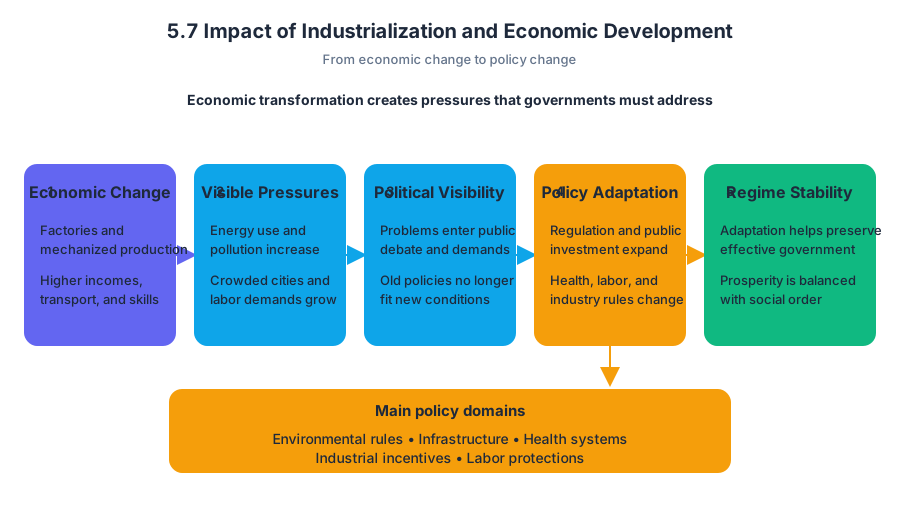
5.8 Causes and Effects of Demographic Change
Key concepts: Demographic change · Political causes of demographic change · Political consequences of demographic change · Environmental consequences of climate change · Conflict · Nigeria · Economic development · Unit 5: Political and Economic Changes and Development · Enduring Understanding LEG-4 · Defensible claims and lines of reasoning
Demographic change is a shift in the size, distribution, or composition of a population over time. A population may grow, shrink, move from rural to urban areas, or cross national borders; each change alters the demands placed on government.
5.8 Causes and Effects of Demographic Change
Demographic change is a shift in the size, distribution, or composition of a population over time. A population may grow, shrink, move from rural to urban areas, or cross national borders; each change alters the demands placed on government.
Enduring Understanding LEG-4: Demographic changes have political causes and consequences, and they can present challenges to a government’s legitimacy.
From population movement to political pressure
People do not move randomly. LEG-4.A.1 identifies growing populations, changing land use and values, and economic opportunities as causes of internal and external population movement. For example, a growing population may place pressure on farmland, while expanding employment in a city attracts workers from rural areas. The result can be rural depopulation, urban growth, changing migration rates, and greater demands for housing, transportation, schools, health care, and employment.
Uneven economic development can attract population to growing regions while depopulating others, producing regional inequalities, migration, and political demands. A government may therefore face two simultaneous problems: rapidly expanding regions need new infrastructure, while declining regions demand investment, services, and protection from economic marginalization.
LEG-4.A.2 adds an explicitly political cause: government policies and employment opportunities can draw workers toward particular geographic regions or influence positive or negative migration rates. A government might locate industries, build transportation networks, subsidize a region, or restrict entry at a border. These choices can deepen preexisting class and regional differences while taxing government resources.
The demographic-change feedback loop
The political process is often circular rather than one-directional:
- A pressure or opportunity emerges: population growth, land degradation, new jobs, or changing land values.
- People move: migration occurs within the country or across borders; rural residents may move to cities.
- Government resources are strained: schools, housing, roads, health systems, and public safety must expand or adapt.
- Inequalities become more visible: migrants and host communities may compete for jobs, land, or services.
- Political demands intensify: citizens may demand redistribution, regional autonomy, immigration controls, or stronger government action.
- Legitimacy is tested: successful adaptation can strengthen confidence in government, while perceived failure can produce protest, distrust, or conflict.
A key analytical distinction is between a cause and a consequence. A government employment program may cause migration toward a region; overcrowded schools and demands for additional public spending may be consequences of that migration.
Nigeria: climate change, migration, and conflict
Environmental consequences of climate change can force demographic change in Nigeria. When environmental conditions damage agricultural production or make land less usable, people may leave vulnerable areas. Movement can increase pressure on receiving communities, especially where employment, land, water, and public services are already limited.
The political consequence is not automatic conflict, but demographic change may increase conflict. New arrivals and established residents can compete over land, livelihoods, and government assistance. Political actors may intensify these tensions by presenting migration as a threat or by distributing resources unevenly. A strong explanation must connect the chain: climate-related environmental pressure causes movement; movement changes local population patterns; altered population patterns increase competition; competition may contribute to conflict and challenge governmental legitimacy.
Worked argument: A defensible claim would be: Climate-related environmental changes in Nigeria may increase conflict when forced migration brings population groups into competition over scarce land, agricultural opportunities, and public resources. The reasoning is stronger when it acknowledges an alternative perspective: migration does not inevitably produce conflict. Effective government planning, fair resource distribution, and cooperation between communities could reduce tensions. The best conclusion is therefore conditional, not absolute.
Data-analysis lens: limitations matter
The suggested skill is Data Analysis (3.E): Explain possible limitations of the data provided. A migration graph may show that a region’s population increased, but it may not reveal why people moved, whether movement was voluntary or forced, or whether the change resulted from births, deaths, internal migration, or international migration. Likewise, a correlation between migration and conflict does not by itself prove that migration caused conflict.
When interpreting data, identify what the evidence demonstrates and what it cannot establish. Ask: Does the measure capture the whole population? Is the time period long enough? Are informal migrants counted? Could another factor—such as unemployment, political exclusion, or weak public services—explain the same pattern?
Misconception check
Misconception: Demographic change is simply a natural population process and therefore has little to do with politics.
Correction: Government policies, employment opportunities, land decisions, and resource distribution can cause population movement. Demographic change then creates political consequences by changing who needs services, who competes for resources, and who believes the government is responding fairly.
Retrieval check
A government builds a major industrial corridor in one region, attracting workers while another region loses population. Name one political cause, one demographic change, and one political consequence. Then state one limitation a population dataset might have when measuring this process.

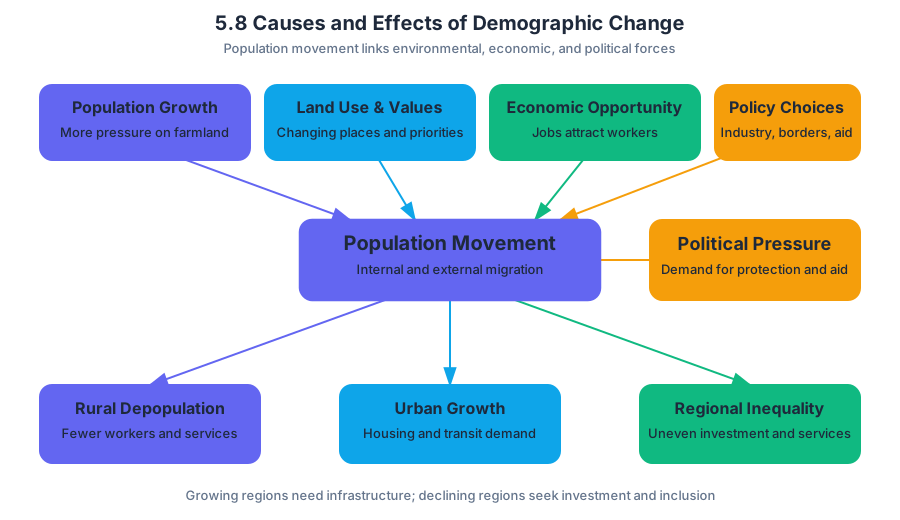
5.9 Impact of Natural Resources
Key concepts: Natural resource exploitation · Globalization · Developing nations · Foreign entities · Rentier state · Nigeria · National revenue · Resource rents · State sovereignty · Democratic and authoritarian regimes
Natural resources can strengthen a state’s economy while simultaneously weakening its sovereignty, legitimacy, and political stability. Oil, gas, minerals, and other valuable resources generate income—but the political consequences depend on who controls that income and how it is distributed.
5.9 Impact of Natural Resources
Natural resources can strengthen a state’s economy while simultaneously weakening its sovereignty, legitimacy, and political stability. Oil, gas, minerals, and other valuable resources generate income—but the political consequences depend on who controls that income and how it is distributed.
Essential question: When a country earns money from natural resources, does that wealth increase the government’s power—or make the country vulnerable to outside actors and internal conflict?
Resource wealth in a globalized economy
Globalization is the increasing connection of economies across political borders through trade, investment, corporations, workers, and capital. It can bring technology, infrastructure, and foreign investment to developing nations. It can also enable foreign entities, such as multinational corporations or foreign governments, to extract resources under conditions that primarily benefit outside actors.
The central political problem is unequal bargaining power:
- A developing nation possesses oil, gas, or minerals.
- A foreign company supplies capital, technology, and equipment.
- The government grants access through contracts, licenses, or concessions.
- The company and state collect revenue.
- Local communities may receive limited benefits while bearing pollution, displacement, or environmental costs.
A government may accept this arrangement because it needs investment or revenue. However, when foreign companies become essential to national income, economic decisions can constrain state sovereignty, meaning the state’s ability to make and enforce policy independently.
Key distinction: Foreign investment is not automatically exploitation. The political issue is whether the host state can regulate extraction, negotiate fairly, protect communities, and retain enough revenue for public purposes.
The rentier state
A rentier state derives all or a substantial portion of its national revenue from resource rents—income earned from controlling and selling valuable natural resources rather than from broad taxation of citizens.
Nigeria is a major example used to illustrate this concept. Oil production has generated substantial state revenue, but dependence on oil can make the economy vulnerable to price changes, production disruptions, corruption, and weak diversification.
| Resource-dependent pattern | Political consequence |
|---|---|
| Government receives revenue from oil exports | Leaders may rely less on taxation |
| Citizens pay fewer direct taxes | Citizens may have less leverage to demand accountability |
| Foreign firms operate extraction projects | State policy may be shaped by external economic actors |
| Wealth is concentrated geographically or socially | Inequality and grievances may intensify |
| One commodity dominates exports | Economic shocks can become political crises |
A rentier state is not simply a country that possesses natural resources. The defining feature is dependence: resource rents provide a substantial share of government revenue.
Worked contextual example: Nigeria
Suppose global oil prices fall sharply. Nigeria’s government now receives less revenue, but it still must fund public services, maintain infrastructure, and respond to political demands. If the economy has not diversified, the government may cut spending, borrow money, or increase pressure on communities and companies.
At the same time, oil-producing communities may argue that they bear environmental damage without receiving a fair share of the wealth. Protest, sabotage, or insurgency can follow. The government may respond with negotiation, regulation, redistribution, or coercion.
This example shows the chain of reasoning:
$$ \text{resource dependence} \rightarrow \text{revenue vulnerability} \rightarrow \text{public dissatisfaction} \rightarrow \text{legitimacy and stability challenges} $$
The same resource wealth can also help leaders maintain power by funding security forces, patronage networks, or public programs.
Regime type does not eliminate resource problems
Natural-resource impacts can occur under both democratic and authoritarian regimes. A democracy may face protests, corruption scandals, regional conflict, or electoral punishment when resource revenue is mismanaged. An authoritarian regime may suppress criticism and use resource income to fund surveillance, security forces, or patronage.
This does not mean that all resource-rich states are authoritarian, or that democracy prevents exploitation. Regime type affects how governments respond, but resource dependence creates incentives and vulnerabilities in either system.
Misconception check
Misconception: “Natural resources automatically produce development.”
Resource wealth can finance schools, roads, health care, and industrial growth. But it can also encourage corruption, weaken accountability, deepen inequality, and expose the state to foreign pressure. The decisive question is not whether resources exist; it is how revenue, ownership, regulation, and political authority are organized.
AP skill connection
This topic is especially suited to Concept Application, Data Analysis, and Argumentation. In a graph showing natural-resource rents as a percentage of GDP, identify the requested country or year precisely, describe a visible pattern, and then explain its political meaning. For example, a high percentage indicates substantial economic dependence; it does not, by itself, prove corruption or authoritarianism.
Essential Question Check: Why might resource revenue increase a government’s power over citizens while decreasing the state’s independence from foreign companies?
CED alignment: Learning Objective 5.9.A; Essential Knowledge 5.9.A.1, 5.9.A.2, and 5.9.A.3.
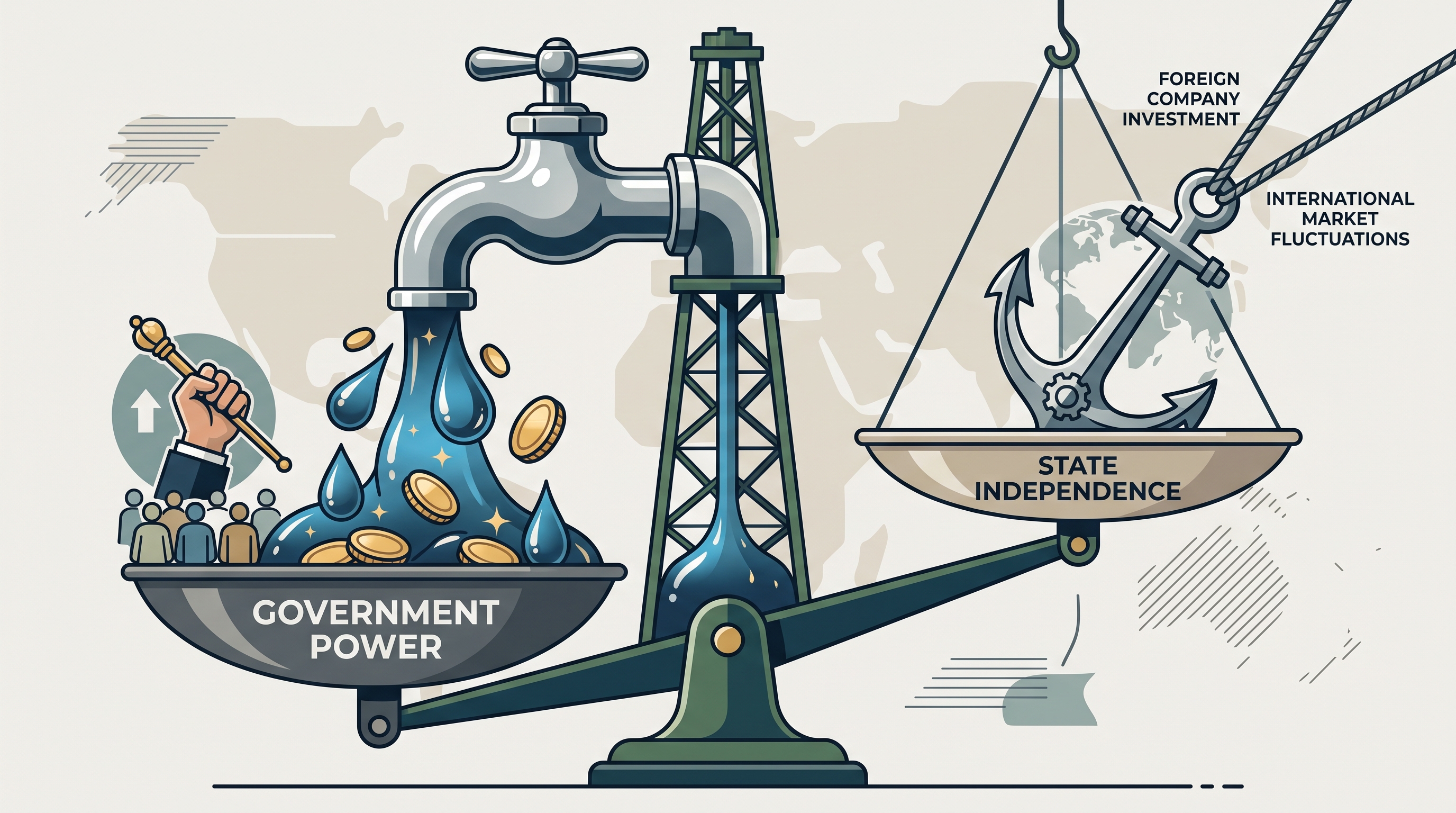
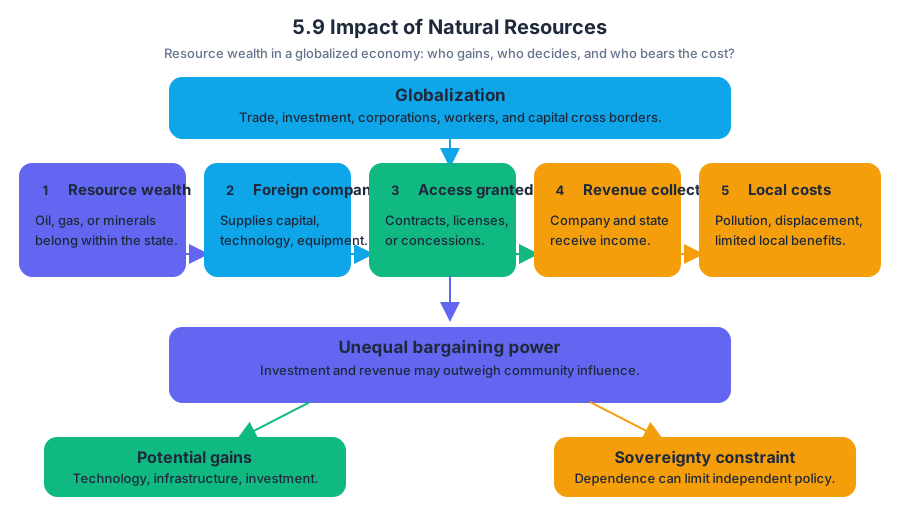
AP Practice 1
Key concepts: Transparency in AP course expectations · Evidence-based reasoning and independent judgment · Respectful debate and classroom inclusivity · Informed choice and access to AP courses · Equitable access to challenging curricula · Comparative government disciplinary practices · Data interpretation, comparison, and application · Evidence-based argumentation · Big ideas and cross-cutting conceptual understanding · Rule of law and limits on arbitrary government decisions
AP Comparative Government and Politics is an introductory college-level course equivalent to a one-semester college course, and it has no prerequisites. Its central discipline is comparison: students examine political structures, policies, and challenges across China, Iran, Mexico, Nigeria, Russia, and the United…
AP Practice 1
AP Comparative Government and Politics is an introductory college-level course equivalent to a one-semester college course, and it has no prerequisites. Its central discipline is comparison: students examine political structures, policies, and challenges across China, Iran, Mexico, Nigeria, Russia, and the United Kingdom while using evidence rather than adopting a required political viewpoint.
The public Course and Exam Description, sample assessments, and related course materials make expectations transparent. Students and teachers can see the required content, the five big ideas, and the disciplinary practices that shape assessment. That transparency matters because AP enrollment should be an informed choice: students should understand the type of reading, data interpretation, comparison, and evidence-based writing the class requires, while teachers should clearly communicate the classroom experience students are agreeing to enter.
What AP Comparative Government asks you to do
The course repeatedly develops five disciplinary practices:
| Disciplinary Practice | What the student does |
|---|---|
| Disciplinary Practice 1: Concept Application | Uses a political concept to interpret a concrete situation. |
| Disciplinary Practice 2: Country Comparison | Identifies meaningful similarities and differences among the six selected countries. |
| Disciplinary Practice 3: Data Analysis | Reads tables, graphs, and other quantitative information accurately. |
| Disciplinary Practice 4: Source Analysis | Assesses what a source says, how credible or useful it is, and what conclusions it supports. |
| Disciplinary Practice 5: Argumentation | Develops a defensible claim supported by relevant evidence and reasoning. |
These practices work together rather than appearing as isolated tricks. A student might interpret a graph showing declining trust in government, compare that pattern across Mexico and the United Kingdom, evaluate whether the data source is credible, apply the concept of legitimacy, and then argue whether the trend threatens political stability.
The first practice: conceptual analysis
For this original practice task, work under a 10-minute target, consistent with the short conceptual-analysis format. The strongest response does not merely recognize a familiar word; it defines the concept precisely, applies it to the situation, and explains the political relationship involved.
Rule of law means that states are governed by established laws rather than by the arbitrary decisions of individual government officials.
Practice prompt: A government announces that officials may ignore court decisions whenever those decisions conflict with the leader’s policy goals. Using the definition of the rule of law, explain why this announcement could weaken political legitimacy.
Worked reasoning: First, establish the concept: the rule of law requires government officials—including powerful leaders—to operate within established legal rules. Next, apply it: allowing officials to disregard court decisions replaces legal constraint with personal or arbitrary decision-making. Finally, explain the consequence: citizens may view government authority as unpredictable or unfair, reducing acceptance of the government’s right to rule. That decline in acceptance can weaken political legitimacy, even if the government continues to possess coercive power.
A rubric-aligned response therefore contains three linked moves: a correct definition, a specific application to the scenario, and a causal explanation connecting the rule of law to legitimacy. Naming both concepts is not enough; the response must show how one affects the other.
Evidence, judgment, and disagreement
AP students are expected to assess source credibility, draw conclusions, and form independent judgments. “Independent” does not mean unsupported or purely personal. It means that the conclusion follows from evaluated evidence and reasoning rather than from a required ideological position.
A strong comparative classroom also permits respectful debate. Students may disagree about whether a policy strengthens stability or suppresses dissent, but personal attacks are unacceptable. Criticizing an argument, evidence choice, or interpretation is different from attacking the person making it.
Debate rule: Challenge claims with evidence and reasoning; never challenge a classmate’s worth or identity.
Big ideas that keep returning
The five big ideas are cross-cutting concepts that build understanding across units and spiral through the course: Power and Authority, Legitimacy and Stability, Democratization, Internal and External Forces, and Methods of Political Analysis. The rule-of-law example connects at least three of them: authority is constrained by law, legitimacy depends partly on lawful governance, and methods of political analysis require evidence-based interpretation.
Equitable access means that all willing and academically prepared students should have the opportunity to take challenging AP coursework. Access, however, is strongest when paired with honest information about expectations, appropriate support, multiple perspectives in course materials, and an inclusive environment in which rigorous disagreement remains possible.
Error review: After answering, label your response with three questions: Did I define the concept precisely? Did I apply it to the facts rather than repeat the definition? Did I explain the political consequence? If one answer is no, revise that sentence before moving on.
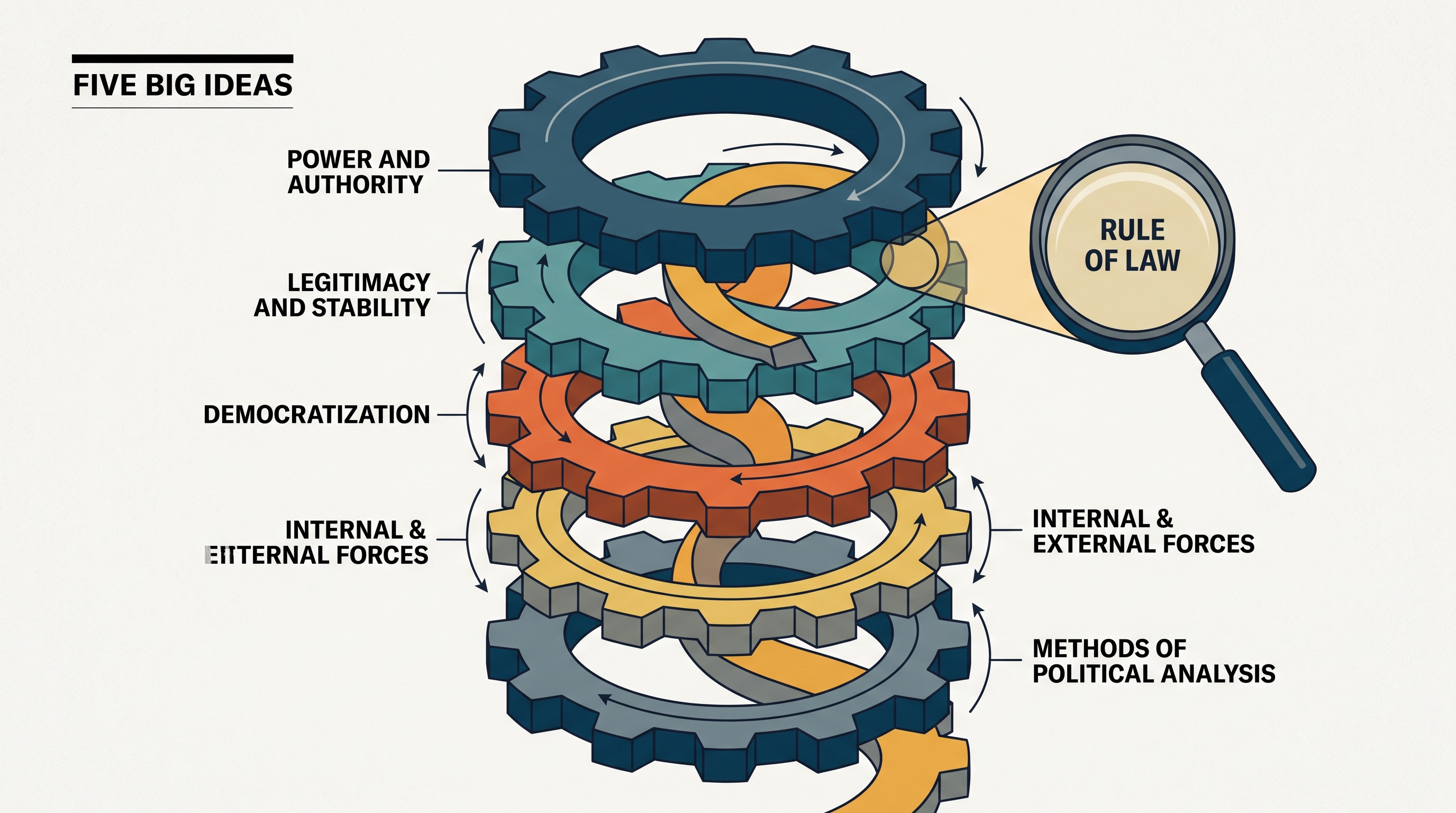
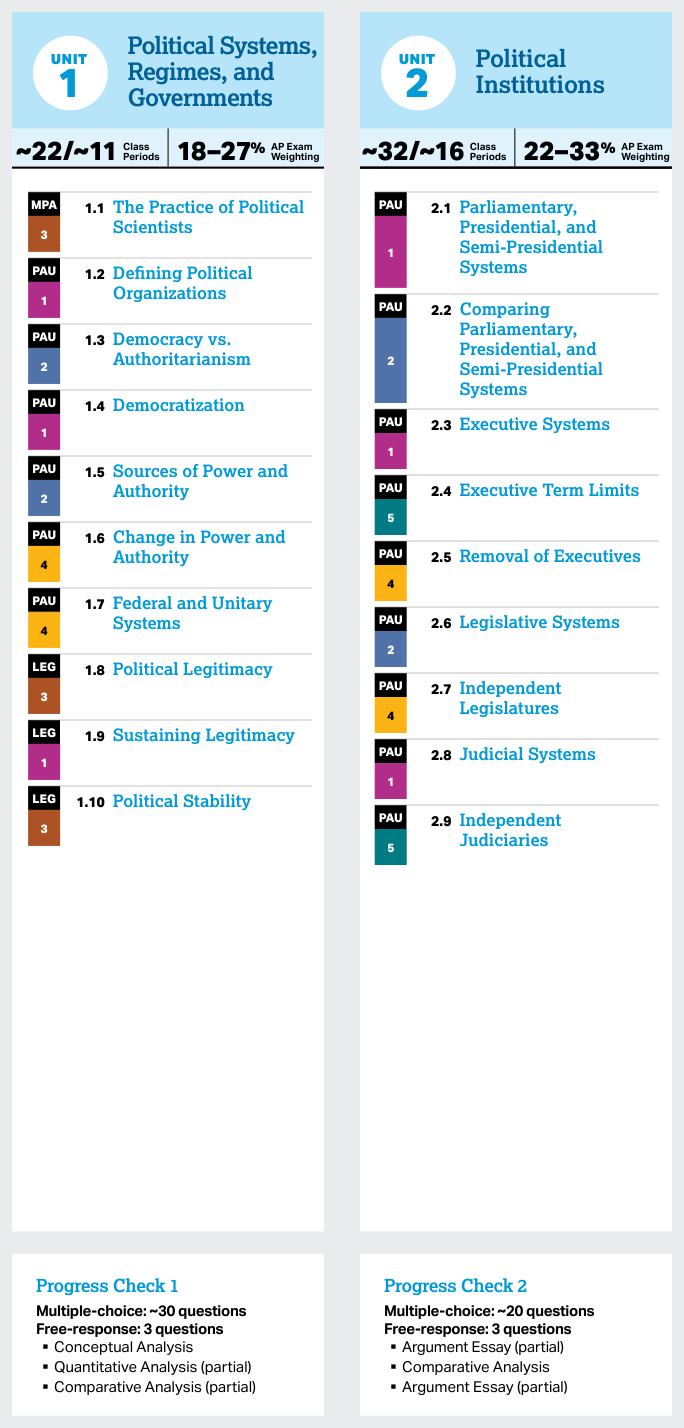
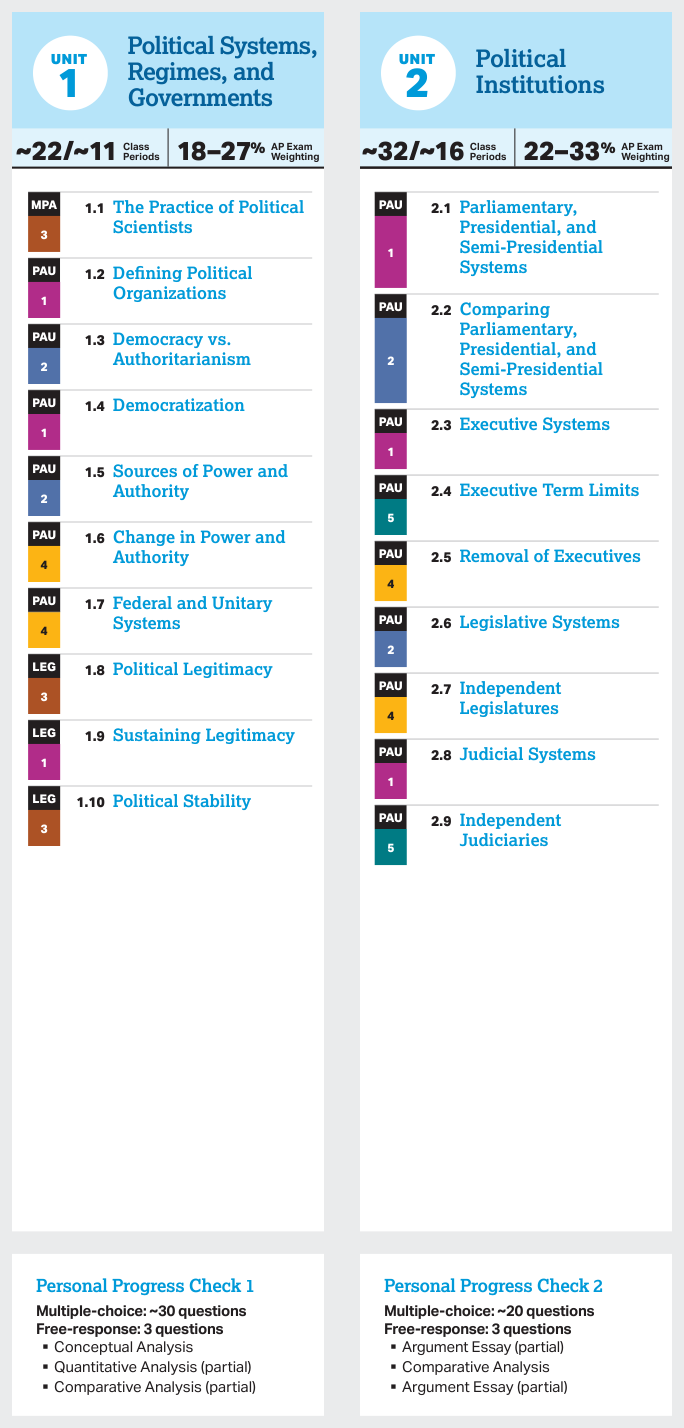
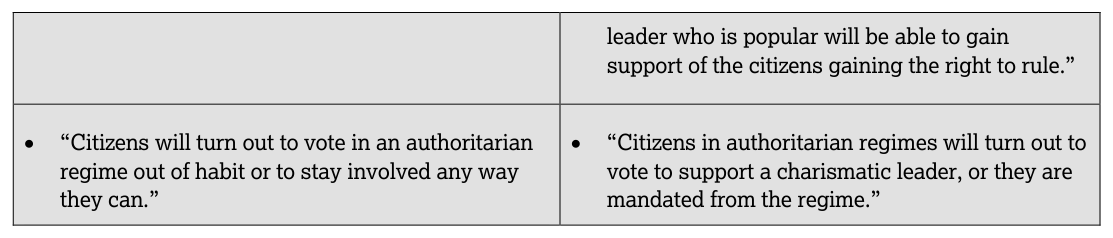
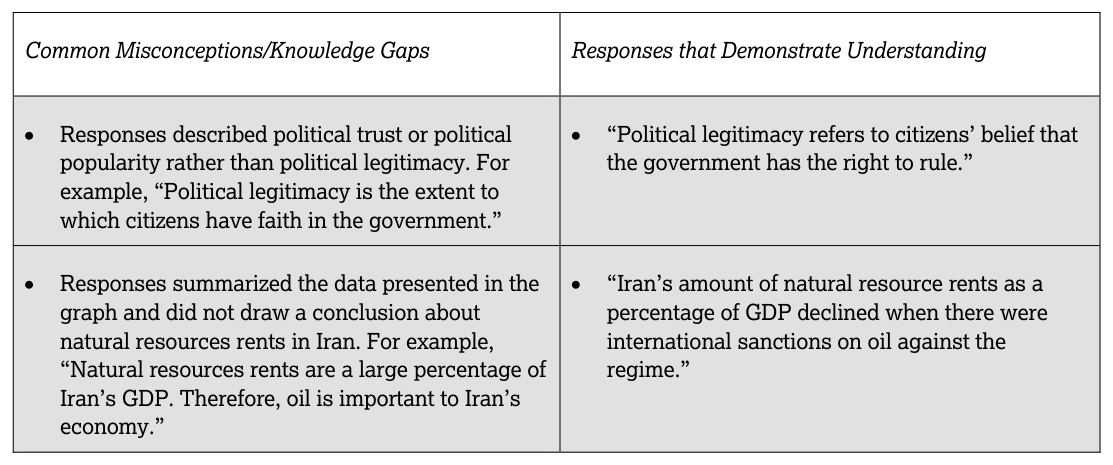
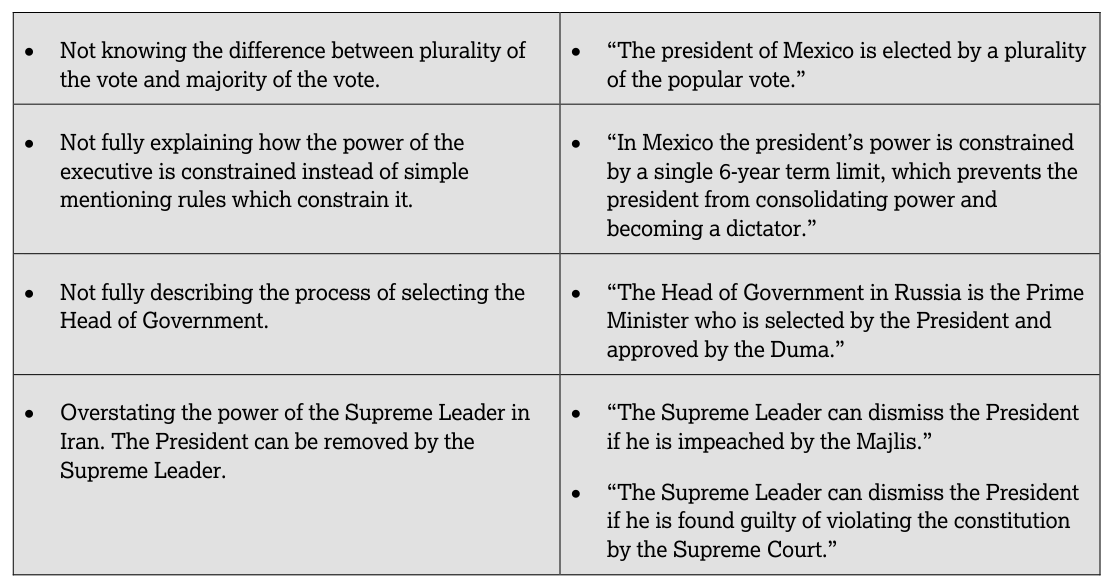
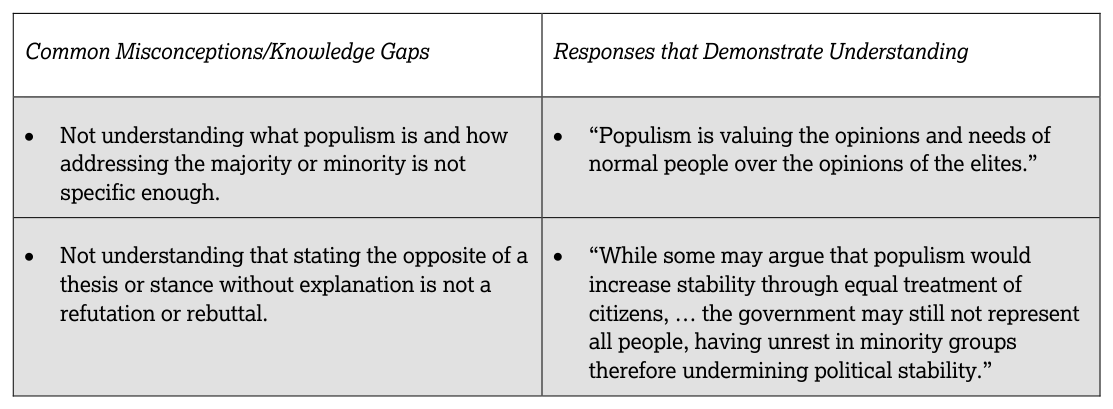
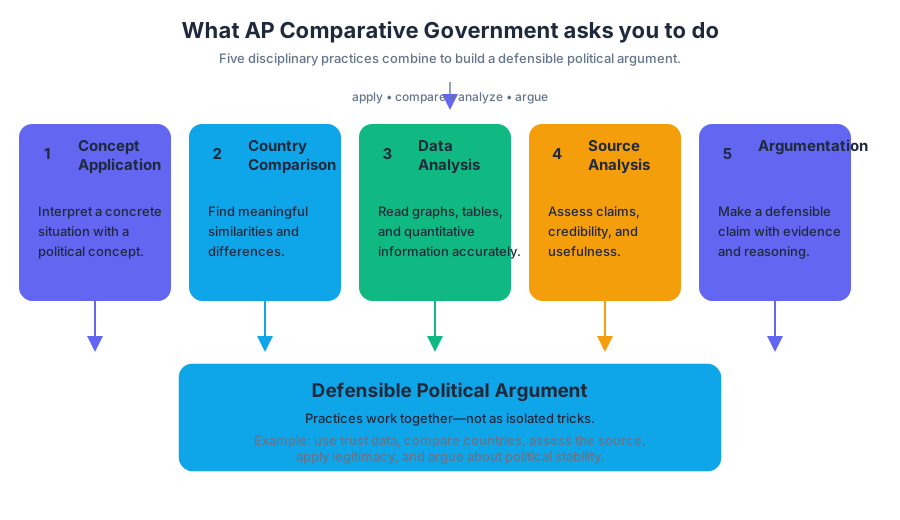
AP Practice 2
Key concepts: Regime stability and control of the military · Transitions from dictatorship to theocracy · Representation of religious, ethnic, and minority groups · Contradictory policies and challenges of policy implementation · Civil service and executive leadership changes · The United Kingdom’s ceremonial monarchy · Single-member and multimember electoral districts · Two-round elections and candidate vetting · One-party dominance and Mexico’s multiparty system · Using data on human development, wealth, and inequality to analyze political consequences
A political system can look stable while changing underneath: a ruling party may retain military control, a monarch may remain politically ceremonial, and regional institutions may broaden representation while also producing contradictory policies.
AP Practice 2
A political system can look stable while changing underneath: a ruling party may retain military control, a monarch may remain politically ceremonial, and regional institutions may broaden representation while also producing contradictory policies. This practice is an original quantitative analysis task built around that tension.
Exam task: analyze a data table, identify patterns, describe a trend, and use comparative-government concepts to explain consequences. A strong response does more than repeat numbers: it connects evidence to concepts such as regime stability, representation, legitimacy, and policy implementation.
The analytical map
Use this sequence when reading quantitative evidence:
| Step | Question to ask | What earns credit |
|---|---|---|
| 1. Identify | What category or country fits the prompt? | A precise selection |
| 2. Describe | What changes, remains stable, or differs? | Numbers and direction |
| 3. Explain | Why might the pattern exist? | A defensible political mechanism |
| 4. Compare | How does one case differ from another? | A meaningful similarity or difference |
| 5. Evaluate | What consequence follows? | A link to legitimacy, stability, representation, or implementation |
The task draws on Practice 3: Data Analysis, especially identifying patterns, describing quantitative information, drawing conclusions, and supporting an explanation with evidence. It also activates Practice 1: Concept Application and Practice 2: Country Comparison.
Original quantitative-analysis task
The following constructed dataset shows the percentage of legislative seats held by the largest party, an index of minority representation, and an index of policy-consistency problems. The representation and policy indices range from $0$ to $100$; higher values indicate more representation or more contradictory policy outcomes.
| Country | Largest-party seats, Year 1 | Largest-party seats, Year 2 | Minority-representation index | Policy-contradiction index |
|---|---|---|---|---|
| China | $92%$ | $93%$ | $18$ | $12$ |
| Iran | $55%$ | $57%$ | $31$ | $28$ |
| Mexico | $68%$ | $47%$ | $54$ | $39$ |
| Nigeria | $51%$ | $46%$ | $62$ | $58$ |
| Russia | $56%$ | $76%$ | $24$ | $21$ |
| United Kingdom | $52%$ | $49%$ | $71$ | $46$ |
The dataset is designed for practice, not as a factual measurement of the six countries. Treat every number as evidence supplied by the prompt; do not replace it with outside knowledge.
Questions
A. Identify the country with the greatest increase in the largest party’s share of legislative seats from Year 1 to Year 2.
B. Describe one trend in the largest party’s legislative-seat share for China, Mexico, or Russia.
C. Using the data, explain how an electoral system can affect representation of religious, ethnic, or minority groups.
D. Explain one way devolution or regional representation could improve legitimacy and one way it could make policy implementation more difficult.
E. Compare China and the United Kingdom with respect to regime stability and executive authority. Use one quantitative difference and one substantive country example.
Worked reasoning
A — Identify the largest increase. Calculate the change for each country:
- China: $93% - 92% = 1$ percentage point
- Iran: $57% - 55% = 2$ percentage points
- Mexico: $47% - 68% = -21$ percentage points
- Nigeria: $46% - 51% = -5$ percentage points
- Russia: $76% - 56% = 20$ percentage points
- United Kingdom: $49% - 52% = -3$ percentage points
Russia has the greatest increase, at $20$ percentage points. Notice the distinction between a percentage-point change and a percentage increase: the table asks for the former.
B — Describe a trend. A complete response includes both endpoints and the direction of change. For example: “Russia’s largest party increased its legislative-seat share from $56%$ in Year 1 to $76%$ in Year 2, a rise of $20$ percentage points.” This is stronger than “Russia became more dominant,” because it proves the claim with data.
C — Explain representation. Election rules shape who converts votes into seats. Single-member districts may reward the strongest candidate in each district, while multimember or proportional systems can allow smaller parties and dispersed religious, ethnic, or socioeconomic groups to gain representation. A second round of voting can also change which candidates survive and which coalitions form. This connects directly to DEM-2.B.6, because election-rule changes affect the representation of different groups.
D — Explain the trade-off. Devolution can improve legitimacy by matching policies to local needs, increasing participation, checking central power, and improving representation of religious, ethnic, or minority groups. However, regional governments may adopt contradictory policies, creating uneven rules and making national implementation more complicated or inefficient. This is the double-edged logic of LEG-1.B.4: decentralization can strengthen legitimacy while weakening coordination.
E — Compare cases. China’s largest party holds $93%$ of seats in Year 2, compared with $49%$ for the United Kingdom’s largest party. China’s Communist Party also maintains control over the military, strengthening regime stability and central authority. In the United Kingdom, the monarch serves ceremonially as head of state, while the prime minister leads the government and oversees the civil service. Thus, both systems may be stable, but their sources of authority differ: centralized party control in China versus parliamentary government operating alongside a ceremonial monarchy in the United Kingdom.
Connected case knowledge
The cases illustrate why data must be interpreted through institutions. Iran’s transition after the 1979 Revolution moved from dictatorial rule to a theocracy based on Islamic principles. Mexico’s party system includes the National Action Party, or PAN, and the Party of the Democratic Revolution, or PRD, within a broader transition away from historically sustained one-party dominance. In some governments, top leadership changes occur behind closed doors while the civil service continues to be overseen, allowing administrative continuity even when executive leadership changes.
Political institutions can broaden representation, but representation does not automatically produce agreement. Governments, citizens, and groups inside and outside government influence policy; contradictory policies may reveal competing centers of authority rather than simple governmental failure. Data on human development, wealth, or inequality can help identify the consequences of those arrangements, but correlation alone does not prove causation.
Misconception check
Misconception: “A high largest-party seat share automatically proves democratic legitimacy.” It does not. A dominant party may reflect popular support, electoral rules, restricted competition, or a managed political system. Similarly, a lower seat share does not automatically prove instability. Always explain the institutional mechanism before making a claim about legitimacy or regime stability.
Timing and error review
For a quantitative-analysis question, aim to spend approximately $20$ minutes: $3$ minutes reading the table, $12$ minutes answering, and $5$ minutes checking. Underline every requested operation—identify, describe, explain, compare—and verify that each numerical claim includes a country, category, direction, and value.
Afterward, label each missed point as one of four errors: reading error—the wrong row or column; calculation error—incorrect change; description error—a claim without evidence; or causal error—a political explanation that does not connect to the data. Rewrite only the weak sentence, adding the missing number or mechanism.
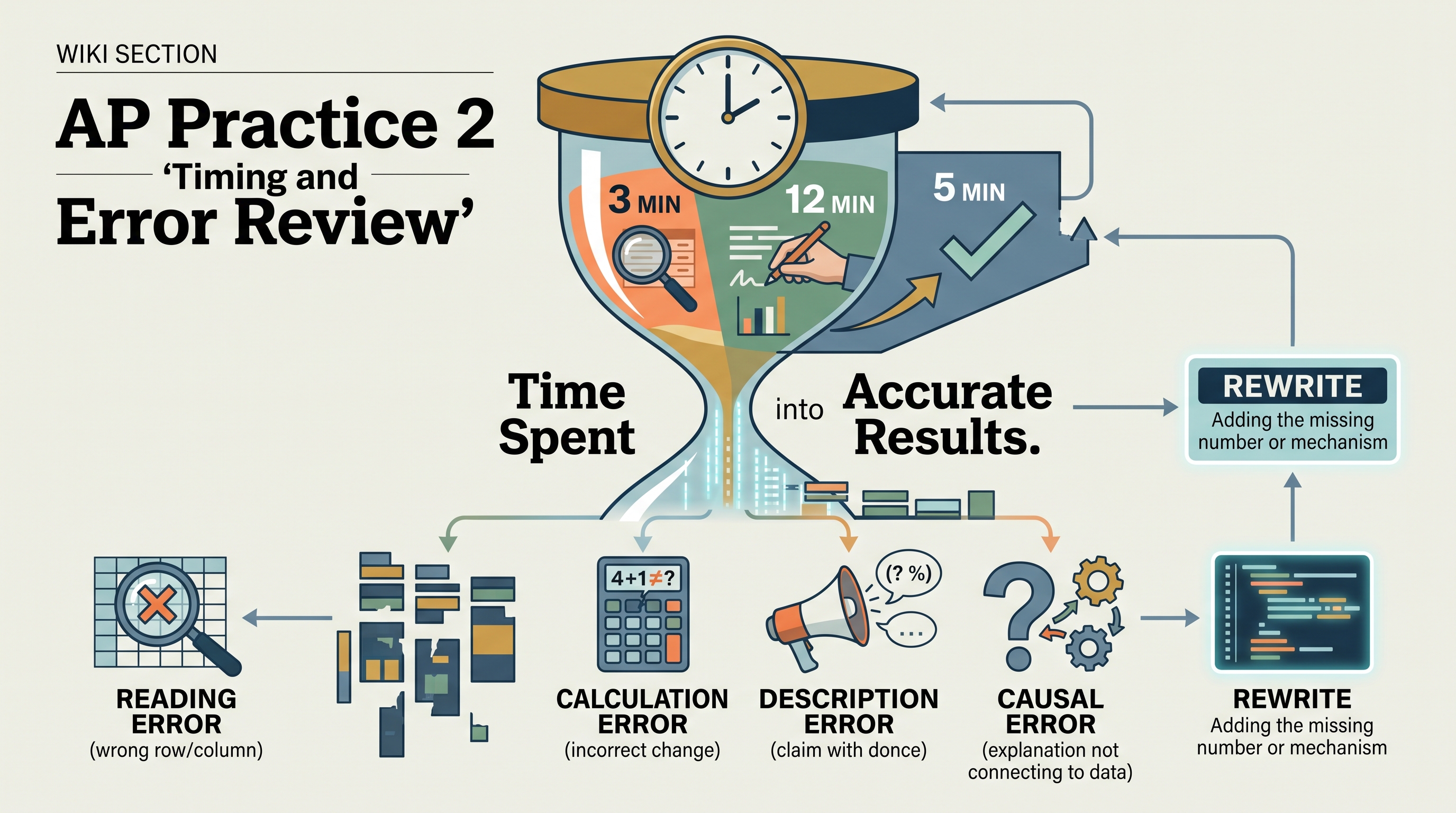
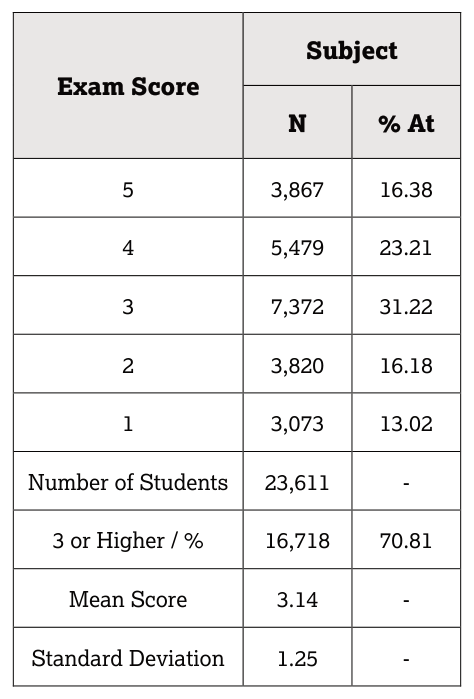
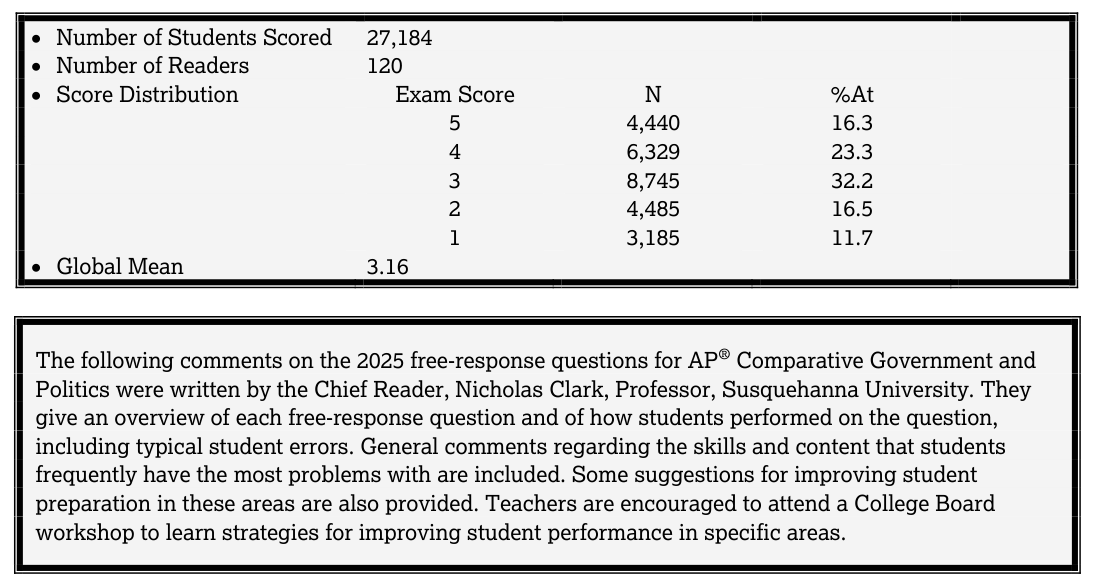
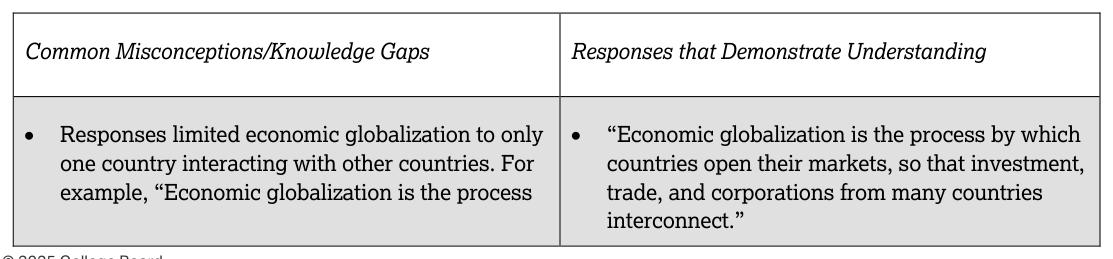
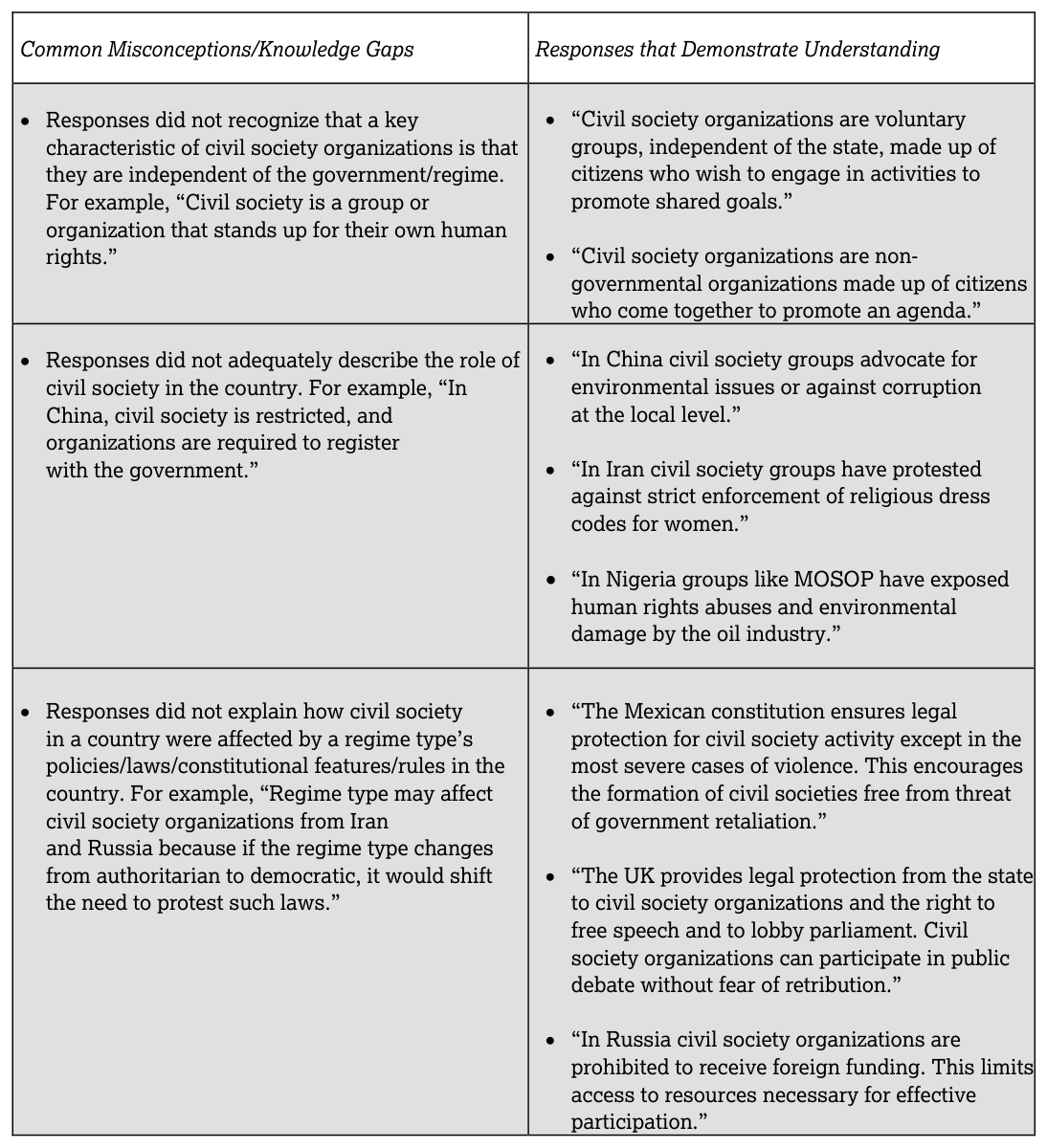
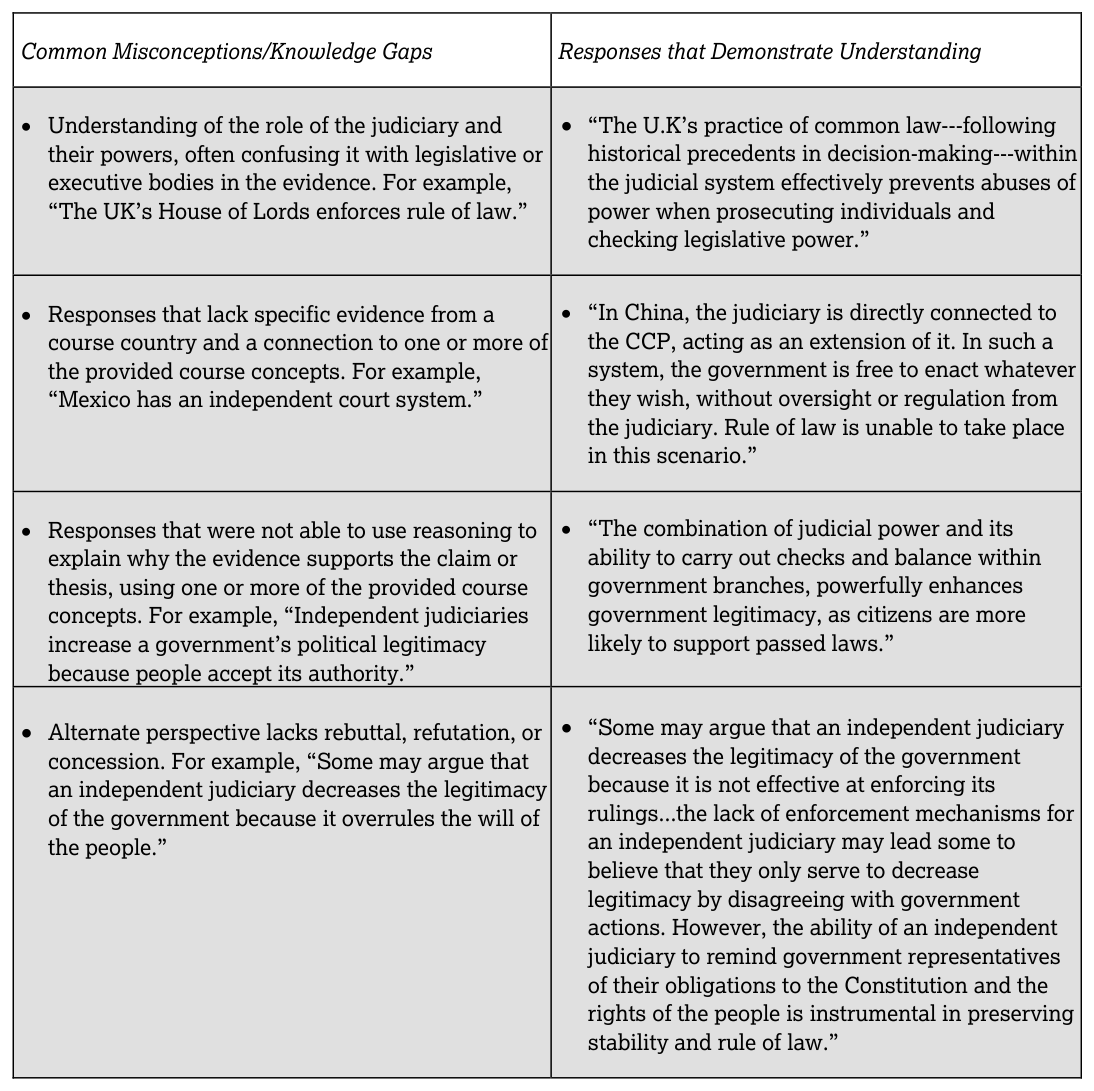
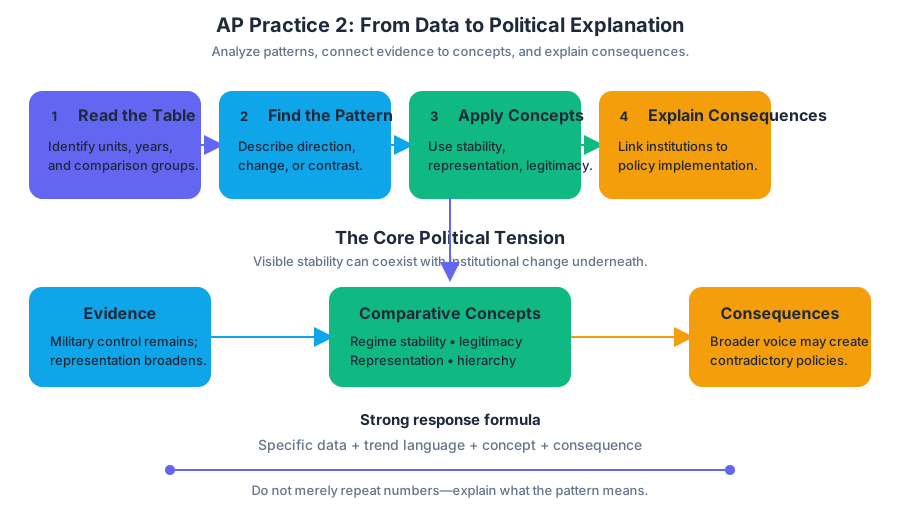
AP Practice 3
A government can liberalize its economy—reducing state controls, opening markets, or encouraging private ownership—while still trying to preserve sovereignty, the state’s supreme authority to govern its territory and make decisions without being controlled by another state.
AP Practice 3
A government can liberalize its economy—reducing state controls, opening markets, or encouraging private ownership—while still trying to preserve sovereignty, the state’s supreme authority to govern its territory and make decisions without being controlled by another state. That tension makes sovereignty and economic liberalization an excellent Conceptual Analysis task: the strongest responses do not merely define terms; they connect a political concept to a specific country and explain a mechanism.
Task profile: Conceptual Analysis
This original, unofficial practice question models one current AP Comparative Government and Politics free-response task type. Allow about 20 minutes. The task rewards precise concept application, country-specific knowledge, and explanations that show how or why a relationship exists.
Core scoring habit: A description tells what happened. An explanation identifies the political process that connects the event to the concept.
Original practice prompt
Use China as the country context.
A. Define sovereignty.
B. Describe one way a government can demonstrate sovereignty while participating in the global economy.
C. Explain how economic liberalization can create a challenge for state sovereignty.
D. Explain one reason a government might pursue economic liberalization even when it could create that challenge.
Pause here before reading the model response. For each part, underline the task verb: define, describe, or explain. The verb determines the kind of evidence the examiner needs.
Worked response with rubric logic
A. Define sovereignty.
Sovereignty is the supreme authority of a state to make and enforce decisions within its territory and to conduct its affairs without being subject to another state’s control.
Why this earns the point: The definition identifies both dimensions that make the concept politically meaningful: authority inside the territory and independence from external control. A vague answer such as “having power” is insufficient because it could describe a political party, legislature, or individual leader rather than a state.
China can demonstrate sovereignty by deciding for itself which foreign companies may operate in China and what regulations those companies must follow. For example, the Chinese government can require firms to comply with national rules on investment, data, or market access.
Why this earns the point: The response gives one concrete action by a government. It does not merely state that China is “powerful” or “independent”; it identifies a visible policy choice showing that the state controls access to its own economy.
Economic liberalization can allow foreign companies, international lenders, or global markets to influence domestic economic decisions. If China becomes dependent on foreign investment or export markets, government leaders may face pressure to change regulations or policies in ways that protect investor confidence rather than fully reflecting domestic priorities. The challenge arises because external economic actors gain leverage over choices that the state would otherwise make independently.
Why this earns the point: This is a causal chain:
$$ \text{liberalization} \rightarrow \text{greater external economic influence} \rightarrow \text{pressure on domestic policy} \rightarrow \text{reduced policy autonomy} $$
The answer explains a mechanism rather than claiming that liberalization automatically destroys sovereignty. That distinction matters: sovereignty may be constrained without disappearing.
China might pursue economic liberalization to attract investment, expand production, and increase economic growth. Higher growth can create jobs and raise government revenue, which may strengthen the state’s capacity to provide services and maintain political stability. Therefore, leaders may accept some external economic influence because the material benefits can reinforce the government’s authority at home.
Why this earns the point: The response identifies a reason and explains its political consequence. It does not stop at “economic growth”; it connects growth to jobs, revenue, state capacity, and stability.
Examiner-rewarded reasoning
A high-scoring response consistently moves from concept → country action → mechanism → consequence. The most common weak pattern is concept-dropping: mentioning China, sovereignty, and globalization in the same paragraph without explaining how one affects another.
| Task verb | What the response must do | Common failure |
|---|---|---|
| Define | State the essential meaning of the concept | Giving an example instead of a definition |
| Describe | Identify or characterize one specific action or feature | Offering a broad claim with no concrete action |
| Explain | Establish a causal or logical connection | Repeating the prompt or using “because” without a mechanism |
This practice develops Disciplinary Practice 1: Concept Application, Disciplinary Practice 2: Country Comparison when multiple cases are used, and Disciplinary Practice 5: Argumentation when a claim is supported with reasoning. It also reinforces the AP reasoning process of distinguishing related concepts: economic influence is not identical to foreign control, and a challenge to sovereignty is not necessarily the loss of sovereignty.
Timing and error review
Use the first 2 minutes to identify the concepts and task verbs, 14 minutes to write, and 4 minutes to audit. During the audit, ask three questions:
- Did I answer every lettered part?
- Did I use a specific country action rather than a slogan?
- Did every explanation show a complete how or why chain?
For error review, label each missed point as definition, specificity, mechanism, or political consequence. Rewrite only the weakest sentence, adding the missing link. If your sentence says “economic liberalization affects sovereignty,” revise it to state which actor gains leverage, what decision is pressured, and why that changes state autonomy.
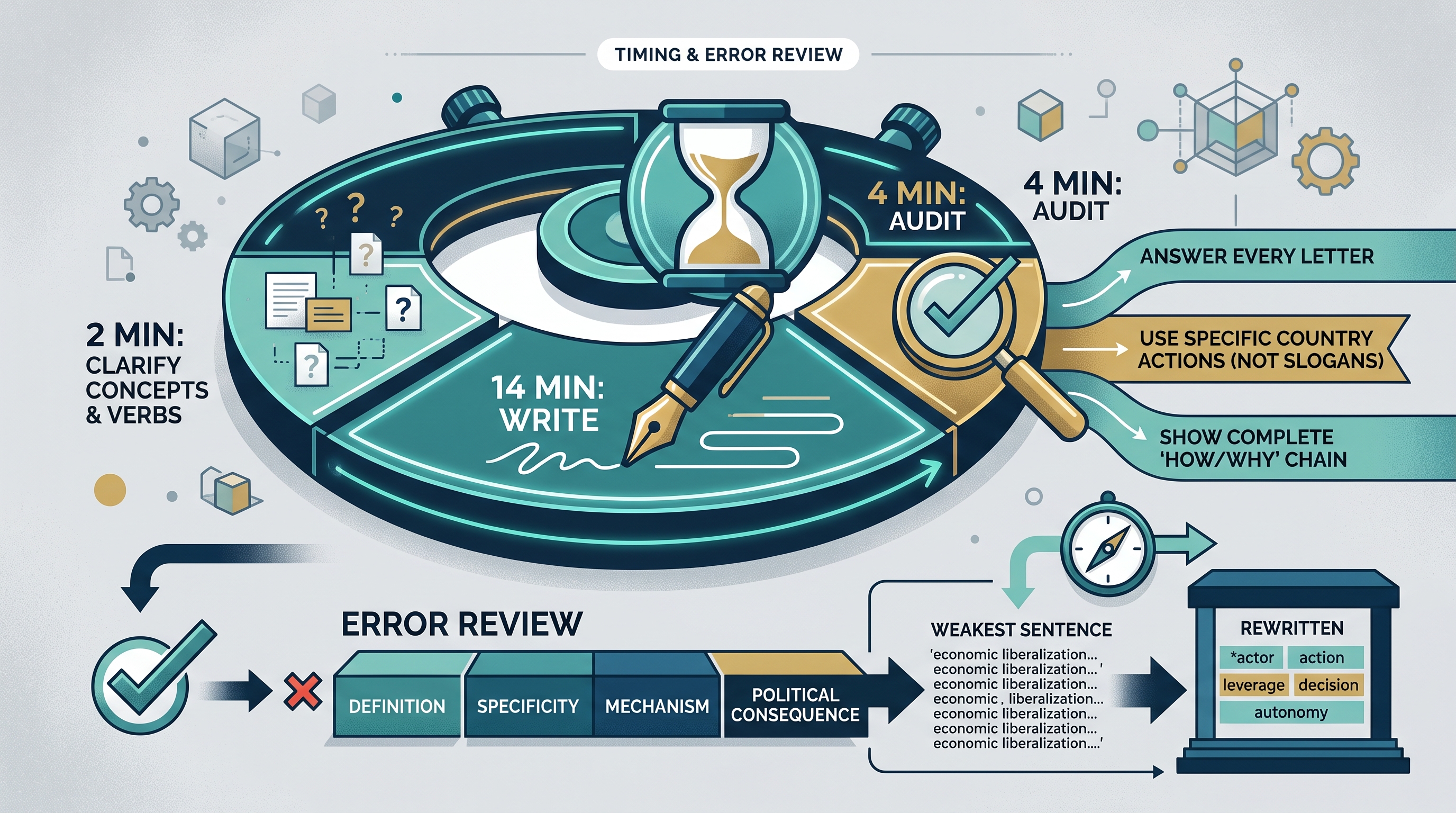
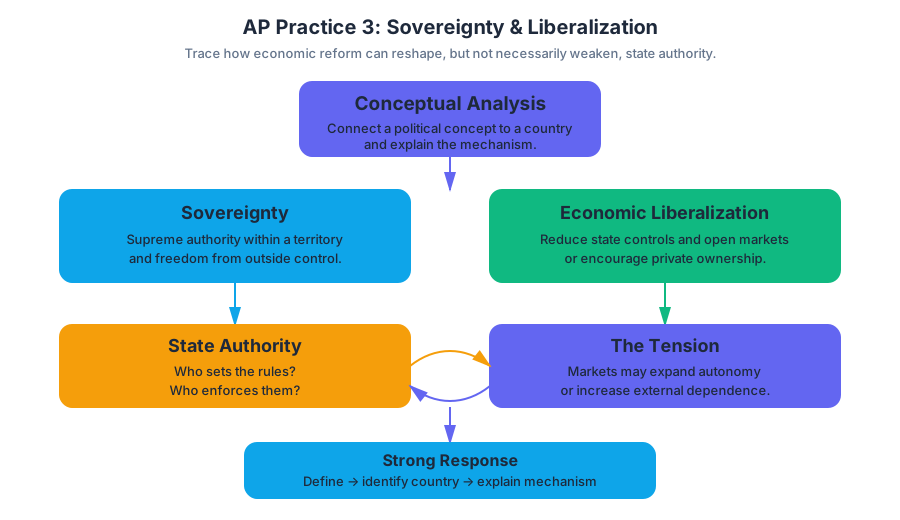
AP Practice 4
An argument essay asks you to do more than state an opinion: you must make a defensible claim, support it with comparative evidence, explain the political mechanism connecting evidence to the claim, and address an alternative perspective.
AP Practice 4
An argument essay asks you to do more than state an opinion: you must make a defensible claim, support it with comparative evidence, explain the political mechanism connecting evidence to the claim, and address an alternative perspective. The strongest response behaves like a carefully built bridge—claim → evidence → reasoning → qualification or rebuttal—rather than a pile of country facts.
Task type: Argument Essay
Timing target: 25 minutes. Spend approximately 3 minutes planning, 18 minutes writing, and 4 minutes checking. Use the final check to confirm that every country example is specific, every paragraph returns to the claim, and every task verb has been answered.
Original practice prompt
Develop an argument about the extent to which civil society organizations strengthen political legitimacy in the six AP Comparative Government and Politics countries. In your response, make a claim, support it with evidence from at least two countries, explain the political reasoning behind your argument, and address an alternative perspective.
What the prompt is really asking
The key concept is civil society: voluntary organizations outside the government, such as professional associations, religious groups, labor unions, advocacy organizations, and community organizations. Political legitimacy means the belief that a government has the right to rule. The prompt does not ask whether civil society is always helpful; it asks you to judge its extent of impact.
Plan before writing
A high-value plan might look like this:
| Essay function | Country evidence | Political reasoning |
|---|---|---|
| Main claim | United Kingdom: independent organizations and media can pressure officials and represent citizens | Participation and accountability can increase consent |
| Comparison | China: state-controlled or restricted organizations may provide services without creating independent accountability | Service delivery can support legitimacy, but limited autonomy weakens representation |
| Qualification | Nigeria: civil society can expose corruption and mobilize citizens, but unequal access and instability can limit its effect | Civil society strengthens legitimacy most when organizations are independent and governments respond |
This plan creates an argument rather than a catalog. It identifies a condition: civil society has the greatest legitimizing effect when organizations can operate independently and when institutions respond to their demands.
Worked response
Civil society organizations generally strengthen political legitimacy when they operate independently and can connect citizens to government decision-making. In the United Kingdom, organizations such as advocacy groups, trade unions, and professional associations provide channels for citizens to organize and pressure elected officials. Their activity can make government more responsive because officials must consider organized public demands, which can increase citizens’ belief that the political system represents them.
The effect is different in China. The government permits some social organizations to provide services and communicate local concerns, but the state restricts organizations that could independently challenge the Communist Party. These organizations may strengthen legitimacy by helping the government deliver services or respond to limited grievances. However, because independent political opposition is constrained, civil society does not create the same level of accountability as it can in the United Kingdom. This comparison shows that the existence of organizations alone is insufficient; their autonomy matters.
Nigeria provides a further example. Civil society organizations and news organizations can expose corruption, advocate for marginalized communities, and encourage citizens to participate in politics. These activities can strengthen legitimacy by making abuses visible and giving citizens tools to demand reform. At the same time, unequal resources, insecurity, and distrust in institutions may prevent civil society from producing consistent political responsiveness. Therefore, civil society strengthens legitimacy to a substantial but conditional extent: it is most effective when organizations are independent, broadly accessible, and connected to institutions capable of responding.
Why this earns credit
Thesis or claim: The opening establishes a defensible position—civil society strengthens legitimacy “when” organizations are independent and connected to decision-making. This is stronger than saying merely that civil society is “important.”
Evidence: The response uses specific evidence from the United Kingdom, China, and Nigeria. Each country is tied to the prompt rather than mentioned as a name-drop. The United Kingdom illustrates representation and accountability; China illustrates state restriction; Nigeria illustrates oversight alongside institutional limitations.
Reasoning: The response explains why each example matters. For instance, organized demands can increase responsiveness, while restrictions on independent opposition limit accountability. These cause-and-effect links demonstrate political reasoning rather than description.
Alternative perspective: The China paragraph recognizes that even restricted organizations can support legitimacy through service delivery and limited grievance communication. The response then qualifies that point by explaining why service provision is not equivalent to independent accountability.
Common failure modes
Misconception: “Argument” means personal opinion. An AP argument must be defensible through political concepts and evidence. Replace “I believe civil society is good” with a conditional claim about autonomy, representation, accountability, or responsiveness.
Misconception: country lists count as evidence. Writing “the United Kingdom, China, and Nigeria all have civil society” proves almost nothing. Evidence must identify what organizations do and connect that action to legitimacy.
Misconception: qualification cancels the thesis. A qualification does not weaken an argument if it clarifies its limits. “Civil society strengthens legitimacy, but mainly when organizations are independent” is more precise than an absolute claim.
Final retrieval check
In one sentence, explain why the China example is more useful than simply stating that China has civil society organizations.
A strong answer would say that China demonstrates the difference between organizations that provide services under state supervision and organizations that independently represent citizens and hold leaders accountable; that distinction directly explains when civil society strengthens political legitimacy.
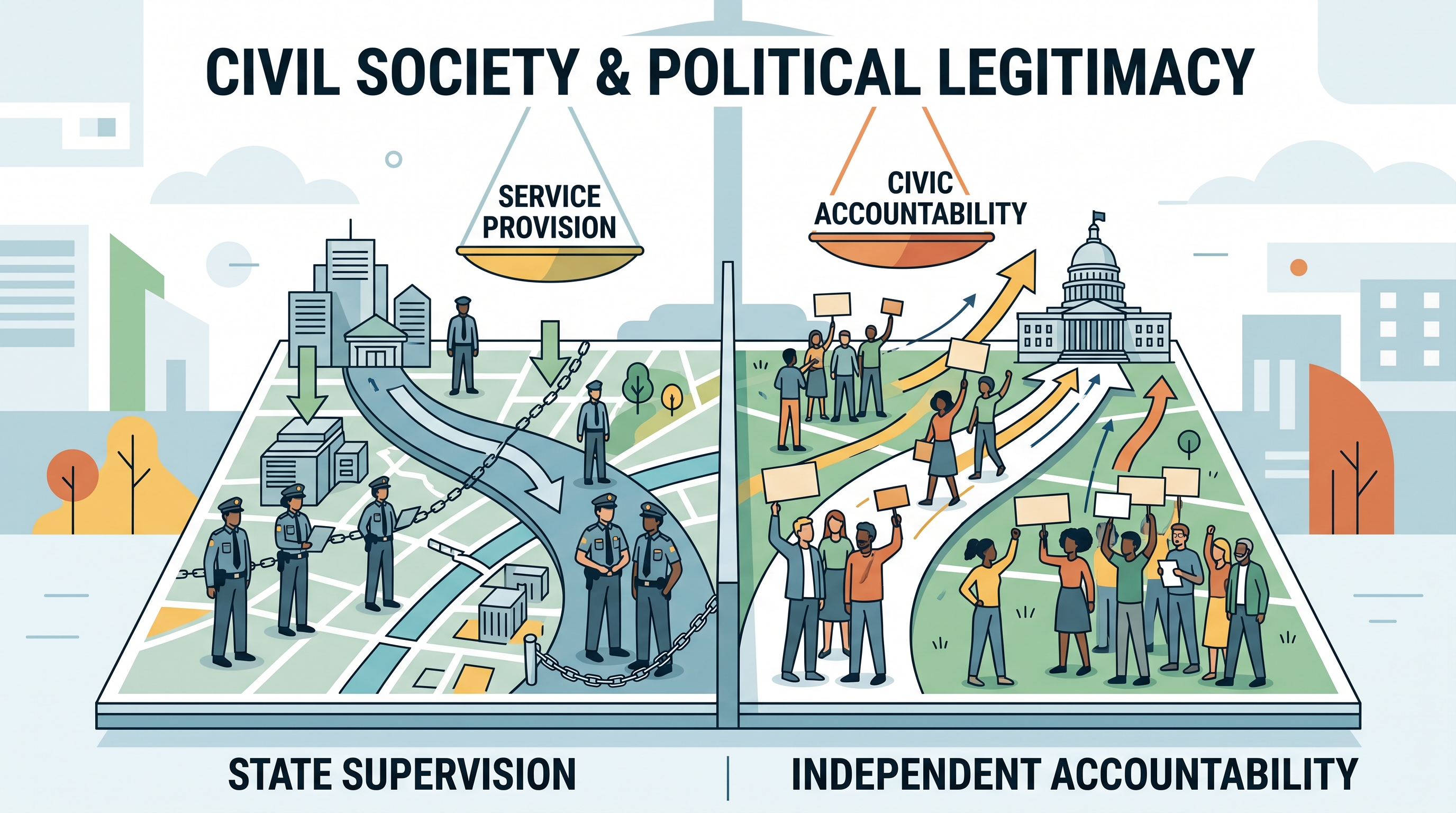
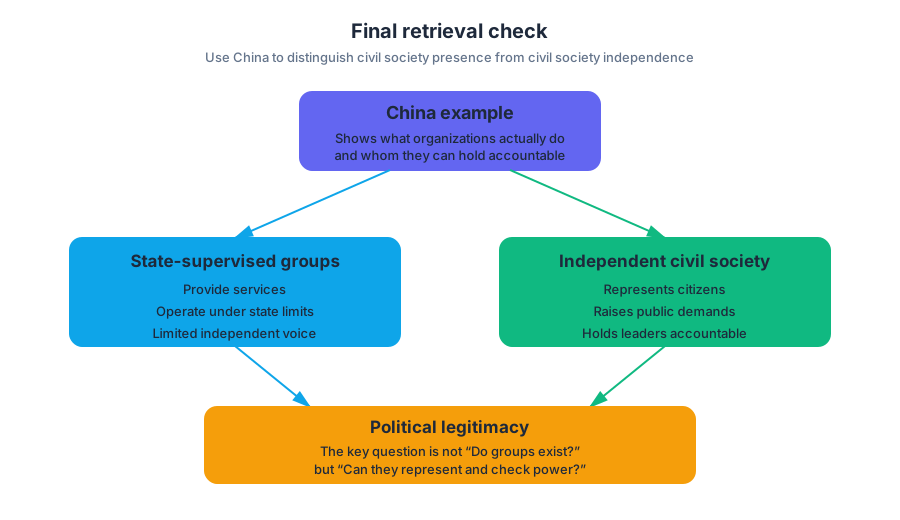
AP Practice 5
A percentage can reveal a political pattern, but it cannot explain that pattern by itself: comparison requires identifying what the data show and connecting the pattern to a defensible political explanation.
AP Practice 5
A percentage can reveal a political pattern, but it cannot explain that pattern by itself: comparison requires identifying what the data show and connecting the pattern to a defensible political explanation.
This original, unofficial practice targets the Quantitative Analysis free-response task and develops Disciplinary Practice 3: Data Analysis. It also reinforces Concept Application when you connect a numerical pattern to ideas such as legitimacy, participation, or economic liberalization.
The task
Use the table to answer all four parts. The figures are invented for practice and represent the percentage of citizens in four selected countries who reported that they trusted the national legislature in two survey years.
| Country | 2015 | 2023 |
|---|---|---|
| United Kingdom | $42%$ | $48%$ |
| Mexico | $36%$ | $29%$ |
| Nigeria | $31%$ | $37%$ |
| Iran | $54%$ | $46%$ |
(a) Identify the country with the greatest increase in legislative trust between $2015$ and $2023$.
(b) Describe the overall change in legislative trust in Mexico and Iran.
(c) Explain one possible political reason why legislative trust might increase in one country while decreasing in another.
(d) Draw one conclusion about the relationship between legislative trust and political legitimacy, using evidence from the table.
Timing strategy
Allow approximately $12$ minutes. Spend the first $2$ minutes reading the title, variables, years, countries, and units. Use the next $7$ minutes to answer the four parts directly, then reserve $3$ minutes to check that every explanation includes a political mechanism rather than merely repeating a number.
A useful visual routine is:
$$ \text{Read variables} \rightarrow \text{Compare values} \rightarrow \text{State pattern} \rightarrow \text{Explain mechanism} \rightarrow \text{Qualify conclusion} $$
Worked reasoning
(a) Point earned: identify the correct value comparison. Nigeria has the greatest increase: $37%-31%=6$ percentage points. The United Kingdom increases by $6$ percentage points as well, so the table actually shows a tie. A precise answer is therefore: Nigeria and the United Kingdom have the greatest increase, each rising by $6$ percentage points.
(b) Point earned: accurately describe both directions. Mexico’s legislative trust decreases from $36%$ to $29%$, a decline of $7$ percentage points. Iran’s trust decreases from $54%$ to $46%$, a decline of $8$ percentage points. Both countries experience declines, but Iran’s decline is larger.
(c) Point earned: connect the pattern to a plausible political cause. Legislative trust may increase when citizens view the legislature as responsive—for example, when it passes visible policies that address unemployment or corruption. Trust may decrease when citizens associate lawmakers with corruption, ineffective policy, or political conflict. The explanation earns its strength from the mechanism: institutional performance or perceived responsiveness changes citizens’ evaluations of the legislature.
(d) Point earned: make a supported, qualified conclusion. The data suggest that legislative trust can change in different directions across countries: trust rises in the United Kingdom and Nigeria but falls in Mexico and Iran. This may affect political legitimacy because citizens who believe institutions are responsive may be more willing to accept governmental authority. However, the table does not prove that trust alone determines legitimacy; legitimacy can also depend on elections, ideology, economic performance, or coercion.
Misconception check
Misconception: “The highest percentage means the greatest increase.” Iran has the highest 2015 value, but it experiences the largest decline. Always distinguish an absolute level from a change over time. Also distinguish percentage points from percent change: moving from $31%$ to $37%$ is an increase of $6$ percentage points, not simply “$6%$.”
Error-review routine
After completing the task, label each response with one question: Did I identify, describe, explain, or conclude? If an explanation only restates the data, add a political mechanism. If a conclusion claims causation, revise it to “suggests” unless the evidence establishes more than association.
Retrieval check: Which response would lose credit: “Trust changed differently,” or “Trust rose in Nigeria and the United Kingdom but fell in Mexico and Iran”? The second is stronger because it names the countries, directions, and evidence-based comparison.
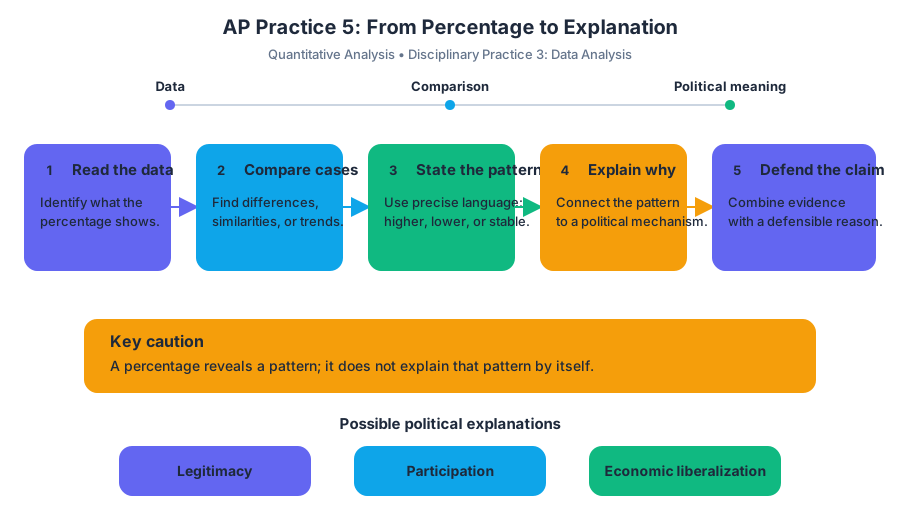
AP Practice 6
An argument essay earns points not for sounding forceful, but for connecting a defensible claim to accurate comparative evidence and explicit political reasoning. The central question is simple: Can you prove a comparative political argument rather than merely state an opinion?
AP Practice 6
An argument essay earns points not for sounding forceful, but for connecting a defensible claim to accurate comparative evidence and explicit political reasoning. The central question is simple: Can you prove a comparative political argument rather than merely state an opinion?
Task focus: Argumentation
This original, unofficial practice task targets Disciplinary Practice 5: Argumentation. It also requires Disciplinary Practice 1: Concept Application and Disciplinary Practice 2: Country Comparison because a strong response applies a political concept and uses evidence from the required countries: China, Iran, Mexico, Nigeria, Russia, and the United Kingdom.
Timing target
Reserve approximately $25$ minutes for the argument essay. A practical sequence is:
- Spend $3$ minutes identifying the key term and choosing evidence.
- Spend $4$ minutes writing a precise thesis.
- Spend $15$ minutes developing evidence and reasoning.
- Spend $3$ minutes checking the thesis, country references, and counterargument.
Original practice prompt
Claim: Political legitimacy is more effectively sustained through government performance than through ideological or traditional appeals.
Write an argument that evaluates the claim. In your response, do the following:
- Present a defensible claim or thesis.
- Support the claim with accurate evidence from at least two required countries.
- Use reasoning to explain how each piece of evidence supports your claim.
- Address an alternative perspective or limitation.
Plan the argument before writing
A useful argument has four connected parts:
| Part | What the examiner must see | Example for this prompt |
|---|---|---|
| Claim | A qualified, defensible answer | Performance is usually stronger over time, but ideology or tradition can protect regimes during crises. |
| Evidence | Specific country-based facts | China’s economic growth; Iran’s religious foundations; the United Kingdom’s electoral legitimacy |
| Reasoning | The “because” connecting evidence to claim | Economic performance can increase acceptance by producing material benefits. |
| Alternative perspective | A limitation or competing explanation | Performance alone may not sustain legitimacy when citizens reject the regime’s underlying ideology. |
Worked response
Thesis: Government performance is generally the most durable way to sustain political legitimacy because effective economic management and public services can persuade citizens that existing institutions produce useful outcomes. However, ideological and traditional appeals may sustain legitimacy when a government’s performance is weak, especially if those appeals are embedded in powerful institutions.
In China, the ruling Communist Party has strengthened its legitimacy partly through economic performance. Rapid economic development, expanded infrastructure, and increased access to consumer goods have allowed the government to present itself as capable of improving living standards. This evidence supports the claim because citizens may tolerate limited political competition when they believe the governing system delivers economic security and national progress. Performance therefore links the state to visible benefits in everyday life.
Iran demonstrates why performance is not the only source of legitimacy. The Islamic Republic draws legitimacy from revolutionary and religious principles, including the authority of the clergy and the state’s claim to defend an Islamic political order. These ideological foundations can preserve support among citizens who value religious governance even when economic problems, sanctions, or dissatisfaction with public administration weaken the government’s performance. In this case, legitimacy rests not only on what the government produces but also on whether it represents an accepted political identity.
The United Kingdom illustrates another form of legitimacy. Its government benefits from long-standing political traditions, including parliamentary government, constitutional practices, and regular competitive elections. These traditions can encourage acceptance of political outcomes even when a particular government performs poorly. Nevertheless, tradition is not an unlimited resource: if public services deteriorate severely or citizens lose confidence in institutions, historical legitimacy may no longer be sufficient.
Overall, performance is usually the strongest foundation for sustaining legitimacy because its effects are concrete and repeatedly experienced. Yet the comparison among China, Iran, and the United Kingdom shows that performance operates alongside ideology and tradition. A government that combines effective performance with a convincing political identity and trusted institutions is more likely to sustain legitimacy than one that depends on only a single source.
Why this response earns credit
- Thesis/claim: The opening makes a clear judgment and qualifies it rather than repeating the prompt.
- Evidence: China, Iran, and the United Kingdom are used accurately and specifically.
- Reasoning: Each paragraph explains why the evidence supports or complicates the argument. Naming economic benefits alone would be description; connecting those benefits to citizen acceptance makes the response analytical.
- Alternative perspective: The Iran and United Kingdom paragraphs show that ideological and traditional legitimacy can matter when performance is weak or uneven.
- Comparison: The final paragraph synthesizes the countries instead of leaving them as three unrelated examples.
Misconception check: “More countries means a better essay”
A long list of countries does not automatically produce a strong argument. Two countries with precise evidence and explanation are more valuable than five countries named without political reasoning. The essential pattern is:
$$ \text{Specific evidence} \rightarrow \text{political mechanism} \rightarrow \text{support for the claim} $$
Error-review routine
After writing, label every sentence C for claim, E for evidence, or R for reasoning. If a paragraph contains evidence but no reasoning, add a sentence beginning with “This supports the claim because…” Then verify that each country reference is accurate, that the thesis answers the prompt directly, and that the alternative perspective is genuinely addressed rather than simply mentioned.
Retrieval check: If a response says, “China experienced economic growth,” what must it add to earn analytical value? It must explain how that growth affected citizens’ acceptance of the government and therefore connected to political legitimacy.
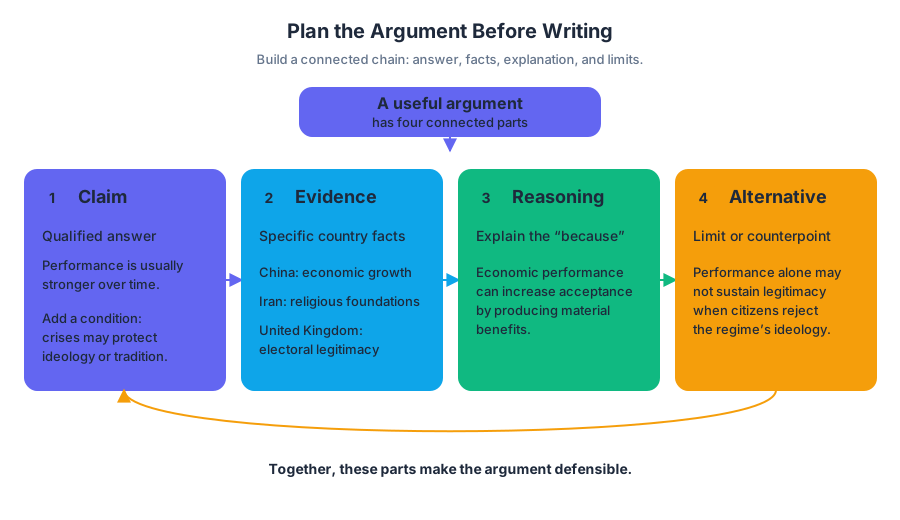
Source Materials
- AP Comparative Government and Politics Course and Exam Description
- AP Comparative Government and Politics Course and Exam Description Clarifications and Corrections
- AP Comparative Government and Politics Course Overview
- AP Comparative Government and Politics Course at a Glance
- AP Comparative Government and Politics Course at a Glance Poster
- AP Comparative Government and Politics
- AP Comparative Government and Politics
- AP Comparative Government and Politics Sample Syllabus 1
- Figure — AP Comparative Government and Politics Course and Exam Description (p. 1)
- Figure — AP Comparative Government and Politics Course and Exam Description (p. 1)
- Figure — AP Comparative Government and Politics Course and Exam Description (p. 19)
- Figure — AP Comparative Government and Politics Course and Exam Description (p. 27)
Study AP Comparative Government and Politics with AI — Free on Lykke
Sign up for free to generate personalized flashcards, quizzes, and study guides from this course. Chat with an AI tutor that knows the material.
Get Started FreeView this course wiki on Lykke · Browse all public course wikis