From the free course AP Comparative Government and Politics on Lykke
3.1 Civil Society
Key concepts: Civil society · Civil society organizations as nongovernmental groups formed by citizens to promote an agenda · Monitoring and lobbying government · Exposing government corruption · Representing members’ interests · Providing members with organizational experience · State protections and legal constraints on civil society · Civil society advocacy for human rights and environmental issues · Ethnic-minority and regional-interest advocacy · Causal analysis linking government policies to civil society activity
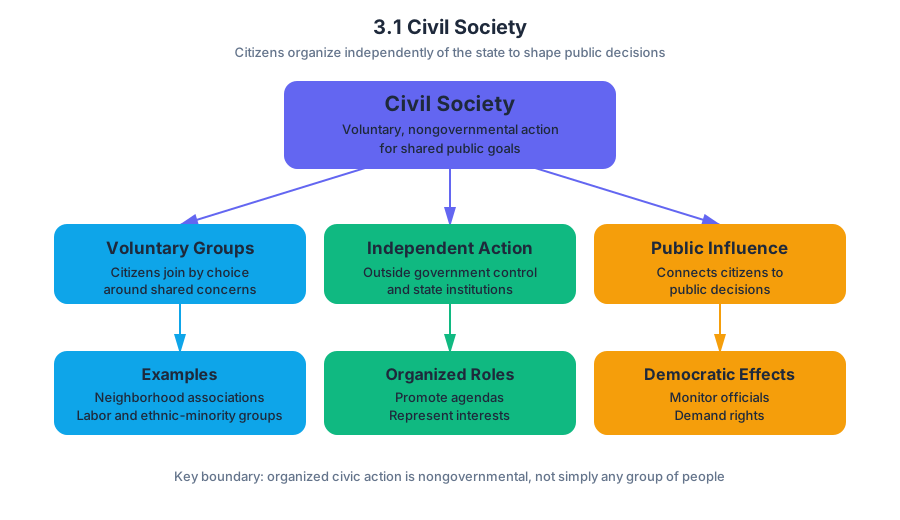
A government may control laws and institutions, but citizens can still organize outside the state to influence what government does. Civil society is the sphere of voluntary, nongovernmental activity in which citizens form groups to promote an agenda, represent interests, monitor officials, or demand rights.
3.1 Civil Society
A government may control laws and institutions, but citizens can still organize outside the state to influence what government does. Civil society is the sphere of voluntary, nongovernmental activity in which citizens form groups to promote an agenda, represent interests, monitor officials, or demand rights.
Civil society: Nongovernmental organizations and voluntary associations made up of citizens who act independently of the state to promote shared goals.
A civil society organization is not simply “any group of people.” Its defining feature is organized activity that connects citizens to public decisions without being part of the government itself. A neighborhood association, environmental organization, labor group, human-rights organization, or ethnic-minority movement can all belong to civil society.
How civil society connects citizens and government
Civil society organizations create a communication and pressure channel between individuals and the state. They can monitor or lobby government, expose corruption, represent members’ interests, and give members organizational experience—skills such as recruiting supporters, conducting meetings, raising funds, communicating demands, and negotiating with officials.
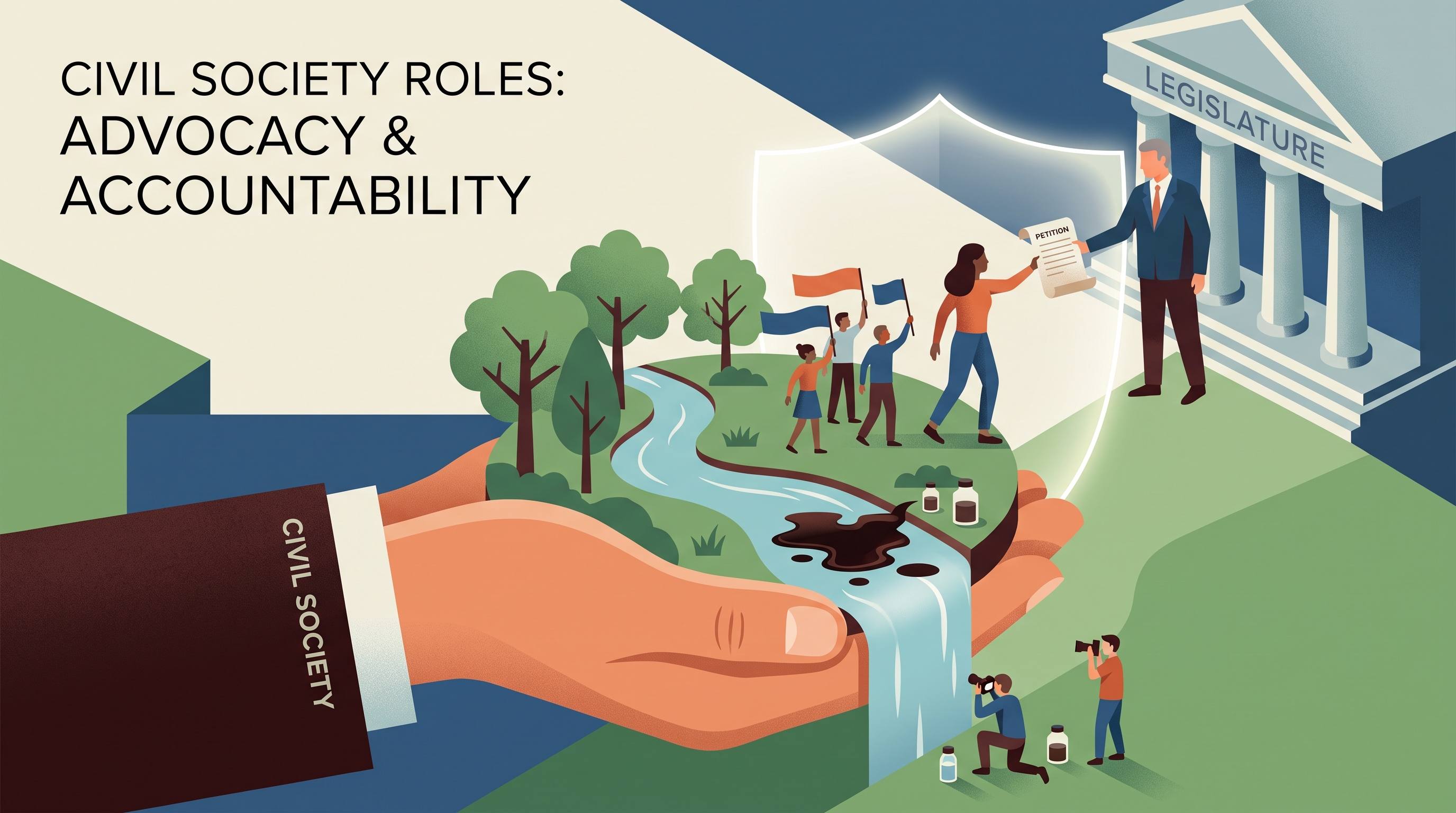
The same organization may perform several roles at once. For example, an environmental group might document pollution, publish evidence, lobby legislators for stricter regulation, represent affected communities, and train local residents to participate in public affairs.
The important causal question is not merely whether civil society exists, but whether government rules allow it to operate. Legal protection for speech, association, assembly, and lobbying lowers the risk of organizing. Registration requirements, censorship, surveillance, or punishment raise the cost of organizing and can force groups to limit their goals.
A country-by-country mechanism
| Country | Civil society activity | Policy or legal condition and effect |
|---|---|---|
| Russia | Groups monitor or lobby government, expose corruption, represent members, and provide organizational experience. | Government restrictions and monitoring can make independent advocacy more difficult. |
| Mexico | Organizations represent members and may advocate on public issues. | Constitutional protection for civil society activity encourages organization by reducing fear of government retaliation, except in severe cases of violence. |
| Nigeria | MEND and MOSOP advocate for ethnic-minority rights, expose abuses, and protest unjust oil-related policies in the Niger Delta. | Democratic-regime protections have supported civil society activity, allowing groups to organize around human-rights and environmental concerns. |
| United Kingdom | Organizations represent members, develop civic skills, and lobby Parliament. | Legal protection for free speech and the right to lobby Parliament gives organizations a secure channel for advocacy. |
| China | Groups advocate for human rights, environmental protection, and opposition to damage caused by the oil industry. | As an authoritarian regime, China restricts organizations through registration requirements, monitoring, censorship, and punishment when activism threatens Communist Party authority. |
The Nigeria example shows why civil society is more than peaceful volunteering. In the Niger Delta, the Movement for the Survival of the Ogoni People (MOSOP) and the Movement for the Emancipation of the Niger Delta (MEND) have advocated for ethnic-minority rights and challenged oil-related policies viewed as unjust. Their actions connect environmental damage, economic grievances, and political representation.
The United Kingdom illustrates the enabling effect of law. When organizations have protected free speech and a recognized right to lobby Parliament, they can turn members’ concerns into policy proposals without treating every act of criticism as a threat to the regime. Members also gain practical organizational experience that can strengthen broader political participation.
China illustrates the opposite mechanism. Civil society groups may advocate locally against corruption or environmental damage, but registration rules, monitoring, censorship, and the possibility of repression constrain independent organization. The key explanation is not simply “China is authoritarian”; it is that authoritarian institutions restrict the communication and organizational space groups need to challenge state policy.
Misconception check
Misconception: “Civil society means opposition to the government.” Civil society organizations may criticize government, cooperate with it, provide services, or represent members without seeking to overthrow the regime. The defining distinction is independence from the state, not permanent hostility toward it.
Misconception: “Naming a regime type explains civil society automatically.” A strong explanation identifies the mechanism: democratic legal protections can encourage organization by protecting speech and lobbying, while authoritarian registration requirements or surveillance can restrict organization and punish independent participation.
Retrieval check
A citizens’ environmental group documents oil pollution, trains local members, and petitions legislators. Identify two roles of civil society it performs, then explain how a legal right to lobby would affect its ability to advocate. A complete answer should name the roles—such as exposing government or corporate harm, representing members, or providing organizational experience—and connect the legal protection to lower risks and greater access to policymakers.
Source Materials
- AP Comparative Government and Politics Course and Exam Description
- AP Comparative Government and Politics Course and Exam Description Clarifications and Corrections
- AP Comparative Government and Politics Course Overview
- AP Comparative Government and Politics Course at a Glance
- AP Comparative Government and Politics Course at a Glance Poster
- AP Comparative Government and Politics
- AP Comparative Government and Politics
- AP Comparative Government and Politics Sample Syllabus 1
- AP Comparative Government and Politics-AP Students-College Board
- AP Comparative Government and Politics-Wikipedia
- AP Comparative Government and Politics Cheat <http://sheets-albert.io>Sheets-Albert.io
- AP Comparative Government and Politics-GOA