From the free course AP Comparative Government and Politics on Lykke
1.1 The Practice of Political Scientists
Key concepts: political legitimacy · political stability · authority · comparative political science · similarities and differences between political systems · quantitative sources · qualitative sources · author’s claims and perspective
A comparative political scientist asks a deceptively simple question: What is similar, what is different, and why does the difference matter? Comparing China, Iran, Mexico, Nigeria, Russia, and the United Kingdom requires more than memorizing institutions.
1.1 The Practice of Political Scientists
A comparative political scientist asks a deceptively simple question: What is similar, what is different, and why does the difference matter? Comparing China, Iran, Mexico, Nigeria, Russia, and the United Kingdom requires more than memorizing institutions. It requires disciplined methods for connecting evidence to political concepts such as authority, political legitimacy, and political stability.
Political legitimacy is the degree to which a government’s right to rule is accepted by the citizenry.
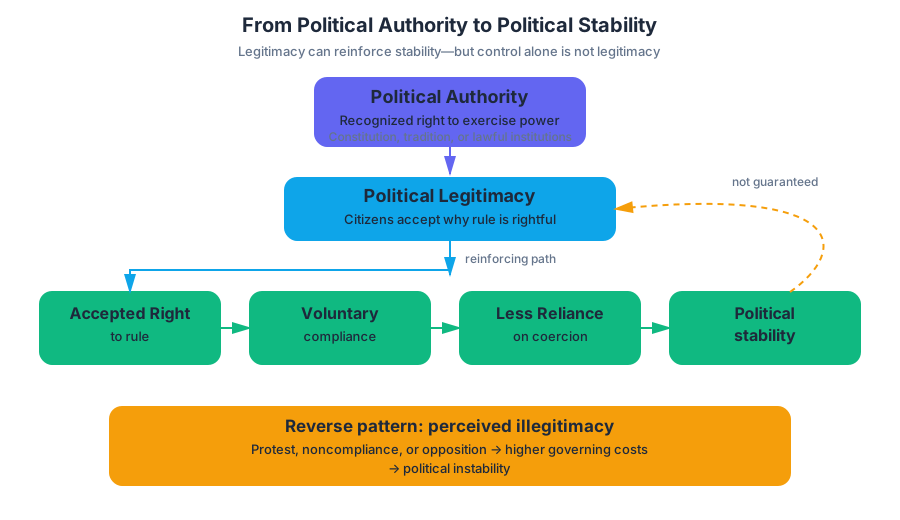
From political authority to political stability
Authority is the recognized right of a government to exercise power—to make and enforce decisions that citizens are expected to obey. A government may possess authority because its constitution grants it power, because citizens accept its traditional role, or because its institutions are viewed as lawful and appropriate.
Political legitimacy is different from mere control. A government can compel obedience through police power while still lacking broad acceptance of its right to rule. Legitimacy concerns why citizens accept rule; authority concerns the recognized right to exercise that rule.
Political stability is the persistence of a political system without frequent, disruptive challenges to the government or its basic institutions. Legitimacy often supports stability because citizens who view rule as rightful are more likely to obey laws, pay taxes, participate through established channels, and accept election outcomes. The relationship is not automatic: a government may remain stable for a time through coercion, while a legitimate government may face instability during war, economic crisis, or a contested transition.
The causal relationship can be pictured as a reinforcing—but not guaranteed—chain:
Accepted right to rule $\rightarrow$ voluntary compliance $\rightarrow$ lower reliance on coercion $\rightarrow$ greater political stability
The reverse pattern is also possible:
Perceived illegitimacy $\rightarrow$ protest, noncompliance, or opposition $\rightarrow$ greater governing costs $\rightarrow$ political instability
Comparative political science as a method
Comparative political scientists study similarities and differences between countries. They apply political concepts to different political systems rather than assuming that one country’s institutions work everywhere in the same way. A comparison might examine whether citizens in two countries view elections as legitimate, whether courts constrain executives, or whether regional governments possess meaningful authority.
A useful comparison changes one’s question from “Is this country democratic?” to a more precise question: “How do political institutions, citizen beliefs, and government performance affect acceptance of the government’s right to rule in these two countries?” This approach helps political scientists evaluate political realities and understand political change.
Worked comparison
Suppose a researcher compares two countries after disputed elections. In Country A, courts independently review complaints, opposition parties can organize, and the governing party accepts an unfavorable ruling. In Country B, courts follow executive instructions, opposition leaders are detained, and official media describe criticism as disloyal.
The researcher should not simply label Country A “good” and Country B “bad.” Instead, the evidence suggests that Country A has institutional procedures that may strengthen legitimacy by making government decisions appear lawful and contestable. Country B may preserve short-term stability through coercion, but restrictions on opposition can weaken citizens’ belief that authority is rightful, creating longer-term instability.
Reading quantitative and qualitative sources
Quantitative sources present numerical information in tables, charts, graphs, maps, or infographics. The first task is accurate description: identify the countries, categories, time period, units, and visible pattern before explaining its political meaning. A statement such as “Country A has a higher percentage than Country B” is description; claiming that the difference results from stronger legitimacy is an explanation that requires additional evidence.
Qualitative, text-based sources require a different method. Identify the author’s claim—the main assertion—and the author’s perspective, meaning the standpoint, interests, assumptions, or position shaping the text. Then evaluate whether the evidence actually supports the claim. An official government statement may claim that restrictions protect stability, but its institutional perspective may lead it to understate the costs to civil liberties or public trust.
Named misconception: stability equals legitimacy
A common mistake is treating the absence of visible protest as proof of legitimacy. Silence may reflect acceptance, but it may also reflect censorship, fear, surveillance, or limited access to political information. Strong analysis separates what the evidence shows from what the evidence may imply, and it avoids claiming causation without supporting evidence.
Skills and reasoning processes
Topic 1.1 The Practice of Political Scientists is aligned with MPA—Methods of Political Analysis—and Disciplinary Practice 3: Data Analysis. Its central learning objective is LO 1.1.A: Explain the research methods used by comparative political scientists. The essential knowledge identifiers are MPA-1.A.1, MPA-1.A.2, MPA-1.A.3, and MPA-1.A.4: comparative political scientists evaluate political realities and political change; study similarities and differences among countries; analyze quantitative sources; and analyze qualitative, text-based sources.
The key AP skills are Skill 2.A: Describe similarities and/or differences between countries, Skill 3.A: Describe data presented in a table, chart, graph, map, or infographic, Skill 3.B: Describe patterns and trends in quantitative data, Skill 4.A: Identify and describe claims and perspectives, and Skill 4.B: Explain how an author’s claim or perspective is supported by evidence. These skills work in sequence: observe accurately, compare carefully, identify claims, and judge whether evidence supports an interpretation.
Retrieval check
A graph shows that citizens in Country X report high trust in the national government, while an article from the government calls restrictions on opposition groups necessary for stability. Name one conclusion supported by the graph, one perspective present in the article, and one reason the evidence does not by itself prove that Country X is legitimate.

Source Materials
- AP Comparative Government and Politics Course and Exam Description
- AP Comparative Government and Politics Course and Exam Description Clarifications and Corrections
- AP Comparative Government and Politics Course Overview
- AP Comparative Government and Politics Course at a Glance
- AP Comparative Government and Politics Course at a Glance Poster
- AP Comparative Government and Politics
- AP Comparative Government and Politics
- AP Comparative Government and Politics Sample Syllabus 1
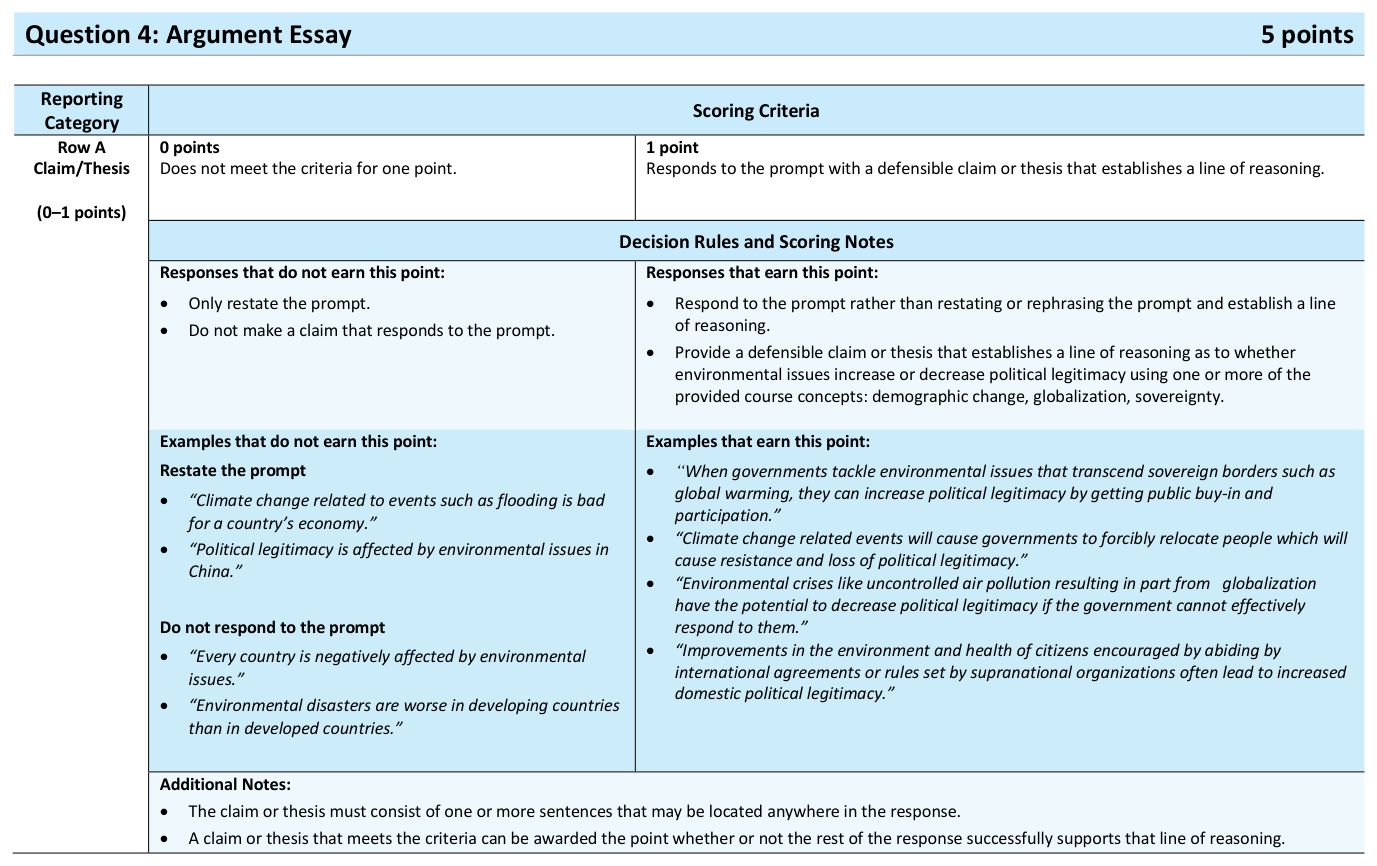
- Figure — Sample Responses Q4 - Set 2 (p. 2)
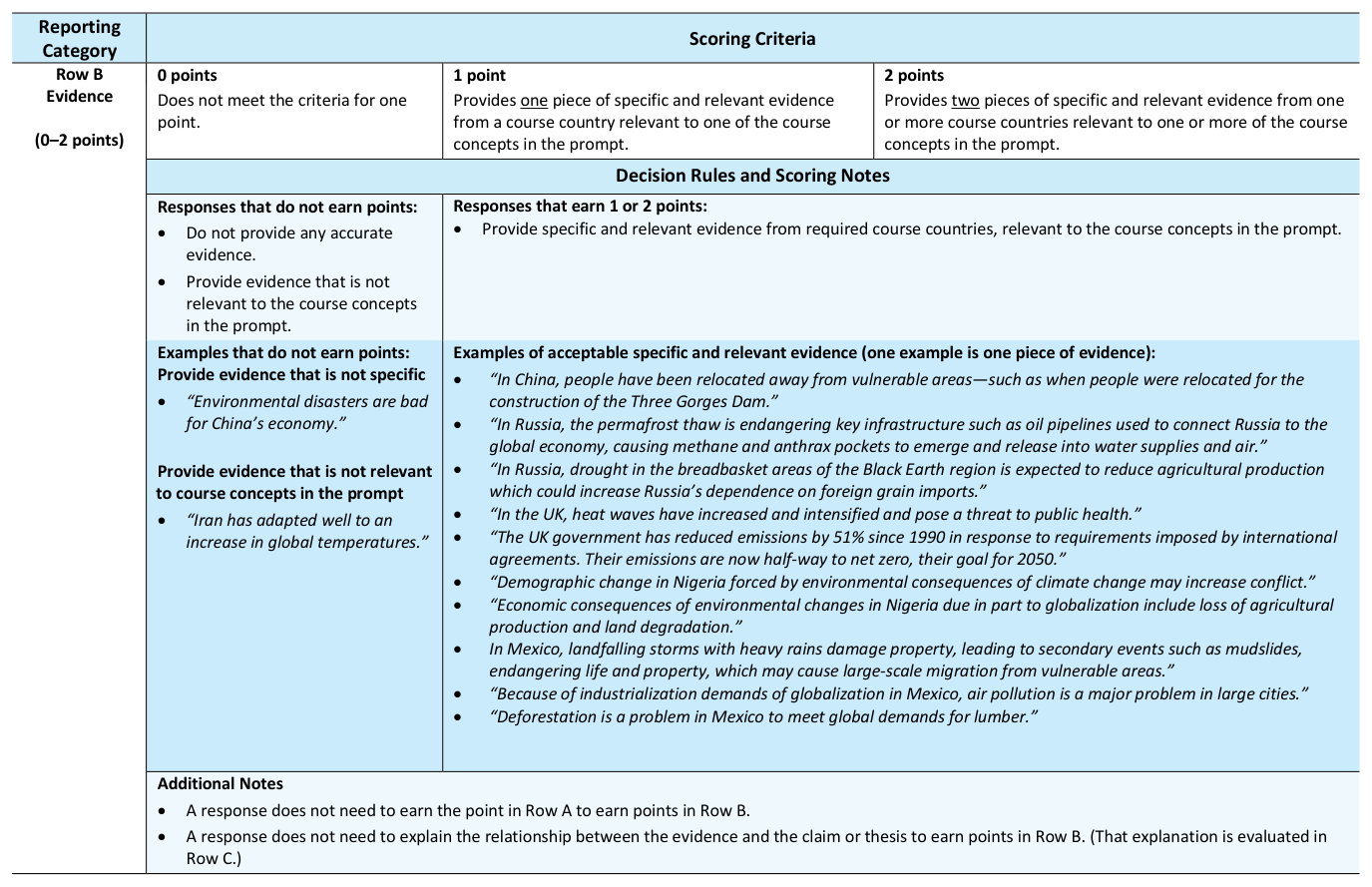
- Figure — Sample Responses Q4 - Set 2 (p. 3)
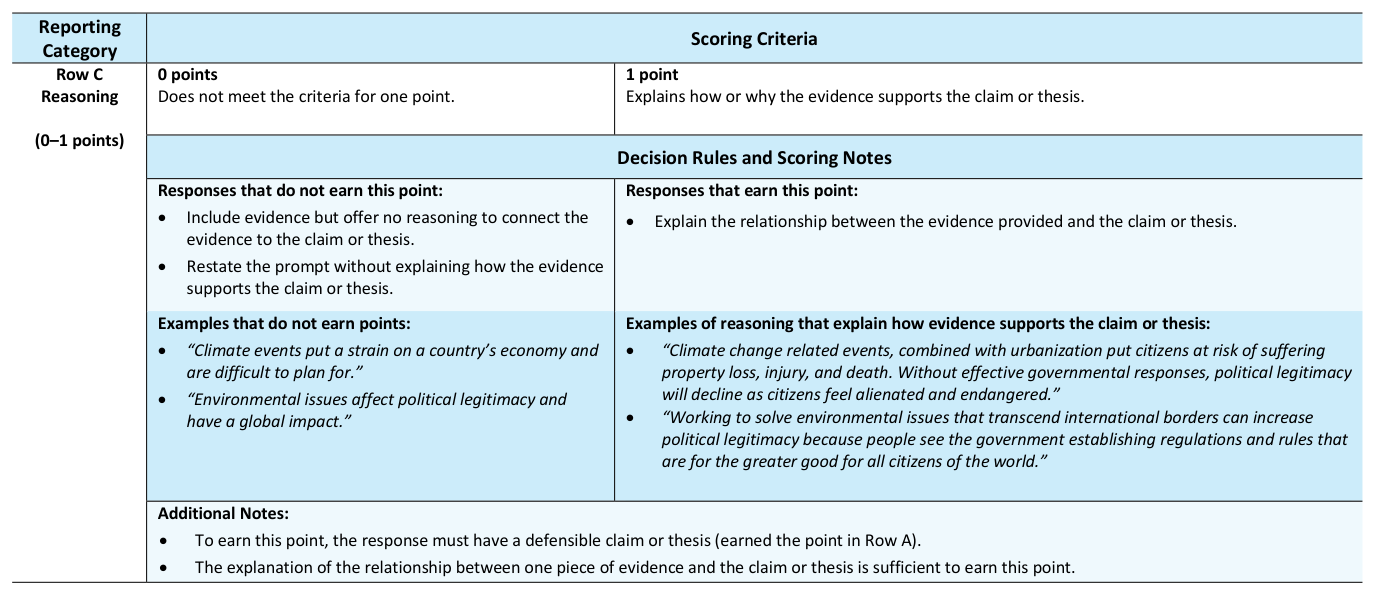
- Figure — Sample Responses Q4 - Set 2 (p. 4)
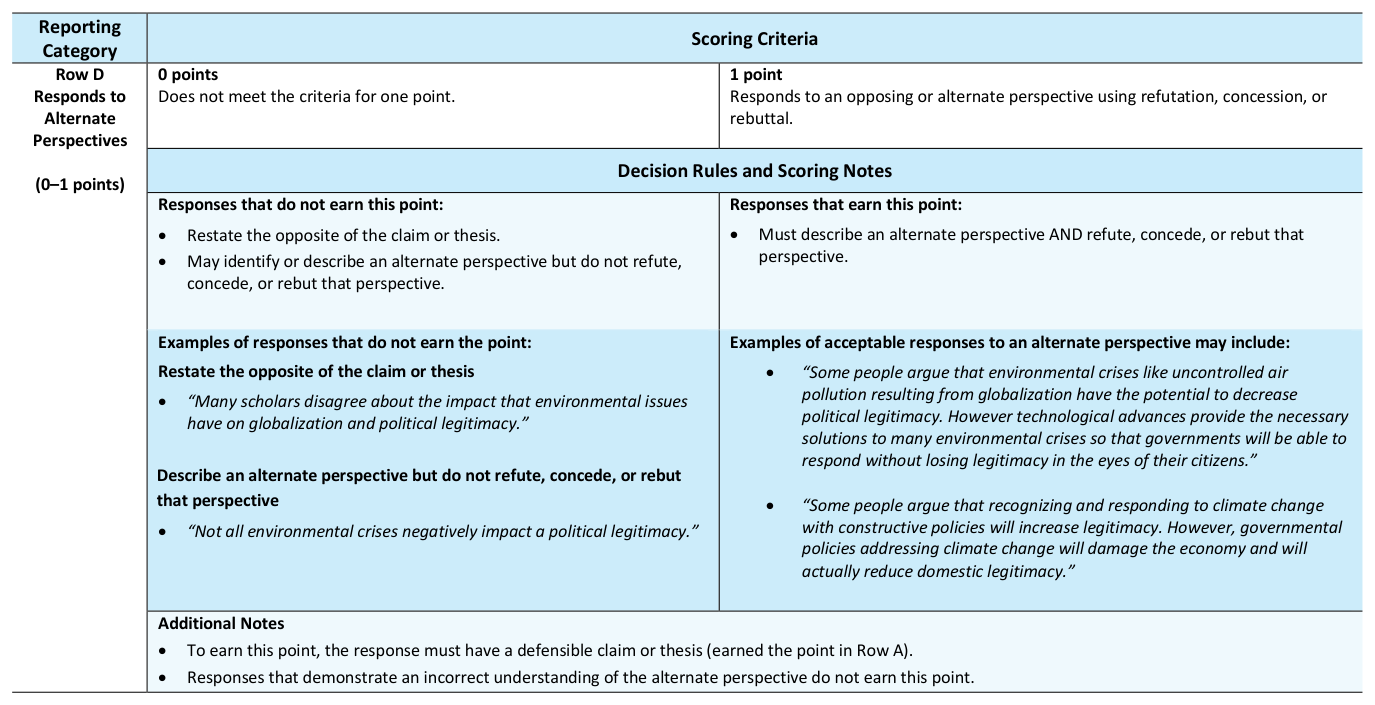
- Figure — Sample Responses Q4 - Set 2 (p. 5)