From the free course AP Comparative Government and Politics on Lykke
3.5 Nature and Role of Political Participation
Key concepts: Nature and role of political participation · Conventional political participation · Violent political behavior · Political participation under authoritarian regimes · Government management and limitation of citizen participation · Environmentalism as a political value linked to participation · Social and economic equality as political values linked to participation · Applying pressure on governments · Using data to analyze political systems, principles, institutions, processes, policies, and behaviors
Political participation is the set of actions through which citizens try to influence government decisions, public policies, or the distribution of political power. It can look routine—casting a ballot, joining a party, contacting a representative—or confrontational, including protest and, when legal avenues seem…
3.5 Nature and Role of Political Participation
Political participation is the set of actions through which citizens try to influence government decisions, public policies, or the distribution of political power. It can look routine—casting a ballot, joining a party, contacting a representative—or confrontational, including protest and, when legal avenues seem closed, violent political behavior.
Investigative question: When does citizen participation strengthen a political system, and when does the regime manage, restrict, or provoke participation?
A spectrum of participation
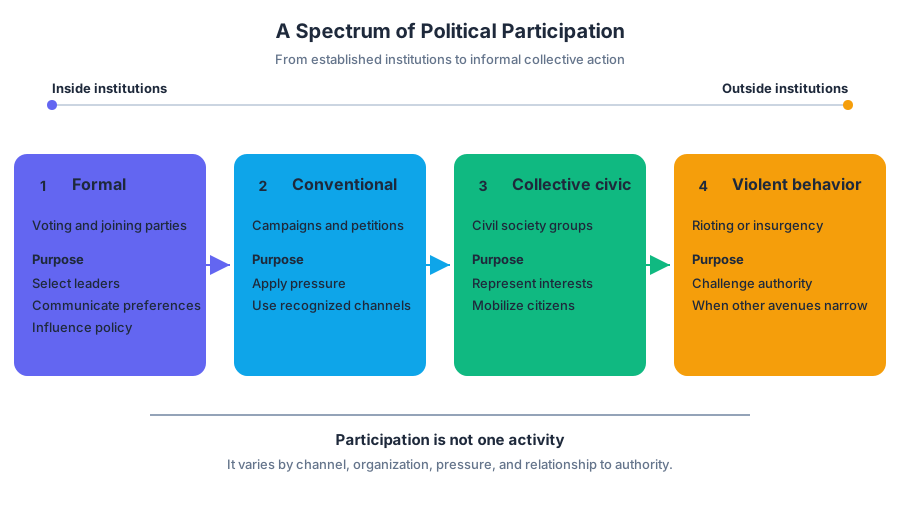
Political participation is not a single activity. It ranges from formal participation inside established institutions to informal collective action outside them.
| Form of participation | Typical action | Political purpose |
|---|---|---|
| Formal participation | Voting in elections, joining a political party, contacting officials | Select leaders, communicate preferences, or influence policy |
| Conventional participation | Campaigning, petitioning, attending lawful demonstrations, lobbying | Apply pressure while using recognized political channels |
| Collective civic participation | Working through civil society organizations or social movements | Represent interests and mobilize citizens |
| Violent political behavior | Rioting, insurgency, or political violence | Challenge authority when other avenues appear ineffective or unavailable |
Formal political participation can serve several regime purposes. Elections may enhance legitimacy, gather information about public preferences, provide a “safety valve” for dissatisfaction, or create a limited check on government power. However, the existence of elections does not automatically mean that citizens can meaningfully change policy or leaders.
Why conventional channels matter
Conventional political participation uses methods that a political system officially recognizes or generally tolerates. Voting, campaigning, lobbying, petitioning, and peaceful protest allow citizens to communicate demands without directly rejecting the political order.
The connection between conventional and violent participation is conditional, not automatic. Citizens may engage in violent political behavior when they believe conventional options are ineffective or unavailable—for example, when elections are manipulated, opposition parties are banned, peaceful demonstrations are violently suppressed, or officials refuse to respond to repeated demands.
Worked contextual example
Imagine a government that permits elections but disqualifies serious opposition candidates, controls major media outlets, and blocks peaceful demonstrations. A citizen who votes has used a conventional channel, but if every available channel produces no policy response, some citizens may conclude that conventional participation cannot work. The analytical chain is:
$$ \text{restricted conventional access} \rightarrow \text{political frustration} \rightarrow \text{pressure outside formal institutions} $$
This pattern does not mean that repression inevitably causes violence. Economic conditions, leadership, social cleavages, state capacity, and beliefs about political effectiveness also matter. The precise claim is narrower: ineffective or unavailable conventional channels make violent political behavior more likely.
Participation under authoritarian regimes
Authoritarian regimes manage and limit citizen participation to a much greater extent than less authoritarian regimes. They may permit carefully controlled elections, state-approved organizations, patriotic demonstrations, or online consultation while censoring criticism, monitoring activists, requiring organizations to register, or punishing unauthorized collective action.
This creates a crucial distinction between participation and political influence. A government can encourage citizens to attend rallies or vote while preventing them from freely choosing leaders, organizing opposition, or changing policy. Participation may therefore strengthen regime legitimacy without substantially increasing citizen control.
Misconception check — “Authoritarian means no participation.”
Authoritarian systems often allow participation, but they shape its timing, acceptable topics, organizational forms, and consequences. The key comparative question is not simply whether citizens participate, but whether participation is autonomous, competitive, and capable of constraining authority.
Participation and political values
Political participation can also apply pressure concerning environmental issues and social and economic equality. Citizens may organize around pollution, climate policy, land use, unequal access to resources, labor conditions, or distribution of wealth. Environmentalism therefore operates as a political value when it becomes a demand directed at government action rather than remaining only a personal preference.
For example, residents who petition a ministry to reduce industrial pollution, organize a demonstration against a proposed pipeline, or lobby legislators for environmental regulation are participating politically because they are attempting to alter public policy. Similarly, a movement demanding expanded social services is participating when it pressures government to reduce social or economic inequality.
AP skill: reading participation data
3.D — Explain what the data implies or illustrates about political systems, principles, institutions, processes, policies, and behaviors. When interpreting participation data, identify the pattern first, then connect it to a political mechanism. A graph showing high turnout but low opposition success may illustrate managed participation rather than strong democratic competition; a graph showing declining turnout may suggest disengagement, barriers to participation, or declining trust, but it does not prove one cause by itself.
A strong interpretation separates observation from inference:
- Describe the evidence: “Turnout is high, while independent opposition representation remains low.”
- Explain the implication: “This pattern may indicate that the regime encourages formal participation but limits meaningful competition.”
- State the caveat: “Turnout alone cannot establish whether participation is free or influential.”
Retrieval check: A government permits voting but bans unsanctioned organizations and censors criticism. Is this evidence that citizens do not participate? Explain why the better answer is that participation exists but is managed and politically constrained.

Source Materials
- AP Comparative Government and Politics Course and Exam Description
- AP Comparative Government and Politics Course and Exam Description Clarifications and Corrections
- AP Comparative Government and Politics Course Overview
- AP Comparative Government and Politics Course at a Glance
- AP Comparative Government and Politics Course at a Glance Poster
- AP Comparative Government and Politics
- AP Comparative Government and Politics
- AP Comparative Government and Politics Sample Syllabus 1