From the free course AP Comparative Government and Politics on Lykke
3.8 Political and Social Cleavages
Key concepts: Social cleavages · Political cleavages · Class, ethnicity, religion, and territory as bases of cleavages · Separatist movements · Autonomy movements · Ethnic and regional divisions · Multinational states · Political stability · Long-term regime stability · Comparative analysis of cleavages across countries
A country can have one government, one territory, and one legal citizenship while containing several politically meaningful communities with competing interests. These internal divisions are social cleavages: durable divisions within society that structure how groups understand their interests, organize…
3.8 Political and Social Cleavages
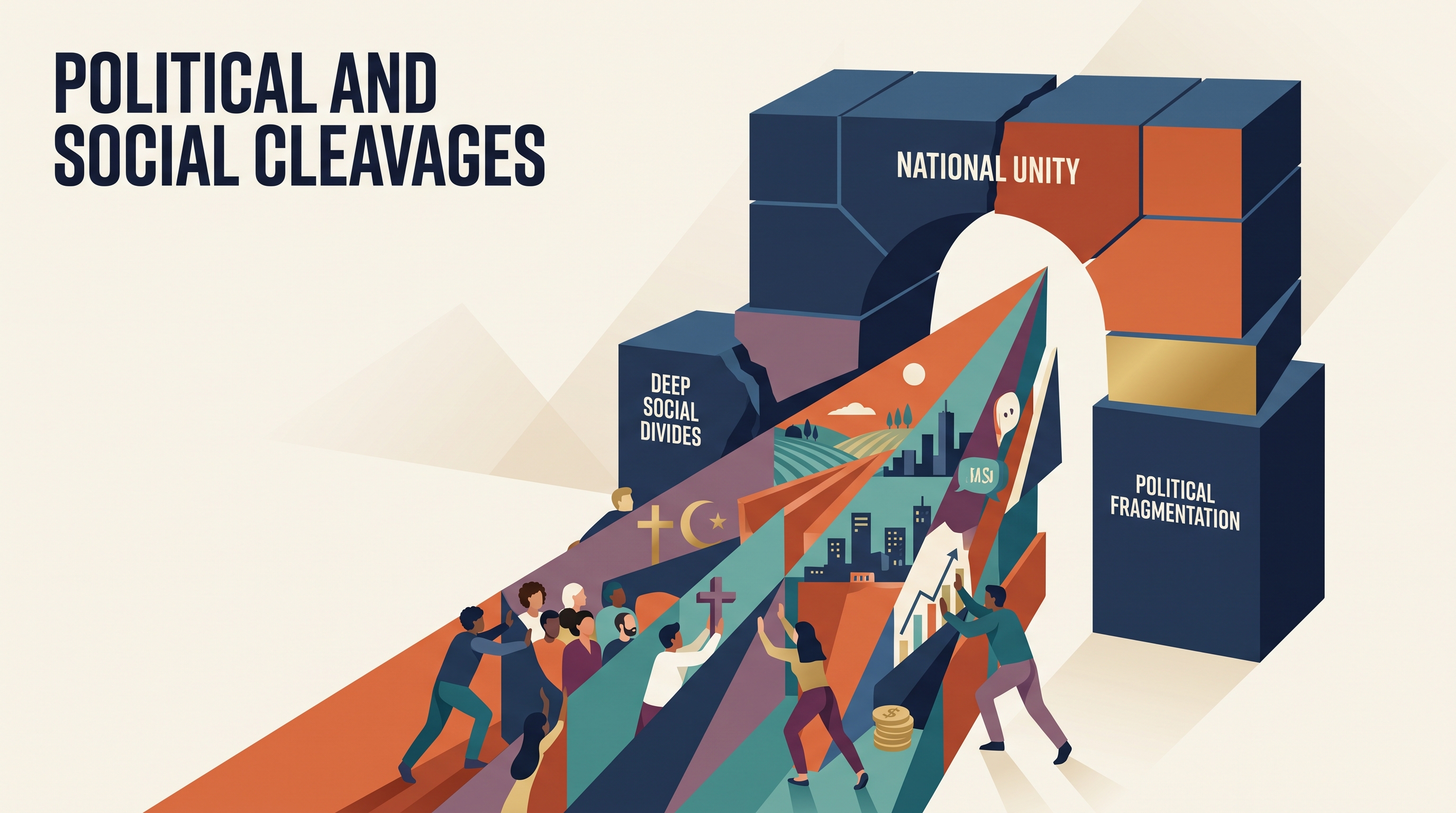
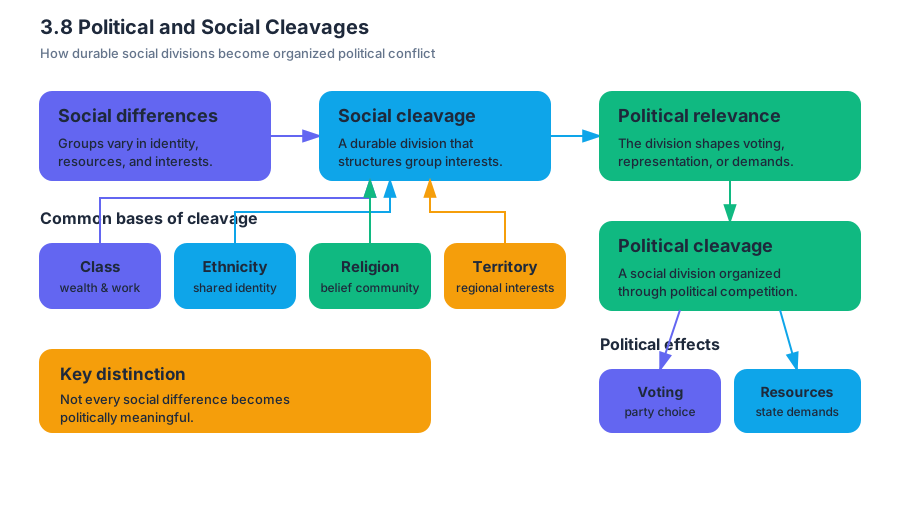
A country can have one government, one territory, and one legal citizenship while containing several politically meaningful communities with competing interests. These internal divisions are social cleavages: durable divisions within society that structure how groups understand their interests, organize politically, and relate to the state.
Social cleavages are internal divisions based on factors such as class, ethnicity, religion, or territory.
A political cleavage is a social division that becomes politically relevant—for example, when an ethnic, religious, regional, or class distinction shapes voting, party competition, demands for resources, or support for and opposition to the government. Not every difference in society is a cleavage. A difference becomes politically significant when it organizes conflict, cooperation, representation, or demands on political institutions.
The main bases of cleavage
Cleavages commonly rest on four overlapping foundations:
| Basis | Political question it can generate | Comparative illustration |
|---|---|---|
| Class | Who receives wealth, services, or economic opportunity? | Conflict between economically advantaged and disadvantaged groups |
| Ethnicity | Which cultural or linguistic group controls the state or public resources? | Han-majority and minority relations in China |
| Religion | Which religious identity or interpretation should influence public authority? | Shi’a majority, Sunni Muslims, and other religions in Iran |
| Territory | Should different regions receive different resources or governing powers? | Regional development differences in China and Mexico |
The categories often reinforce one another. A regional minority may also differ ethnically, linguistically, economically, or religiously from the national majority. That overlap can make a cleavage more politically powerful because a single dispute—such as unequal development—may be experienced simultaneously as economic exclusion, ethnic discrimination, and regional marginalization.
Country comparison: where cleavages appear
In China, ethnic and regional cleavages divide the majority Han population from at least $55$ recognized ethnic minorities, including the Uyghurs in the northwest and Tibetans in the southwest. China also contains regional divisions between areas that have developed at different rates. The political issue is therefore not only identity; it also concerns territory, development, representation, and the distribution of state resources.
In Iran, religious cleavages exist between the Shi’a Muslim majority and members of other religions, including Christianity, Judaism, and Zoroastrianism, as well as between Shi’a and Sunni Muslims. Ethnic cleavages also divide the majority Persian population from groups such as Azerbaijanis and Kurds. These divisions can affect how citizens perceive inclusion, authority, and the legitimacy of national political institutions.
In Mexico, ethnic divisions include differences between the Amerindian, or Indigenous, population and whites and mestizos. Regional cleavages also distinguish the more developed north from the south. However, ethnicity has played a more significant political role in Nigeria than in Mexico because Nigeria has greater diversity and politicization of ethnic and religious identities, shaped in part by different colonial histories.
Separatism versus autonomy
A separatist movement seeks independence: the creation of a separate sovereign state. An autonomy movement seeks self-government within the existing state, without necessarily demanding full independence.
Separatism = leave the state.
Autonomy = govern more of your own affairs while remaining inside the state.
Separatist movements have emerged from social cleavages in China, Iran, Nigeria, Russia, and the United Kingdom. Autonomy movements—demanding self-government rather than independence—have emerged in Mexico and the United Kingdom. The United Kingdom therefore illustrates why the distinction matters: a movement can seek greater control over regional affairs without seeking complete international sovereignty.
Why government responses affect stability
Governments can respond to cleavages through accommodation, decentralization, representation, restriction, or coercion. Accommodation may reduce conflict by recognizing group interests; coercion may suppress visible opposition without resolving the underlying division. The response affects citizen-government relations because groups judge whether the state is fair, authoritative, and legitimate.
Unresolved cleavages can produce three connected problems: conflicting interests and competition among groups and political parties; a perceived lack of governmental authority or legitimacy; and pressure for autonomy or secession. In a multinational state, these pressures can weaken long-term regime stability when citizens increasingly identify with an ethnic, religious, or regional community rather than with the state as a whole.
Worked comparative example
Suppose a regional minority believes that the national government distributes development unevenly and excludes its representatives. A strong response identifies the chain of reasoning:
- Cleavage: territorial and ethnic differences structure political interests.
- Political effect: the group demands greater representation, autonomy, or independence.
- Government response: accommodation may build trust; repression may intensify alienation.
- Stability consequence: if citizens view the government as unable or unwilling to govern fairly, legitimacy and regime stability may decline.
Misconception check — “Every diverse society is unstable.” Diversity alone does not cause instability. The key variables are the political significance of the cleavage and the government’s response. Nigeria and Mexico both contain ethnic divisions, but ethnicity has had a more significant political role in Nigeria because historical conditions produced greater diversity and stronger politicization of ethnic and religious identities.
AP skill focus and retrieval check
This topic develops Country Comparison (COMP-1) by comparing the basis and political effects of cleavages across China, Iran, Mexico, Nigeria, Russia, and the United Kingdom. It also develops Argumentation (ARG-1): a strong claim must connect evidence about a cleavage to a government response and then explain the effect on citizen-government relations or regime stability. The relevant CED identifiers are LEG-2.A, LEG-2.A.1, and LEG-2.B.5.
Retrieval check: A movement demands control over education, language, and local administration but does not seek an independent country. Is it separatist or autonomy-seeking, and why could the government’s response affect political stability?
Source Materials
- AP Comparative Government and Politics Course and Exam Description
- AP Comparative Government and Politics Course and Exam Description Clarifications and Corrections
- AP Comparative Government and Politics Course Overview
- AP Comparative Government and Politics Course at a Glance
- AP Comparative Government and Politics Course at a Glance Poster
- AP Comparative Government and Politics
- AP Comparative Government and Politics
- AP Comparative Government and Politics Sample Syllabus 1