From the free course AP Comparative Government and Politics on Lykke
5.6 Adaptation of Social Policies
Key concepts: Adaptation of social policies · Political, cultural, and economic change · Government creation of new social policies · Gender equity · Health care policy · Gender quotas in Mexico · Unequal gender access to education in northern and southern Nigeria
A government’s social policy changes when society changes—or when existing policies no longer solve political problems. Adaptation of social policies means creating or revising government policies to respond to political, cultural, and economic conditions while improving citizens’ lives and often strengthening…
5.6 Adaptation of Social Policies
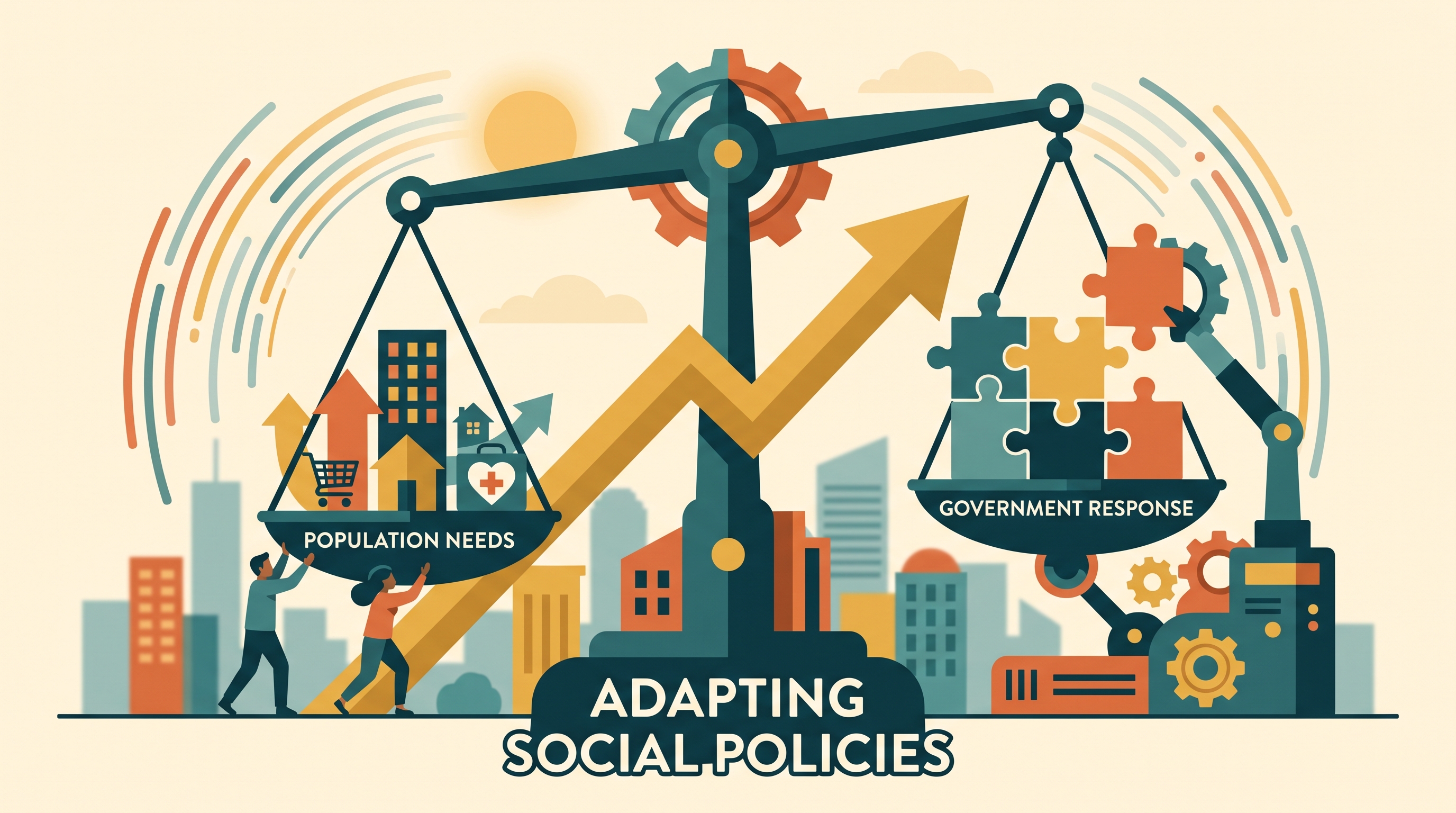
A government’s social policy changes when society changes—or when existing policies no longer solve political problems. Adaptation of social policies means creating or revising government policies to respond to political, cultural, and economic conditions while improving citizens’ lives and often strengthening political legitimacy.
Essential idea — LEG-3.B.1: In response to political, cultural, and economic changes, governments create new social policies, including policies involving gender equity, health care, and education.
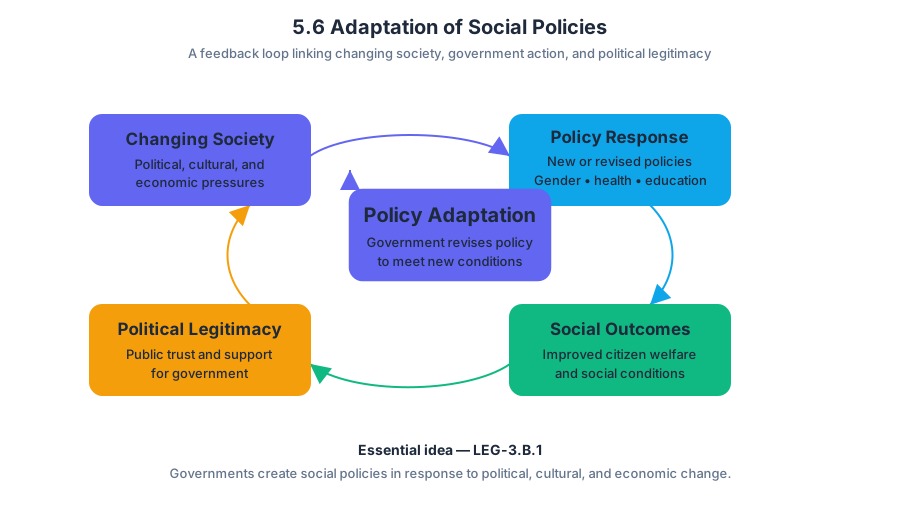
A useful way to picture adaptation is as a policy feedback loop: social conditions create pressure, governments choose a response, and the results affect both citizens’ welfare and the government’s legitimacy.
Why governments adapt social policies
Political change may create new demands for representation or equality. Cultural change may alter public expectations about gender, education, or family life. Economic change may increase poverty, expand access to technology, or create new demands for public health and education. Governments respond by implementing social welfare policies—policies intended to reduce poverty, increase literacy, improve public health, or expand access to political and social opportunities.
The response has two connected purposes:
| Policy purpose | What the government is trying to do |
|---|---|
| Improve citizens’ lives | Expand access to education, health care, political participation, or economic security |
| Maintain or bolster political legitimacy | Demonstrate that the government recognizes social needs and can respond effectively |
This does not mean that every policy is equally effective or equally inclusive. A government may adopt a policy to satisfy public demands, manage conflict, or improve its reputation, yet still leave important inequalities in place.
Gender equity as social policy
Gender equity refers to policies designed to reduce unfair barriers affecting people because of gender. It can involve voting rights, access to elected office, appointment to government positions, education, university programs, sporting events, and reproductive policy.
Iran illustrates why social policy must be examined as a set of related rules rather than reduced to a single label. Iranian policies address women’s voting, election to the Majles, and appointment to cabinet positions. At the same time, disputes concern female access to certain university degree programs and women’s attendance at and participation in sporting events. These examples show that political access in one area does not automatically produce equal access in every other area.
Mexico provides another example. Gender quotas are policies that reserve or require a specified share of candidacies or political positions for women. They are intended to correct unequal representation by changing the rules through which political offices are filled. Mexico also demonstrates that social policy can vary within one country: abortion policies differ among local and state governments.
Worked comparison: Suppose women gain the formal right to vote but remain sharply underrepresented among legislators. Voting rights create political access, but they do not guarantee descriptive representation. A gender quota addresses the second problem by changing recruitment and election rules. The policy therefore adapts the political system to an inequality that the original rule did not solve.
Education and health care
Education and health care are also social-policy areas because governments decide who receives services, under what conditions, and with what level of public support. Education policy can increase literacy and expand opportunity; health care policy can improve public health and reduce preventable inequalities.
Gender access to education is unequal between northern and southern Nigeria. The comparison matters because national policy alone does not guarantee equal outcomes across regions. Local economic conditions, cultural expectations, infrastructure, security, and government capacity can shape whether girls and women can actually attend school.
A similar distinction applies to health care: announcing universal access is not the same as delivering clinics, trained personnel, medicines, and affordable treatment. Policy design states what the government intends; policy implementation determines what citizens experience.
Misconception check
Misconception: “A new social policy automatically creates equality.” A policy is an official response, not proof that the underlying problem has disappeared. To evaluate adaptation, ask three questions: What political, cultural, or economic change produced pressure? What policy did the government create or revise? Did implementation improve access, and did the response strengthen or weaken legitimacy?
CED alignment and retrieval check
Enduring Understanding LEG-3.B: Governments implement social welfare policies to reduce poverty, increase literacy, and improve public health, both to improve citizens’ lives and to maintain or bolster political legitimacy.
Learning Objective LEG-3.B.2: Explain how governments adapt social policies to address political, cultural, and economic changes. Suggested Skill: Country Comparison—especially explaining the implications of similarities and differences between countries with similar political systems, as identified in the CED.
Retrieval check: Nigeria shows unequal gender access to education between its northern and southern regions. Identify one political, cultural, or economic condition that could create pressure for a new education policy, then explain how that policy might improve citizens’ lives and bolster political legitimacy.
Source Materials
- AP Comparative Government and Politics Course and Exam Description
- AP Comparative Government and Politics Course and Exam Description Clarifications and Corrections
- AP Comparative Government and Politics Course Overview
- AP Comparative Government and Politics Course at a Glance
- AP Comparative Government and Politics Course at a Glance Poster
- AP Comparative Government and Politics
- AP Comparative Government and Politics
- AP Comparative Government and Politics Sample Syllabus 1