From the free course AP Comparative Government and Politics on Lykke
1.3 Democracy vs. Authoritarianism
Key concepts: Democracy · Claiming and maintaining power in a country · Religious influence in a democracy
A government can claim power through elections yet maintain power by restricting competition, controlling information, or weakening opponents. The central comparative question is therefore not merely Who governs?
1.3 Democracy vs. Authoritarianism
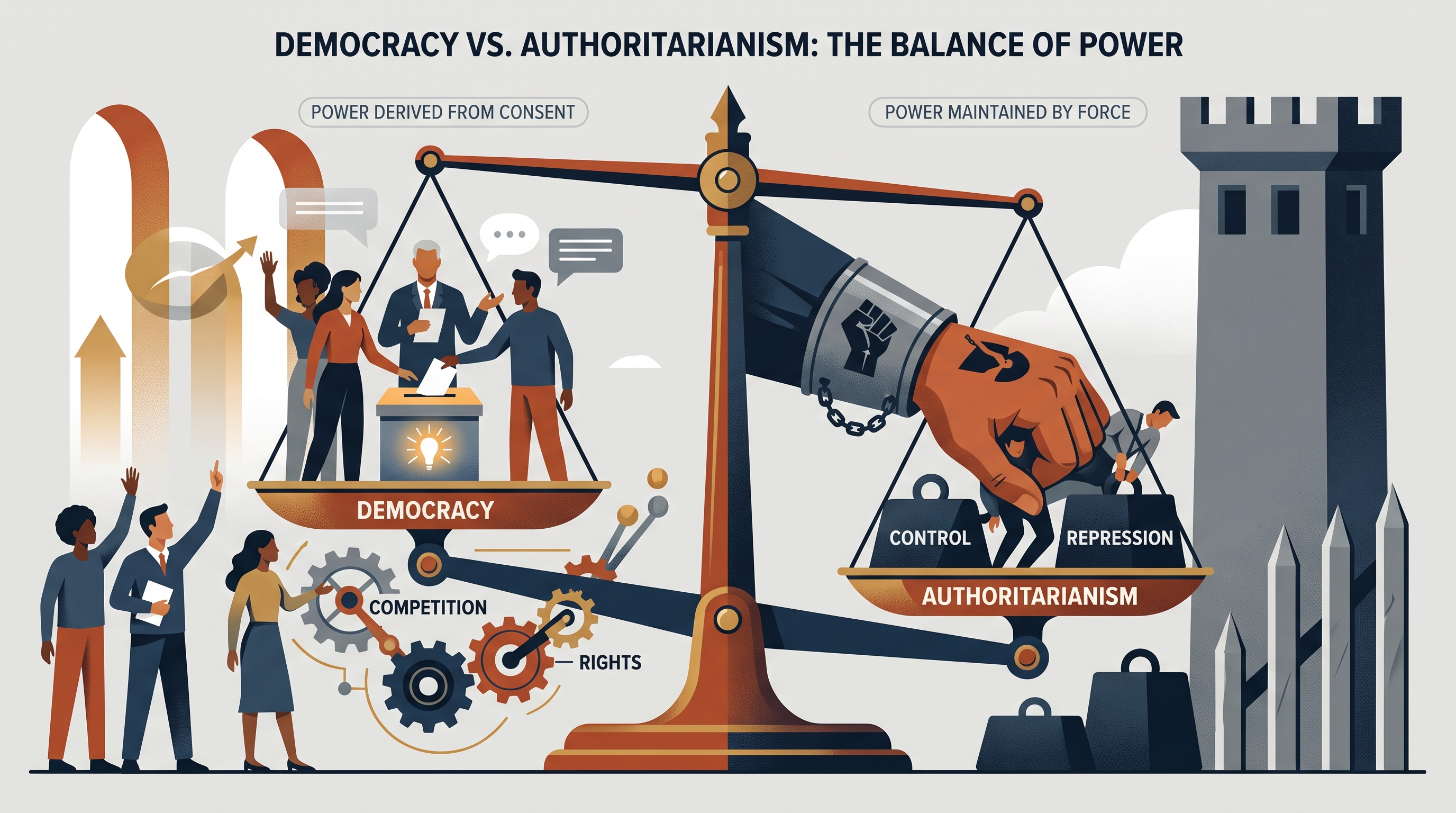
A government can claim power through elections yet maintain power by restricting competition, controlling information, or weakening opponents. The central comparative question is therefore not merely Who governs? but How is power claimed, exercised, and maintained?
Democracy is a system in which political authority is grounded in popular participation and meaningful competition, supported by institutions that protect political rights and limit government power.
Authoritarianism is a system in which political power is concentrated in one leader, one party, a military establishment, or a small governing group, while political competition and civil liberties are significantly restricted.
The institutional difference
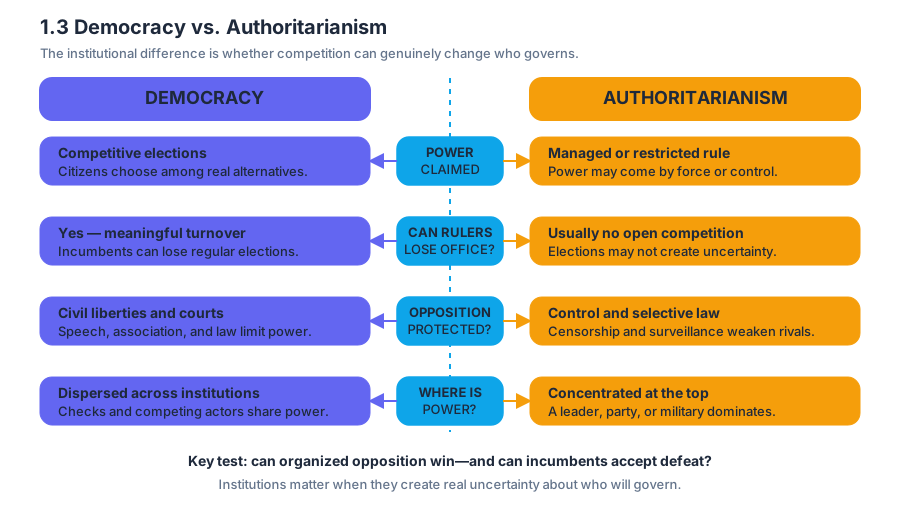
In a democracy, leaders claim power through procedures that allow citizens to choose among competing alternatives. Elections must be more than ceremonies: opposition candidates must be able to organize, voters must have meaningful choices, and the rules must permit incumbents to lose. Democratic government also depends on protections such as freedom of expression, freedom of association, an independent judiciary, and the rule of law.
In an authoritarian system, leaders may use elections, constitutions, legislatures, and courts, but these institutions do not necessarily create genuine uncertainty about who will govern. The ruling group may restrict opposition parties, censor criticism, manipulate electoral rules, control the media, or use state institutions against political rivals.
| Question | Democracy | Authoritarianism |
|---|---|---|
| How is power claimed? | Competitive elections and recognized constitutional procedures | Appointment, inherited authority, military takeover, dominant-party control, or tightly managed elections |
| Can rulers lose office? | Yes, through regular and meaningful elections | Usually not through open competition |
| What protects opposition? | Civil liberties, independent courts, and legal limits | Surveillance, censorship, restrictions, or selective enforcement of law |
| Where is power concentrated? | Dispersed among institutions and competing political actors | Concentrated in a leader, party, military, or ruling elite |
| What makes rule durable? | Institutional legitimacy and peaceful succession | Coercion, patronage, ideology, performance, or controlled participation |
Claiming and maintaining power
The distinction between claiming and maintaining power is essential. A leader may claim authority constitutionally but maintain it through practices that undermine democratic competition. Conversely, an authoritarian government may claim power through a revolution or military takeover but later maintain it by creating a dominant-party system, distributing patronage, or delivering economic growth.
Coercion means using force or the threat of force to secure obedience. Patronage means distributing jobs, contracts, money, or other benefits to supporters. Authoritarian governments often combine coercion with patronage: repression raises the cost of opposition, while rewards encourage loyalty.
A useful analysis asks four questions:
- Who may participate in politics?
- Can organized opposition realistically challenge the government?
- Are political rights protected even when citizens criticize leaders?
- Can institutions remove or constrain those currently in power?
Exam insight: Do not classify a regime from one feature alone. The presence of elections does not automatically make a country democratic, and the presence of strong executive power does not automatically make it authoritarian. Analyze the entire pattern of competition, rights, institutional constraints, and leadership turnover.
Religious influence in a democracy
Religious influence does not by itself make a country nondemocratic. A democracy may have a religious majority, religious political parties, or public policies shaped partly by religious beliefs. The decisive issue is whether citizens retain political equality and whether government institutions protect participation and rights for people who hold different beliefs—or no religious belief.
Nigeria illustrates why this distinction matters. Nigeria is a democracy with religious influence, including substantial Christian and Muslim populations. Religious identities can shape voting behavior, party appeals, public debates, and policy preferences. Yet religious influence alone does not determine the regime type; the analysis must examine elections, political competition, civil liberties, and the functioning of institutions.
Misconception check — “A religiously influenced country cannot be democratic.” False. Religion may influence democratic politics in the same way that ethnicity, region, class, or ideology can influence political preferences. Democracy requires inclusive and meaningful political competition, not the absence of religious beliefs from public life.
Worked comparison
Suppose Country A has regular elections, several parties, independent news organizations, and courts that sometimes rule against the president. Religious organizations influence campaigns, but minority parties may compete and citizens may criticize the government. Country A is more consistent with democracy.
Country B also holds elections, but the ruling party controls television, prevents major opponents from organizing, and uses courts to disqualify challengers. Even if voting occurs, Country B is more consistent with authoritarianism because competition is not genuinely open.
AP skill connection
1.A — Define and explain political concepts and processes is assessed when you identify democracy or authoritarianism and connect the label to observable evidence. A strong response does not merely state “Nigeria is democratic” or “Country B is authoritarian”; it explains the classification using competition, rights, institutional limits, and the process by which leaders claim and maintain power.
Retrieval check: A country has elections, but the governing party controls media access, bans major opposition groups, and makes peaceful turnover nearly impossible. Which feature matters most in classifying the regime, and why? The best answer identifies the lack of meaningful competition and explains that elections alone do not establish democracy.
Source Materials
- AP Comparative Government and Politics Course and Exam Description
- AP Comparative Government and Politics Course and Exam Description Clarifications and Corrections
- AP Comparative Government and Politics Course Overview
- AP Comparative Government and Politics Course at a Glance
- AP Comparative Government and Politics Course at a Glance Poster
- AP Comparative Government and Politics
- AP Comparative Government and Politics
- AP Comparative Government and Politics Sample Syllabus 1