From the free course AP Comparative Government and Politics on Lykke
AP Practice 6
An argument essay earns points not for sounding forceful, but for connecting a defensible claim to accurate comparative evidence and explicit political reasoning. The central question is simple: Can you prove a comparative political argument rather than merely state an opinion?
AP Practice 6
An argument essay earns points not for sounding forceful, but for connecting a defensible claim to accurate comparative evidence and explicit political reasoning. The central question is simple: Can you prove a comparative political argument rather than merely state an opinion?
Task focus: Argumentation
This original, unofficial practice task targets Disciplinary Practice 5: Argumentation. It also requires Disciplinary Practice 1: Concept Application and Disciplinary Practice 2: Country Comparison because a strong response applies a political concept and uses evidence from the required countries: China, Iran, Mexico, Nigeria, Russia, and the United Kingdom.
Timing target
Reserve approximately $25$ minutes for the argument essay. A practical sequence is:
- Spend $3$ minutes identifying the key term and choosing evidence.
- Spend $4$ minutes writing a precise thesis.
- Spend $15$ minutes developing evidence and reasoning.
- Spend $3$ minutes checking the thesis, country references, and counterargument.
Original practice prompt
Claim: Political legitimacy is more effectively sustained through government performance than through ideological or traditional appeals.
Write an argument that evaluates the claim. In your response, do the following:
- Present a defensible claim or thesis.
- Support the claim with accurate evidence from at least two required countries.
- Use reasoning to explain how each piece of evidence supports your claim.
- Address an alternative perspective or limitation.
Plan the argument before writing
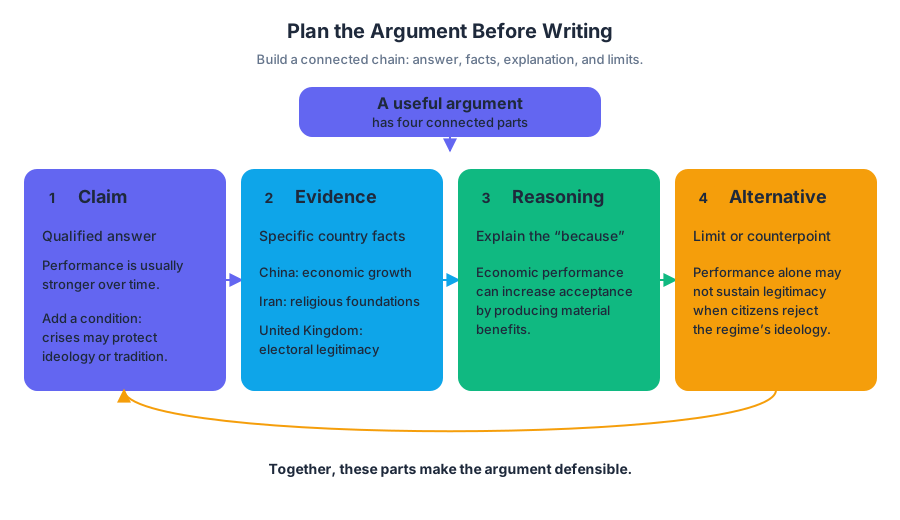
A useful argument has four connected parts:
| Part | What the examiner must see | Example for this prompt |
|---|---|---|
| Claim | A qualified, defensible answer | Performance is usually stronger over time, but ideology or tradition can protect regimes during crises. |
| Evidence | Specific country-based facts | China’s economic growth; Iran’s religious foundations; the United Kingdom’s electoral legitimacy |
| Reasoning | The “because” connecting evidence to claim | Economic performance can increase acceptance by producing material benefits. |
| Alternative perspective | A limitation or competing explanation | Performance alone may not sustain legitimacy when citizens reject the regime’s underlying ideology. |
Worked response
Thesis: Government performance is generally the most durable way to sustain political legitimacy because effective economic management and public services can persuade citizens that existing institutions produce useful outcomes. However, ideological and traditional appeals may sustain legitimacy when a government’s performance is weak, especially if those appeals are embedded in powerful institutions.
In China, the ruling Communist Party has strengthened its legitimacy partly through economic performance. Rapid economic development, expanded infrastructure, and increased access to consumer goods have allowed the government to present itself as capable of improving living standards. This evidence supports the claim because citizens may tolerate limited political competition when they believe the governing system delivers economic security and national progress. Performance therefore links the state to visible benefits in everyday life.
Iran demonstrates why performance is not the only source of legitimacy. The Islamic Republic draws legitimacy from revolutionary and religious principles, including the authority of the clergy and the state’s claim to defend an Islamic political order. These ideological foundations can preserve support among citizens who value religious governance even when economic problems, sanctions, or dissatisfaction with public administration weaken the government’s performance. In this case, legitimacy rests not only on what the government produces but also on whether it represents an accepted political identity.
The United Kingdom illustrates another form of legitimacy. Its government benefits from long-standing political traditions, including parliamentary government, constitutional practices, and regular competitive elections. These traditions can encourage acceptance of political outcomes even when a particular government performs poorly. Nevertheless, tradition is not an unlimited resource: if public services deteriorate severely or citizens lose confidence in institutions, historical legitimacy may no longer be sufficient.
Overall, performance is usually the strongest foundation for sustaining legitimacy because its effects are concrete and repeatedly experienced. Yet the comparison among China, Iran, and the United Kingdom shows that performance operates alongside ideology and tradition. A government that combines effective performance with a convincing political identity and trusted institutions is more likely to sustain legitimacy than one that depends on only a single source.
Why this response earns credit
- Thesis/claim: The opening makes a clear judgment and qualifies it rather than repeating the prompt.
- Evidence: China, Iran, and the United Kingdom are used accurately and specifically.
- Reasoning: Each paragraph explains why the evidence supports or complicates the argument. Naming economic benefits alone would be description; connecting those benefits to citizen acceptance makes the response analytical.
- Alternative perspective: The Iran and United Kingdom paragraphs show that ideological and traditional legitimacy can matter when performance is weak or uneven.
- Comparison: The final paragraph synthesizes the countries instead of leaving them as three unrelated examples.
Misconception check: “More countries means a better essay”
A long list of countries does not automatically produce a strong argument. Two countries with precise evidence and explanation are more valuable than five countries named without political reasoning. The essential pattern is:
$$ \text{Specific evidence} \rightarrow \text{political mechanism} \rightarrow \text{support for the claim} $$
Error-review routine
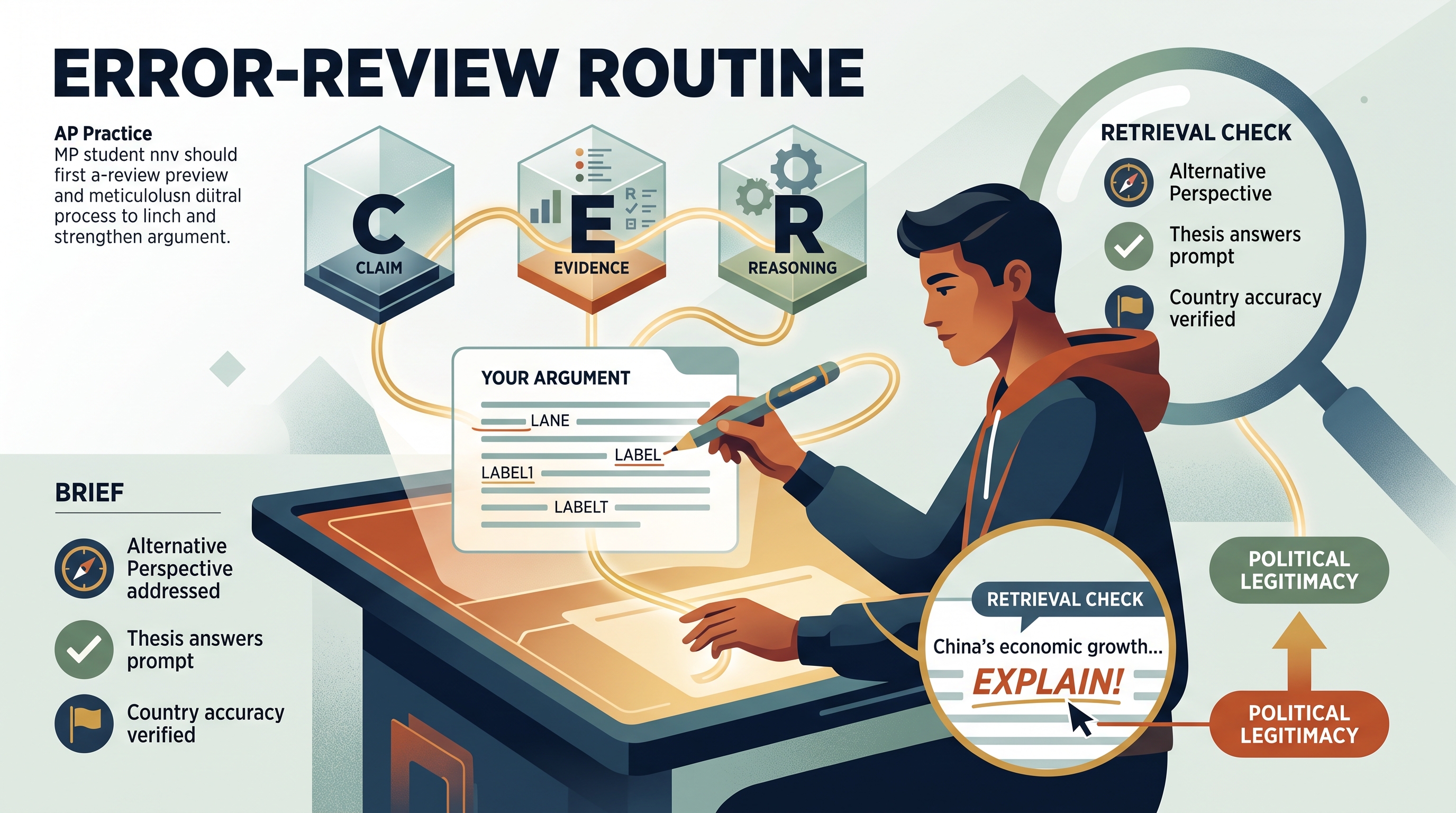
After writing, label every sentence C for claim, E for evidence, or R for reasoning. If a paragraph contains evidence but no reasoning, add a sentence beginning with “This supports the claim because…” Then verify that each country reference is accurate, that the thesis answers the prompt directly, and that the alternative perspective is genuinely addressed rather than simply mentioned.
Retrieval check: If a response says, “China experienced economic growth,” what must it add to earn analytical value? It must explain how that growth affected citizens’ acceptance of the government and therefore connected to political legitimacy.
Source Materials
- AP Comparative Government and Politics Course and Exam Description
- AP Comparative Government and Politics Course and Exam Description Clarifications and Corrections
- AP Comparative Government and Politics Course Overview
- AP Comparative Government and Politics Course at a Glance
- AP Comparative Government and Politics Course at a Glance Poster
- AP Comparative Government and Politics
- AP Comparative Government and Politics
- AP Comparative Government and Politics Sample Syllabus 1
- AP Comparative Government and Politics-AP Students-College Board
- AP Comparative Government and Politics-Wikipedia
- AP Comparative Government and Politics Cheat <http://sheets-albert.io>Sheets-Albert.io
- AP Comparative Government and Politics-GOA