From the free course AP Comparative Government and Politics on Lykke
2.2 Comparing Parliamentary, Presidential, and Semi-Presidential Systems
Key concepts: Parliamentary systems · Presidential systems · Semi-presidential systems · Country comparison · Institutional obstacles to policymaking · Divided branch powers · Executive-legislative relations · Prime minister approval by the legislature · Cabinet accountability · Comparing course countries by relevant categories
The central comparative question is not simply who leads, but how many institutional obstacles stand between leadership and policy. A parliamentary government usually concentrates executive and legislative authority, while a presidential government divides those powers; a semi-presidential government deliberately…
2.2 Comparing Parliamentary, Presidential, and Semi-Presidential Systems
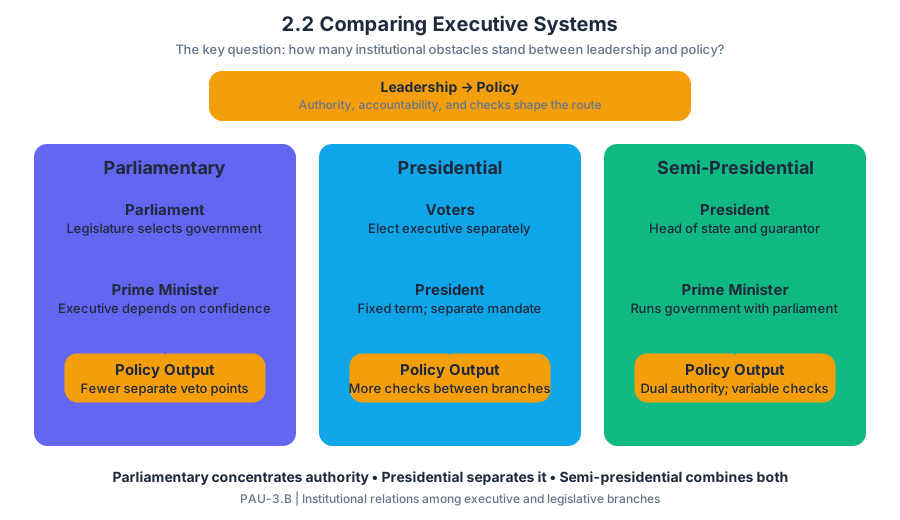
The central comparative question is not simply who leads, but how many institutional obstacles stand between leadership and policy. A parliamentary government usually concentrates executive and legislative authority, while a presidential government divides those powers; a semi-presidential government deliberately combines both arrangements.
PAU-3.B: Compare institutional relations among parliamentary, presidential, and semi-presidential systems.
The institutional comparison
| Category | Parliamentary system | Presidential system | Semi-presidential system |
|---|---|---|---|
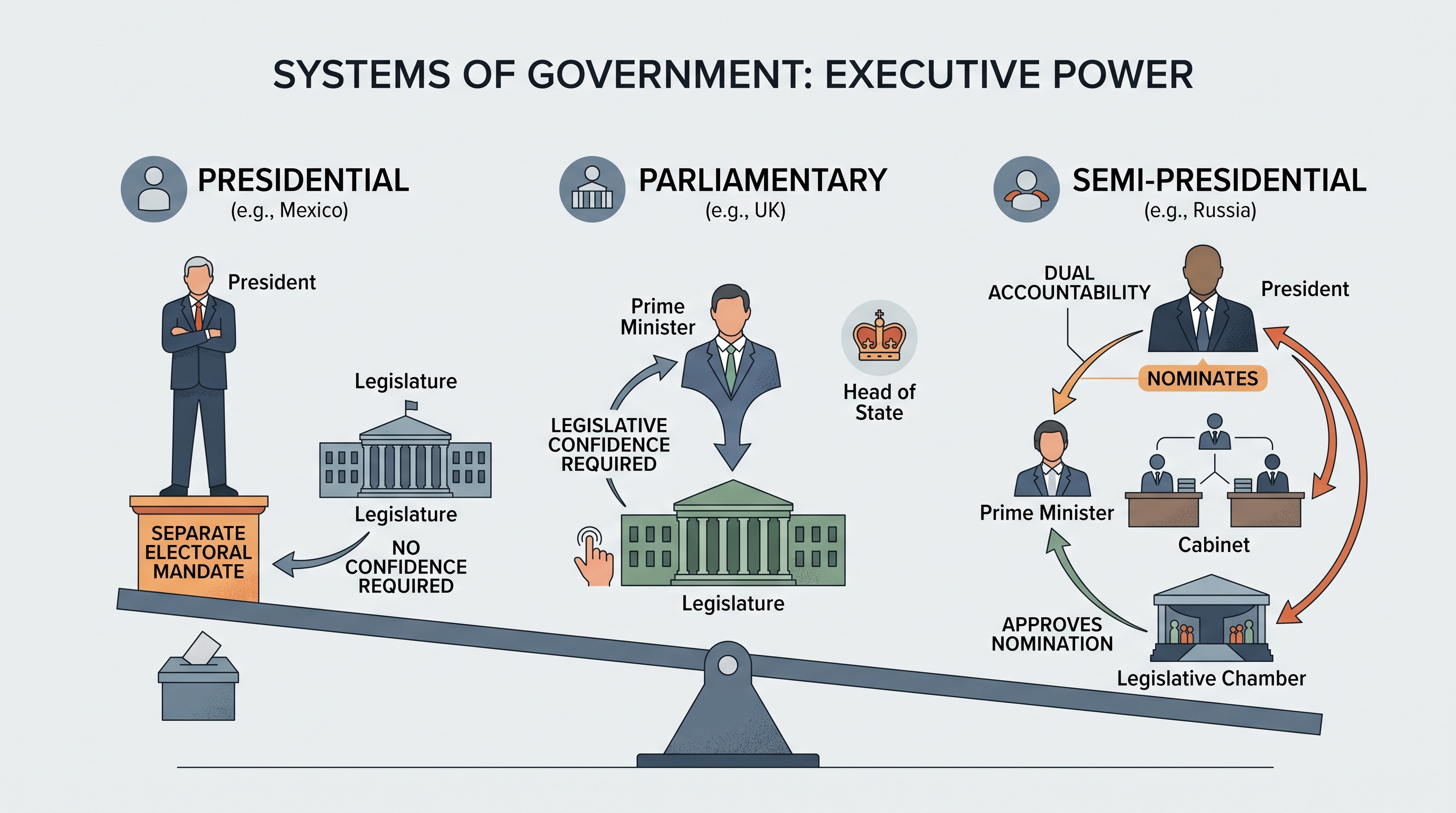
| Head of government | Prime minister, normally selected from the legislative majority or coalition | President | Prime minister and president share executive responsibilities |
| Legislative relationship | Prime minister normally must be approved by, or retain the confidence of, the legislature | President has a separate electoral mandate from the legislature | President nominates a prime minister who must be approved by the legislature |
| Cabinet accountability | Cabinet is accountable primarily to the legislature through the prime minister | Cabinet is accountable primarily to the president | Cabinet members are accountable to both the president and the legislature |
| Terms and removal | Government may fall if it loses legislative confidence; elections may follow | President and legislature usually serve separately elected, often fixed terms | President and legislature have distinct mandates; the prime minister depends on legislative approval |
| Typical policymaking obstacle | Fewer institutional obstacles when the governing party controls the legislature | More obstacles because executive and legislative branches are divided | Obstacles vary according to the relationship among president, prime minister, and legislature |
| Course-country model | United Kingdom | Mexico and Nigeria | Russia |
Parliamentary systems: streamlined, but not unchecked
In the United Kingdom, the prime minister normally emerges from the party or coalition able to command a majority in the House of Commons. That means the prime minister does not possess a completely separate electoral mandate: the government depends on continuing legislative confidence. If governing legislators withdraw their support, the prime minister may be forced to resign, form a new coalition, or call an election under the applicable rules.
This arrangement can make policymaking comparatively efficient. When the governing party controls both the cabinet and the legislature, executive proposals often face fewer veto points than they would in a presidential system. However, fewer obstacles does not mean no checks. Under PAU-3.B.1 and PAU-3.B.2, a parliament may censure cabinet ministers, refuse proposed legislation, question the executive and ministers, and impose deadlines related to calling new elections.
Presidential systems: separate mandates, divided powers
Mexico and Nigeria illustrate presidential arrangements in which the president serves as both head of state and head of government. The president receives a mandate separate from that of the legislature, and the executive branch does not normally depend on a legislative confidence vote to remain in office. This separation can provide stability during legislative disagreement, but it can also produce gridlock.
A presidential system has divided branch powers: the president leads the executive branch, while the legislature makes laws and may control funding, investigate officials, or reject executive proposals. These independent sources of authority create more institutional obstacles to policymaking. A president may win an election and still lack the legislative support needed to enact a program.
Semi-presidential systems: two executive centers
Russia is treated in the course comparison as a semi-presidential system because it combines presidential and parliamentary features. The president has an important independent mandate, but the system also includes a prime minister and cabinet connected to the legislature.
In the described arrangement, the president nominates a prime minister, and the prime minister must be approved by the legislature. This is the crucial distinction from a purely presidential system: the president cannot simply treat the prime minister as an entirely independent presidential appointee. Cabinet members are accountable to both the president and the legislature, creating the possibility of divided responsibility or conflict between the two executive centers.
Worked country comparison
Suppose all three governments propose the same education reform. In the United Kingdom, a majority government may move the bill through Parliament relatively quickly, although legislators can question ministers or reject the proposal. In Mexico or Nigeria, the president may support the reform while the legislature delays or rejects it. In Russia, the president may nominate a prime minister who must secure legislative approval, so policymaking depends on the interaction of presidential authority, parliamentary support, and cabinet accountability.
The comparison earns analytical credit only when it explains the implication: institutional design shapes the likelihood of rapid action, legislative resistance, executive accountability, and policy conflict. This is the purpose of Country Comparison (2.C): Explain the implications of the similarities and differences between countries with different political systems, principles, institutions, processes, policies, and behaviors.
Misconception check
Misconception: “Parliamentary systems have no checks and balances because the executive and legislature are connected.” The correction is that parliamentary systems may have fewer obstacles to enacting policy, but legislatures still check executives through censure, refusal to pass legislation, questioning ministers, and control over confidence and election timing.
Retrieval check
A president in Mexico has a separate electoral mandate, while the United Kingdom’s prime minister normally must retain legislative confidence. In Russia’s semi-presidential arrangement, who nominates the prime minister, who must approve that nomination, and to whom are cabinet members accountable? A complete answer should identify the president, the legislature, and both institutions, then explain how that dual accountability can create a different policymaking relationship from either the British or Mexican model.
Source Materials
- AP Comparative Government and Politics Course and Exam Description
- AP Comparative Government and Politics Course and Exam Description Clarifications and Corrections
- AP Comparative Government and Politics Course Overview
- AP Comparative Government and Politics Course at a Glance
- AP Comparative Government and Politics Course at a Glance Poster
- AP Comparative Government and Politics
- AP Comparative Government and Politics
- AP Comparative Government and Politics Sample Syllabus 1
- Figure — Sample Responses Q4 - Set 2 (p. 2)
- Figure — Sample Responses Q4 - Set 2 (p. 3)
- Figure — Sample Responses Q4 - Set 2 (p. 4)
- Figure — Sample Responses Q4 - Set 2 (p. 5)