From the free course AP Comparative Government and Politics on Lykke
4.6 Pluralist and Corporatist Interests
Key concepts: Pluralist interests · Corporatist interests · Unit 4: Party and Electoral Systems and Citizen Organizations · Topic 4.6 curriculum · Relationships between overarching educational goals and specific content knowledge · Hierarchical curriculum structure
A political system reveals how it treats organized interests: does the state let many groups compete for influence, or does it organize representation through a limited set of officially recognized organizations?
4.6 Pluralist and Corporatist Interests
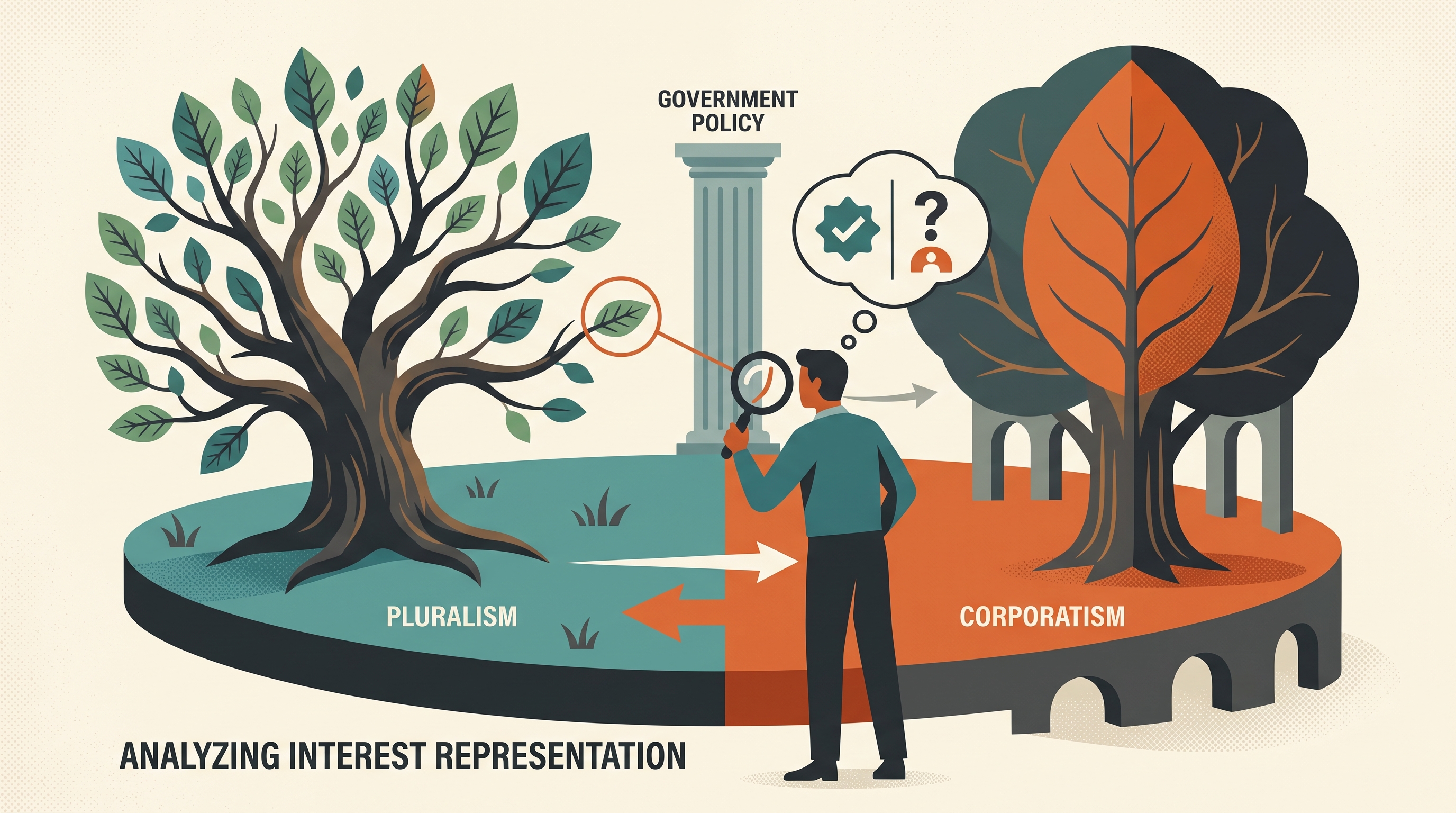
A political system reveals how it treats organized interests: does the state let many groups compete for influence, or does it organize representation through a limited set of officially recognized organizations? Pluralism and corporatism describe these contrasting relationships between citizen organizations and the state.
Pluralist interests operate in a system where multiple, independent groups compete to influence public policy. Corporatist interests operate in a system where the state recognizes, coordinates, or controls a limited number of major organizations that represent social or economic sectors.
The curriculum’s hierarchy: from big idea to usable knowledge
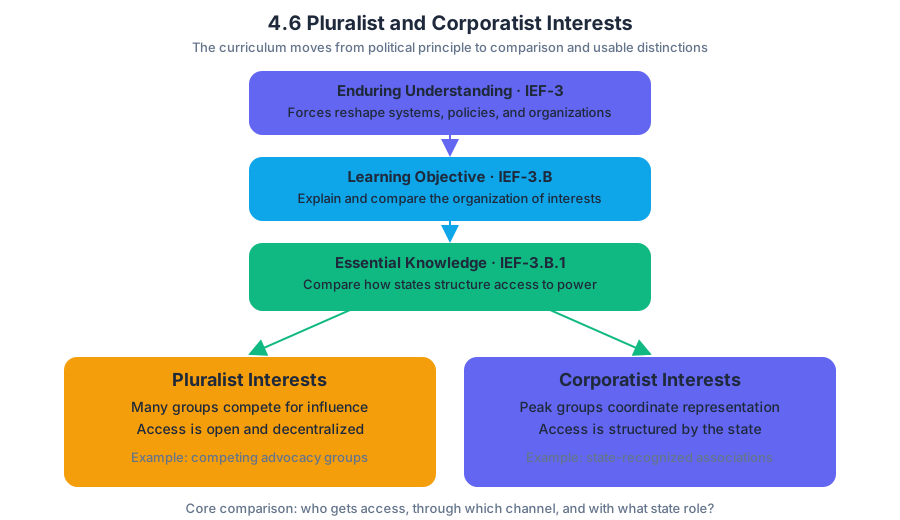
Topic 4.6 Pluralist and Corporatist Interests belongs to Unit 4: Party and Electoral Systems and Citizen Organizations. Its required-course-content layout moves downward from an Enduring Understanding to a Learning Objective and then to Essential Knowledge. The structure matters: the enduring understanding supplies the political principle, the learning objective states the analytical task, and the essential knowledge supplies the distinctions and examples needed to perform that task.
The relevant organizing idea is IEF-3: economic globalization and other internal or external forces can reshape political systems, institutions, policies, and citizen organizations. In Topic 4.6, the key question is not simply whether interest groups exist. It is how the state structures their access to power.
A useful reading path is:
| Curriculum level | Question it answers |
|---|---|
| Enduring Understanding: IEF-3 | What broad forces shape political organization and policy? |
| Learning Objective: IEF-3.B | How can the organization of interests be explained and compared? |
| Essential Knowledge: IEF-3.B.1 and related content | What distinguishes pluralist from corporatist interest representation? |
Pluralist interests: competition among organizations
In a pluralist system, influence is dispersed among many organizations: business associations, labor unions, professional groups, environmental organizations, religious organizations, and other advocacy groups. These groups may lobby officials, provide policy expertise, mobilize members, use media campaigns, or challenge government decisions through courts and elections.
The state does not necessarily treat every organization equally, because money, expertise, membership, and access vary. However, no single organization is supposed to possess an exclusive legal claim to represent an entire social sector. Political influence therefore resembles a crowded marketplace: groups compete, form coalitions, and try to persuade decision makers.
Corporatist interests: organized representation through the state
In a corporatist system, the government structures political representation through a smaller number of officially recognized organizations. A state may negotiate with a national labor federation, a national business organization, or another designated body rather than responding to dozens of independent groups.
Corporatism can improve coordination. Governments may reach agreements about wages, prices, taxation, or economic planning more quickly when recognized organizations speak for large sectors. The trade-off is political autonomy: organizations may receive privileged access, but they may also face state supervision, restrictions on membership, or pressure to support official policies.
Worked comparison: the same policy problem
Suppose a government proposes a major increase in the minimum wage.
- In a pluralist system, several labor unions, employer associations, poverty organizations, economists, and political parties might submit competing proposals. The final policy would emerge from bargaining among independent actors.
- In a corporatist system, the government might invite a recognized labor federation and a national employers’ organization to negotiate a national agreement. Smaller groups could have less direct access, even if the agreement is easier to implement.
The comparison is not “democracy versus dictatorship.” Pluralist arrangements can exist within democracies, while corporatist arrangements can appear in democratic or authoritarian settings. The decisive issue is the relationship between the state and organized interests: open competition and independent access versus structured recognition and state coordination.
Country application and misconception check
The United Kingdom is commonly analyzed through a largely pluralist pattern because many independent groups seek access to policymakers. Mexico’s political history includes strong corporatist features, especially during the long period of Institutional Revolutionary Party dominance, when major labor, peasant, and business organizations were incorporated into state-linked structures. Contemporary systems can be mixed: a country may permit independent advocacy in some sectors while controlling or coordinating representation in others.
Misconception check — “Corporatism means corporations control the government.”
Corporatism does not simply mean rule by private businesses. It refers to a system of organized representation in which the state recognizes and manages major social or economic groups. Businesses may be included, but labor and other sectors can also be corporatist partners.
AP skill: Source Analysis
The suggested skill for this topic is 4.C, Source Analysis: explain how the implications of an author’s argument or perspective may affect political systems, principles, institutions, processes, policies, and behaviors. A strong response identifies the source’s perspective, connects it to pluralist or corporatist organization, and explains a political consequence.
For example, if a source praises a government for consulting one national labor federation, the evidence may suggest corporatist coordination—but the analysis must also ask what happens to unaffiliated workers. The strongest conclusion identifies both the benefit, such as policy coordination, and the cost, such as reduced independent representation.
Retrieval check: A government permits hundreds of independent organizations to lobby, protest, and compete for access, but wealthy groups receive more attention than smaller ones. Is this pluralist or corporatist, and what feature proves your answer?
Source Materials
- AP Comparative Government and Politics Course and Exam Description
- AP Comparative Government and Politics Course and Exam Description Clarifications and Corrections
- AP Comparative Government and Politics Course Overview
- AP Comparative Government and Politics Course at a Glance
- AP Comparative Government and Politics Course at a Glance Poster
- AP Comparative Government and Politics
- AP Comparative Government and Politics
- AP Comparative Government and Politics Sample Syllabus 1