From the free course AP Comparative Government and Politics on Lykke
1.7 Federal and Unitary Systems
Key concepts: Federal systems · Unitary systems · Decentralization and local autonomy · Division of power between national and regional governments · Social cleavages · Federalism as a response to regional needs · Centralized government and uniform policies · Political systems in Mexico, Nigeria, Russia, and the United Kingdom
A federal system divides political power between a national government and regional governments, while a unitary system concentrates ultimate authority in the national government. The key question is not whether regions have offices or local officials, but whether they possess constitutionally protected powers or…
1.7 Federal and Unitary Systems
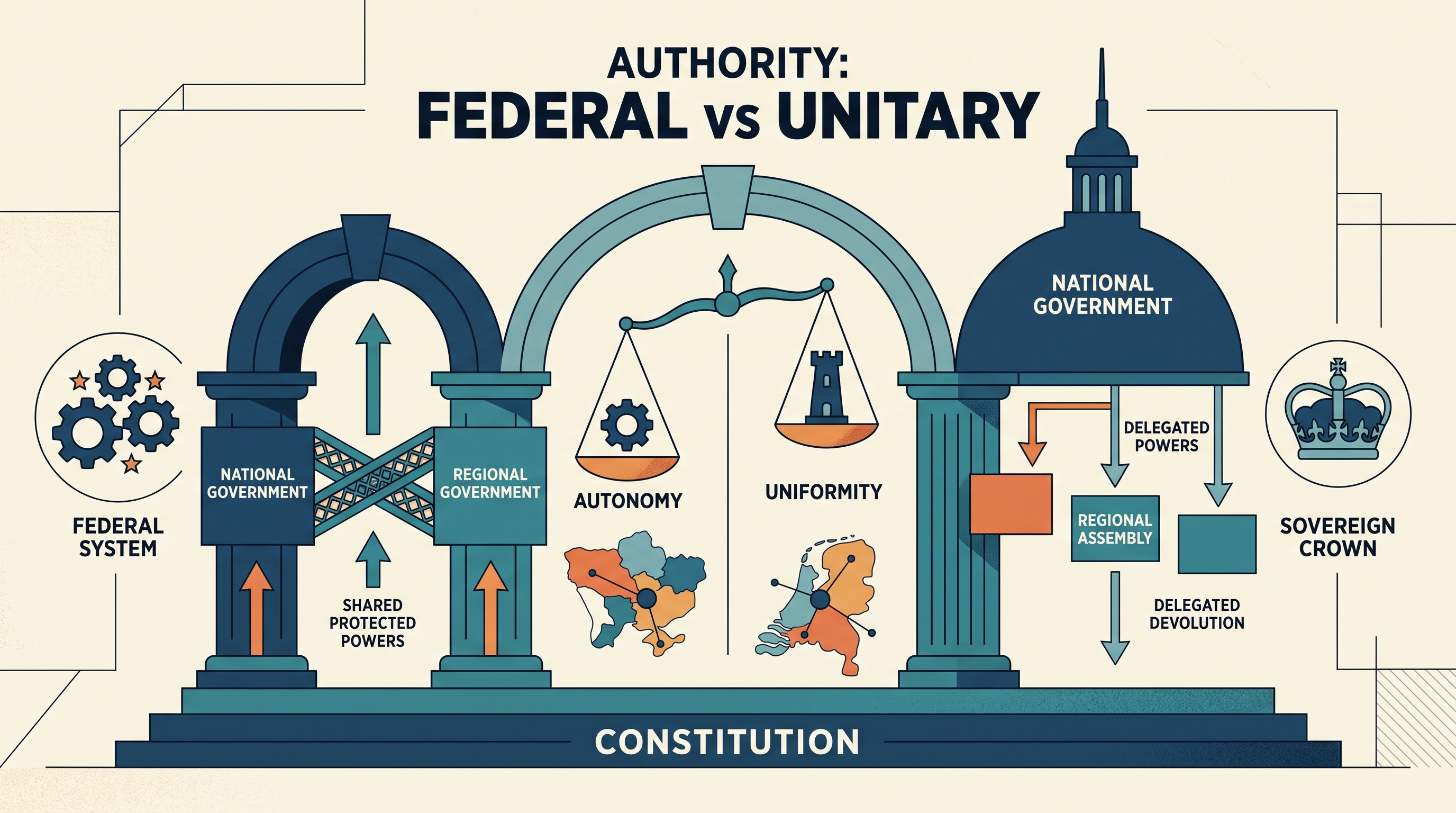
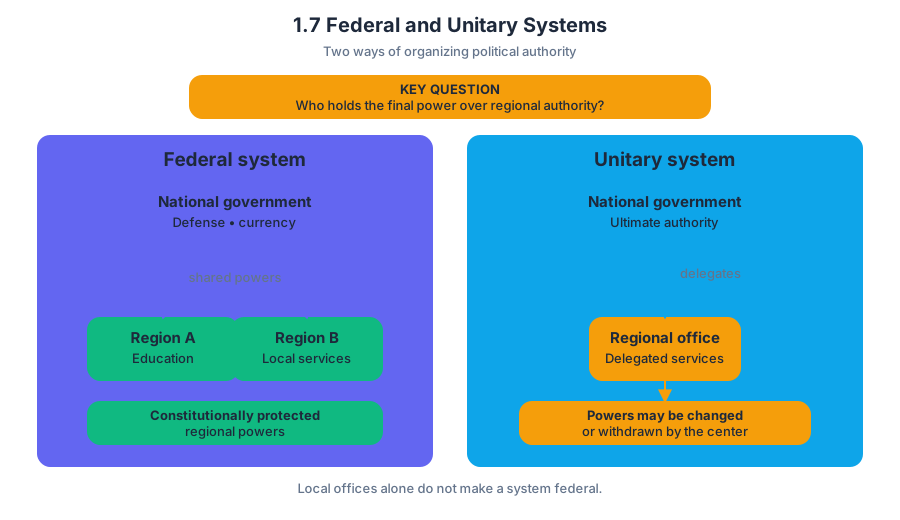
A federal system divides political power between a national government and regional governments, while a unitary system concentrates ultimate authority in the national government. The key question is not whether regions have offices or local officials, but whether they possess constitutionally protected powers or merely exercise authority delegated by the center.
Imagine a building with two managers. In a federal system, the national manager controls some responsibilities—such as defense or national currency—while regional managers retain authority over other matters, such as education or local services. In a unitary system, the national manager may allow regional offices to make decisions, but can generally define, alter, or withdraw those powers.
Two ways to distribute governmental power
| Feature | Federal system | Unitary system |
|---|---|---|
| Main distribution of power | Power is divided among national and regional governments | Power is concentrated at the national level |
| Regional autonomy | Regional governments retain a degree of local autonomy | Regional governments exercise authority delegated by the center |
| Policy variation | Different regions may adopt different policies | Policies are more likely to be uniform nationwide |
| Course-country examples | Mexico, Nigeria, and Russia | China, Iran, and the United Kingdom |
| Central advantage | Regional governments can respond to local conditions | National authorities can coordinate and standardize policy more easily |
| Central risk | Regional differences can complicate national coordination | Uniform policies can marginalize groups with distinctive needs |
This distinction is summarized in PAU-2.A.1: federal states divide power among levels of government, reserving some powers for the national government while granting regional autonomy; unitary states concentrate power nationally and may produce more uniform, potentially more efficient policymaking.
Federal systems: autonomy with reserved national powers
Federalism does not mean that regional governments are independent countries. The national government still reserves important powers, but regional governments possess meaningful authority within their jurisdictions. Federal arrangements are especially useful when a country contains substantial regional, ethnic, religious, linguistic, or economic differences.
Mexico illustrates how federalism can accommodate regional needs. Northern Mexican states have different economic patterns and connections to trade than southern states, where different social and economic conditions may require different governmental priorities. Allowing regional governments to shape some social, educational, and economic policies can produce a better fit than imposing one identical policy across the entire country.
Nigeria also uses a federal system to manage major regional and religious differences. Dividing authority among national, state, and local levels gives geographically concentrated groups some ability to influence policies affecting their communities while preserving national powers. Federalism therefore can reduce the pressure for every group to win complete control of the national government.
Russia demonstrates an important caveat: a country may formally be federal while power remains highly concentrated at the national level. The label “federal” describes the constitutional structure, but the actual distribution of power depends on how much autonomy regional governments can exercise in practice.
Unitary systems: national authority and delegated power
In a unitary system, regional governments do not possess the same constitutionally protected share of sovereignty found in a federal system. They may administer local services, but their authority originates from the national government. China and Iran are unitary systems in which subnational governments cannot make major policies without approval from central political or theocratic authorities.
Centralization can make nationwide action faster and more consistent. A national government can establish one educational standard, one legal rule, or one social-service policy rather than negotiating separate arrangements with every region. However, the same uniformity can harm minority groups when a national policy ignores distinct languages, religions, identities, or local economic conditions.
The United Kingdom is a unitary system, yet its central government has devolved—delegated—varying powers to regional assemblies in places such as Scotland, Wales, and Northern Ireland. Devolution can address regional demands without changing the fact that ultimate authority remains concentrated in the central state. Thus, decentralization exists on a spectrum: a unitary state may become more decentralized without becoming federal.
Federalism, devolution, and social cleavages
A social cleavage is a politically significant division within society, such as a conflict based on ethnicity, religion, language, national identity, or region. The division of governmental power can respond to a cleavage by allowing a concentrated regional group to influence policies that directly affect its members.
Consider a country in which one region has a distinct national identity and demands greater control over education and cultural policy. A federal system could grant that region constitutionally protected powers. A unitary system could instead use devolution, as the United Kingdom has done, giving a regional assembly authority to address local preferences while retaining national sovereignty.
The trade-off is clear: autonomy may improve representation, but too much regional independence can make national coordination difficult or encourage separatism. Excessive centralization may preserve uniformity and territorial control, but it can deepen resentment when minority groups believe that national institutions do not represent them.
Misconception check: “If a country has regional governments, it must be federal.” Not necessarily. The decisive issue is whether regional powers are constitutionally protected and independently retained, or whether the national government has simply delegated them and can reclaim them.
Retrieval check: Mexico and Nigeria are federal because regional governments retain meaningful powers alongside national authorities. The United Kingdom is unitary because its central government remains ultimately sovereign, even though it has devolved powers to regional assemblies. Russia shows why analysts must compare formal structure with actual political practice.
Source Materials
- AP Comparative Government and Politics Course and Exam Description
- AP Comparative Government and Politics Course and Exam Description Clarifications and Corrections
- AP Comparative Government and Politics Course Overview
- AP Comparative Government and Politics Course at a Glance
- AP Comparative Government and Politics Course at a Glance Poster
- AP Comparative Government and Politics
- AP Comparative Government and Politics
- AP Comparative Government and Politics Sample Syllabus 1