From the free course AP Comparative Government and Politics on Lykke
5.9 Impact of Natural Resources
Key concepts: Natural resource exploitation · Globalization · Developing nations · Foreign entities · Rentier state · Nigeria · National revenue · Resource rents · State sovereignty · Democratic and authoritarian regimes
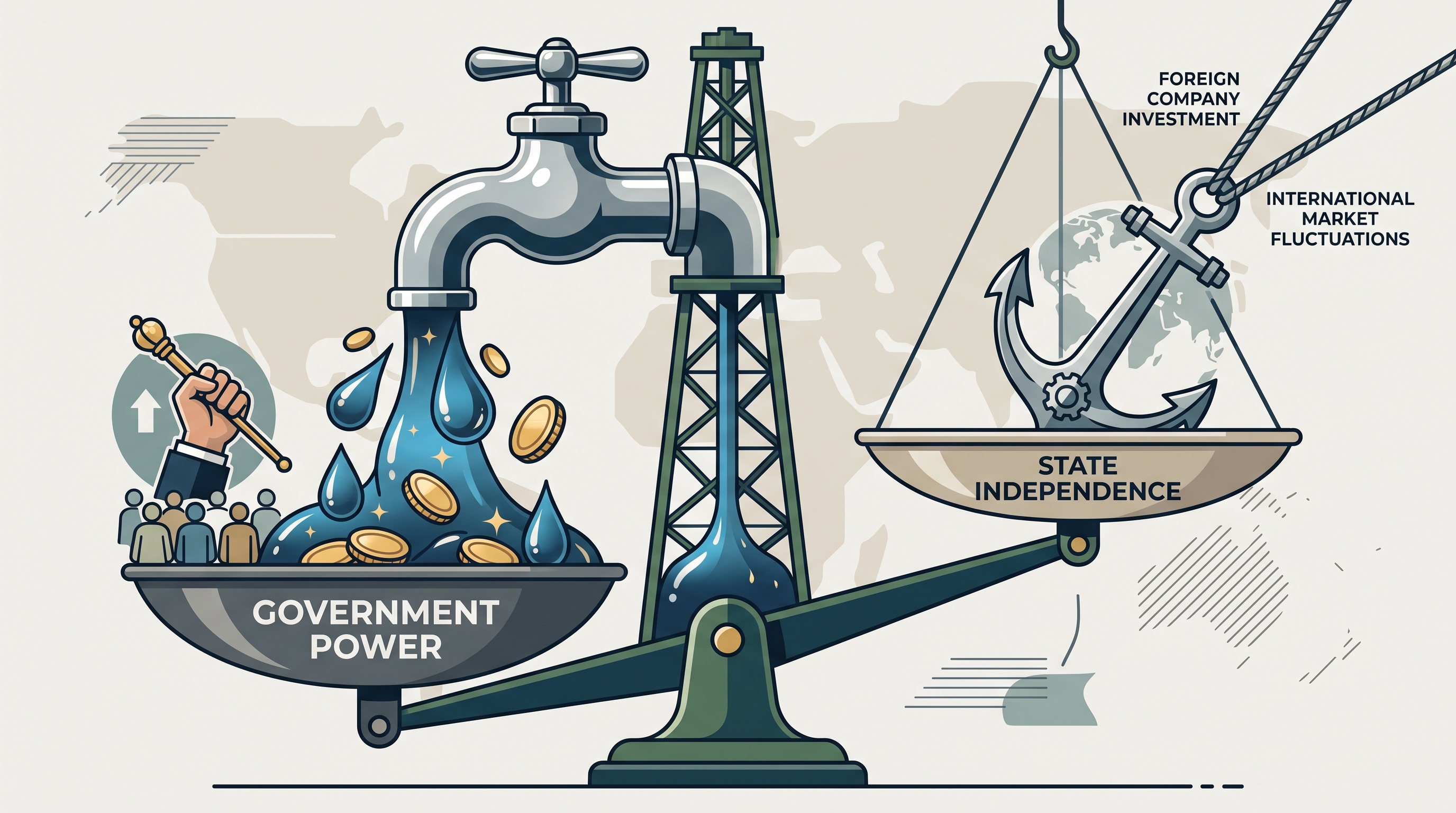
Natural resources can strengthen a state’s economy while simultaneously weakening its sovereignty, legitimacy, and political stability. Oil, gas, minerals, and other valuable resources generate income—but the political consequences depend on who controls that income and how it is distributed.
5.9 Impact of Natural Resources
Natural resources can strengthen a state’s economy while simultaneously weakening its sovereignty, legitimacy, and political stability. Oil, gas, minerals, and other valuable resources generate income—but the political consequences depend on who controls that income and how it is distributed.
Essential question: When a country earns money from natural resources, does that wealth increase the government’s power—or make the country vulnerable to outside actors and internal conflict?
Resource wealth in a globalized economy
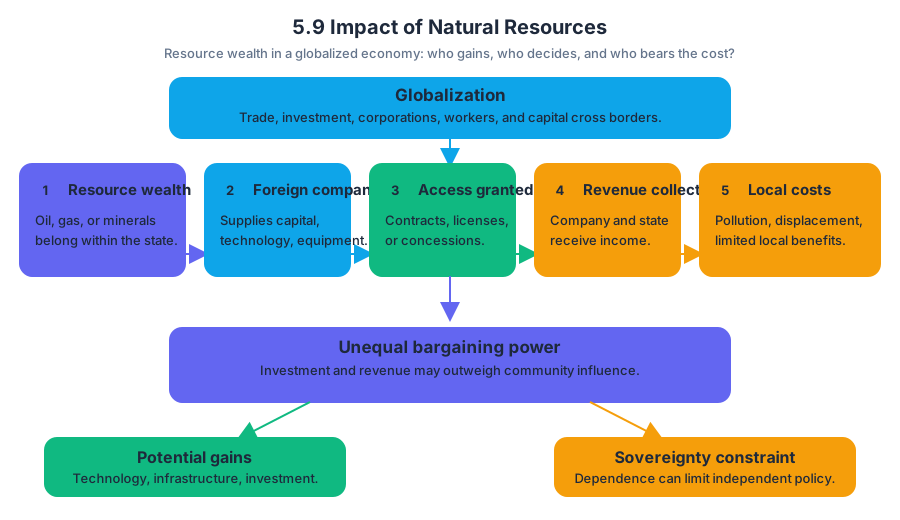
Globalization is the increasing connection of economies across political borders through trade, investment, corporations, workers, and capital. It can bring technology, infrastructure, and foreign investment to developing nations. It can also enable foreign entities, such as multinational corporations or foreign governments, to extract resources under conditions that primarily benefit outside actors.
The central political problem is unequal bargaining power:
- A developing nation possesses oil, gas, or minerals.
- A foreign company supplies capital, technology, and equipment.
- The government grants access through contracts, licenses, or concessions.
- The company and state collect revenue.
- Local communities may receive limited benefits while bearing pollution, displacement, or environmental costs.
A government may accept this arrangement because it needs investment or revenue. However, when foreign companies become essential to national income, economic decisions can constrain state sovereignty, meaning the state’s ability to make and enforce policy independently.
Key distinction: Foreign investment is not automatically exploitation. The political issue is whether the host state can regulate extraction, negotiate fairly, protect communities, and retain enough revenue for public purposes.
The rentier state
A rentier state derives all or a substantial portion of its national revenue from resource rents—income earned from controlling and selling valuable natural resources rather than from broad taxation of citizens.
Nigeria is a major example used to illustrate this concept. Oil production has generated substantial state revenue, but dependence on oil can make the economy vulnerable to price changes, production disruptions, corruption, and weak diversification.
| Resource-dependent pattern | Political consequence |
|---|---|
| Government receives revenue from oil exports | Leaders may rely less on taxation |
| Citizens pay fewer direct taxes | Citizens may have less leverage to demand accountability |
| Foreign firms operate extraction projects | State policy may be shaped by external economic actors |
| Wealth is concentrated geographically or socially | Inequality and grievances may intensify |
| One commodity dominates exports | Economic shocks can become political crises |
A rentier state is not simply a country that possesses natural resources. The defining feature is dependence: resource rents provide a substantial share of government revenue.
Worked contextual example: Nigeria
Suppose global oil prices fall sharply. Nigeria’s government now receives less revenue, but it still must fund public services, maintain infrastructure, and respond to political demands. If the economy has not diversified, the government may cut spending, borrow money, or increase pressure on communities and companies.
At the same time, oil-producing communities may argue that they bear environmental damage without receiving a fair share of the wealth. Protest, sabotage, or insurgency can follow. The government may respond with negotiation, regulation, redistribution, or coercion.
This example shows the chain of reasoning:
$$ \text{resource dependence} \rightarrow \text{revenue vulnerability} \rightarrow \text{public dissatisfaction} \rightarrow \text{legitimacy and stability challenges} $$
The same resource wealth can also help leaders maintain power by funding security forces, patronage networks, or public programs.
Regime type does not eliminate resource problems
Natural-resource impacts can occur under both democratic and authoritarian regimes. A democracy may face protests, corruption scandals, regional conflict, or electoral punishment when resource revenue is mismanaged. An authoritarian regime may suppress criticism and use resource income to fund surveillance, security forces, or patronage.
This does not mean that all resource-rich states are authoritarian, or that democracy prevents exploitation. Regime type affects how governments respond, but resource dependence creates incentives and vulnerabilities in either system.
Misconception check
Misconception: “Natural resources automatically produce development.”
Resource wealth can finance schools, roads, health care, and industrial growth. But it can also encourage corruption, weaken accountability, deepen inequality, and expose the state to foreign pressure. The decisive question is not whether resources exist; it is how revenue, ownership, regulation, and political authority are organized.
AP skill connection
This topic is especially suited to Concept Application, Data Analysis, and Argumentation. In a graph showing natural-resource rents as a percentage of GDP, identify the requested country or year precisely, describe a visible pattern, and then explain its political meaning. For example, a high percentage indicates substantial economic dependence; it does not, by itself, prove corruption or authoritarianism.
Essential Question Check: Why might resource revenue increase a government’s power over citizens while decreasing the state’s independence from foreign companies?
CED alignment: Learning Objective 5.9.A; Essential Knowledge 5.9.A.1, 5.9.A.2, and 5.9.A.3.
Source Materials
- AP Comparative Government and Politics Course and Exam Description
- AP Comparative Government and Politics Course and Exam Description Clarifications and Corrections
- AP Comparative Government and Politics Course Overview
- AP Comparative Government and Politics Course at a Glance
- AP Comparative Government and Politics Course at a Glance Poster
- AP Comparative Government and Politics
- AP Comparative Government and Politics
- AP Comparative Government and Politics Sample Syllabus 1