From the free course AP Comparative Government and Politics on Lykke
4.4 Role of Political Party Systems
Key concepts: Political party systems ranging from dominant-party systems to multiparty systems · China’s one-party political system and Communist Party of China (CPC) control · China’s use of party-system rules to maintain centralism and order · China’s allowance of eight other political parties despite CPC control · Russia’s dominant-party system · Legal and procedural mechanisms used to suppress opposition in Russia · Election rules as a factor shaping political party systems · Comparing similarities and differences among countries’ party systems · Political culture’s relationship to citizen behavior and the role of the state · Implications of party-system differences for political institutions and processes
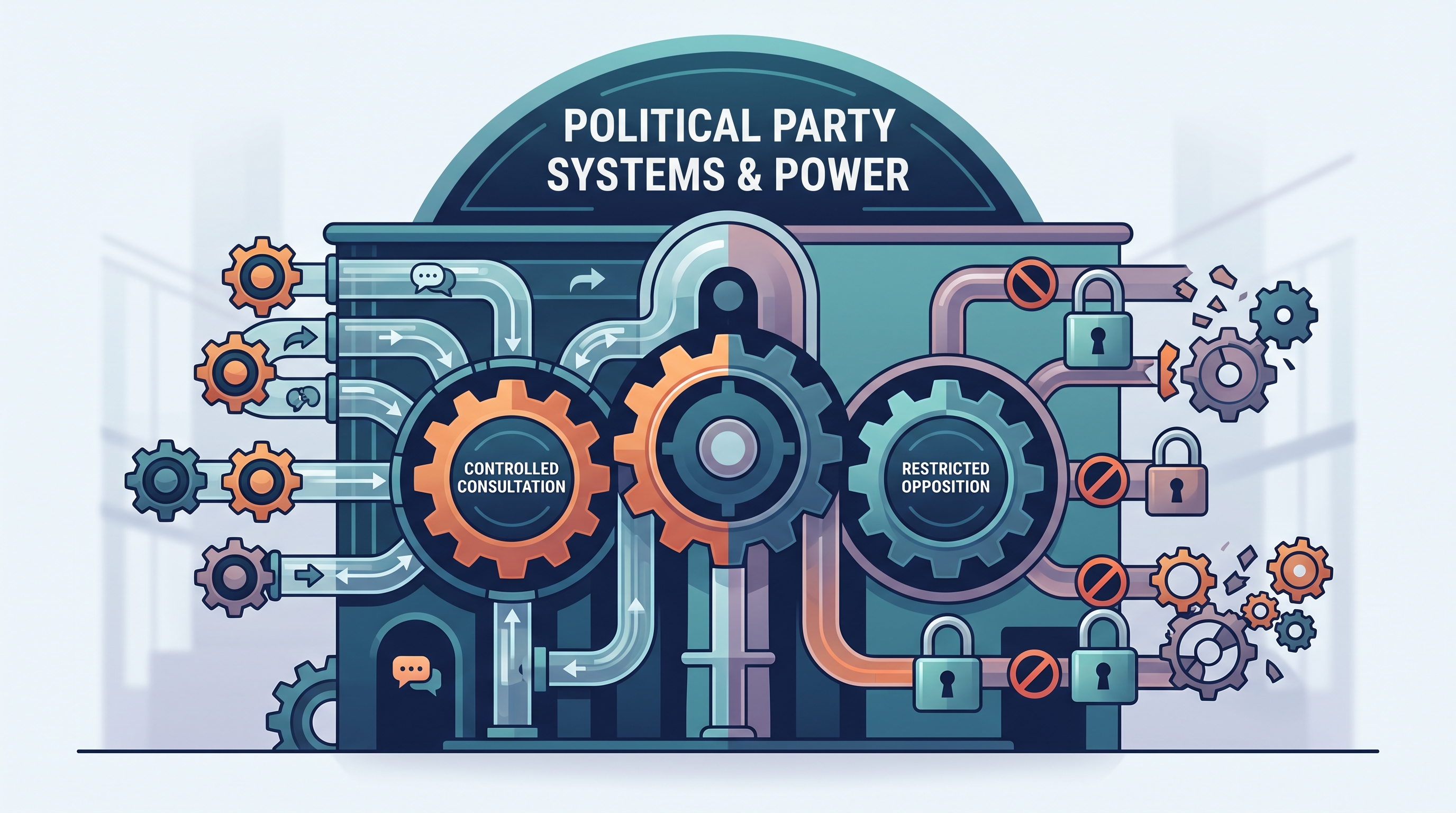
China and Russia demonstrate that the decisive question is not simply how many parties exist, but whether party-system rules allow meaningful competition for governing power.
4.4 Role of Political Party Systems
China and Russia demonstrate that the decisive question is not simply how many parties exist, but whether party-system rules allow meaningful competition for governing power. China permits several parties to operate while reserving national governing authority for the Communist Party of China (CPC); Russia permits opposition parties to exist but uses legal and procedural barriers to make replacement of the dominant party extremely difficult.
PAU-4.A: Political party systems shape access to political power, representation, competition, and the relationship between citizens and the state.
From party categories to political consequences
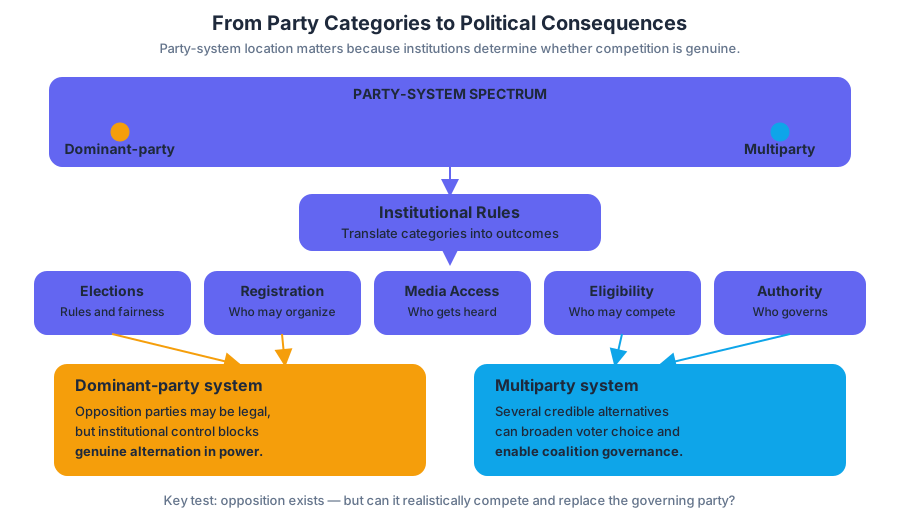
PAU-4.A.1 places party systems on a spectrum ranging from dominant-party systems to multiparty systems. The important comparative task is to connect a country’s location on that spectrum to the rules governing elections, party registration, media access, candidate eligibility, and the distribution of governing authority.
A multiparty system may give voters several credible governing alternatives. A dominant-party system may contain multiple legally recognized parties, yet the governing party’s control of institutions, resources, and electoral procedures prevents genuine alternation in power. Thus, the existence of opposition parties does not automatically prove that political competition is effective.
China: controlled pluralism under CPC leadership
PAU-4.A.2 states that China’s rules allow only the Communist Party of China to control governing power. The CPC justifies this arrangement through the values of centralism—coordinated authority directed from the center—and order. From this perspective, unrestricted party competition could produce conflict or fragmentation, while CPC leadership is presented as necessary for national unity and effective governance.
China nevertheless permits eight other political parties to exist. These parties do not function as opposition parties capable of replacing the CPC in national government; instead, they broaden discussion and consultation within a political system whose governing power remains under CPC control. This creates a crucial distinction between participation in consultation and competition for executive authority.
The system therefore combines limited party diversity with centralized political control. Citizens may encounter organized discussion and consultation, but the party-system rules define the boundaries of acceptable participation and preserve the CPC’s central role in the state.
Russia: dominant-party control through rules
Russia is best treated here as a dominant-party system. Opposition parties may legally exist, but registration requirements, ballot-access rules, media restrictions, candidate disqualifications, and electoral procedures limit their ability to compete effectively or replace the governing party.
PAU-4.A.3 identifies several mechanisms that preserve dominant-party control:
- Increasing party-registration requirements makes it harder for new parties to qualify.
- Allowing only legally registered parties to run for office excludes unregistered opposition movements.
- Selective court decisions can disqualify candidates or parties.
- Restrictions on opposition access to media reduce their ability to present competing viewpoints.
- Higher electoral thresholds limit which parties can gain representation.
- Eliminating gubernatorial elections removes a direct route through which regional voters might challenge central political control.
These mechanisms often appear procedural rather than openly coercive: a registration rule, a court decision, a media restriction, or a threshold requirement. Their combined effect, however, is political. They narrow the field of viable competitors and help the dominant party retain control while preserving the appearance of formal party pluralism.
Comparison: similar outcome, different justification
| Feature | China | Russia |
|---|---|---|
| Party-system pattern | CPC-controlled one-party dominance with eight additional parties | Dominant-party system with legally existing opposition |
| Stated or functional rationale | Centralism, order, discussion, and consultation | Preservation of dominant-party control through legal and procedural rules |
| Role of other parties | Consultation without control of governing power | Opposition may exist but faces barriers to effective competition |
| Key electoral effect | Governing power remains reserved for the CPC | Opposition faces restricted registration, media, candidacy, and ballot access |
The similarity is that neither system permits ordinary party competition to produce an easy transfer of national governing power. The difference is how control operates: China openly institutionalizes CPC leadership while permitting consultative parties, whereas Russia maintains a dominant-party structure in which opposition is formally present but systematically constrained.
Political culture and citizen behavior
Political culture—the shared beliefs and expectations people hold about government—helps explain how citizens respond to these arrangements. In China, a political culture emphasizing centralism and order may make coordinated state authority appear legitimate or desirable. In Russia, restricted competition and limited opposition visibility can encourage citizens to view politics as the domain of the dominant party, reducing expectations that elections will produce alternation in power.
These are analytical relationships, not assumptions that every Chinese or Russian citizen thinks alike. A strong response connects political rules to likely patterns of behavior: participation may take the form encouraged by the state, while citizens may have fewer practical incentives or opportunities to organize around replacing the governing party.
Worked comparison and misconception check
Prompt: Country X allows three opposition parties to register, but only the governing party receives unrestricted national media coverage and opposition candidates are frequently removed from ballots by courts. Country Y permits eight minor parties, but only the CPC may control governing power. Compare the role of party systems in Country X and Country Y.
Reasoning: Country X resembles Russia because opposition parties legally exist but face procedural barriers that prevent meaningful competition. Country Y resembles China because additional parties broaden consultation while the governing party retains exclusive control of governing power. Both systems restrict alternation in power, but Country X does so through dominant-party procedures, whereas Country Y explicitly organizes party participation around CPC centralism and order.
Misconception check: “Several legal parties automatically make a system multiparty and competitive.”
Correction: Count not only the parties, but also whether they can register, campaign, reach voters, appear on ballots, win representation, and replace the governing party.
Skill focus: Country Comparison 2.C
2.C: Explain the implications of the similarities and differences between political systems, principles, institutions, processes, policies, and behaviors. To earn the analytical force of this skill, identify a similarity or difference, name the specific rule producing it, and explain its consequence for governing power or citizen behavior. Saying that China and Russia are “both authoritarian” is only a starting classification; explaining how China’s consultative parties differ from Russia’s restricted opposition demonstrates the implication.
Retrieval check: If opposition parties exist in both countries, what evidence would distinguish China’s CPC-controlled system from Russia’s dominant-party system? Answer by identifying one difference in the formal organization of party power and one difference in the procedures that restrict competition.
Source Materials
- AP Comparative Government and Politics Course and Exam Description
- AP Comparative Government and Politics Course and Exam Description Clarifications and Corrections
- AP Comparative Government and Politics Course Overview
- AP Comparative Government and Politics Course at a Glance
- AP Comparative Government and Politics Course at a Glance Poster
- AP Comparative Government and Politics
- AP Comparative Government and Politics
- AP Comparative Government and Politics Sample Syllabus 1