From the free course AP Comparative Government and Politics on Lykke
1.4 Democratization
Key concepts: Democratization · Press freedom · Press Freedom Index · Quantitative analysis of political data · Relationship between largest-party seat share and democratization in Nigeria · Press-freedom trends · Drawing conclusions from data · Mexico’s level of democratization · Iran’s regime type · Competitive elections and political actors
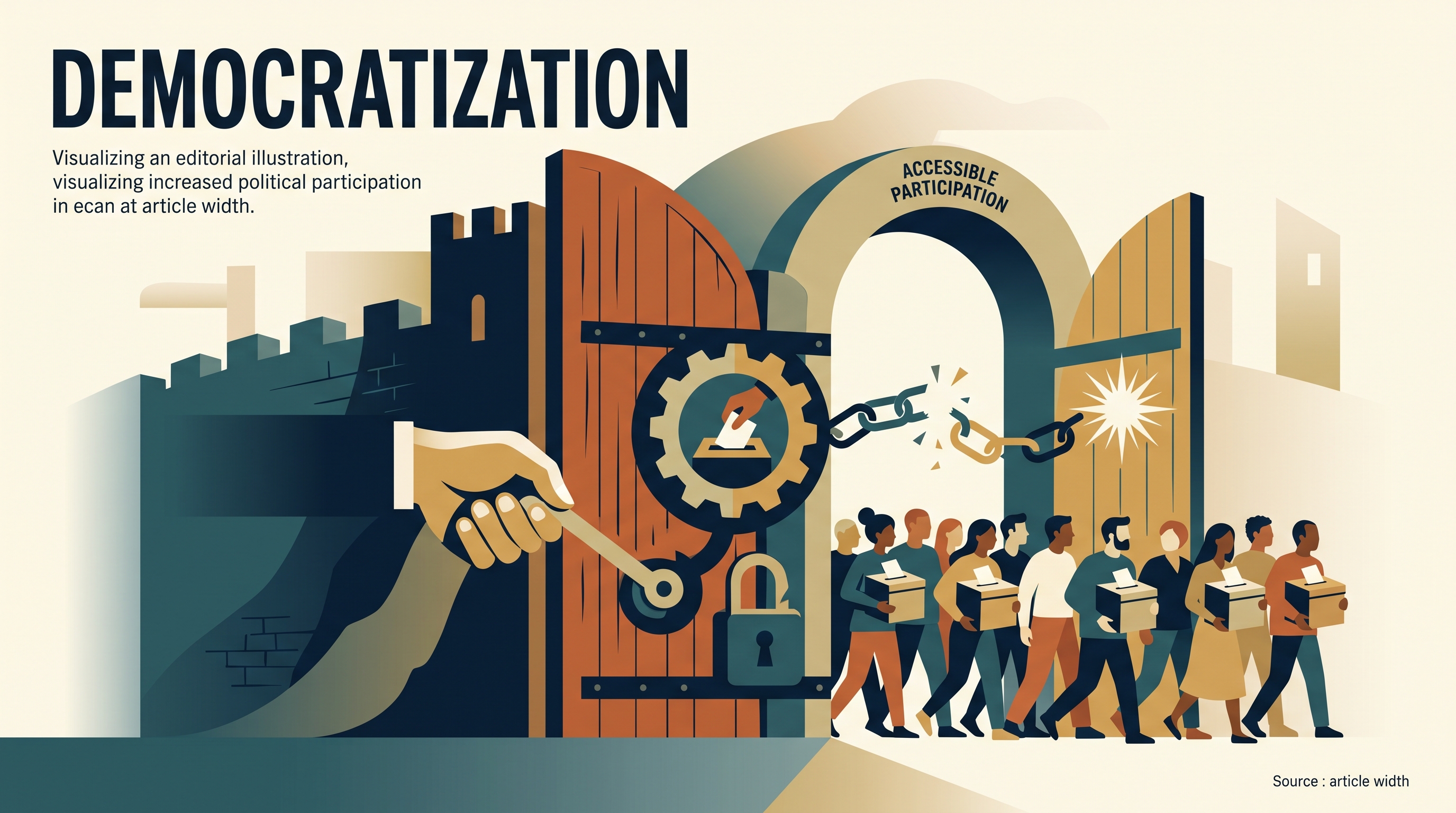
Democratization is the process through which a political system becomes more democratic by expanding meaningful political participation, competitive elections, accountability, and protected freedoms. It is not a switch that moves a country permanently from “authoritarian” to “democratic”; it can advance, stall,…
1.4 Democratization
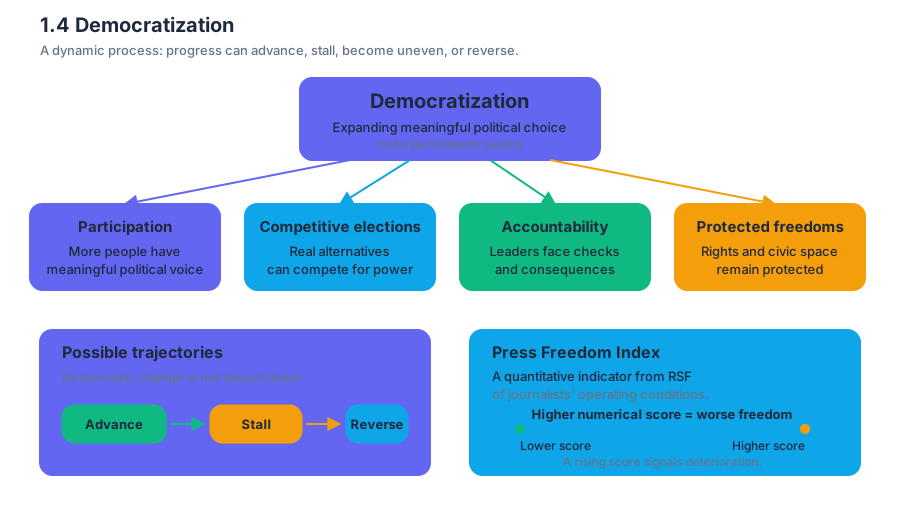
Democratization is the process through which a political system becomes more democratic by expanding meaningful political participation, competitive elections, accountability, and protected freedoms. It is not a switch that moves a country permanently from “authoritarian” to “democratic”; it can advance, stall, become uneven, or reverse.
Key idea: Elections may become more competitive while other democratic conditions—especially press freedom—remain weak.
The Press Freedom Index, produced by Reporters Without Borders, provides a quantitative indicator of how freely journalists and news organizations can operate. When interpreting its scores, read the scale carefully: a higher numerical score generally indicates worse press freedom, so a rising score represents deterioration rather than improvement.
Democratization is multidimensional
A country’s democratization should be judged across several dimensions rather than from one indicator alone:
| Dimension | Evidence of democratic development |
|---|---|
| Elections | Opposition parties can organize, compete, and win |
| Political participation | Citizens can vote, organize, protest, and influence policy |
| Accountability | Leaders and institutions face meaningful oversight |
| Civil liberties | Speech, association, and political opposition receive protection |
| Press freedom | Journalists can investigate and criticize those in power |
This distinction matters because a country can make progress in one dimension while losing ground in another. Competitive elections are important evidence of democratization, but they do not automatically guarantee free media, an independent judiciary, or equal political rights.
Worked data analysis: Nigeria
Suppose the table shows Nigeria’s largest-party share of legislative seats increasing from approximately 52 percent in 2011 to 54 percent in 2015, reaching 56 percent in 2018, and remaining near 56 percent in 2020. Over the same general period, Nigeria’s Press Freedom Index results show worsening press freedom, reflected in a higher numerical score.
The relationship can therefore be described in three steps:
- Describe the seat-share trend: Nigeria’s largest party gained legislative strength, including a largest-party seat share of approximately 56 percent in 2018.
- Describe the press-freedom trend: Nigeria’s Press Freedom Index score increased, indicating declining press freedom.
- Connect the indicators cautiously: Greater legislative dominance occurred alongside weaker press freedom, suggesting that Nigeria’s democratization was limited or uneven.
This is a correlation, not proof of causation. The data show that the trends occurred together; they do not establish that the largest party’s growing seat share directly caused restrictions on journalists. A strong explanation would identify a possible mechanism—such as reduced legislative opposition limiting oversight—while acknowledging that other forces, including intimidation by state or non-state actors, may also affect press freedom.
Exam distinction: “The score increased” describes a trajectory. “The ruling party restricted critical media through its legislative dominance” explains a cause or mechanism—and requires evidence beyond the number itself.
Worked conclusion: Mexico
Mexico’s data support a clear, qualified conclusion: Mexico has experienced partial or uneven democratization rather than complete democratic consolidation. Competitive elections demonstrate meaningful democratic development because opposition parties can compete and voters can alter political leadership.
However, Mexico’s press-freedom trend shows that democratization has not advanced uniformly. State actors or non-state actors may undermine journalists and media organizations even when elections remain competitive. The best conclusion is therefore that Mexico’s democratization is uneven and potentially stalled in some areas: electoral competition has expanded, but press freedom has not been secured to the same degree.
Iran and regime type
Iran’s very low level of press freedom is consistent with its authoritarian theocratic regime. Political authorities control or influence major media institutions, and criticism of religious or political leadership can be restricted. The supreme leader’s influence over institutions that regulate broadcasting helps explain why Iran receives a poor Press Freedom Index result.
Do not argue that the index score alone proves Iran’s regime type. Instead, use country knowledge to connect the quantitative evidence to institutional practice: authoritarian control over media reduces the ability of journalists to criticize leaders, which produces a low level of press freedom.
Skill focus and retrieval check
This topic develops 1.A Define and describe political concepts and processes, especially democratization; 1.B Explain political concepts and processes, by linking press freedom to regime characteristics; 3.A Identify the information presented, 3.B Describe the data, and 3.C Explain patterns and trends in quantitative data; and 5.A Develop an argument, by drawing a qualified conclusion from evidence. It also uses 2.A Describe similarities and differences when comparing democratic development across countries.
Retrieval check: If a country’s elections become more competitive but its Press Freedom Index score worsens, what is the strongest conclusion? The country is experiencing uneven democratization: electoral competition has improved, while press freedom has deteriorated. The data establish the pattern; country-specific political knowledge is needed to explain why.
Source Materials
- AP Comparative Government and Politics Course and Exam Description
- AP Comparative Government and Politics Course and Exam Description Clarifications and Corrections
- AP Comparative Government and Politics Course Overview
- AP Comparative Government and Politics Course at a Glance
- AP Comparative Government and Politics Course at a Glance Poster
- AP Comparative Government and Politics
- AP Comparative Government and Politics
- AP Comparative Government and Politics Sample Syllabus 1