From the free course AP Comparative Government and Politics on Lykke
1.2 Defining Political Organizations
Key concepts: Political systems and regimes · Civil society organizations · Nongovernmental organizations (NGOs) · Organizations autonomous from the state · Regime type and civil society strength · Roles of civil society organizations · Electoral regulatory organizations · Multinational corporations (MNCs) and state sovereignty
A government is never the only organized force in a society. Religious associations, neighborhood groups, professional bodies, news organizations, businesses, and nongovernmental organizations can all shape what citizens demand and what governments are able—or willing—to do.
1.2 Defining Political Organizations
A government is never the only organized force in a society. Religious associations, neighborhood groups, professional bodies, news organizations, businesses, and nongovernmental organizations can all shape what citizens demand and what governments are able—or willing—to do. The central question is: who has political power, and how independently can citizens organize outside the state?
Political systems, regimes, states, and governments
A political system is the broad arrangement of laws, ideas, and procedures that determines who should rule and how much influence government should have over people and the economy. A state is a political organization with a permanent population, governing institutions, a defined territory, and international recognition.
A regime consists of the fundamental rules governing access to political power and the exercise of that power. Regimes usually last longer than individual governments: a new president or cabinet may take office while the underlying regime remains unchanged. A government is the group of officials currently directing the state, while a nation is a community connected by shared identity, history, culture, or political aspirations.
PAU-1.A.1: Political systems comprise the laws, ideas, and procedures that address who should have authority to rule and what the government’s influence on its people and economy should be.
PAU-1.A.2: States combine a permanent population with governing institutions to control a defined territory with international recognition; regimes establish the fundamental rules for access to and exercise of political power.
PAU-1.A.3: A regime can be characterized as democratic or authoritarian according to how it establishes rules and makes decisions about political power.
These concepts connect to the enduring understanding PAU-1: political systems and regimes reflect a dynamic balance of power between government and citizens. Civil society is one way to observe that balance. If citizens can organize independently, they may monitor, criticize, or pressure the government; if the government controls nearly every organization, citizens have fewer independent channels for collective action.
Civil society: organization outside the state
Civil society organizations are voluntary associations that are autonomous from the state. “Voluntary” means people join by choice rather than by legal requirement. “Autonomous” means the organization is not created, directed, or controlled by government officials.
Examples include local religious organizations, neighborhood associations, news media, business and professional associations, and NGOs. An NGO, or nongovernmental organization, is an organization that operates independently of the government, often to pursue humanitarian, environmental, educational, economic, or human-rights goals.
An organization is not automatically part of civil society merely because it is called an association or does useful work. The key test is its relationship to the state:
| Organization | Civil society? | Why |
|---|---|---|
| Independent neighborhood association | Yes | Citizens voluntarily organize outside direct state control. |
| Independent news outlet | Yes | It can provide information and scrutinize officials. |
| Government ministry | No | It is a formal state institution. |
| State-sponsored “union” required to represent workers | Not fully autonomous | Its legal existence or leadership may depend on government control. |
| Amnesty International | Yes | Its members and supporters organize voluntarily, and the organization can criticize governments rather than serve as a government agency. |
Strength, variety, and regime type
Civil society varies in strength and variety depending on the regime in which it operates. Registration requirements, surveillance, censorship, restrictions on funding, and government monitoring can limit which organizations exist and what they are allowed to do. In a more open political environment, many organizations may compete to represent different interests; in a more restrictive environment, organizations may be narrow, state-approved, or forced to avoid political criticism.
Consider the United Kingdom and China. In the United Kingdom, independent charities, professional associations, news organizations, and advocacy groups can generally organize, lobby Parliament, publish criticism, and campaign publicly. In China, organizations may provide social services or represent professional interests, but registration and monitoring policies give the state greater ability to restrict organizations that challenge the Chinese Communist Party.
Misconception check — “Civil society means civil rights.”
Civil rights are legally protected claims to equal treatment and participation. Civil society is the network of voluntary organizations operating independently from the state. Civil-rights groups may belong to civil society, but the concepts are not interchangeable.
What civil society organizations do
Civil society organizations are not necessarily political. A neighborhood association may focus on sanitation, and a professional association may set standards for its members. Nevertheless, a robust civil society can become an agent of democratization by teaching people how to organize, communicate demands, monitor officials, and participate collectively.
For example, Nigerian civil society organizations can represent community interests, expose corruption, monitor government performance, and lobby for policy changes. In Mexico, NGOs and independent civic groups can document abuses, advocate for victims, and pressure public institutions to respond. These organizations also give members practical organizational experience—holding meetings, selecting leaders, raising funds, and coordinating campaigns.
Civil society organizations may therefore perform four major roles: monitoring and lobbying government, exposing governmental malfeasance, representing members’ interests, and providing organizational experience. Their success depends partly on whether the regime permits independent activity and whether citizens can safely participate.
Electoral regulators and controlled participation
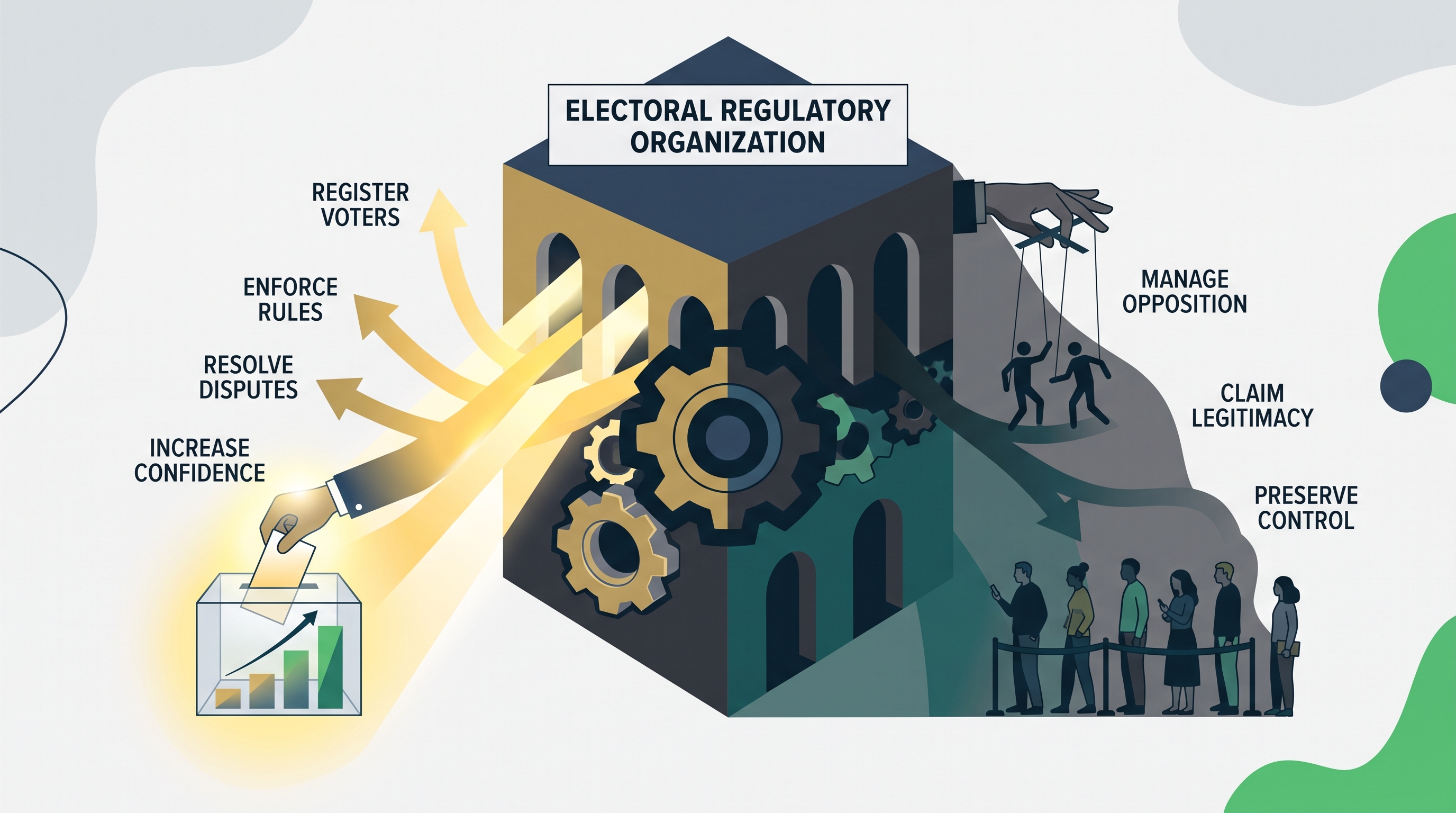
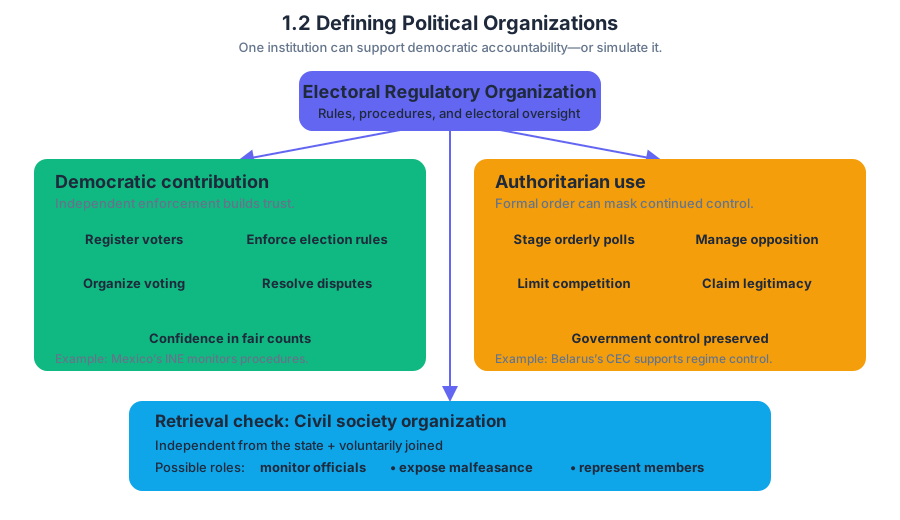
An electoral regulatory organization can contribute to democratization by registering voters, enforcing election rules, organizing voting procedures, resolving electoral disputes, and increasing confidence that votes are counted fairly. However, an authoritarian system might also create such an organization to produce the appearance of orderly elections, manage opposition participation, or claim domestic and international legitimacy while preserving government control.
Skill connection — 1.A: Concept Application — “Describe political systems, principles, institutions, processes, policies, and behaviors.” A strong application identifies the concept, gives a specific country example, and explains the mechanism. Do not merely write “an NGO helps democracy”; explain how it monitors officials, represents members, or changes political participation.
Retrieval check: An organization is independent from the state, voluntarily joined, and campaigns against corruption. What makes it a civil society organization, and which two roles could it perform? A complete answer should identify its autonomy and voluntary membership, then explain monitoring, exposing malfeasance, representation, or organizational training.
Source Materials
- AP Comparative Government and Politics Course and Exam Description
- AP Comparative Government and Politics Course and Exam Description Clarifications and Corrections
- AP Comparative Government and Politics Course Overview
- AP Comparative Government and Politics Course at a Glance
- AP Comparative Government and Politics Course at a Glance Poster
- AP Comparative Government and Politics
- AP Comparative Government and Politics
- AP Comparative Government and Politics Sample Syllabus 1